
9 x 12 Rugs
Origin ▼
Style ▼
Material ▼
9×12 Area Rugs: Anchoring Space with Architectural Intent
In professional interiors, the 9×12 area rug holds a unique position: it is large enough to anchor primary seating groups yet refined enough to support layered interiors, visual hierarchy, and spatial clarity. This size is a preferred choice in projects where proportional balance and functional articulation matter most—whether in grand living rooms, dining spaces, libraries, or open-plan layouts.
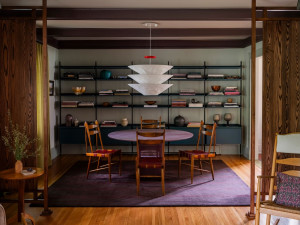
Prospect Refuge Studio Taylor Hall O’Brien
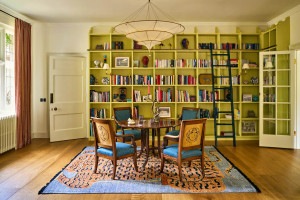
Work by Studio Holland. Photography by Tom Mannion
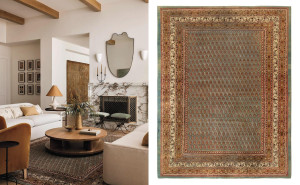
SKU 12314 Architectural Digest + Rug & Kilim
Why the 9×12 Format Is Fundamental in High-End Practice
The 9×12 rug endures because it provides both coverage and clarity in spaces that demand compositional gravity. Unlike smaller rugs that unintentionally fragment design, a 9×12 rug ensures that key furniture, material surfaces, and spatial thresholds are woven into a unified plan. Its generous field acts as the ground plane of a room, defining zones and shaping circulation without relying on architectural partitions.
Designers specify 9×12 rugs when working with:
- Grand living rooms and great rooms
- Open-plan arrangements requiring visual boundaries
- Dining areas with eight-seat tables or larger
- Bedrooms with king beds and adjacent seating
- Layered interiors where a base rug supports smaller overlays
Living Rooms & Great Rooms: The Primary Anchor
In living rooms and great rooms, the 9×12 rug becomes the spatial anchor for seating areas and conversational groupings. Its dimensions allow all major pieces—sofas, armchairs, coffee tables, side tables—to coexist on a continuous textile ground. This produces a composed, intentional arrangement rather than a collection of floating elements.
Placement insights designers rely on:
- Align the rug with architectural lines and circulation paths
- Allow consistent exposed flooring (12–18 in.) along perimeter walls
- In open-plan spaces, place the rug to visually separate the living zone from dining or kitchen areas without physical barriers
Whether interpreted through bold geometric patterns, subtle tonal weaves, or neutral foundations, the 9×12 rug in a living space functions as a measured canvas for the room’s composition.
Dining Spaces: Proportion That Supports Function & Flow
In formal or open dining areas, a 9×12 format offers the necessary footprint beneath a table seating six to eight. Designers ensure the rug extends at least 24 inches beyond the edge of the table so chairs remain on the rug when pulled out—a key factor in both comfort and visual order.
Material & weave preferences:
- Low-pile and flatwoven surfaces for ease of movement
- Durable fibres that withstand regular chair traffic
At this scale, pattern and field design can either recede to support furniture hierarchy or become a narrative anchor for dining rooms with distinct palettes.
Bedrooms & Quiet Spaces: Proportional Balance
For spacious bedrooms, particularly with king beds, a 9×12 rug ensures an elegant, unified field beneath the bed and adjacent zones such as seating groups or reading nooks.
Placement strategies:
- Center the rug under the bed with equal exposure on either side
- Extend the field to incorporate bedside seating or benches
- Consider layering with smaller accent rugs to introduce texture depth
In these quieter interiors, the rug becomes a tactile foundation that enhances comfort and complements architectural detail.
Layering, Art-Textile Narratives & Tapestry Influence
At the 9×12 scale, tapestry-inspired rugs and one-of-a-kind artistic textiles find their most compelling use. Larger fields allow intricate motifs, historical references, or artistic narratives to function as design focal points—especially when combined with contemporary minimal furnishings.
This idea resonates with museum and craft-based presentations of textile art where rugs are treated as cultural artefacts or suspended works. Exhibitions such as A Closer Look at Rugs have emphasized the craft and narrative depth of larger rugs by contextualizing them like tapestries in gallery settings.
Custom 9×12 Rugs: Precision & Personalization
For projects with bespoke architectural conditions, designers often commission custom 9×12 rugs. A custom approach allows fine-tuning of:
- Exact dimensions
- Colour calibration
- Pattern scale in relation to furnishings
- Material specification tailored to wear and acoustics
Custom work ensures the rug fits precisely with the spatial geometry of the room—particularly valuable in bespoke residential and boutique commercial interiors.
Pattern, Material & Collection Intelligence
At 9×12 scale, rug patterns and materiality become central to spatial narrative:
- Large-scale motifs and medallions anchor formal spaces
- Soft tonal fields sustain minimalist and modern aesthetics
- Statement weaves and cultural patterns enrich layered compositions
- Flatweaves & kilims reinforce modernist interiors
Designers increasingly draw from the Rug & Kilim curated collections—including antique Persian or Turkish works that echo historical depth and characterization.
Market & Cultural Signals Designers Respect
The significance of rugs in design is not limited to scale and placement; it extends into the worlds of museum exhibitions and auctions. Galleries have shaped the taste and procurement of fine rugs for designers and museums alike, with sales and exhibitions that bridge craft, history, and high design.
Similarly, auctions bring together antique, vintage, and modern rugs that define stylistic sophistication for collectors and design professionals.
These market and cultural arenas reinforce the idea that rugs—especially at substantial scales like 9×12—operate both as functional architectural elements and cultural artefacts within interiors.
Why Designers Continue to Specify 9×12 Rugs
For architects and interior designers, the 9×12 rug is indispensable because it:
- Anchors large furniture groupings with compositional clarity
- Defines spatial zones without physical partitions
- Supports layered and open-plan interiors with subtle architectural logic
- Accommodates custom and tapestry works with narrative depth
This size is not chosen out of convenience—it is chosen for its capacity to harmonize proportion, function, and material intelligence.
A Curated Selection of 9×12 Rugs by Rug & Kilim
Rug & Kilim’s 9×12 area rug collection includes antique, vintage, contemporary, custom, and tapestry-inspired works—each selected for scale, material integrity, and relevance to contemporary practice.
Whether used as foundational ground planes or statement textile narratives, these rugs are curated to perform at the highest level of professional interior design—structurally, materially, and culturally.