Default Rugs
- Under 6 x 9
- Runners
- 6 x 9
- 8 x 10
- 9 x 12
- 10 x 14
- 12 x 15
- Over 12 x 15
Origin ▼
Style ▼
Material ▼
Width
Length
To connect with a specialist, click here
Stories from the Default Archive
Essays, artist dialogues, and provenance notes drawn from Rug & Kilim’s editorial desk.
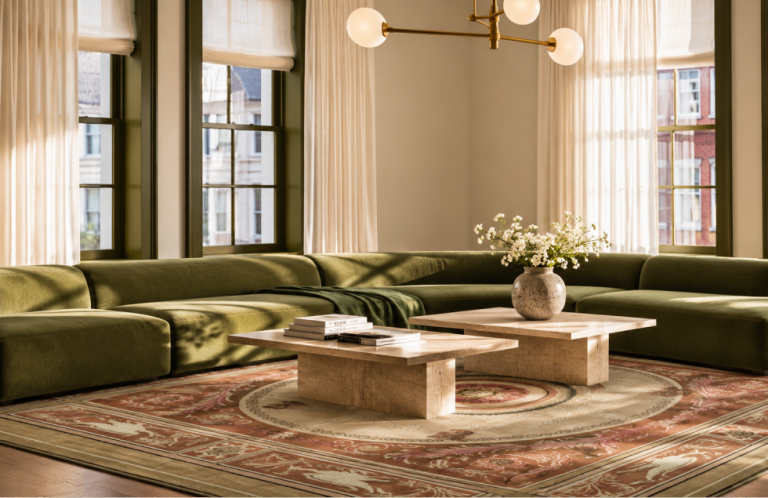
Rug of the Week: The Neoclassical 19th Century Oversized Savonnerie as a French Masterpiece
Every civilization that has reached a certain confidence has wanted to put its worldview on the floor. The Persians wove paradise gardens; the Chinese, the cosmos in miniature. France, under the Sun King, wove order itself. The Savonnerie, the royal carpet manufactory brought to its height under Louis XIV, the symmetry of the formal garden, the architecture of Versailles, the neoclassical grammar of acanthus and rosette and laurel that announced a culture certain of its own supremacy. A Savonnerie is a political philosophy you can stand on. All of which makes the four small creatures hidden in this particular example so delightfully subversive.
Read the Feature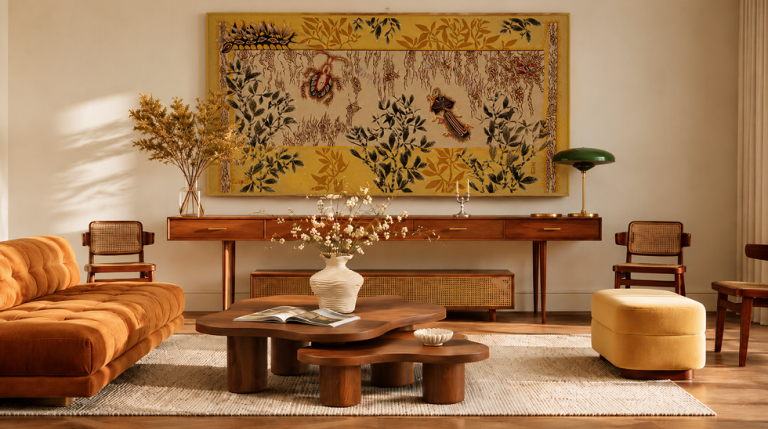
Signatures, Editions, and the Bolduc on Modern and Rare Tapestries: The Mark of the Masters and Artists
There is a particular pleasure, known to every serious collector, in turning an object over. The front of a great tapestry or carpet is what seduces; the back, and the edges, are what tell the truth. And on the finest modern tapestries, that truth is written in a specific and often misunderstood language, a language of signatures, edition numbers, and a small woven label the French call the bolduc. To read it fluently is to hold the difference between a decorative object and a documented work of art. It is the same literacy that governs the print room and the rare book library, where a collector learns to read a plate mark, a watermark, a colophon. The modern tapestry, elevated to the status of fine art by Jean Lurçat and his circle in the mid-twentieth century, borrowed the apparatus of the fine art edition precisely because it wished to be understood as fine art. To understand the apparatus is to understand the ambition.
Read the Feature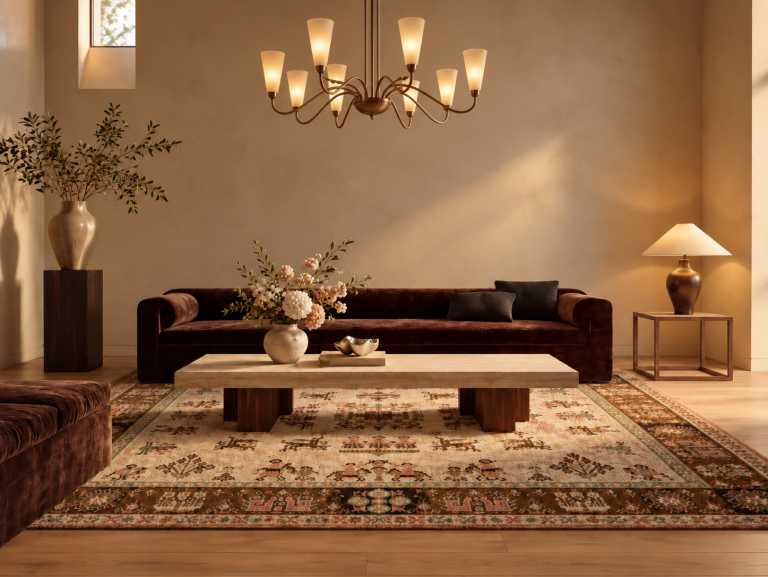
A Guide to Axminster Rugs: History, Craftsmanship, and British Design Heritage
Among the most influential carpet traditions to emerge from Europe, Axminster rugs occupy a distinguished position within the history of decorative arts, architecture, and interior design. Renowned for their exceptional craftsmanship, technical innovation, and artistic sophistication, Axminster carpets represent one of Britain's most important contributions to the global history of textile design. Originating in the historic market town of Axminster in Devon, England, these carpets became synonymous with luxury, refinement, and excellence from the eighteenth century onward. Their influence extended far beyond Britain, shaping carpet production, interior decoration, and architectural furnishing throughout Europe, North America, and the wider world.
Read the Feature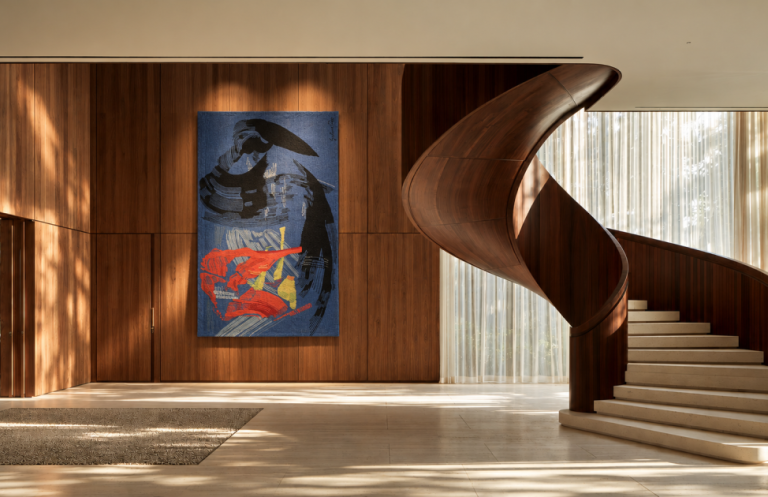
The Art of Bespoke Design by Rug & Kilim: How a Painting, a Fabric, or a Fragment Becomes a Custom Rug
Every custom rug begins with a question that sounds simple and is not: what does this room want to stand on? The answer, in the finest commissions, rarely arrives as a specification. It arrives as an object. A client brings in a painting they have loved for thirty years. A designer adores a length of antique silk, or lays down a sample of a document fabric, or produces a photograph of a fresco glimpsed on a wall in Ravenna. The brief is a feeling, held in another medium, waiting to be carried into wool or silk or sometimes, exotic fibres. This act of carrying is the true art of the custom rug, and it is far older and more serious than the word “custom” suggests. It is translation, in the fullest literary sense: the movement of meaning from one language into another, with everything gained and lost that translation implies. It is also, increasingly, the way the most celebrated interiors in the world are made. When AD100 designer Heidi Caillier needed flatweaves for a coastal retreat, when Fawn Galli reimagined a historic Beaux-Arts townhouse on the Upper West Side, when a Jacques Grange penthouse called for a hand-knotted silk carpet, the floor did not come off a shelf. It was translated into being, object by object, idea by idea.
Read the Feature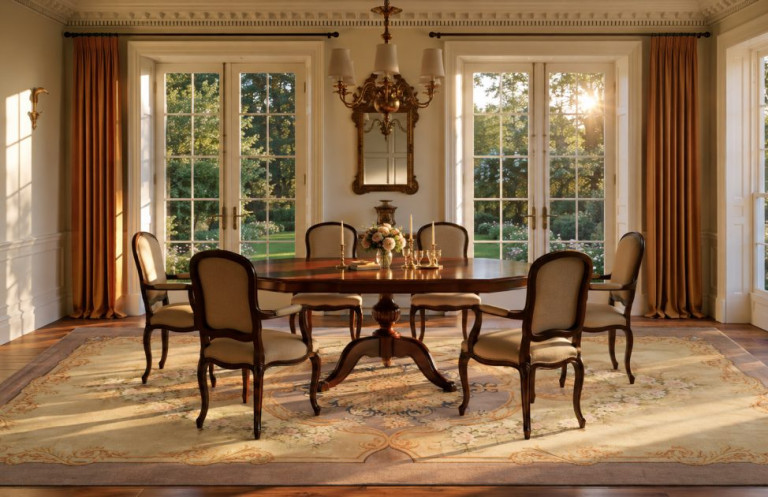
The House the European Stuycks Kept: Madrid’s Royal Loom, Goya’s Cartoons, and the Spanish Carpet
There is a building in Madrid, a short walk from the Atocha station, where the same craft has been practiced without interruption for more than three hundred years. Its brick and its Neo-Mudéjar arches were raised in the nineteenth century, but the work carried on inside them belongs to a lineage older still, to 1720, when Philip V, having lost the Flemish tapestry workshops of the Spanish Netherlands to the Peace of Utrecht, resolved that Spain would simply make its own. He summoned a family of Flemish weavers, the Vandergotens, to Madrid, and founded the Real Fábrica de Tapices de Santa Bárbara. Three centuries later, in the presence of the King and Queen of Spain, the factory marked its tercentenary as one of the last places on earth where royal weaving continues by the hand, exactly as it always has.
Read the Feature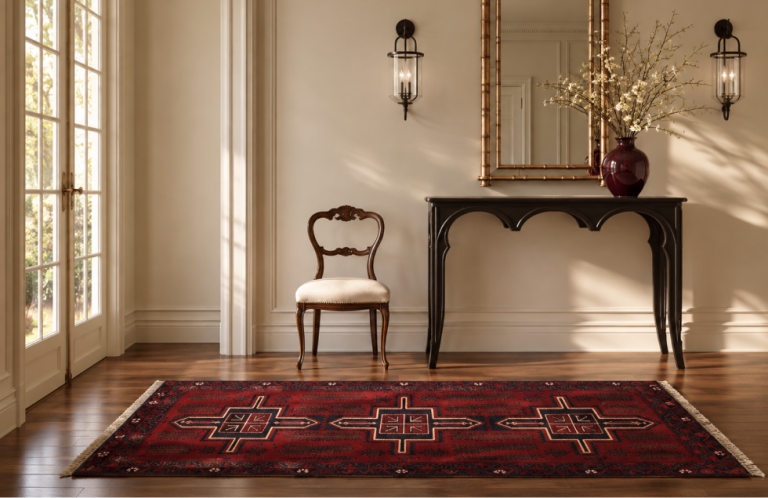
On Gift-Sized Rugs and the Art of Placing Them with Intention
There is a certain kind of design confidence that reveals itself not in the grand room but in the modest one. Anyone with means can lay a great carpet beneath a grand piano or across the floor of a double-height salon. The room does half the work; the scale flatters the object. It takes a far subtler eye to bring a jewel of a weaving into the kitchen, along the narrow run of a hallway, beneath the feet at a bedside, into the threshold where guests first stand, the working, in-between, unglamorous spaces of a home that most people surrender to practicality without a second thought. The designers whose interiors endure understand that these are precisely the spaces where taste declares itself most clearly. The small rug is the connoisseur's signature.
Read the Feature