Understanding Art Deco Rugs: Modernism, Luxury, and Timeless Style
November 2, 2026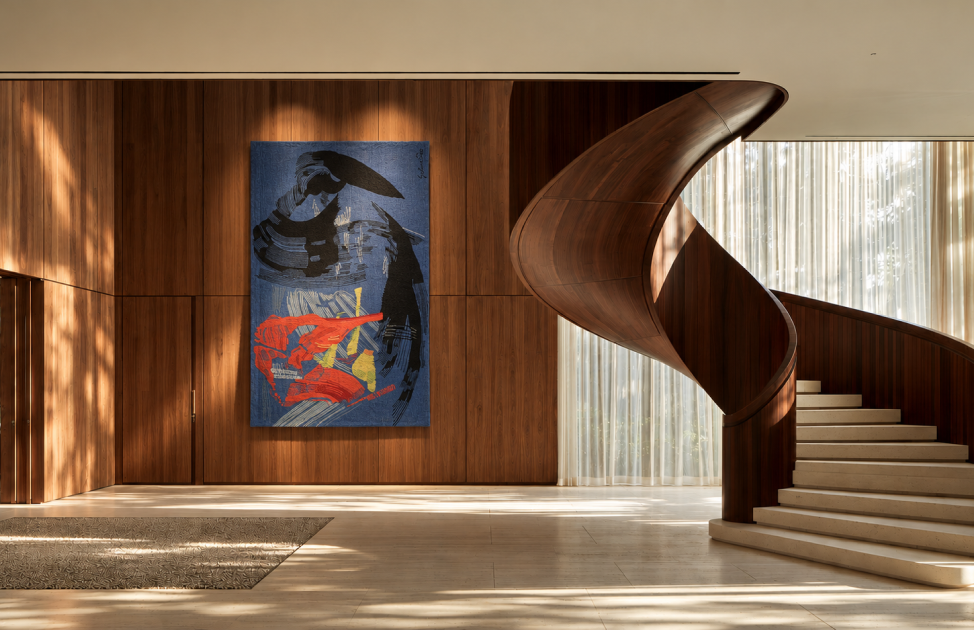
Every custom rug begins with a question that sounds simple and is not: what does this room want to stand on? The answer, in the finest commissions, rarely arrives as a specification. It arrives as an object. A client brings in a painting they have loved for thirty years. A designer adores a length of antique silk, or lays down a sample of a document fabric, or produces a photograph of a fresco glimpsed on a wall in Ravenna. The brief is a feeling, held in another medium, waiting to be carried into wool or silk or sometimes, exotic fibres.
This act of carrying is the true art of the custom rug, and it is far older and more serious than the word “custom” suggests. It is translation, in the fullest literary sense: the movement of meaning from one language into another, with everything gained and lost that translation implies. It is also, increasingly, the way the most celebrated interiors in the world are made. When AD100 designer Heidi Caillier needed flatweaves for a coastal retreat, when Fawn Galli reimagined a historic Beaux-Arts townhouse on the Upper West Side, when a Jacques Grange penthouse called for a hand-knotted silk carpet, the floor did not come off a shelf. It was translated into being, object by object, idea by idea.
The Source Object
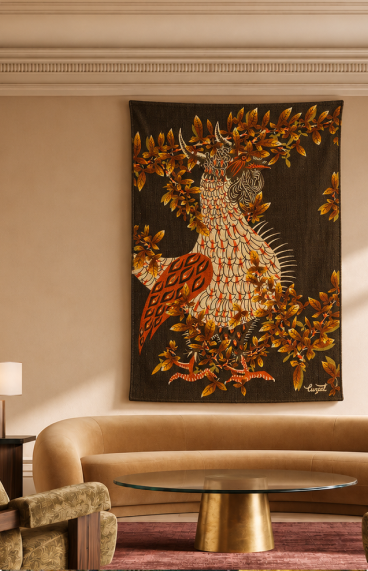
A painting is the most common starting point, and the most instructive. When a client arrives with an idea they wish to see beneath their feet, the task is never to copy it. A painting lives in pigment and gesture, in the visible speed of the brush; a rug lives in knots and dye, in a surface built slowly over months. To translate the one into the other is to ask what in the painting is essential and what is merely its medium. The great modernists understood this precisely. When Marie Cuttoli commissioned Léger, Braque, and Le Corbusier to design for the Aubusson looms in the 1930s, the resulting tapestries were not reproductions of their paintings. They were new works, the artist’s vision rethought for thread. The same principle governs the custom rug. The source is not an image to be duplicated. It is an intelligence to be understood.
Fabric offers a different kind of source, and a richer one than it first appears. A fragment of eighteenth-century toile, a bolt of a client’s grandmother’s sari, a swatch from a fashion house’s archive: each carries not only a pattern but a scale, a density, a way of handling repetition and space. The designers who work with us at the highest level understand that a fabric translated to the floor must be rescaled entirely. What reads as delicate on a cushion reads as frantic across fourteen feet. The translation requires an eye that can hear, in a small pattern, the larger music it might become.
The Fragment, and the Art of the Incomplete
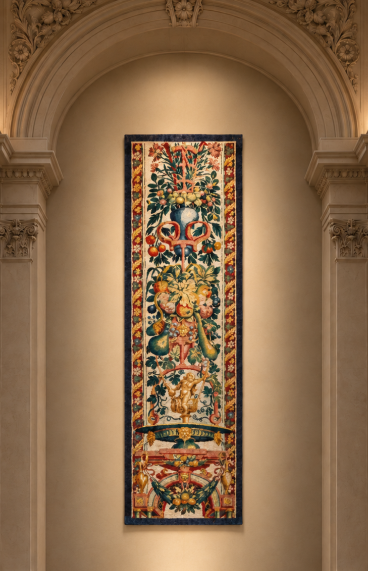
Most moving of all is the fragment. A torn corner of an antique carpet too far gone to save. A section of a tapestry that survived when the rest did not. The fragment has always held a particular power in the history of art. The Renaissance built itself on the broken statuary of antiquity, the Belvedere Torso instructing Michelangelo precisely because it was incomplete. The collage artists of the twentieth century, from Schwitters to the Cubists, made the fragment the central gesture of modern art. To commission a rug from a fragment is to participate in this lineage. It is to take something incomplete and, rather than merely restoring it, allow it to father something whole and new. The finest of these commissions do not hide their origin. They honor it, the way a building honors the ruin it was raised upon.
The Workshop as Interpreter
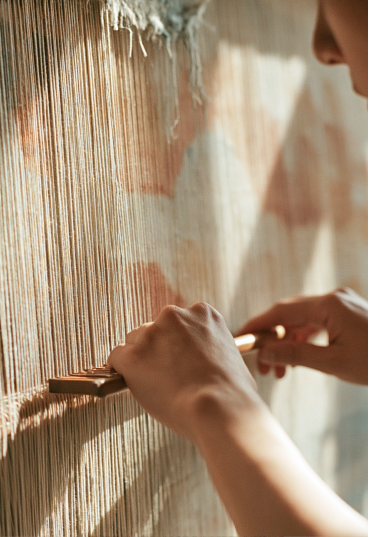
Between the source and the finished rug stands the workshop, and here the translation becomes material. The cartoon must be drawn, every shift of color mapped across a field of hundreds of thousands of knots. The yarns must be chosen and the dyes developed, often across many samples, until the blush of a painting or the particular faded green of an old fabric is found in wool. This is where Rug & Kilim’s decades of relationships with the finest looms become decisive, and where the house’s own practice of complementing, the deliberate mixing of yarns, weights, and spins, allows a surface to be built that answers the source not only in color but in texture and light. A commission is finished not when it matches the source, but when it has become its equal in a new medium. When Bobby McAlpine’s Palm Beach jewel box required a Scandinavian rug to serve as a quiet, textural counterpoint to a richly layered room, the achievement was precisely this: a surface calibrated to do a specific job in a specific space, made rather than merely selected.
What the Finished Custom Rug Knows
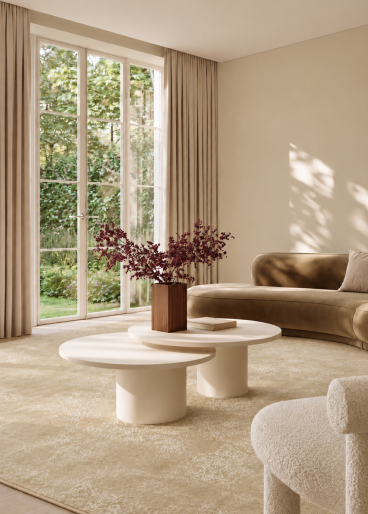
The custom rugs that endure, the ones that anchor the interiors photographed decades on, are never the ones that merely reproduced a reference. They are the ones that understood it. They carry the memory of the painting, the fabric, the fragment that began them, the way a great translation carries the memory of its original: faithful in spirit, transformed in substance, and alive in a way the source alone could never have been underfoot.
Rug & Kilim’s designer rugs integrate artistic expression with intention. Jahanshah Josh Nazmiyal and his Design team, with four decades of experience, personally oversee the entire process of bringing your idea to life. Every day we explore new possibilities of textures, yarn and colors, and we create one-of-a-kind rugs every time. Our mature relationship with the topmost workshops in the world has considerably reduced the weaving time, making the production process efficient. This is how we respect your lead time as a designer and make the most of your experience with us.
To commission a rug from a beloved object is, in the end, to ask that the thing you love be given a new life in the most lived-with medium there is. It is the most personal act available in all of decoration, and at its finest, the most artful. The painting hangs on the wall and is admired. The rug it became is walked upon every day, and becomes, over the years, part of the life of the room, and of the person who first loved the thing that started it all.