Bidjar Rugs: Persian Weaving Mastery and Historic Design
November 20, 2026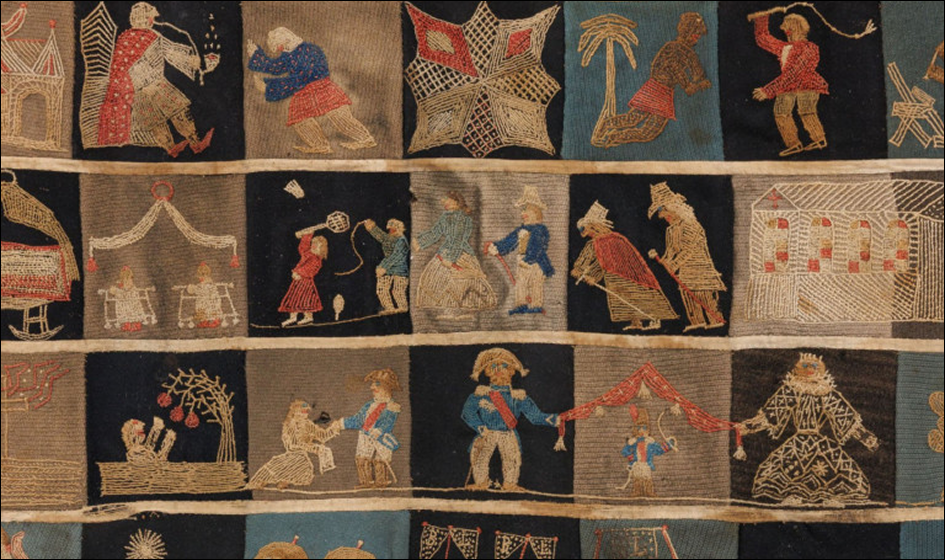
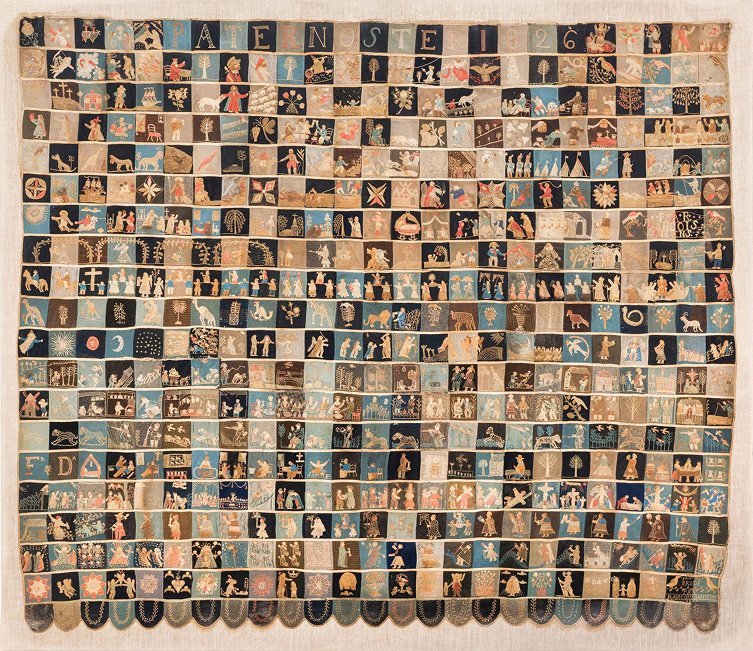
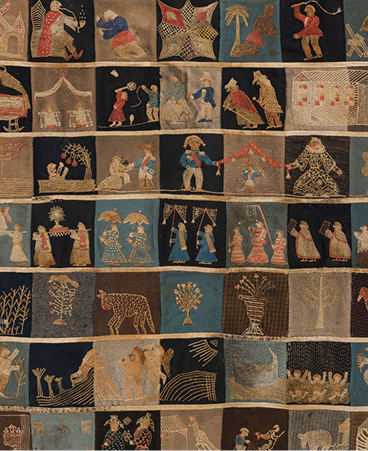
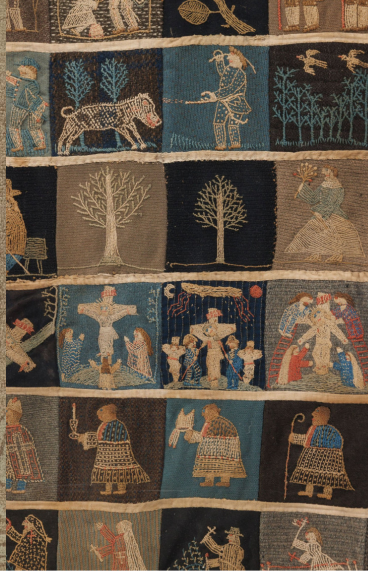
Some objects you appraise. This one you simply stand before, for a long time, and let it undo your sense of what a single human being can do. Hand-worked in wool and natural silk in Arras, France, in 1826, and signed four times over by its maker, the Pater Noster embroidery of François Damiens is composed of four hundred and seventy-five individual pictorial panels, each one a tiny woven scene, arranged in a vast grid that reads, from across a room, like the pixelated memory of an entire world. Biblical narratives. Processions. The labours of the seasons. Animals, trees, houses, saints, ordinary people doing ordinary things. Four hundred and seventy-five times, one small square at a time, a man sat down and embroidered a fragment of everything he knew.
We have spent decades in the company of extraordinary textiles, and we can say that objects like this almost do not exist. It is not merely rare. It is nearly singular.
The Arithmetic of Obsession
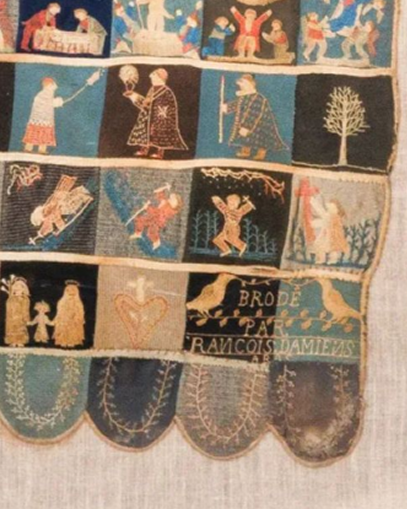
What does this object actually represent in human time? Not months. Not a season’s commission. The sheer accumulation of four hundred and seventy-five fully realised scenes, each individually designed and worked by hand, points unmistakably to one conclusion: this was not made to order. It was a life’s work, in the most literal sense, the private obsession of a man named François Damiens who signed himself again and again, Par François Damiens, Brodé par François Damiens, the initials F.D., as if to insist, across the decades of its making, that he was still here, still working, still alive inside it.
There is something almost vertiginous in that repetition. It belongs to the same strange and magnificent human impulse that produced the medieval Books of Hours, illuminated page by page by monks who would never see them finished, and the outsider art of visionaries like Henry Darger or the Facteur Cheval, who spent thirty-three years building a palace out of stones he collected on his postal route. Damiens belongs to this lineage of the sublime obsessive, the maker for whom the work was not a product but a life.
The Grid That Contains a Cosmos
What moves us most is the form he chose. The grid. Four hundred and seventy-five small framed scenes, each on its own coloured ground, organised into neat rows like the panels of a comic strip drawn a century before comics existed, or like the predella panels beneath a Renaissance altarpiece, where the great sacred scene above was footnoted by small narrative episodes below. Damiens took the predella and made it the whole cathedral. The structure is encyclopedic, and that is precisely the point: this is one man’s attempt to embroider the totality of his faith and his world, to hold everything, the sacred and the agricultural, the eternal and the everyday, inside a single frame.
It recalls the great medieval tapestry cycles, the Apocalypse of Angers, the stone tympanums of Gothic churches where all of creation was carved in registers above the door. But those were the work of guilds, of workshops, of institutions with the resources of the Church behind them. This was one man, in Arras, with wool and silk and what must have been an almost unbearable patience.
Why Arras Matters
That it comes from Arras is not incidental, and the collector who knows their history will feel the resonance immediately. Arras was, in the late medieval period, the most famous tapestry-weaving city in all of Europe, so famous that the word “arras” entered the English language as a synonym for tapestry itself. It is the very arras behind which Polonius hides in Hamlet. By 1826, that great industrial glory was long past, but one senses in Damiens’s work the deep cultural memory of a place that had textile in its blood, the vernacular afterlife of a once-imperial craft. He was not weaving for a king, as his Arras forebears had. He was embroidering for God, and for himself, in the humble medium of a provincial needleworker who carried, perhaps without knowing it, five centuries of his city’s genius in his hands.
Where a Work Like This Belongs
An object of this ambition does not go where rugs go. It is not furniture, and to treat it as such would be a kind of category error; this is a work to be hung, lit, and read, and the rooms that suit it are the rooms built for contemplation rather than traffic. The first and most obvious home is the library or the study, where its density finds its natural company: shelved spines, a reading chair, the low warm light of a single lamp. Hung above a long desk or a bank of books, the Pater Noster becomes what it has always secretly been, an illuminated manuscript opened to the wall, and the room acquires the hushed, scholarly gravity of a private collection. There is no object better suited to the room where a serious person thinks.
The more daring placement, and the one the most sophisticated collectors are making now, is to treat it as contemporary art and hang it accordingly, in a spare modern interior where it has nothing to compete with and everything to say. Against a wall of pale limewashed plaster or raw concrete, floated in a deep shadow-box frame with museum glass and a whisper of internal light, this 1826 embroidery reads as astonishingly modern: four hundred and seventy-five small panels in a rigorous grid, which is to say, a structure the twentieth century would later call a Agnes Martin canvas, an Ad Reinhardt meditation, the serial grids of Sol LeWitt. Place it in a minimalist room and the dialogue across two centuries becomes the whole point, the vernacular devotion of a provincial needleworker speaking directly to the language of post-war abstraction. It is the single most interesting thing such a room could hold, precisely because it was never meant to hang there.
A third option, for the collector with genuine nerve, is the dining room, long the most theatrical room in any serious house. The eighteenth and nineteenth centuries understood that dinner was a performance and dressed their dining rooms with the grandest narrative tapestries they owned, scenes to be read and discussed across the length of an evening. The Pater Noster revives that tradition with a modern intelligence. Hung the full length of a dining wall, lit low, it gives a long table exactly what the best dinners require: an inexhaustible object that rewards the wandering eye, four hundred and seventy-five small stories to be discovered over the course of years of evenings, a guaranteed and endless conversation woven into the very walls.
Wherever it goes, three principles hold. Light it deliberately and gently, as a museum would, from above and at low intensity, so the natural silk catches and the wool stays soft; never let direct sun near it. Frame it to float, with space to breathe and no competing pattern anywhere near it, because a work this dense needs silence around it the way a soloist needs a quiet hall. And give it a wall of its own.
An object that took a man his life to make has earned the right to be the only thing you look at.
What It Asks of Us
An object like this does not belong to the ordinary categories of the market, and it resists the ordinary language of acquisition. It is closer to a manuscript than a furnishing, closer to a work of visionary art than a decorative textile. It asks to be hung and read, slowly, the way one reads an illuminated book or walks the stations of a cathedral, one small scene at a time, discovering across weeks of living with it the sheer inexhaustible density of what one man made.
To own it is less to possess a thing than to become the temporary guardian of a vanished life’s entire devotion, four hundred and seventy-five small windows into the mind of François Damiens of Arras, who in 1826 set out, improbably and magnificently, to stitch the whole of his world. We have been in the presence of many great textiles.
We have rarely been in the presence of a soul so completely preserved in thread.