Understanding Aubusson Rugs: French Heritage and Timeless Luxury
November 6, 2026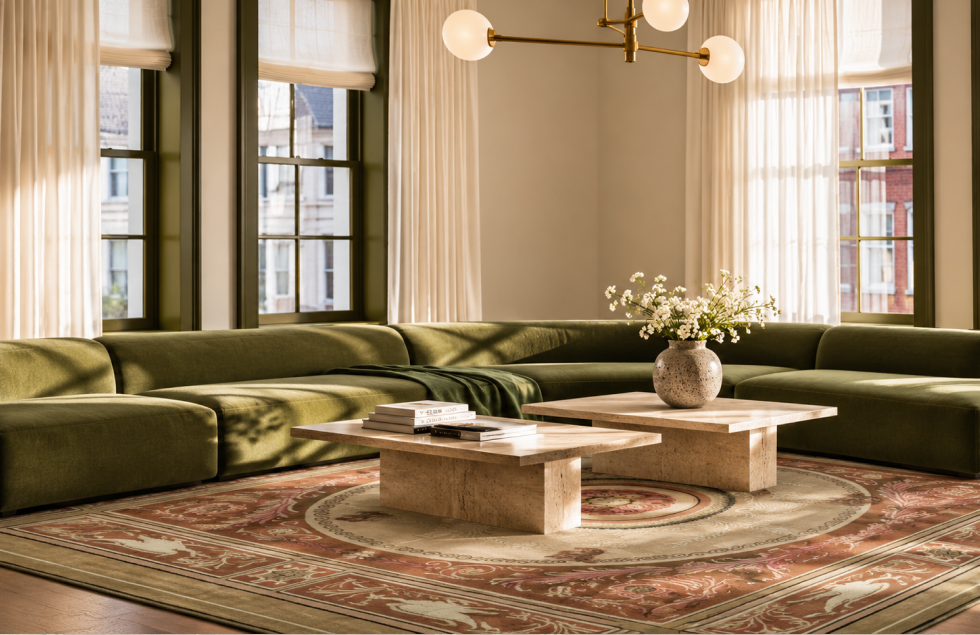
Every civilization that has reached a certain confidence has wanted to put its worldview on the floor. The Persians wove paradise gardens; the Chinese, the cosmos in miniature. France, under the Sun King, wove order itself. The Savonnerie, the royal carpet manufactory brought to its height under Louis XIV, the symmetry of the formal garden, the architecture of Versailles, the neoclassical grammar of acanthus and rosette and laurel that announced a culture certain of its own supremacy. A Savonnerie is a political philosophy you can stand on. All of which makes the four small creatures hidden in this particular example so delightfully subversive.
In 1627, Louis XIII granted a royal privilege to a workshop installed in a former soap factory on the outskirts of Paris, and gave the grandest carpet tradition in European history its humble name: savon, soap, Savonnerie. For more than a century afterward, no one but the King of France could own one. These were instruments of statecraft, woven under royal monopoly to carpet the Louvre and Versailles, their designs supplied by the same court painters who decorated the ceilings above them. To walk on a Savonnerie was, quite literally, a privilege of the crown. Which is what makes the carpet before us so quietly astonishing. It carries all the authority of that imperial tradition, and then, hidden in its vines, it does something no royal Savonnerie would ever have dared: it tells a joke.
This is the quiet genius of the piece, and the reason it rewards a longer look than its grandeur alone would command.
The Weight of the Tradition
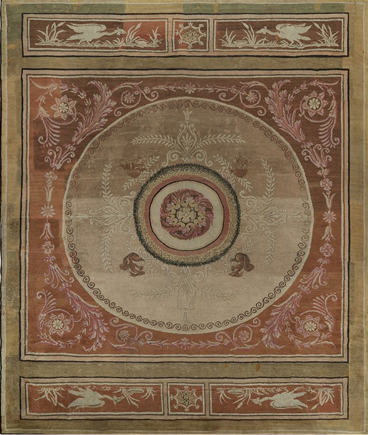
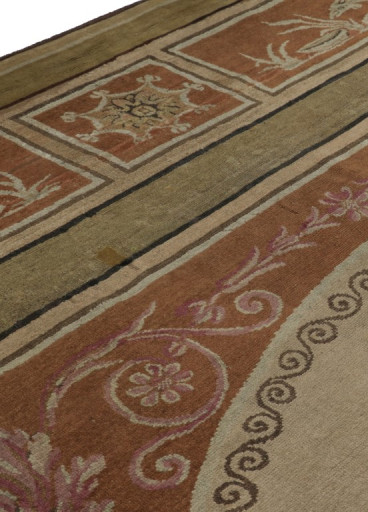
To understand why the squirrels matter, one must understand what they are interrupting. The Savonnerie is the grandest of all European carpet traditions, established under Louis XIII and brought to its height under Louis XIV, woven exclusively, in its earliest days, for the French crown. Its visual language is the language of absolute power expressed through perfect order: the symmetry of the formal garden, the architecture of Versailles, the neoclassical designs of acanthus and rosette and laurel that announced a civilization’s confidence in its own refinement. Hand-knotted in wool in France between 1880 and 1889, this oversized 14×16 example speaks that language fluently. Its medallion commands the field with the authority of a dome seen from below. Its borders, framed with classical motifs and crowned at the ends with serene swans amid tufts of grass, are as composed as a facade.
Everything about the carpet’s structure says: this is a serious object, made for a serious room.
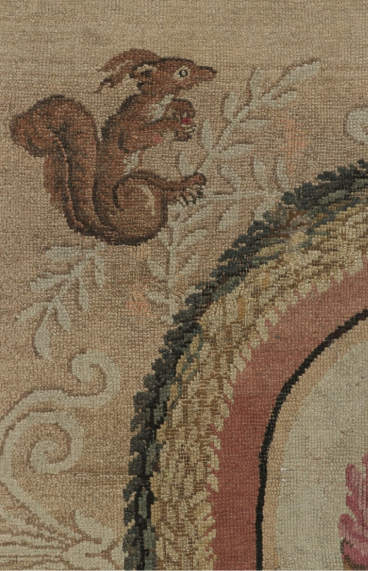
The Squirrels, and the Permission to Delight
And into that seriousness, the weaver has set four squirrels. It is worth pausing on how unusual this is. The Savonnerie tradition admitted animals rarely, and when it did, they tended toward the heraldic and the grand, the eagle, the lion, the swan that appears, properly dignified, in this very carpet’s end panels. The squirrel is something else. It is domestic, quick, faintly comic, a creature of the garden and the hedgerow rather than the coat of arms. To place four of them in the field of a monumental Savonnerie is a small act of wit, a decision to let delight coexist with grandeur.
This instinct has a long and distinguished lineage in the decorative arts. The medieval millefleurs tapestries scattered rabbits and small birds through their thousand flowers. The grotesque ornament of the Renaissance, revived from Nero’s buried Golden House and beloved by Raphael, filled the margins of the most serious schemes with playful hybrid creatures. The Rococo, in the generation before the neoclassical severity this carpet descends from, made whimsy a governing principle, the singeries of Christophe Huet, with their dressed monkeys, delighting the greatest houses of France. The squirrels belong to this tradition of sanctioned play, the understanding that the very grandest interiors can afford, precisely because they are so assured, a note of charm. In Northern Renaissance portraiture the squirrel appeared as an emblem of the diligent, provident household, and a tamed squirrel on a chain was a known attribute of the devoted wife, famously so in Hans Holbein’s portrait of a lady with a squirrel and a starling, now in the National Gallery in London. To weave four squirrels around the medallion of a carpet destined for a great house was, therefore, not only playful but quietly apt: a wish for abundance and good husbandry, woven into the very floor of the home it would furnish. The whimsy, it turns out, is also a blessing.
Whimsy as Confidence
There is a lesson here that the finest designers know instinctively, that true sophistication is never humorless. A room that takes itself entirely seriously is a room that is slightly insecure. The interiors that endure, the ones with real character, almost always contain a moment of wit, an unexpected object, a flash of the personal, a small wild creature where one expected only ornament. The squirrels are exactly this kind of moment, woven permanently into the fabric of an otherwise formal masterpiece.
They are the reason this carpet has a personality and not merely a pedigree.
Where It Belongs
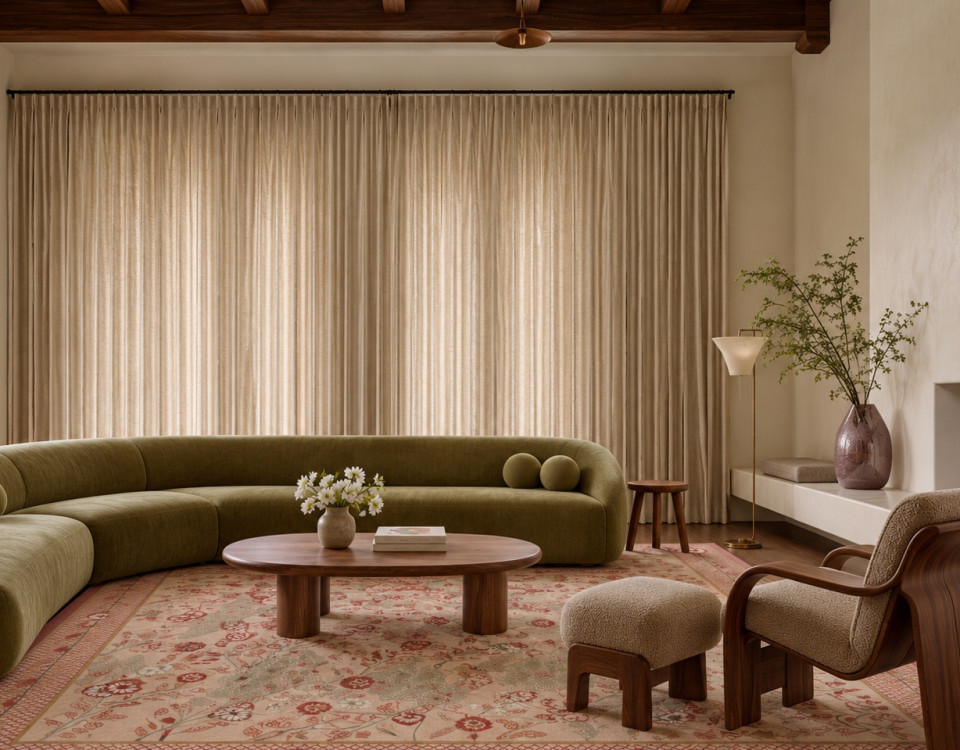
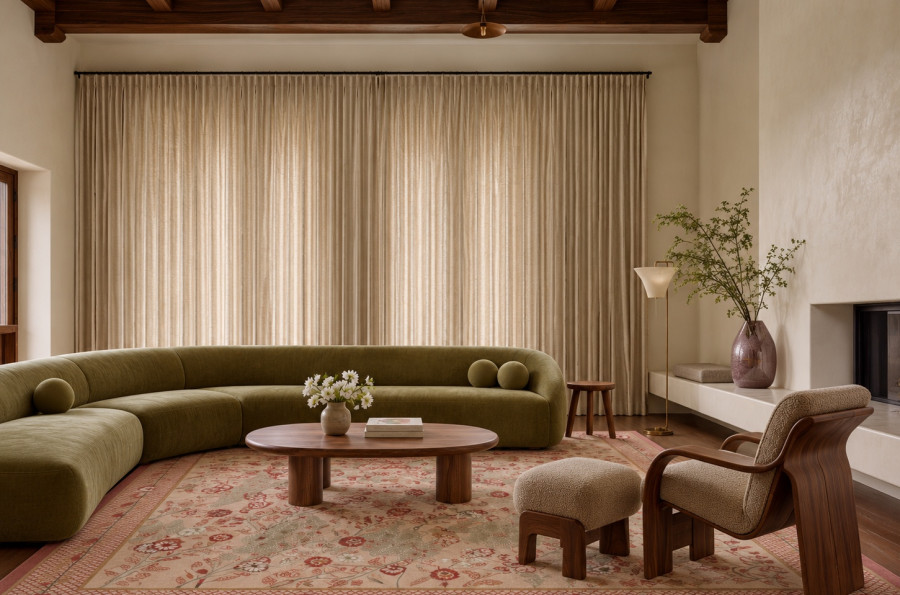
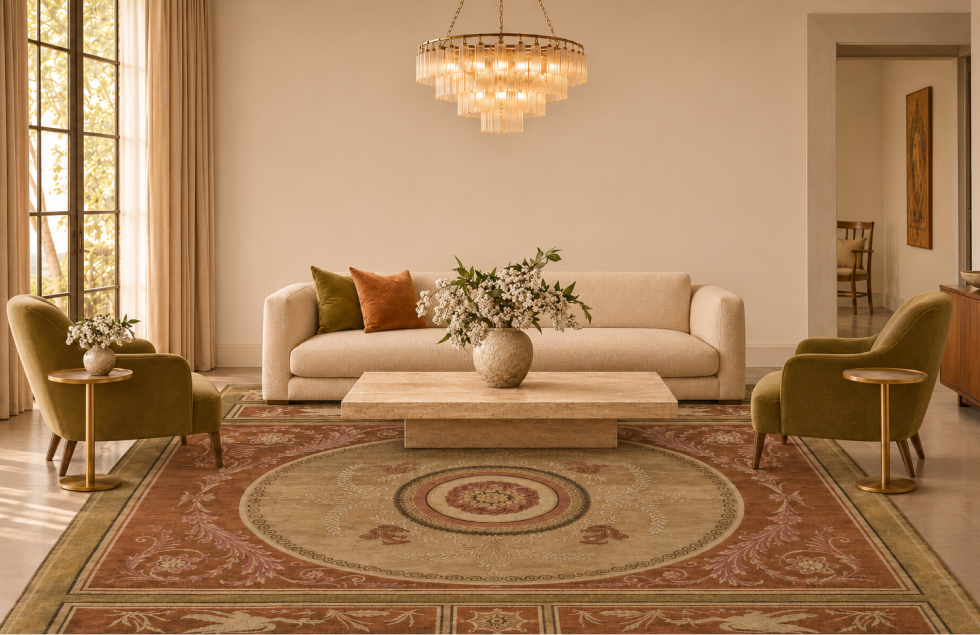
Such a piece asks for a room confident enough to appreciate the joke. It would be magnificent in a traditional interior, anchoring a grand salon with its neoclassical authority. But it would be even more interesting in a contemporary one, its tan field and soft palette reading as quiet and modern, its grandeur and its whimsy together providing exactly the kind of layered, slightly unexpected note that the most sophisticated current interiors prize. Against pale plaster and spare modern furniture, the squirrels would do what they have always done: reward the person who looks closely, and tell them something about the taste of whoever chose to live with them.
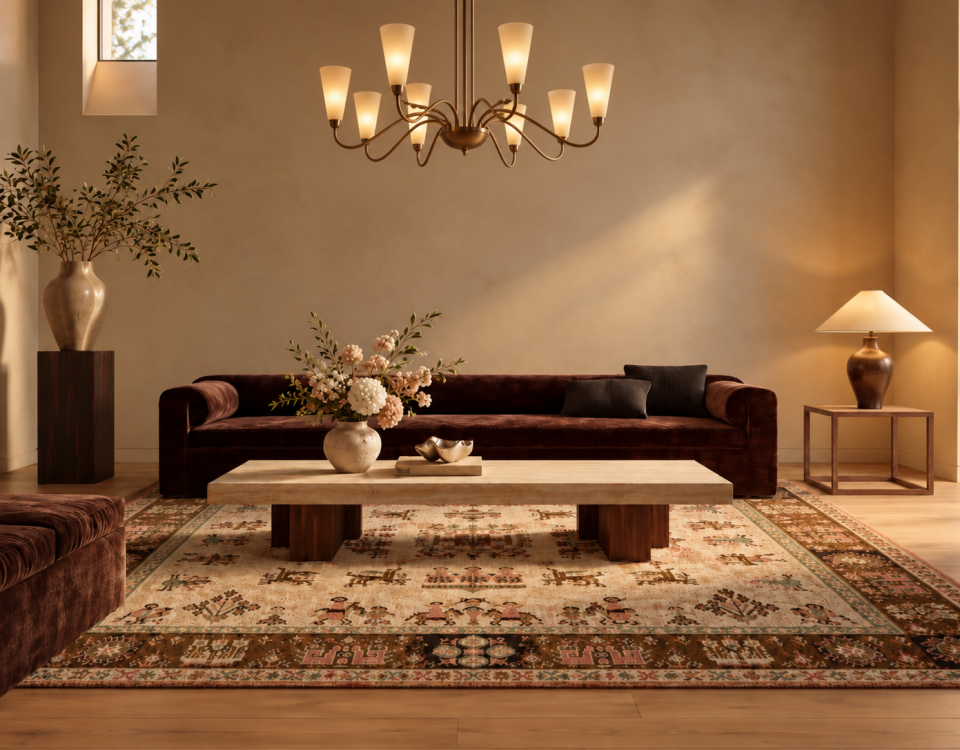
A carpet of this scale and character rewards a confident hand. The instinct to match its formality with an equally formal room is the obvious choice, and a fine one: beneath a crystal chandelier, anchoring a salon of gilt and silk, it would read as pure classical authority, the squirrels a private pleasure for those who linger long enough to find them. But the more interesting move, and the one the most accomplished designers are making now, is to set it against restraint. The great lesson of the past decade of interior design is that antique grandeur reaches its highest expression not in period rooms but in spare, modern ones, where a single historic object carries all the weight. Style this Savonnerie in a room of pale plaster walls, raw oak, and a few pieces of clean-lined modern furniture, and its tan field reads as quiet and contemporary while its medallion supplies the architecture the room deliberately withholds. It is the principle Axel Vervoordt built a career upon, and the one that gives a Jean-Michel Frank interior its serene tension: the old and the austere, placed in conversation.
The soft palette makes this easier than it sounds. Blush pink, sage green, and warm brown against tan are not period colors so much as permanent ones; they sit as comfortably with a contemporary linen sofa as with an eighteenth-century bergère. The idea is to allow the carpet to lead, keep the upholstery quiet, and resist the urge to crowd it; a composition this complete asks for space around it, the way a significant painting asks for a wall of its own. And place it where it will be walked slowly, an entry, a library, a dining room, so that the squirrels are discovered over time, by those who live with it, rather than announced all at once. The best detail in any room is the one you find yourself, on the hundredth day, having missed it for the first ninety-nine.
A great carpet, in the end, is never only about its grandeur. The ones we remember are the ones with a secret, a detail that waits to be found and, once found, cannot be unseen. This Savonnerie keeps four of them, warm brown and perfectly symmetrical, nestled in the vines. It is a masterpiece that also happens to be a delight, which is the rarest and most charming thing a serious object can be.