Style
Chinese
Every piece in this style, across all of our collections. Narrow them down by size and price.
- Under 6 x 9
- Runners
- 6 x 9
- 8 x 10
- 9 x 12
- 10 x 14
- 12 x 15
- Over 12 x 15
Origin ▼
Style ▼
Material ▼
Width
Length
To connect with a specialist, click here
Stories from the Chinese Archive
Essays, artist dialogues, and provenance notes drawn from Rug & Kilim’s editorial desk.
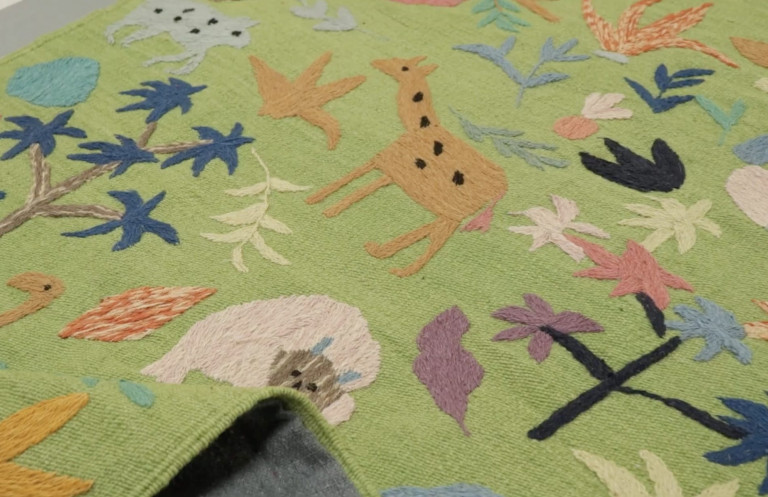
The Long Life of a Green: On Celery, Color of the Year, and the Four Centuries of Weaving That Anticipated It
Every year, the color world makes its pronouncement, and every year the design world turns to see what it has been given. For 2027, Sherwin-Williams has named Celery; a light, airy, herbal green with a yellow undertone, chosen, in the company's words, for a moment that prizes wellness, balance, and connection. It is a soft color with a quiet glow and a faint edge; it pairs, its makers note, with white for something breezy, with cranberry red for something playful, with brown for something elevated. It is, by any measure, a beautiful and intelligent choice. It is also a color the great weavers of the world have understood for four hundred years.
Read the Feature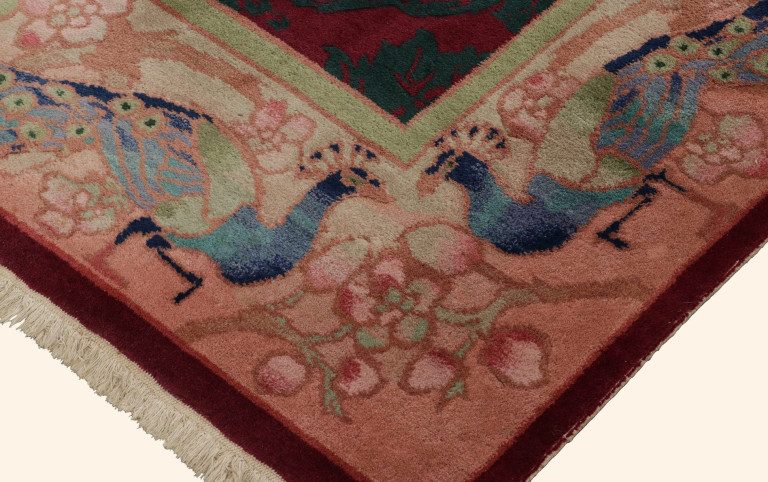
Rug of the Week VI: Chinese Art Deco and the French Imagination, 1920–1930
In the long arc of design history, there is art that merely follows a style, and there is fine art that redefines the geography of taste. This Chinese Art Deco rug—woven between 1920 and 1930, at the height of the Jazz Age—belongs to the latter. It was not born of a single tradition, but of a cultural duet: the East’s millennia-old textile mastery and the West’s avant-garde hunger for reinvention. A Tale of Two Modernities The 1920s marked a feverish moment in both Shanghai and Paris. While the French ateliers of Ruhlmann and Rateau were designing interiors for modern aristocracy, Chinese workshops in Tianjin and Beijing were reimagining their classical vocabulary for export. The result was an East–West synthesis unlike anything seen before—luxurious, daring, and utterly modern.
Read the Feature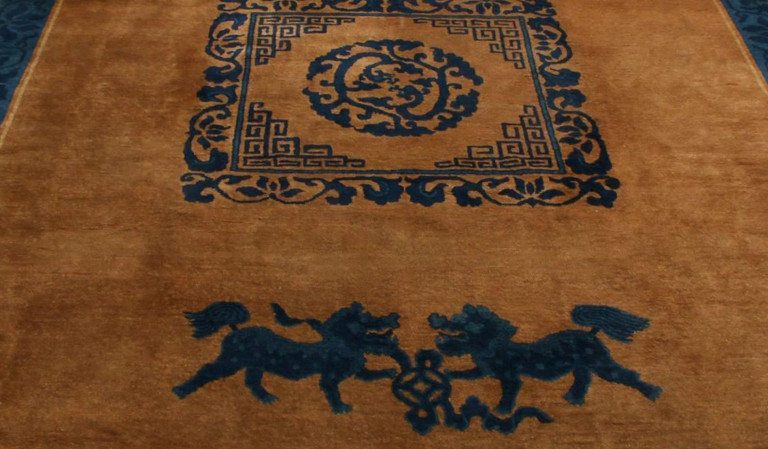
The Art, Politics, and Design of Peking Rugs: From Qing Palaces to Contemporary Interiors
To engage with an antique Peking rug is to step into a dialogue between art, politics, and spatial philosophy. Unlike their Persian or Ottoman counterparts, Peking rugs do not overwhelm with ornament. They persuade quietly, through disciplined geometry, reserved color palettes, and motifs that echo the restrained harmony of Chinese architecture and literati aesthetics. Born in the imperial looms of late Qing Dynasty Beijing and carried into early 20th-century trade ateliers, these rugs embody a convergence: the rigor of Confucian order, the symbolism of Taoist cosmology, and the pragmatism of a China entering global modernity. To own or study a Peking rug is not merely to examine a textile, but to read a palimpsest of political transition, philosophical belief, and design refinement.
Read the Feature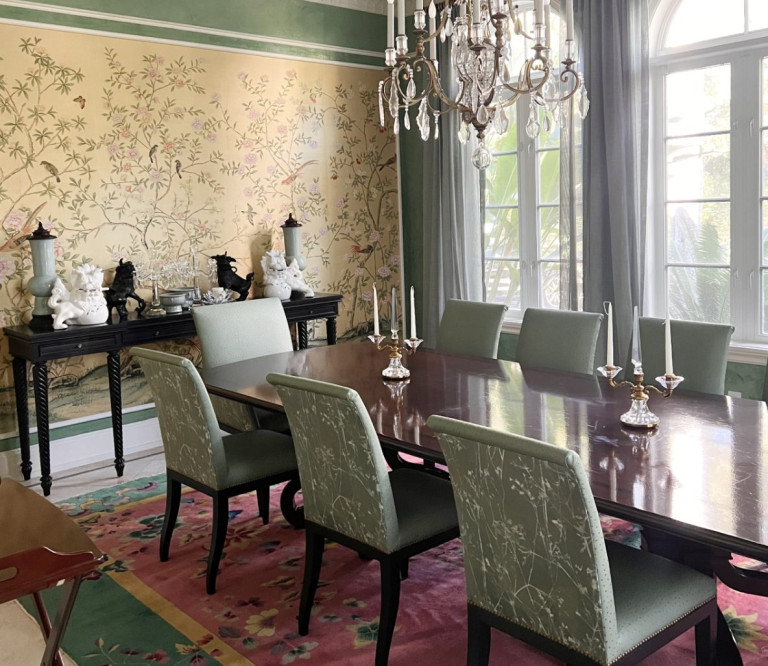
Walter Nichols and the Renaissance of Chinese Rugs
Chinese rug weaving traditions stretch back into antiquity, with earliest textual references appearing in classical Chinese annals. While scholarly debate continues regarding whether carpet weaving originated in China or the Near East, archaeological evidence confirms weaving practices in China by the Han Dynasty (206 BCE - 220 CE). Initially serving practical and ceremonial functions in imperial courts and Buddhist temples, Chinese carpets evolved distinctive characteristics that set them apart from their Persian counterparts. Traditional Chinese carpets were characterized by their use of simplified motifs, distinctive indigo blues, and symbolic imagery drawn from Buddhist, Taoist, and imperial iconography.
Read the Feature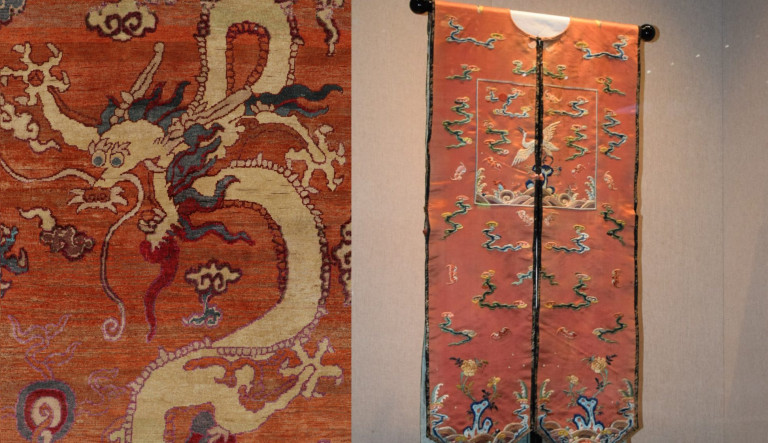
A Guide to History and Significance of Chinese and Tibetan Dragon Pictorial Rugs
Dragon, as the perfect representation of cyclical nature of life, where from every end, a new beginning emerges, is also a perfect marriage of Chinese spiritual heritage and art. Our special dragon rugs’ line is a commemoration of the spirit of the Chinese dragon, wherein each rug complements the other in the collection and reflects continuity of age-old designs and transformations in our modern touch to these pictorial rugs. At the same time, dragons, or Chinese traditional designs at large, also represent a commitment to regenerative and cyclical nature of life—thus birthing the modern concept of sustainability.
Read the Feature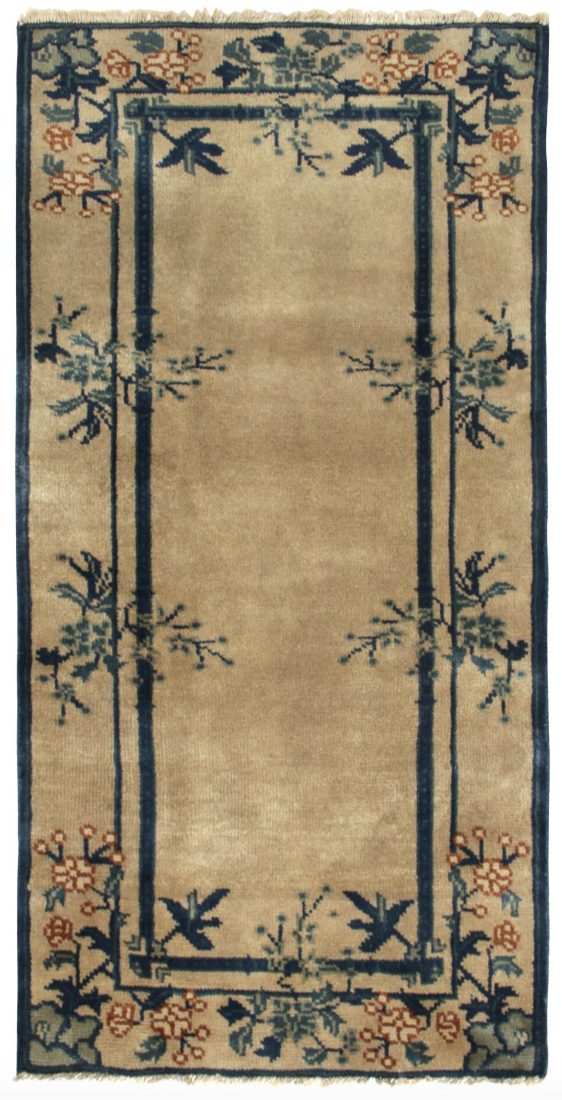
A Guide to Chinese Art Deco
Featured above is a vintage ode to Chinese Deco styles of the 1920s exemplifying classic frames in royal blue atop a luxurious beige-brown backdrop comfortably supporting the florals in aegean blue, teal & yellow-brown tones. The light and dark spots only complement the healthy wool pile of this hand-knotted vision, making it an exemplary piece in Oriental style. The exhibition "China Through the Looking Glass," showcased at the Metropolitan Museum of Art in 2015, provides a captivating exploration of the profound influence of Chinese aesthetics on contemporary Western fashion. The exhibition ingeniously juxtaposes traditional Chinese costumes, carpets, paintings, porcelain, and other artistic treasures with the creations of modern high-end fashion. This amalgamation of Chinese cultural artifacts and over 140 examples of haute couture and avant-garde ready-to-wear fashion unveils the enduring impact of Chinese art and culture on the imaginative landscape of Western fashion. Renowned designers like Cristobal Balenciaga, Paul Poiret, Roberto Cavalli, Vivienne Westwood, and Yves Saint Laurent contribute to this dialogue, creating a visually rich tapestry that bridges the historical and the contemporary in the realm of fashion.
Read the Feature