
Designing Corridors and Galleries with Runners: The Power of Narratives in Spaces
October 6, 2025
Hannah Ryggen’s Memories of Three Returns to the Market: Tapestries Redefining the Art of Interior
October 27, 2025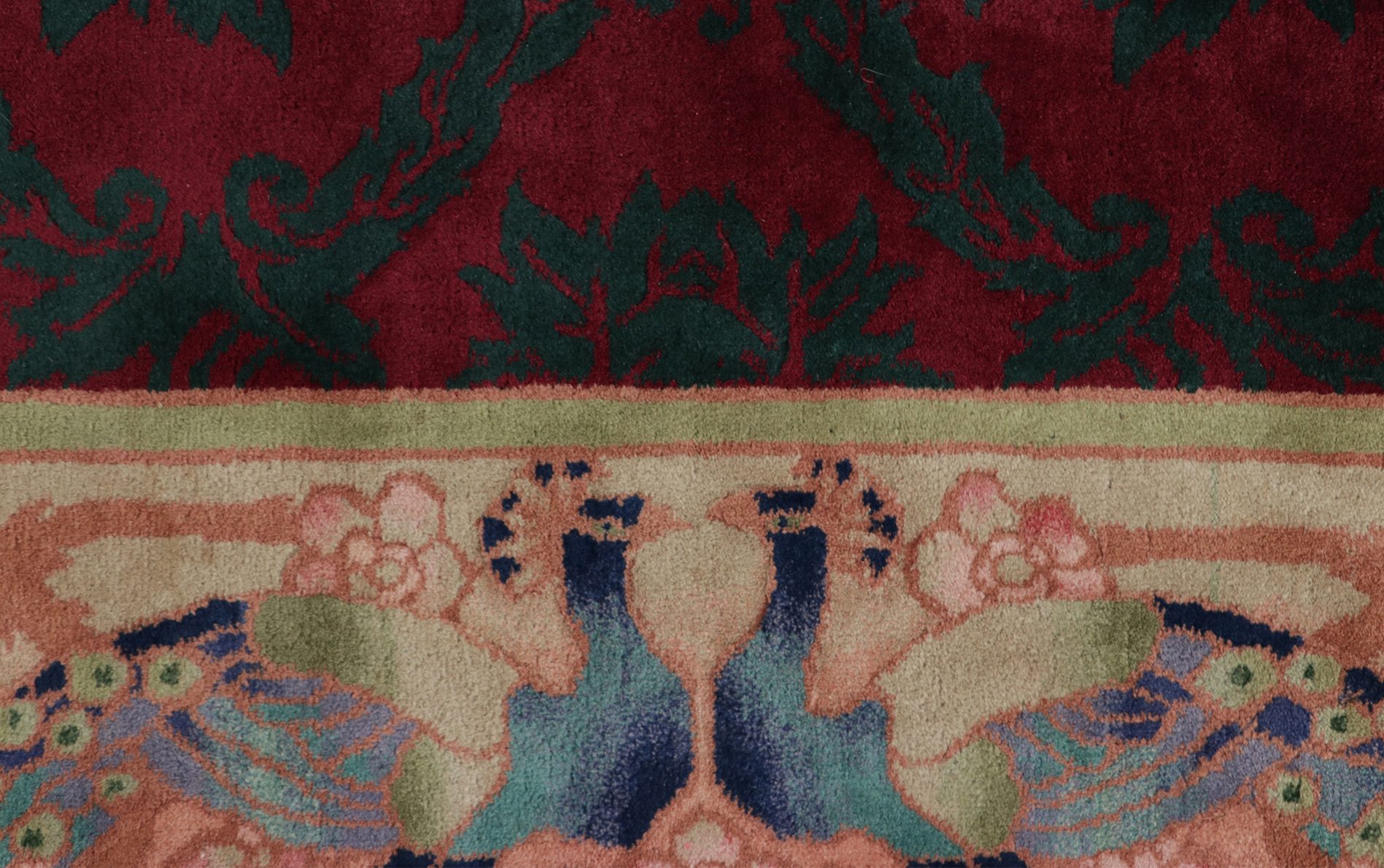
In the long arc of design history, there is art that merely follows a style, and there is fine art that redefines the geography of taste. This Chinese Art Deco rug—woven between 1920 and 1930, at the height of the Jazz Age—belongs to the latter. It was not born of a single tradition, but of a cultural duet: the East’s millennia-old textile mastery and the West’s avant-garde hunger for reinvention.
A Tale of Two Modernities
The 1920s marked a feverish moment in both Shanghai and Paris. While the French ateliers of Ruhlmann and Rateau were designing interiors for modern aristocracy, Chinese workshops in Tianjin and Beijing were reimagining their classical vocabulary for export. The result was an East–West synthesis unlike anything seen before—luxurious, daring, and utterly modern.
This rug sits precisely at that intersection. Commissioned for the French market, it fuses Chinese symbolism and Art Deco geometry, producing a textile that transcends geography. It does not merely borrow from the past—it translates it, turning imperial imagery into cosmopolitan abstraction.
The Art of the Border
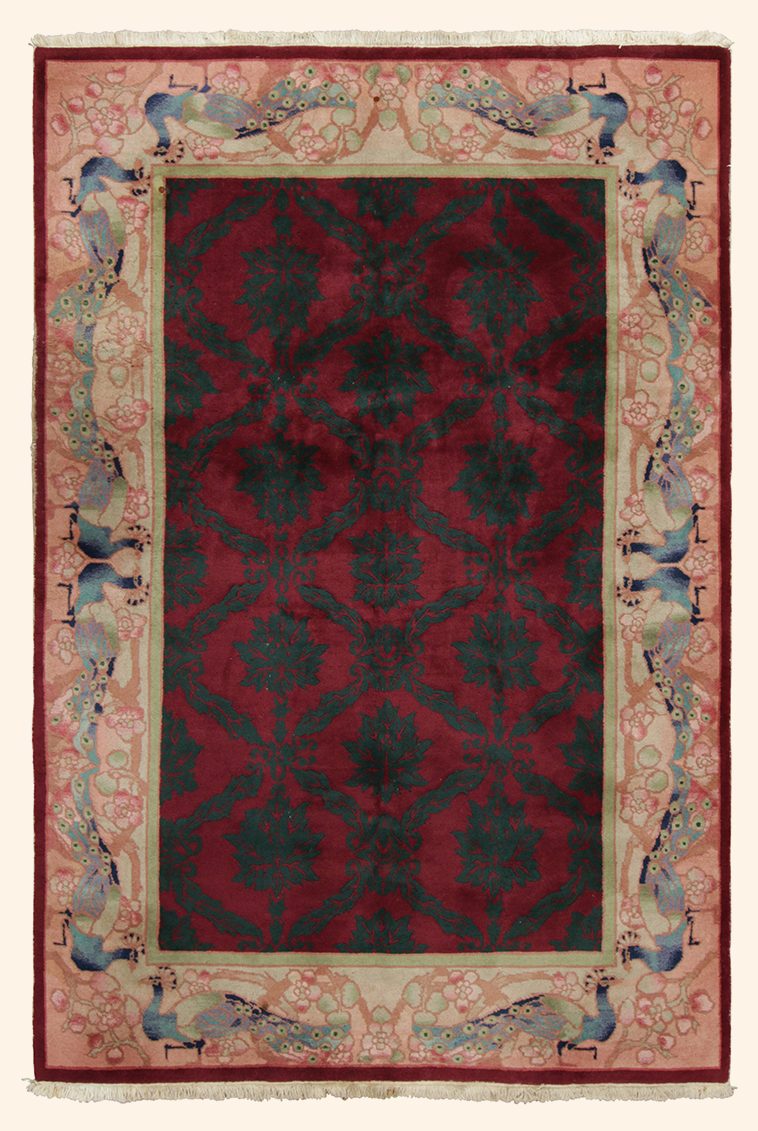
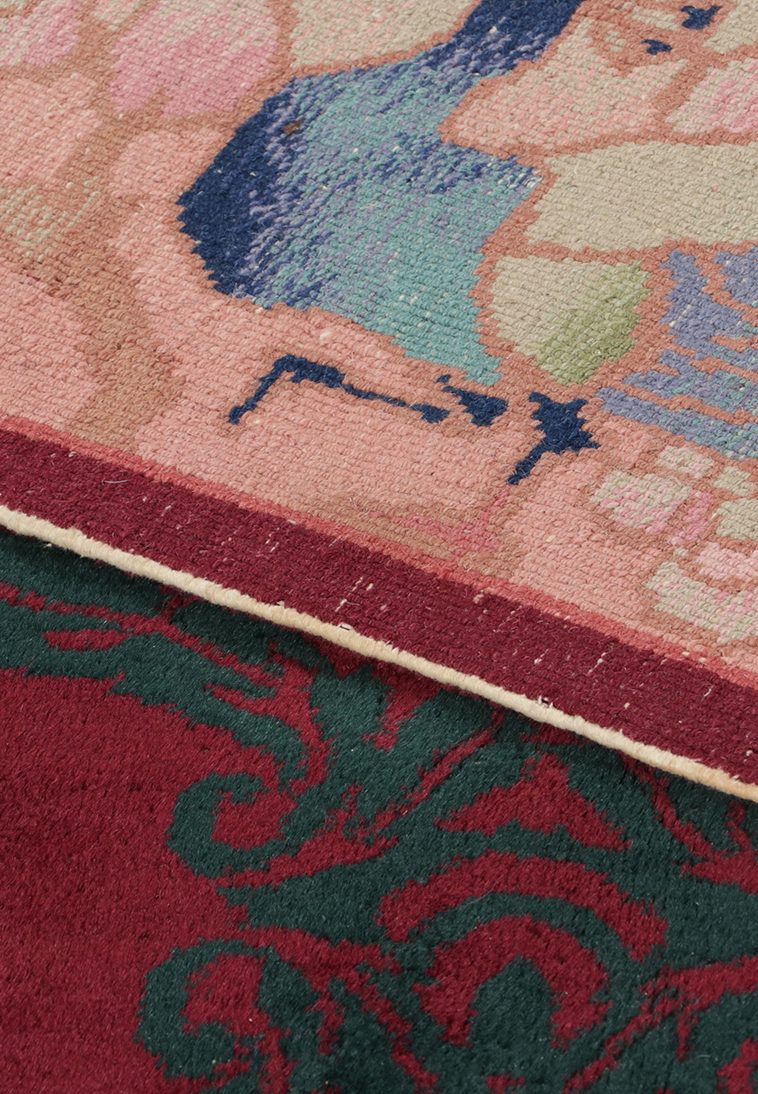
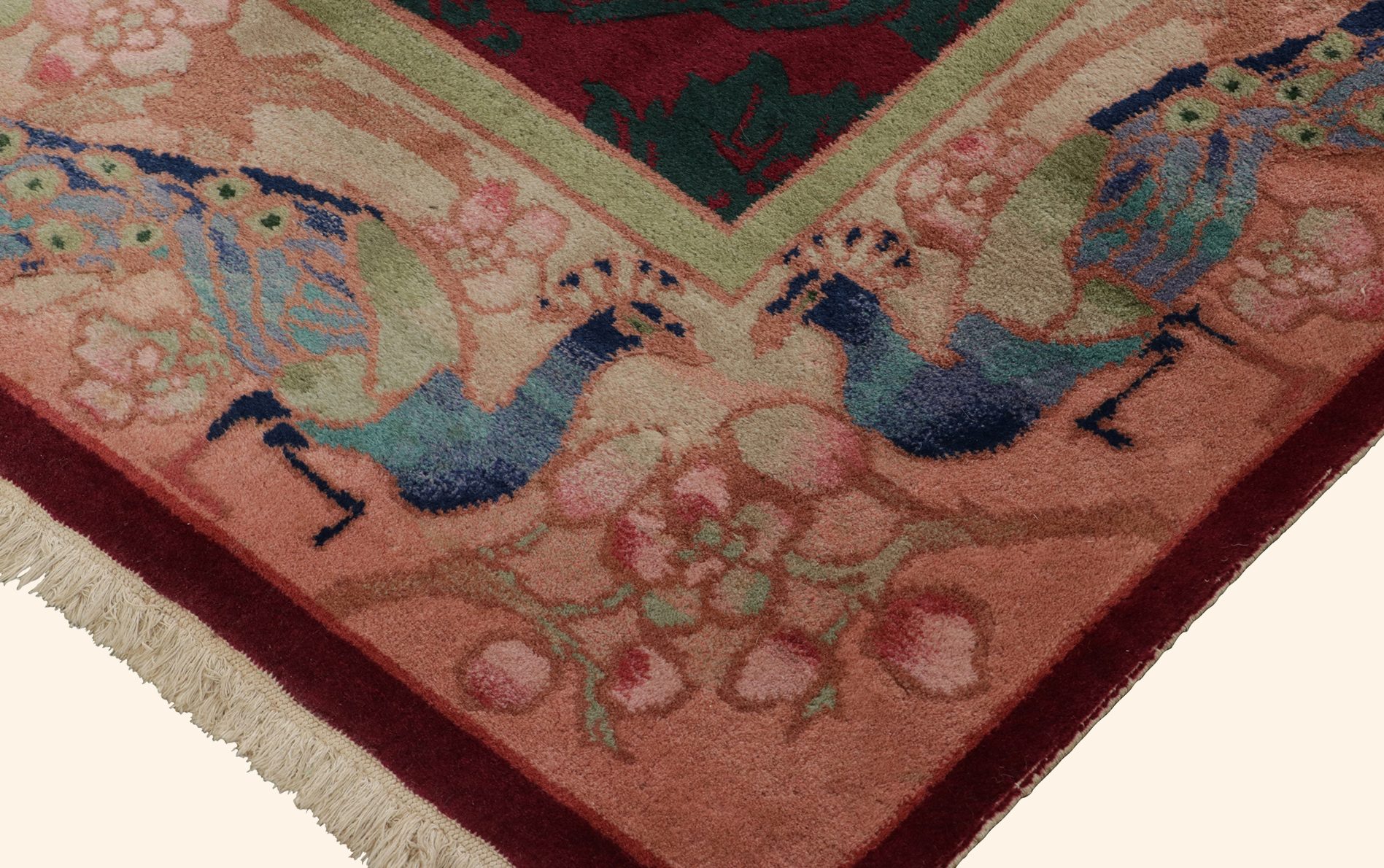
The border of this piece is a revelation: a scroll of peacocks in indigo, teal, and soft emerald, striding against a powder-pink ground. The peacock—long revered in Chinese art as an emblem of dignity and immortality—is here rendered with the poise of French costume illustration. Its feathers are not naturalistic but composed, flattened into geometric rhythm, recalling the posters of Erté and the frescoes of Jean Dupas.
This pink border—delicate yet assertive—marks a radical turn in Chinese carpet design. It transforms the rug’s frame into a pictorial field of its own, reversing the hierarchy between center and edge. The border becomes the main focus, its peacocks performing the East–West ballet of the interwar imagination.
The Field and the Modernist Eye
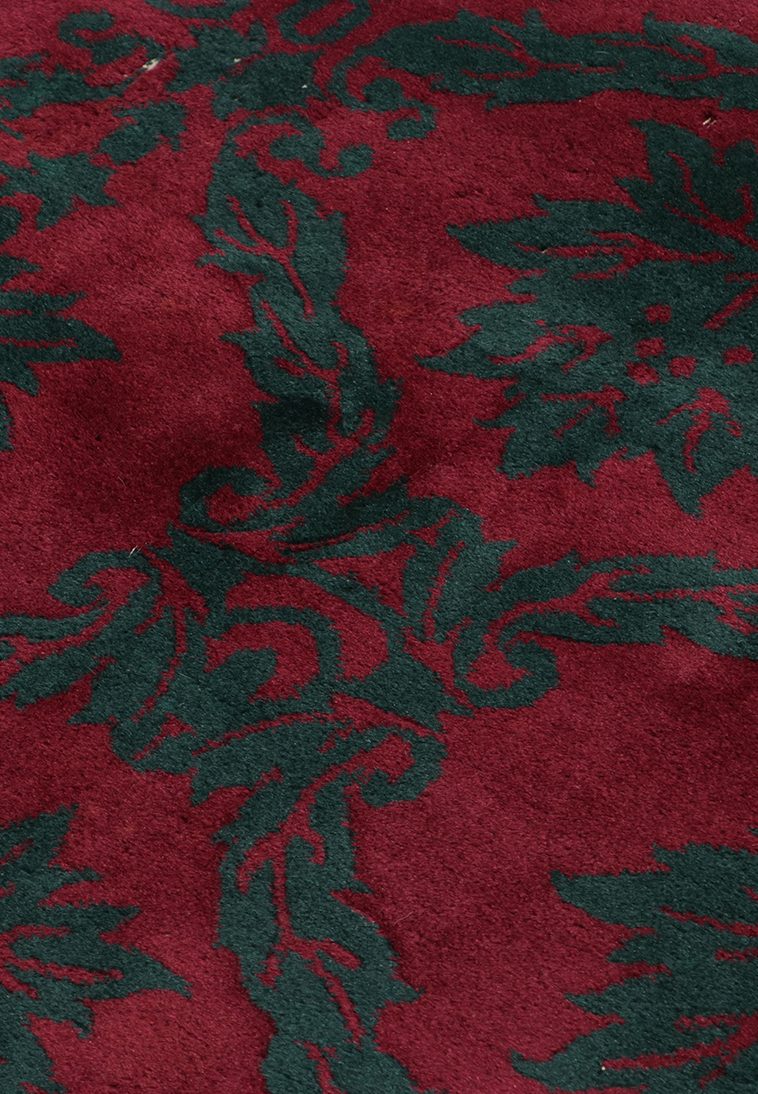
Anchoring this spectacle is a field of deep burgundy red, a tone that echoes both imperial lacquer and the moody interiors of 1920s Paris. Upon it unfolds a trellis of midnight-blue florals, stylized yet organic, suggesting the influence of both Chinese textile tradition and British Arts & Crafts design.
Where many Art Deco rugs sought precision, this one breathes. The rhythm of its floral lattice feels hand-hewn, alive with the imperfection that defines all great design. It holds the tension between structure and spontaneity—between the rationalism of Deco and the lyricism of the handmade.
Paris, Shanghai, and the Politics of Luxury
To understand this rug fully, one must consider its politics. The 1920s and ’30s were decades of colonial exchange—an era when European consumers viewed “the Orient” through a lens of fascination and fantasy. Yet Chinese artisans were not passive participants in this dialogue. They were, in many ways, co-authors of global modernism, subtly redirecting the Western gaze through the quiet power of craft.
This rug, with its French palette and Chinese soul, is a document of that reciprocity. It speaks to a time when Chinoiserie was not revivalist pastiche but a live conversation between cultures—an early act of global design diplomacy. It’s no coincidence that such carpets found their way into the salons of French collectors, American heiresses, and British diplomats.
To own one was to declare allegiance not to a nation, but to an idea: that beauty could transcend borders.
Craft, Dye, and the Language of Texture
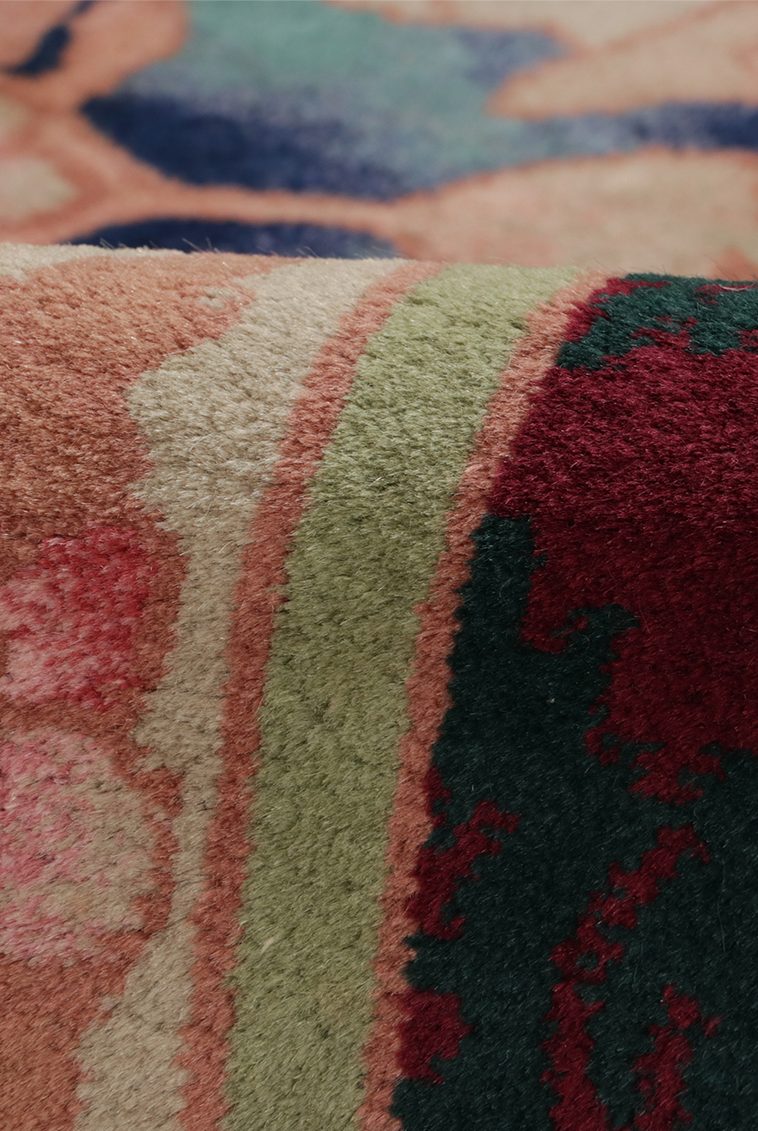
Technically, this is an exceptional weave. The wool, hand-spun and lustrous, carries the density typical of Chinese Deco carpets but with an uncommon suppleness. The dyework—especially the reds, delicate pinks and blues—is emblematic of the 1920s palette shaped by European Art Deco interiors and the influence of synthetic aniline dyes, newly perfected in China’s export workshops.
What distinguishes this particular piece is its depth of tonality. The contrast between the blush-pink border and the rich burgundy field achieves a chromatic sophistication rarely seen even in Nichols or Fette carpets of the period. The juxtaposition is not loud, but deliberate—meant to invite contemplation rather than spectacle.
A Dialogue Between Ornament and Modernism
In many ways, this carpet answers a question that defined early modern design: how can ornament survive in an age of abstraction? Where Bauhaus sought purity through reduction, the Chinese Deco movement found modernity in refinement. This rug does not reject ornament; it disciplines it. Every motif—peacock, blossom, trellis—is stylized to the edge of geometry, yet never loses its narrative warmth.
That balance is what makes Chinese Art Deco rugs profoundly relevant to today’s designers. In an era of digital pattern and algorithmic design, they remind us that modernism can still be sensual, and that the handmade remains a form of resistance.
From Salon to Sanctuary
For the contemporary collector or interior designer, this rug occupies a rarefied category. It is not an accessory, but a curatorial centerpiece—meant for spaces that speak fluently in history and material culture. Picture it beneath a Jean-Michel Frank parchment table, or in dialogue with lacquered panels by Eileen Gray. It could live just as harmoniously in a minimalist gallery, where its color fields echo Rothko’s restrained intensity.
Its visual rhythm—the procession of peacocks, the deep red field—lends itself to rooms of narrative stillness: places designed not for display, but for meditation.
Legacy and Continuity
To collectors of Chinese Deco, this rug represents the apex of cross-cultural design. It stands alongside the finest examples attributed to Walter Nichols’ Tianjin workshops, yet it carries a rarer pictorial identity—one that moves beyond geometry into storytelling. Wher
e many Deco carpets of the era flirted with Western abstraction, this one remains rooted in allegory.
Its motifs—birds, blossoms, trellises—encode continuity: the enduring dialogue between art and utility, ornament and meaning.
The Weave as Worldview
This Chinese Art Deco rug is not simply an artifact of the 1920s—it is a worldview in wool. It captures the optimism of a time when design sought universality, when the East and West mirrored each other in pursuit of modernity.
In its blush-pink border and peacock procession, one glimpses the fantasy of Parisian luxury; in its burgundy field, the grounded gravitas of Chinese tradition. It is, in essence, a chinoiserie for the new age—a textile manifesto for the belief that beauty, at its highest, is never provincial.