
Rug of the Week VI: Chinese Art Deco and the French Imagination, 1920–1930
October 15, 2025
Rugs and Kilims in Conversation with Design Icons of Ponti, Le Corbusier, and Wegner
October 30, 2025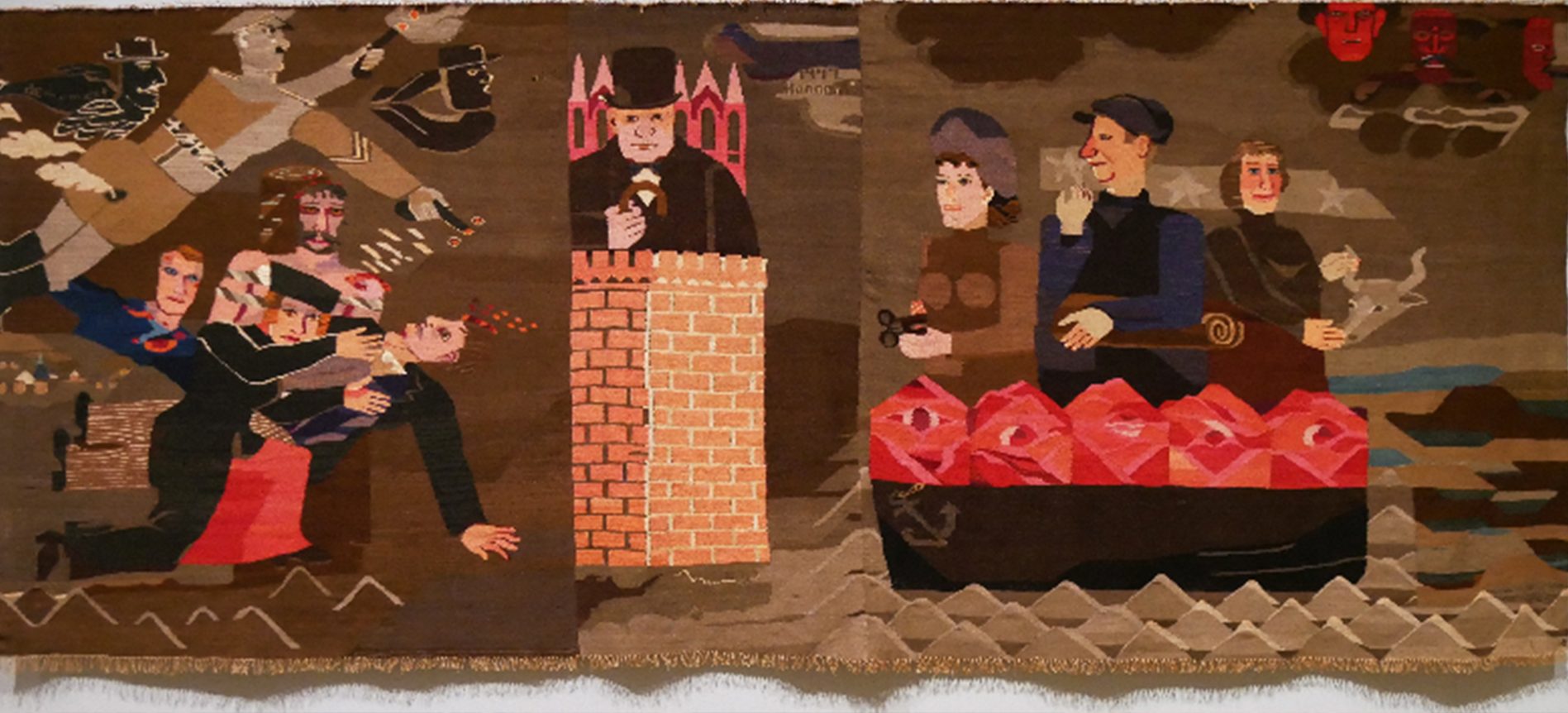
Hannah Ryggen: “6th October 1942”, 419,5 x 175 cm, 1943, tapestry, wool and linen; photo Beatrijs Sterk
In an era where art and design often chase the ephemeral, Hannah Ryggen (1894–1970) remains a force of permanence. Her tapestries — complex, moral, and defiantly handmade — occupy a rare space where textile becomes monument. As one of her most intimate works, Memories of Three (1949), returns to the market this October, the global art and design world is reminded of the profound intelligence and integrity that thread can hold.
As Hannah Ryggen’s “Memories of Three” returns to market in 2025, the art and design world revisits how one woman turned thread into conscience and color into legacy.
Originally estimated at SEK 200,000–250,000 ($21,500–26,800), the tapestry ultimately achieved an astonishing SEK 2,801,400 including buyer’s premium and taxes — a record-setting result that underscores the surging esteem for Ryggen’s work among international collectors.
Art as Ethics
Born in Malmö and later settled on a self-sustaining farm in Ørland, Norway, Ryggen’s practice was inseparable from her principles. She spun, dyed, and wove every fiber herself, rejecting industrial convenience for ideological purity. Each tapestry began in the soil — bark, lichen, madder, indigo — and ended in a woven reflection of the human condition. Her studio was not an atelier but a moral landscape.
She famously mixed her dyes with natural agents, most notably the now-iconic potteblått, or “piss blue,” created from fermented urine and indigo. It became her chromatic signature — luminous, defiant, and alive with paradox: an earthy hue that radiated transcendence. Male visitors to her farm were expected to contribute to its making; in Ryggen’s world, even color was communal labor.
She described herself as an anti-fascist, anti-militarist, communist, feminist, and humanist, weaving conviction as intricately as she did wool. Her art, while steeped in Scandinavian craft tradition, operated at a modernist and philosophical scale — transforming domestic material into moral architecture.
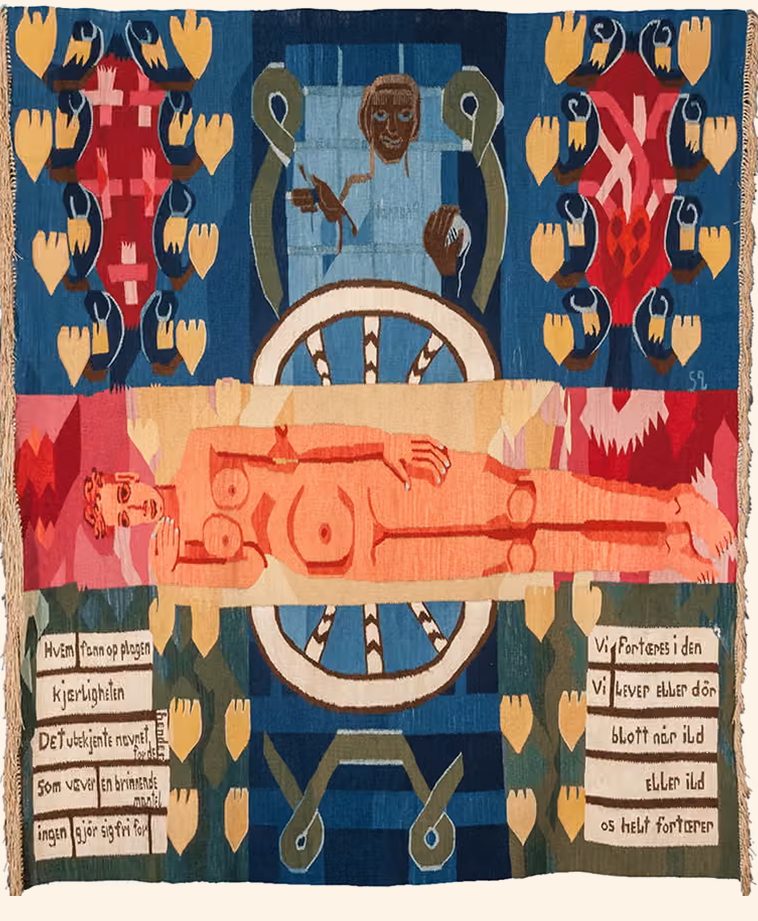
Hannah Ryggen, Poem by TS Eliot, 1952
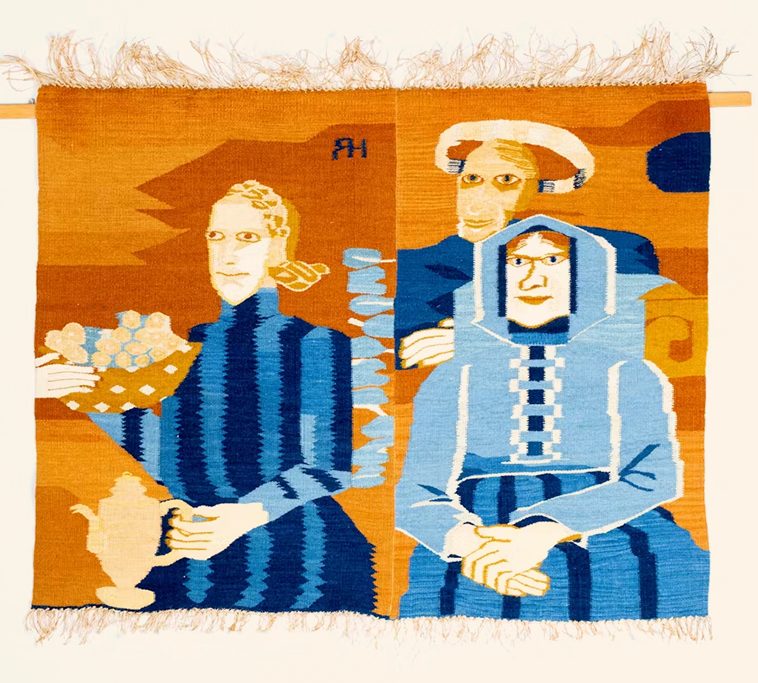
Hannah Ryggen’s Tapestry ‘Memories of Three’
“Memories of Three”: From Intimacy to Monument
On October 5, 2025, Memories of Three — a tapestry preserved within the same family since the 1940s — was auctioned at Olséns Auktioner in Stockholm. The work represents not only a rare acquisition opportunity but also a fragment of modern textile history. Measuring 130 × 100 cm and executed in the double-sided flamskväv technique, the tapestry depicts three women who shaped Ryggen’s life: her mother Karna Gall Jönsson, her aunt Elna Gall Nilsson, and her friend Olivia, her first weaving teacher. The composition’s clarity belies its depth — a triad of figures woven not for spectacle but remembrance, their forms dissolved into a language of abstract empathy.
The tapestry’s provenance and exhibition record speak to its stature: shown at Malmö Museum (1951), Moderna Museet, Stockholm (1962), and Nordenfjeldske Kunstindustrimuseum, Trondheim (1970), the latter now home to the largest Ryggen collection.
The Colour of Conscience: The Alchemy of “Piss Blue”
In Memories of Three, Ryggen’s potteblått blue becomes more than a pigment — it is a worldview. According to art historian Inga E. Næss, the dye included a secret ingredient, perhaps orange peel, to achieve its rare radiance. Ryggen’s insistence on crafting her own hues stemmed not from eccentricity but belief: color should be alive, ethical, and earned.
In the chromatic language of twentieth-century modernism, her “piss blue” stands beside Jean Lurçat’s revolutionary reds and Anni Albers’s copper neutrals — colors that carried ideology within their fiber. To collectors and designers alike, Ryggen’s palette represents integrity made visible: a handmade modernism that resists both industrial reproduction and decorative superficiality.
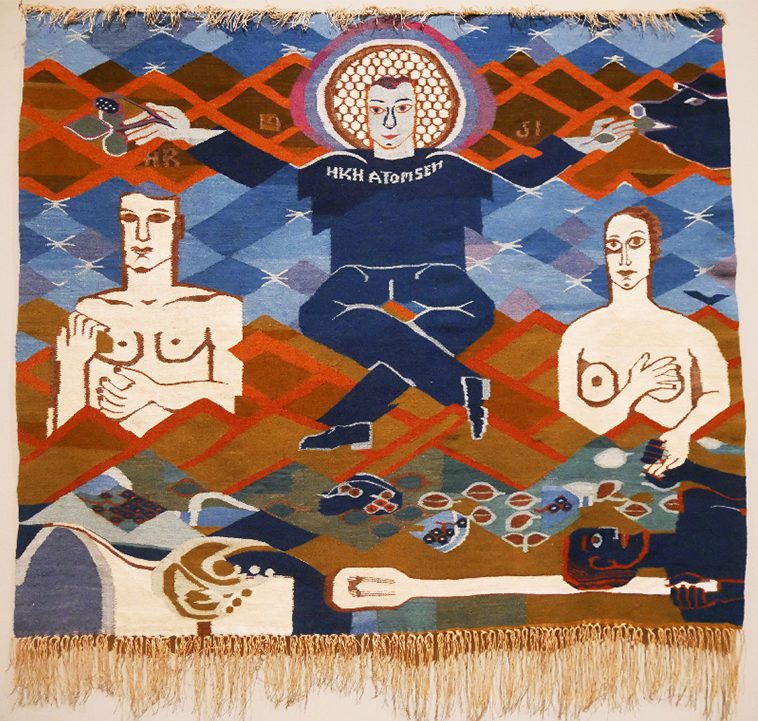
Hannah Ryggen: “Atomsen (Mr Atom)”, 1951
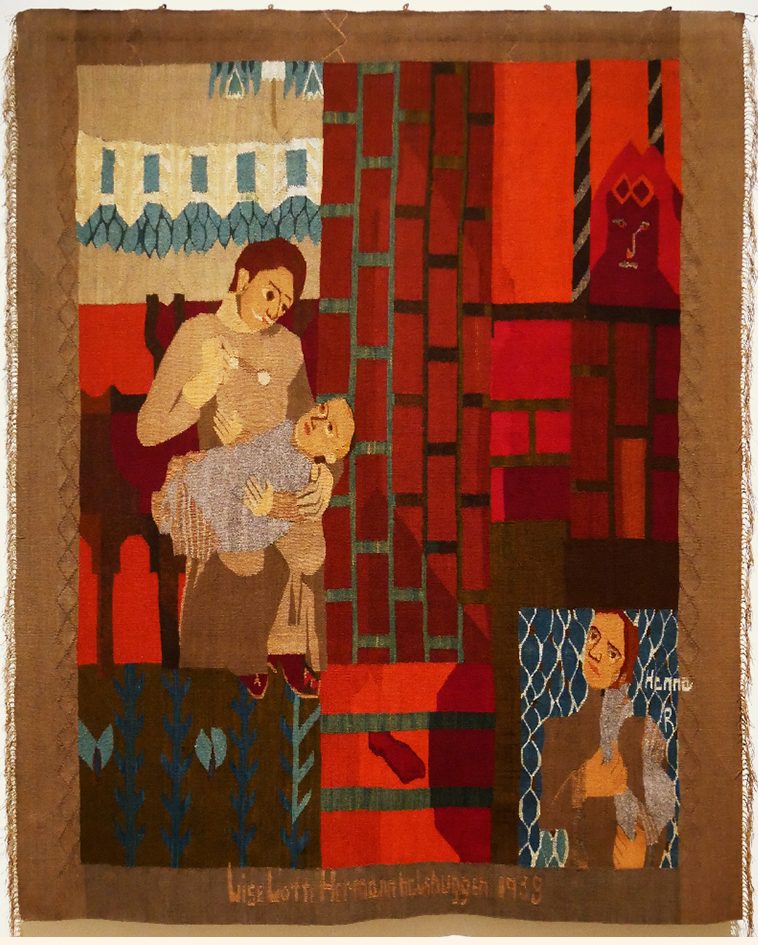
Hannah Ryggen:” Liselotte Herrmann decapitated”, 1938
The Woven Vanguard: Ryggen and Her Contemporaries
Though she worked in rural Norway, Ryggen was a central figure in the modernist revival of tapestry. Across Europe, artists such as Jean Lurçat in France and Anni Albers in Germany and the U.S. were reclaiming the loom as a site of innovation. Lurçat transformed Aubusson workshops into laboratories of abstract composition, while Albers turned textile structure into architectural rhythm.
Yet Ryggen’s vision was distinctly her own. Her loom was not merely formalist but existential. Her tapestries served as woven editorials — addressing fascism, inequality, and love through color and code. Memories of Three emerges as her lyrical counterpoint to these overt political works: a meditation on women, lineage, and the moral inheritance of making.
Tapestry as Interior Architecture
In today’s design landscape, Ryggen’s works feel startlingly contemporary. The resurgence of textile art within architectural interiors — from Axel Vervoordt’s monastic minimalism to Pierre Yovanovitch’s sculptural modernism — has positioned tapestry as both art and spatial instrument.
A work like Memories of Three transforms a room not through grandeur but through gravity. Against lime-washed plaster or walnut-paneled walls, its vegetal palette lends warmth and authority. It absorbs sound, modulates light, and softens modern rigor with tactile intellect. In luxury design today, this is the new opulence: silence, authenticity, and craft as conscience.
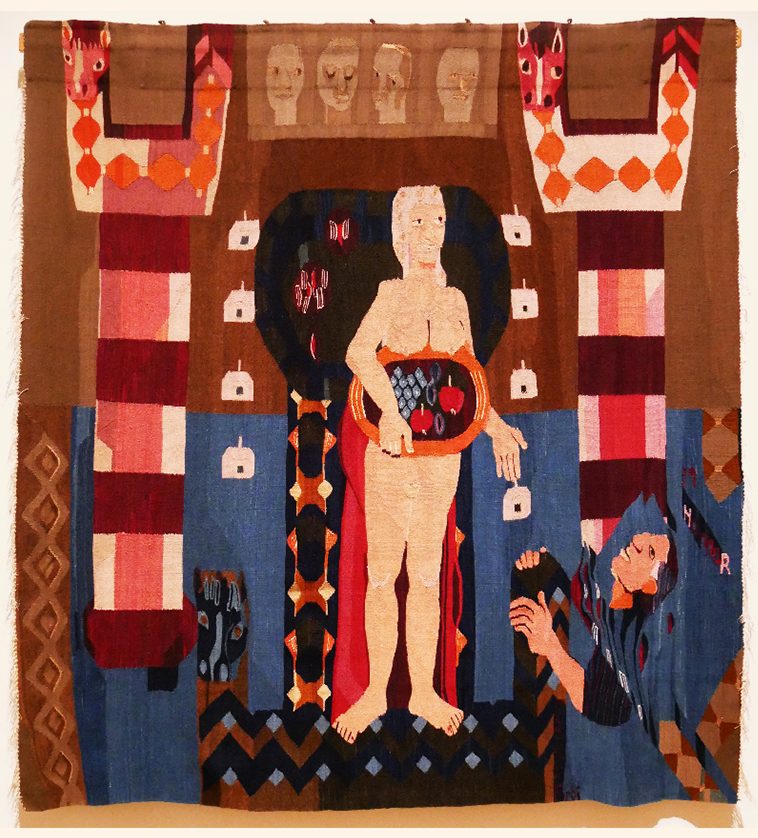
Hannah Ryggen:”Life Slides By”, 185 x 190 cm, 1939, tapestry , wool and linen
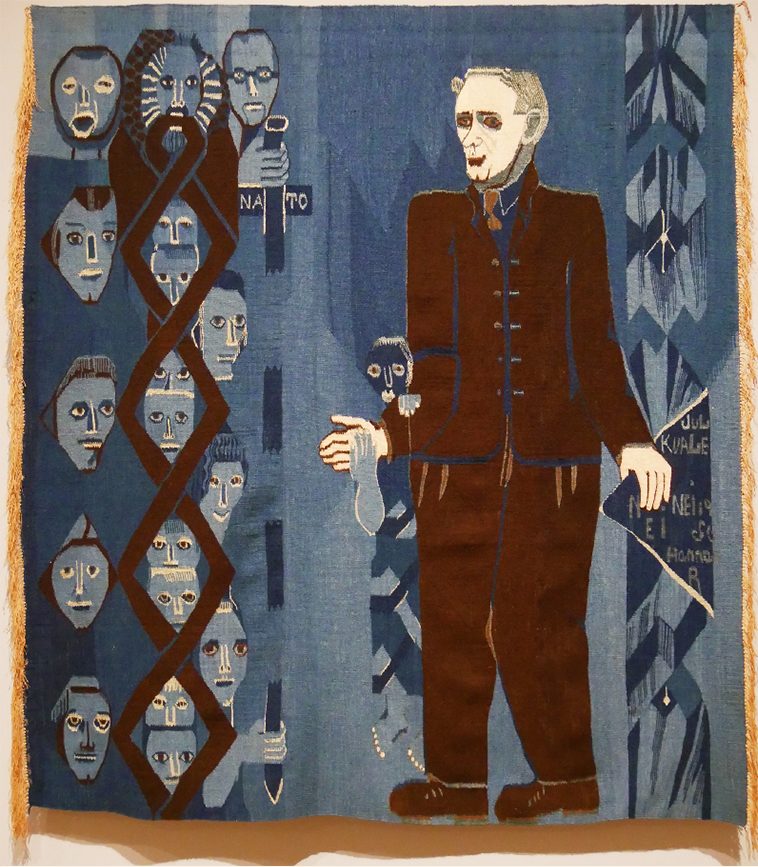
Hannah Ryggen:” Jul Kvale”, 1965
The Market’s Moral Turn
The sale of Memories of Three marks more than a transaction — it signals a continuing market renaissance for 20th-century textile modernism. Museums from Venice to Frankfurt have staged retrospectives of Ryggen, Magdalena Abakanowicz, and Sheila Hicks, recognizing that the woven medium shaped modern thought as profoundly as painting or sculpture.
Collectors, too, are recalibrating value. In a culture saturated with reproducible art, Ryggen’s works embody the rarity of the truly handmade — tangible, time-intensive, and ideologically intact. Her market ascension is thus not trend but correction.
A Family of Makers
The upcoming Olséns auction also offers a pastel by Ryggen, a tapestry by her daughter Mona, and paintings by her husband Hans — a creative lineage that mirrors Memories of Three itself. Mona’s tapestry, depicting the plane crash that killed UN Secretary-General Dag Hammarskjöld, continues her mother’s tradition of moral reportage through weaving.
Within this intergenerational dialogue, Memories of Three reads as prophecy — a woven acknowledgment that the act of creation, when rooted in truth, never ends with the artist.
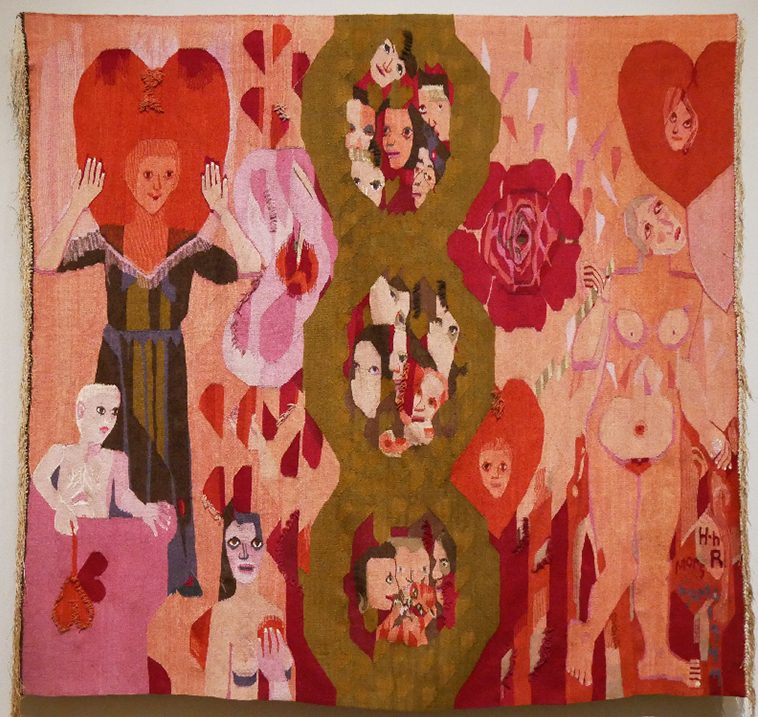
Hannah Ryggen: “Mother´s Heart” ,186 x 190 cm,1947, tapestry, wool and linen
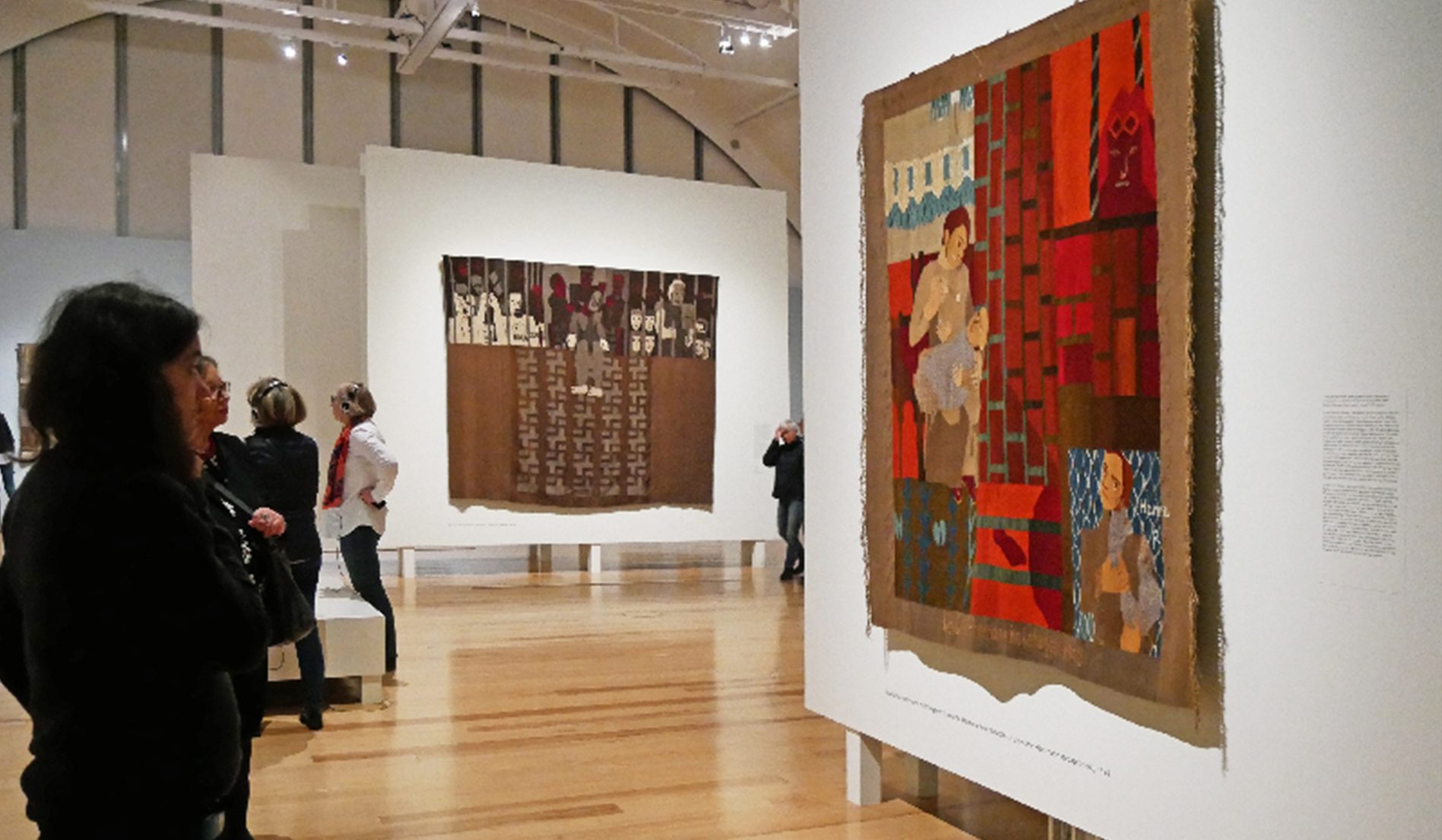
HANNAH RYGGEN – Monumental Tapestries with Striking Topicality | Watch Video >>
Threads of Permanence
Hannah Ryggen once said that weaving was her way of “thinking slowly.” In that slowness lies her genius.
Memories of Three resists both spectacle and obsolescence. It is an artifact of care in an age of acceleration — a meditation on women, color, and conscience rendered eternal by wool.
As it passes from private stewardship to public auction, the tapestry re-enters a world newly attuned to its values.
Among the collectors and designers who understand that luxury and ethics are not opposites but allies, Ryggen’s art stands as a reminder: true beauty is built on integrity — thread by thread.