Inquire About this Volume
Learn more about this volume
by calling an expert on our team.
Fashioning Chinese Women
Govan, Michael
Available: Shipping As Soon As Tomorrow
DelMonico Books, 2025
"Rug & Kilim is one of our favorite sources when looking for quality handmade rugs. Their team go above and beyond to find &/or make the rugs that fit our clients needs as well as their dreams."
— Becca Ford, Emily Lindberg Design
A standard since our inception upheld across every acquisition,
transaction, and delivery.
45+ Year Old Institution
More than four decades of expertise and stewardship, under the leadership of our Principal, Jahanshah "Josh" Nazmiyal.
Favorable Return Policy
Our return policy is 48 hours upon receipt allowing you to confirm the purchase in your space with confidence.
Product Warranty
Each rug is hand selected or produced through the most reputable sources under the direct supervision of our Principal.
Trusted Global Delivery
Reliable worldwide delivery handled with care, precision and constant communication.
Exceptional Support
Attentive, knowledgeable guidance before and after purchase from our dedicated team of specialists.
Long Term Care
We stand behind every piece we place and remain a resource to our clients for the lifetime of their collection.
Stories from the Volumes Collection
Essays, artist dialogues, and provenance notes drawn from Rug & Kilim’s editorial desk.
The Long Life of a Green: On Celery, Color of the Year, and the Four Centuries of Weaving That Anticipated It
Every year, the color world makes its pronouncement, and every year the design world turns to see what it has been given. For 2027, Sherwin-Williams has named Celery; a light, airy, herbal green with a yellow undertone, chosen, in the company's words, for a moment that prizes wellness, balance, and connection. It is a soft color with a quiet glow and a faint edge; it pairs, its makers note, with white for something breezy, with cranberry red for something playful, with brown for something elevated. It is, by any measure, a beautiful and intelligent choice. It is also a color the great weavers of the world have understood for four hundred years.
Read the Feature
On the Changing Nature of Money, and a Quiet Shift in How the World’s Great Collections Are Built
As seen in Milieu Magazine’s Summer 2025 Issue, designed by Studio Meghan Eisenbergh, features an antique Amritsar rug from Rug & Kilim’s collection.View More >> Something has changed in the psychology of collecting, and it has changed quietly. For most of the modern era, the serious collector acquired for love, for scholarship, for the pleasure of living with beautiful things, and the question of value, while never absent, sat politely in the background. That arrangement has quietly inverted. Across the last two years, industry surveys have recorded a striking figure: the share of high-net-worth collectors intending to sell from their holdings has fallen from more than half to roughly a quarter. The collector of this moment is not looking to liquidate. They are looking to hold. And they are increasingly treating the objects they acquire not as expenditures but as architecture, as a considered, diversified structure of wealth that also happens to be beautiful.
Read the Feature
How The Objects Around Us Define Us: An Interior As A Self-Portrait
We like to believe we choose our possessions. It is nearer the truth to say that, over time, they choose us back, that the objects we live among slowly become a portrait of who we are, drawn in a language more honest than any we would use to describe ourselves. Show a designer or a collector a person's rooms, and I will tell you what they value, what they have learned, and what they intend to leave behind. The interior is autobiography, whether we mean it to be or not. This is an old idea, and a serious one. The philosophers of every age have understood that we are shaped by what surrounds us, that character is formed not only by what we think and do but by what we choose to keep near. William Morris gave the conviction its most famous form: have nothing in your houses that you do not know to be useful, or believe to be beautiful. It was not decorating advice. It was a moral proposition, that the objects we live with either elevate us or diminish us, and that we are responsible for the company we keep among things as surely as among people.
Read the Feature
The Total Art: Vienna’s Century, From the Gold Frieze to the Contemporary Era
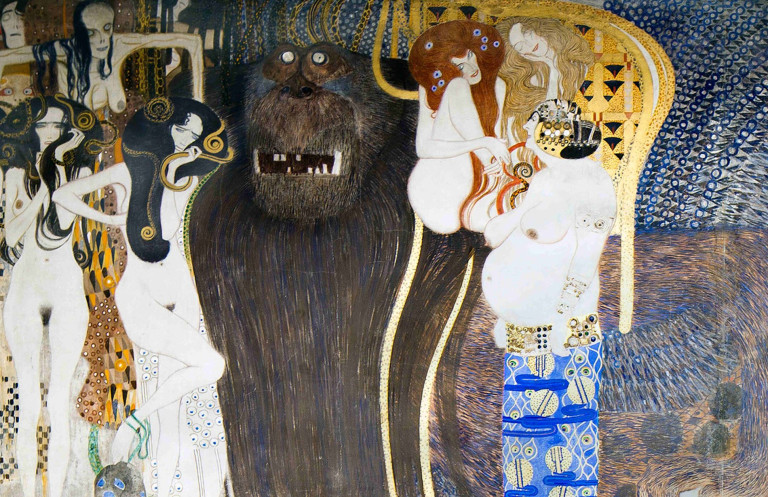
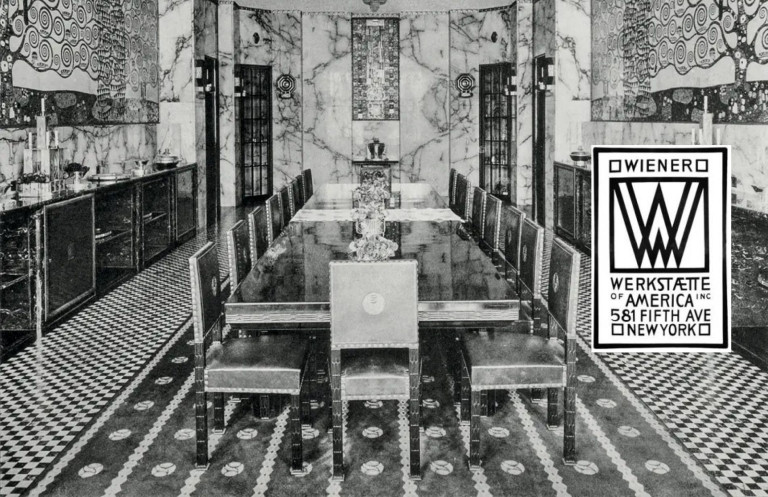
In the dining room of a banker's house in Brussels there is a wall of gold. Klimt designed it; the Stoclet Frieze, a tree of life branching across marble and enamel and coral, a dancer on one side and an embracing couple on the other, the couple a direct rehearsal for the painting the whole world would later know as The Kiss. But to stand in that room, were one ever permitted to, is to understand that the frieze is not the point of it. The point is that the frieze, the marble, the cutlery, the door handles, and the carpet underfoot were all conceived as a single object by a single mind. The Palais Stoclet, built by Josef Hoffmann between 1905 and 1911 and now sealed as a UNESCO World Heritage Site, is the most complete surviving statement of the idea that organised an entire Viennese century: the Gesamtkunstwerk, the total work of art, in which nothing; not the spoon, not the dress, not the floor, ranks below the painting on the wall.
Read the Feature
Leo and Greti Wollner and the Vienna Carpet Inheritance
There is a particular authority that attaches to an object when one can trace its maker's hand, teacher by teacher, back to a single revolutionary moment, and in the case of Leo and Gretl Wollner, that moment is the Wiener Werkstätte. To own a Wollner carpet is to hold the last living end of a thread that runs directly to Josef Hoffmann, to Koloman Moser, to the Vienna of 1903 that resolved, against the whole weight of European convention, that there should be no hierarchy dividing the fine arts from the applied ones. A painting and a carpet were to be judged by the same measure. A century later, the Wollners are among the very last to have been taught that creed by the people who founded it.
Read the Feature
Christian Bérard, Jean-Michel Frank, and the Making of Nelson Rockefeller’s Most Personal Room
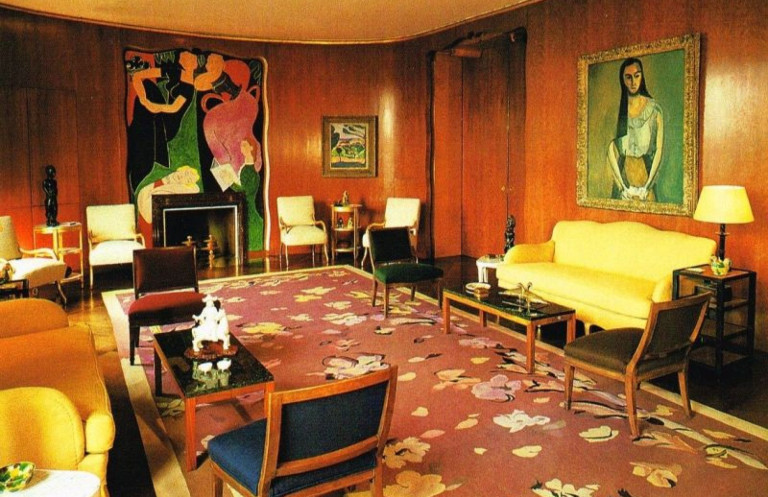
In April 1939, the SS Normandie docked in New York Harbor carrying, somewhere in her hold, a rolled carpet. The Normandie was herself the most extravagant object afloat; an emblem of French luxury and design, her marble lounges dressed with Aubusson carpets, signed furniture, and exceptional lighting, a vessel so audaciously beautiful that the New York Times had described her maiden crossing as "the greatest mass of steel and machinery ever to sail the sea." She was also, in April 1939, five months from her last voyage. Germany would invade Poland in September. The Normandie would be seized by the United States Navy, catch fire during conversion to a troopship, and capsize into the Hudson River, taking with her the full weight of the civilization she had been built to represent.
Read the Feature
Fashioning Chinese Women
Govan, Michael
$50
Available: Shipping as Soon as Tomorrow
DelMonico Books, 2025
"Josh has been able to dredge up some of the rarest and most beautiful carpets for our nerdy and stringent requirements. And we have had a grand time together assembling collections for clients."
— Ralph Harvard, Ralph Harvard Inc.