
Zeki Müren and the Carpet as Self-Portrait: The Pasha Who Designed His Own Floor
July 17, 2026
Leo and Greti Wollner and the Vienna Carpet Inheritance
August 26, 2026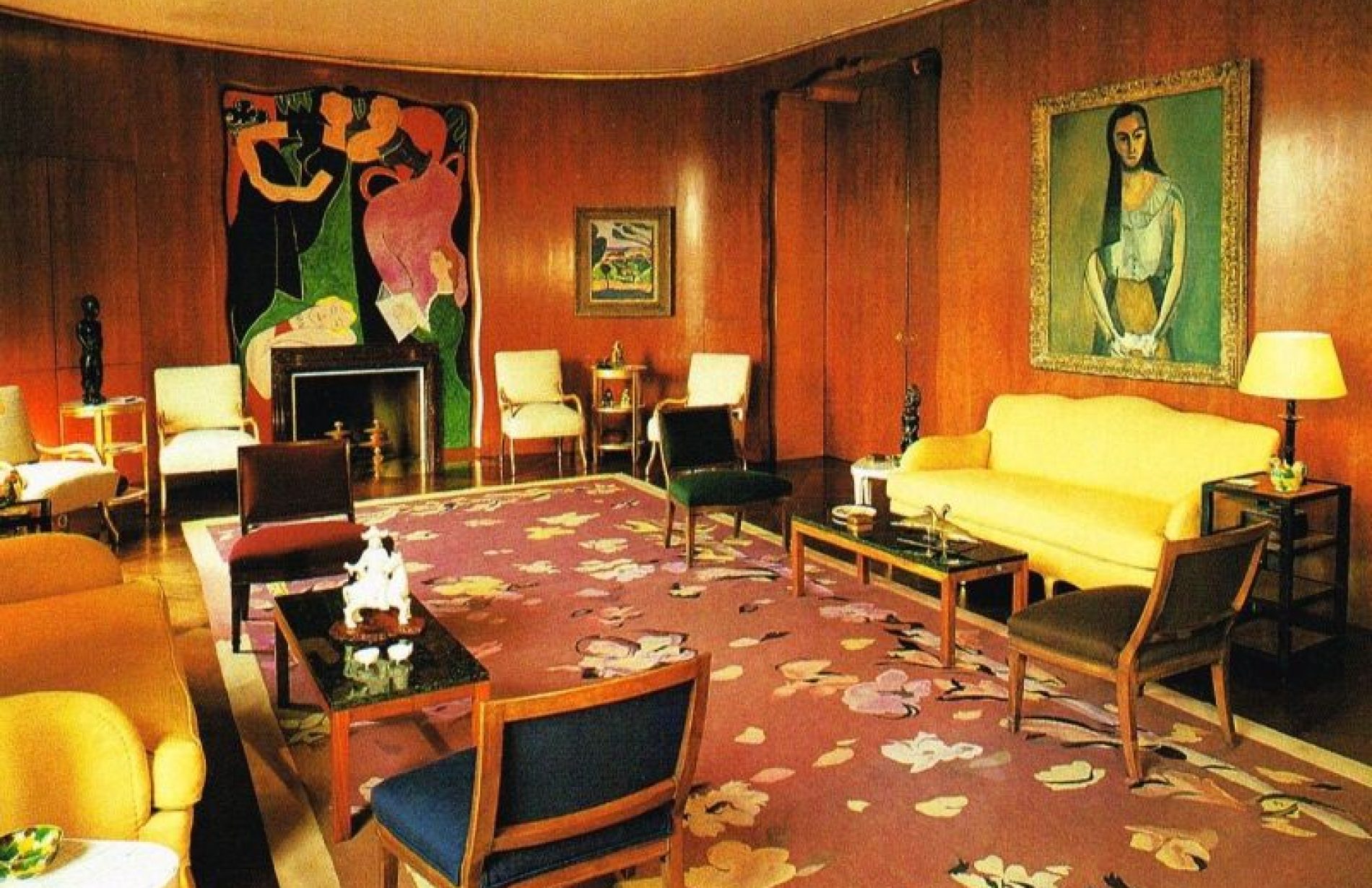
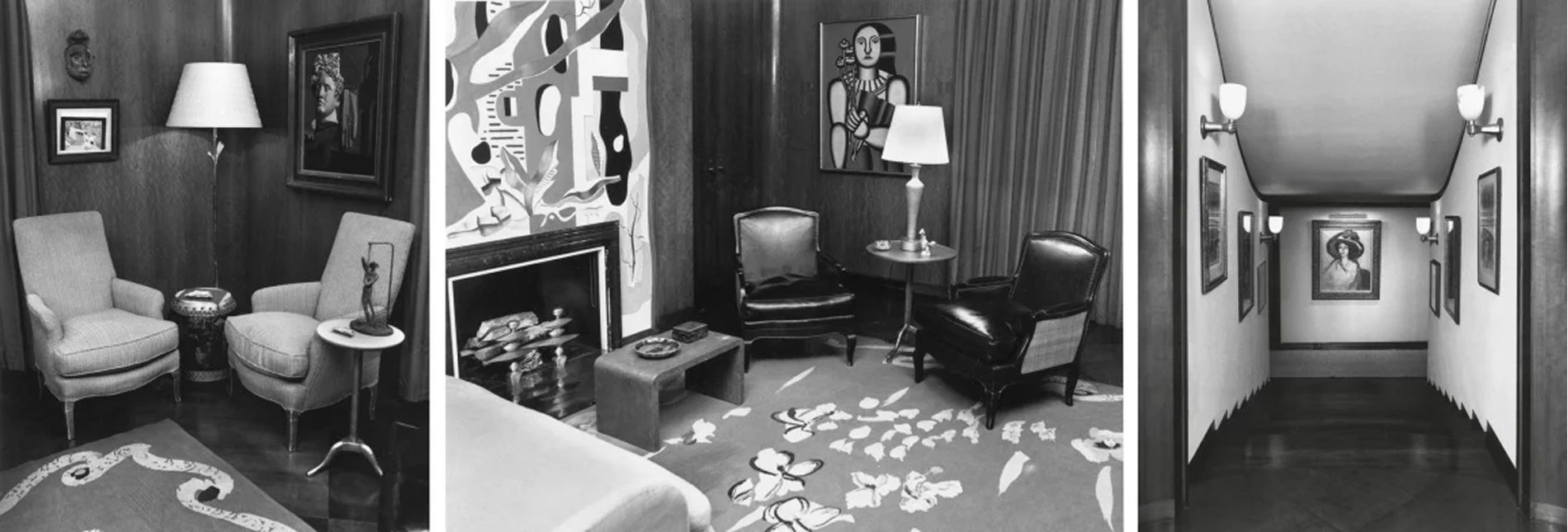
The living room at 810 Fifth Avenue
From the Rug & Kilim editorial and curatorial archive
In April 1939, the SS Normandie docked in New York Harbor carrying, somewhere in her hold, a rolled carpet. The Normandie was herself the most extravagant object afloat; an emblem of French luxury and design, her marble lounges dressed with Aubusson carpets, signed furniture, and exceptional lighting, a vessel so audaciously beautiful that the New York Times had described her maiden crossing as “the greatest mass of steel and machinery ever to sail the sea.” She was also, in April 1939, five months from her last voyage. Germany would invade Poland in September. The Normandie would be seized by the United States Navy, catch fire during conversion to a troopship, and capsize into the Hudson River, taking with her the full weight of the civilization she had been built to represent.
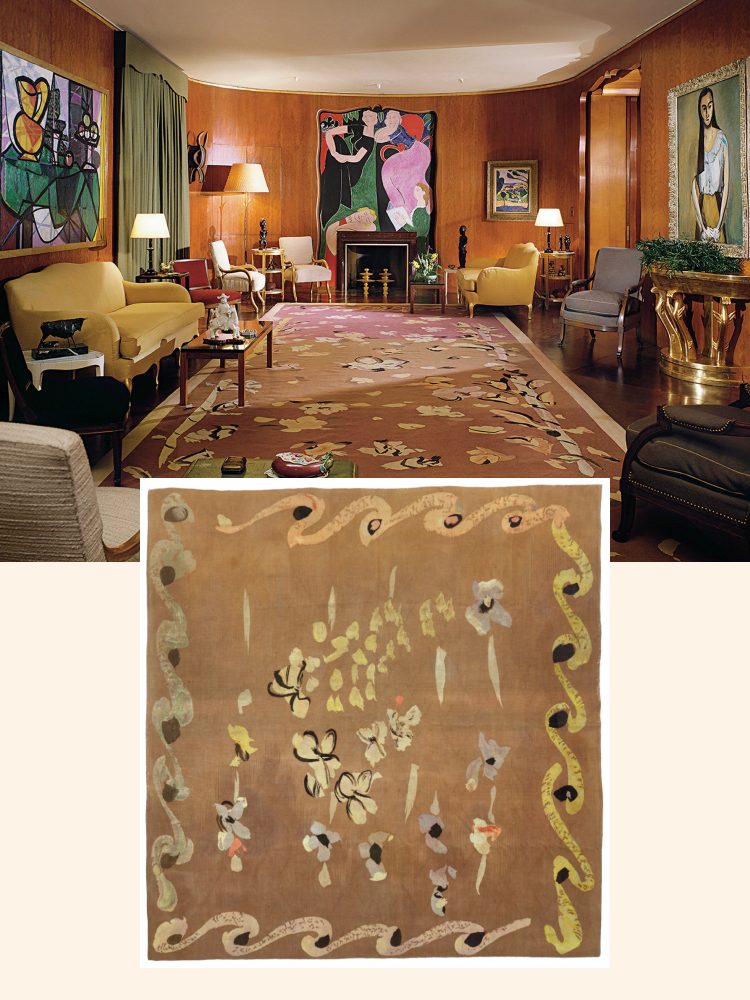
The carpet she was carrying that April knew nothing of this. It was hand-woven wool, 120 by 115 inches, produced at the Aubusson workshops in France to a design by Christian Bérard and supervised by Jean-Michel Frank. Its destination was the living room of Nelson Rockefeller’s apartment at 810 Fifth Avenue, where it was to be placed near the Léger fireplace, in a room that also contained a Matisse mural and bronzes by Giacometti, in what was already being described as the most extraordinary private interior in New York. The carpet arrived. The room was completed. The world it was made for ended before the year was out.
What remains, eighty-six years later is the carpet itself.
Bérard and Frank: The Most Consequential Friendship in Interwar Paris
To understand this carpet is to understand the relationship between the two men who made it, and to understand that relationship is to understand the precise moment in French decorative history when color was permitted back into the room after years of disciplined exile.
Jean-Michel Frank committed his interior designs for much of his career to a neutral color palette, white, eggshell, beige, camel; such soft tones allowing volume and form to dictate the spaces he created. He was, as one observer put it, a man who understood that a room could be furnished most luxuriously by unfurnishing it. Frank’s interiors were exercises in a kind of sacred restraint; vellum-covered walls, mica screens, shagreen surfaces, the noble material speaking for itself without ornament or distraction. He even scrutinized and resisted the inclusion of paintings within his carefully conceived interiors, arguing that their decorative presence was disruptive to the natural harmony of forms.
Then he met Christian Bérard.
Known affectionately as Bébé, Bérard was a flamboyant figure in the creative bohemia of Paris in the 1930s and 1940s; a sack-bodied man, unpredictable, tramp-like in his dress, who wore his jackets soiled and kept his trousers up with string; yet lyrical in his talent, he had only to ask “Isn’t pink a lovely colour?” to send designers running to their shelves. He was the son of André Bérard, the official architect of Paris, and had studied at the Académie Ranson under Édouard Vuillard, an education that gave him a painter’s instinct for surface and light that no amount of theatrical discipline ever entirely suppressed. He was simultaneously a painter, a fashion illustrator for Vogue and Harper’s Bazaar, a set and costume designer for Jean Cocteau and the Ballet Russes, a muralist, and a collaborator with every significant creative intelligence in Paris. His work confounded the critics because it was unclassifiable; it existed outside the current theories of art, and he interchanged techniques and disciplines.
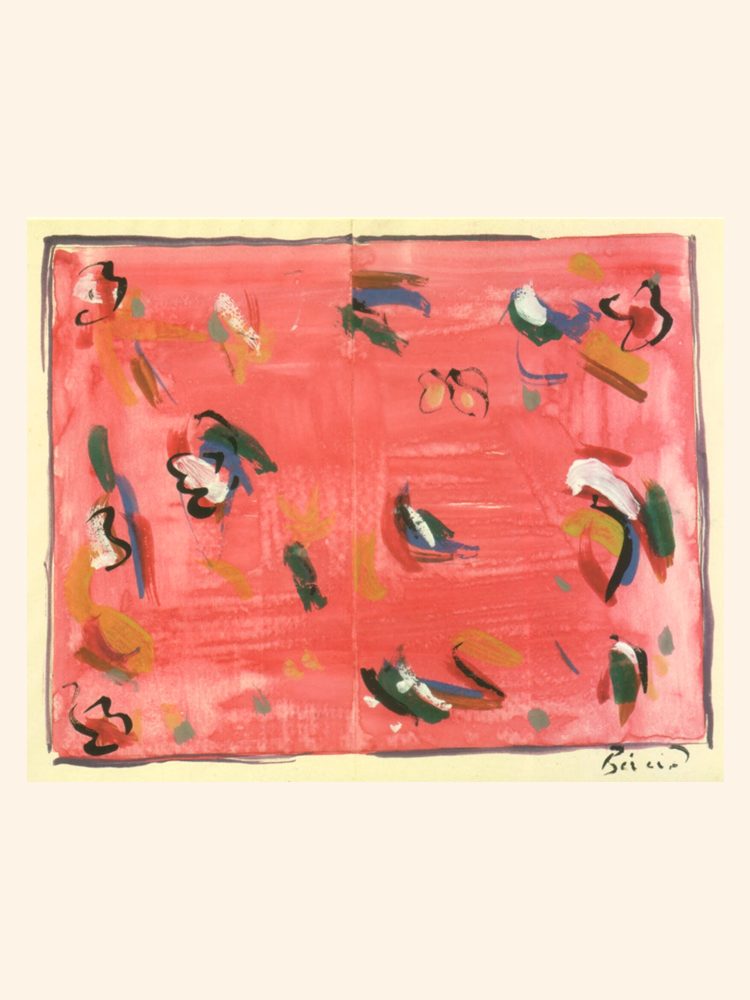
Bérard was forever creating, and even while dining with friends he would constantly be drawing on tablecloths, napkins, menus; caricatures, stage sets, costumes, which waiters would eagerly whisk away, keen to sell on to collectors.
When Frank encountered this man in the late 1920s, something shifted in his aesthetic, not dramatically, but irreversibly. He began commissioning Bérard to design tapestries and carpets. Sage green, pale blue, lemon yellow and soft mauve; Bérard’s preferred palette, entered Frank’s interiors in the form of upholstery, carpets and painted decorations, imparting a levity, poetry and playfulness that were previously absent from Frank’s work. The collaboration was not one of equals in the commercial sense; Frank was the designer, Bérard the artist he commissioned, but it was one of equals in the deeper sense: two intelligences, operating in different registers, producing together what neither could have produced alone.
The Rockefeller carpet is the fullest surviving expression of this partnership.

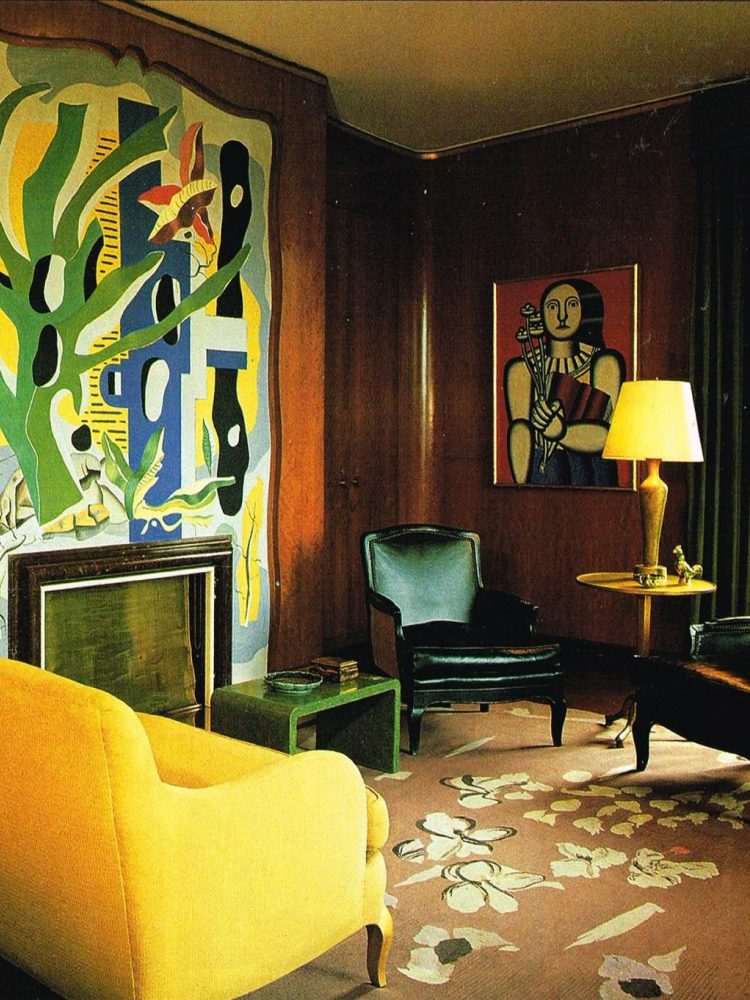
Nelson Rockefeller Fifth Avenue Residence – living room
Nelson Rockefeller and the Apartment at 810 Fifth Avenue
Nelson Rockefeller was not a man who approached art as decoration. He approached it as a necessity; the way other people approach oxygen. He used words like “love,” “passion,” and “ecstasy” when he talked of art; words that Alfred Hamilton Barr Jr., his close friend and the founding director of the Museum of Modern Art, described as reflecting “an insatiable appetite.” He collected Abstract Expressionists and Dadaists, African sculpture and eighteenth-century European porcelain, Central American folk art and the paintings of the Paris avant-garde. He aspired, as Sotheby’s has noted, to situate himself as a political patron who championed the arts in a vein akin to that of the Medicis of fifteenth-century Florence.
In the fall of 1938, this man called upon the most avant-garde decorator of the period; Jean-Michel Frank, to redesign a floor of his newly renovated triplex at 810 Fifth Avenue. The commission was substantial by any measure: a Chase Manhattan Bank wire transfer of $95,000 was signed by Nelson Rockefeller on the same day Frank wrote to confirm he knew “exactly what you desire.” Frank immediately boarded the Normandie for Paris, where the work of assembling the greatest private interior in New York would begin, in correspondence, in sketch, and in the workshops of France.
What followed was one of the great creative exchanges of the twentieth century. Letters traveled between Paris and New York with the precision of diplomatic cables.
Rockefeller reviewed carpet sketches and wrote to Frank on January 13, 1939, that he “liked very much the sketches for the carpets.”
Frank replied within days: “The two carpet drawings you selected have been put into exact scale by an artist who works for me under Bérard’s and my supervision and I presume I shall go in a month or so to Aubusson to see how they are progressing.” By April, both carpets were complete, crated, and loaded onto the Normandie.
The present carpet, identified as number 41 in the Rockefeller-Frank correspondence of October 31, 1938, was positioned in the living room near the Léger fireplace. On the walls above it hung a Henri Matisse mural and a Fernand Léger. On the floor of the same room, bronze Giacomettis stood on Frank’s own furniture. It was, as Elsa Schiaparelli declared when she visited; a woman not easily impressed; spectacular.
The Carpet Itself: What Bérard Made
To look at this carpet now, in the particular way it demands to be looked at, not quickly, not from a distance, but close and with time, is to understand something that no description of its provenance can fully prepare you for. It is a work of art by a man who could not be anything else, produced in a medium he understood precisely enough to use with complete freedom.
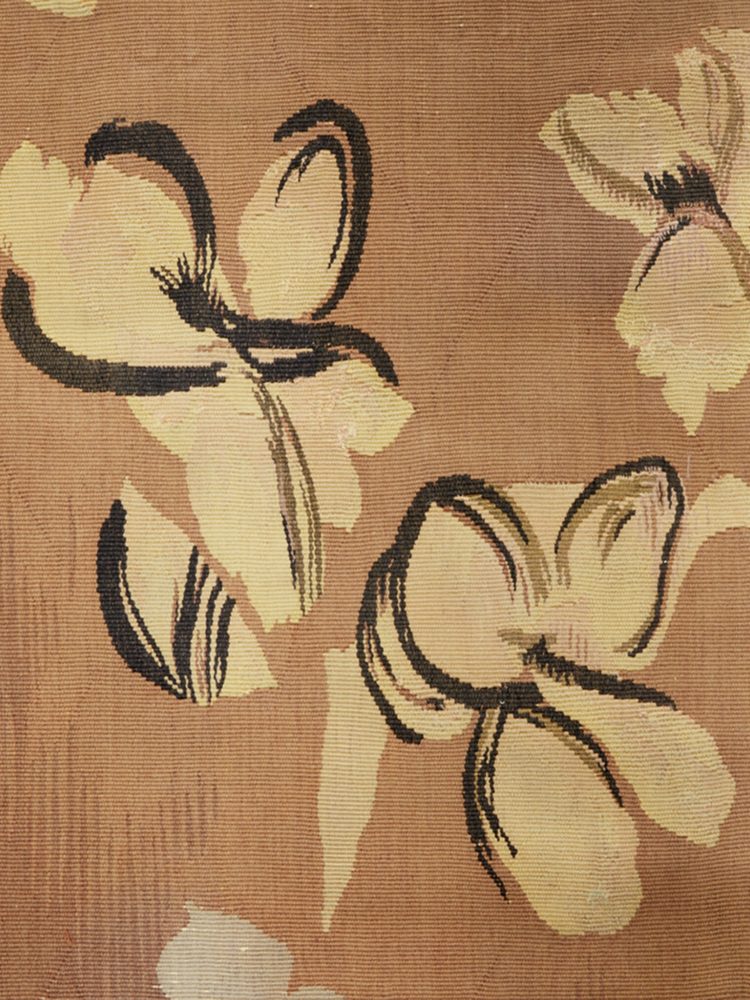
The ground is a warm amber; not the deep amber of autumn light or aged cognac, but something softer and more complex, the color of Aubusson wool that has absorbed decades of sunlight and given some of it back. Against this ground, Bérard has scattered flowers with the particular freedom of a hand that draws constantly, on any surface available, at any moment the image arrives. They are irises predominantly; pale blue, cream, white, with the characteristic black-centered petal that Bérard rendered in his fashion illustrations with the same fluid line he used here, but also other blooms, undifferentiated by botanical name, existing as pure color-form: yellow petals that dissolve at their edges, orange accents of a single brush-touch, passages of pale green that seem to hover above the ground rather than lie on it.
The borders do not frame this field in the conventional sense. They move; four serpentine ribbons, each a different color, yellow on one side, green on another, cream and rose completing the circuit, their undulating forms carrying within them small dark seeds or eyes that give the whole border a quality of organic life. These are not the geometric borders of the Persian tradition or the symmetrical acanthus of the Savonnerie. They are the borders of a man who designed sets for Cocteau; suggestions of enclosure rather than enclosure itself, a frame that breathes rather than constrains.
What Bérard understood, and what this carpet demonstrates more fully than almost any woven object of the period, is that the Aubusson flatweave could be made to behave like paint on canvas if the designer trusted the medium enough to work in its register rather than against it. The weft-faced construction that gives Aubusson its characteristic surface; smooth, matte, absorbing light rather than reflecting it, is precisely the surface that allows color to be laid as freely as in a watercolor, without the structural constraints of pile or knot. Bérard’s flowers do not have the precision of botanical illustration or the formality of period floral carpets. They have the freedom of a sketch made by the greatest draughtsman of his generation on whatever surface was to hand, which, in 1939, happened to be wool.
The Context: Frank, Aubusson, and the Modernist Carpet in Paris
The Aubusson tradition Bérard and Frank were working within when they produced this carpet was already four hundred years old; a royal manufactory established to supply the French nobility with the flat-woven carpets that the Savonnerie’s court exclusivity denied them, carried through Louis XV and Madame de Pompadour, through Napoleon’s Empire-style revival, into the twentieth century. What Frank and his circle did with it in the 1930s was neither reverent nor destructive: they simply used it, with the same ease with which they used Louis XV furniture and Giacometti bronzes, as one element in a total interior that drew no distinction between centuries or between disciplines.
This is precisely the attitude that made the 810 Fifth Avenue apartment the most important private interior of its era. Frank’s floor plan for the living room included a detailed inventory of every element in precise placement; French furniture, modernist art, hand-woven carpets, united by a vision that saw no contradiction between a fourteenth-century weaving tradition and a painting made in 1939. The carpet near the Léger fireplace was not decorating a modernist room. It was completing it, providing the warm, animate, hand-made surface that Léger’s machine-age geometry above required as its counterpoint.
This is also the tradition that connects this carpet directly to the great tapestry and carpet commissions of the French interwar period, Jean Lurçat’s Gobelins revival, Da Silva Bruhns’s Cubist floor paintings for Doucet and Chareau, the Leleu firm’s architecturally disciplined productions for the grands appartements of Paris. All of them were working from the same conviction: that a woven object designed by a serious artist, produced in a serious workshop, could hold its ground in any company, including the company of Matisse and Léger on the walls above it.
After the Room: The Carpet’s Long Life
The apartment at 810 Fifth Avenue did not survive Nelson Rockefeller intact. Objects from it have appeared at Sotheby’s across multiple sale events, each dispersal a further installment in the biography of a room that lasted in its original form for only a few years before the war, the careers, and the decades intervened. The Bérard carpets, both of them, the pair that Rockefeller selected from Frank’s designs in January 1939, appeared at Sotheby’s New York in November 2018, in the sale titled ‘A Modernist Vision: Property from the Collection of Nelson and Happy Rockefeller’. The present carpet was lot 10 from the Cycad Collection sold that year itself for about $200k.
The biography of an object of this consequence is never fully written. It passes through rooms and collections and sale rooms and private hands, accumulating with each passage the particular patina of having been recognized, over and over again, by people who understood what they were looking at. This carpet was recognized by Frank, by Bérard, by Rockefeller, by the successive custodians who understood that what they held was not simply a floor covering from a famous apartment but a primary document of one of the most significant creative collaborations of the twentieth century.
Placing This Carpet: The Room It Requires and Deserves
A carpet of this provenance and this visual intelligence makes specific demands of the room it enters, not because it is difficult or imperious, but because it has enough presence of its own that the room must rise to meet it rather than the other way around.
Its amber ground, warm, complex, absorbing rather than asserting, makes it a remarkable collaborator with the right walls. Against plaster of the right tone, the particular un-white of a Paris apartment or an Upper East Side prewar interior, it holds its ground with the authority of an object that has spent decades in precisely these rooms. Against the restrained minimalism of a contemporary interior, concrete, glass, the deliberate emptiness of serious modern architecture, it provides exactly what Bérard and Frank always understood a great carpet provides: the human, the animate, the made-by-hand, the record of a creative intelligence working freely in a tradition it understood completely.
The designers who have placed objects of comparable provenance in rooms of comparable ambition; Albert Hadley, Sister Parish, the Parish-Hadley generation that understood the floor as the room’s primary argument, understood that such objects do not require styling. They require space, light, and the confidence to let them be what they are.
What they are, in this case, is the following: a carpet designed by Christian Bérard, executed at Aubusson under the supervision of Jean-Michel Frank, commissioned by Nelson Rockefeller for the living room of his apartment at 810 Fifth Avenue, shipped to New York on the SS Normandie in April 1939, placed near a Léger fireplace in the most extraordinary private interior of its era, preserved across eight decades of changing hands and changing rooms, to the collector who understands what it means to own not just a great carpet but a chapter of the century that made it.
At Rug & Kilim, we do not use the word irreplaceable lightly. We have spent over four decades looking at heirlooms all over the world, and we have learned to reserve that word for the ones that earn it without asking. This carpet has earned it in full.