
Deventer, KVT and the Dutch Carpet: The Workshop that Wove for Royalty
July 10, 2026
Christian Bérard, Jean-Michel Frank, and the Making of Nelson Rockefeller’s Most Personal Room
August 19, 2026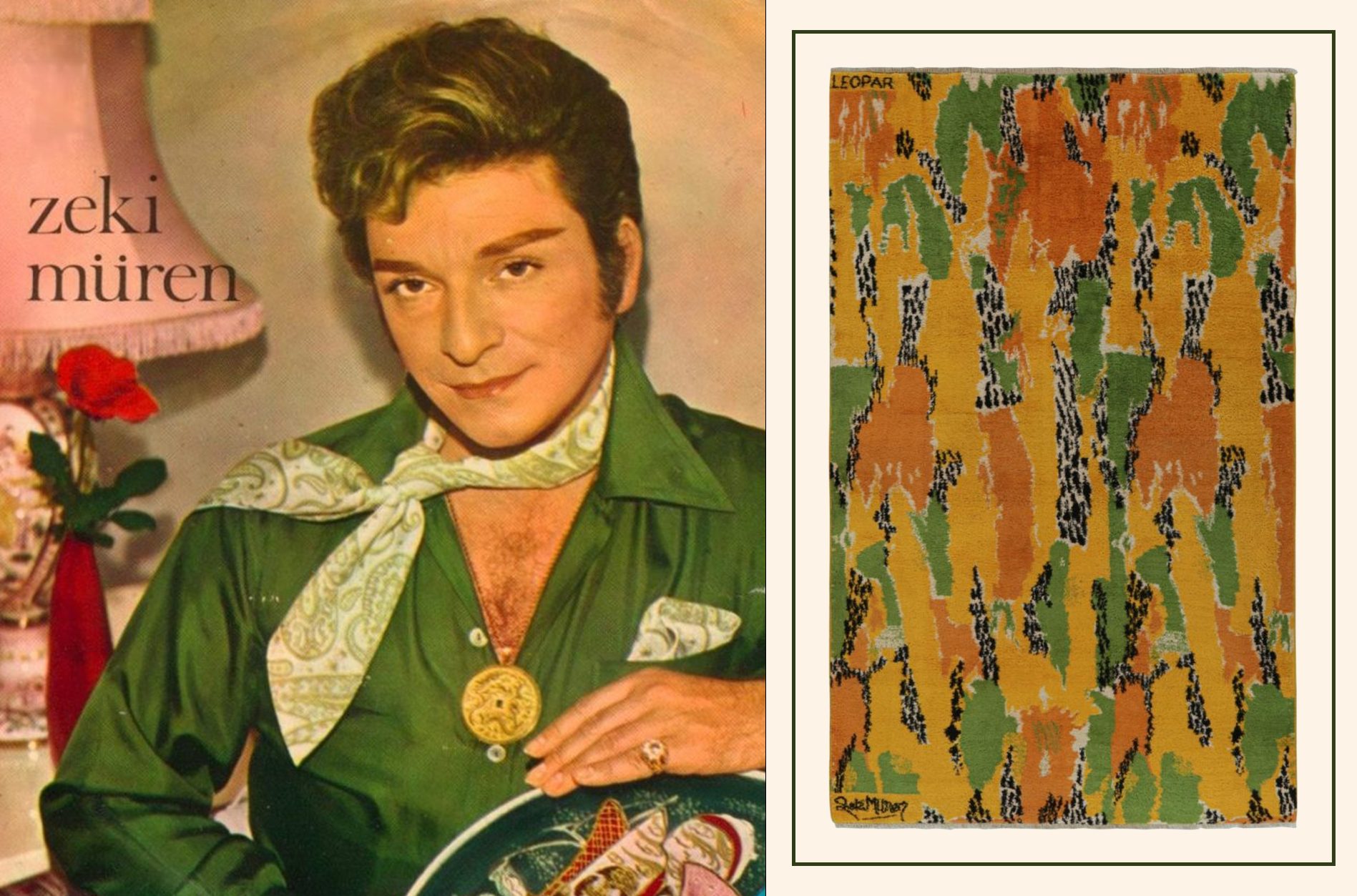
In the showroom of Hüseyin Kaplan, in the Sultanahmet quarter of Istanbul beneath the minarets of the old city, there are more than five hundred carpets that belong to no classical category. They are not Hereke, not Oushak, not the courtly Ottoman medallion weavings that the connoisseur expects from this geography. They are jewel-toned and abstract, shot through with an abstract confidence, and they bear, some of them, the signed ones, a name woven into the border that any Turk and most serious collectors would recognise instantly. They are the work of Zeki Müren, and they constitute one of the most singular bodies of design the twentieth-century carpet has produced.
The Sun of Art
To understand the rugs one must first understand the magnitude of the man, because in Turkey the two are inseparable. Müren was Sanat Güneşi, the Sun of Art, and Pasha, a title borrowed from the Ottoman military aristocracy and conferred on him by acclamation after a single performance. He was the defining voice of Turkish classical music across four and a half decades, the first Turkish artist to be certified gold, a composer of three hundred songs, a poet, an actor in eighteen films, and the designer of his own legendary stage wardrobe, the jewelled capes, the kohl, the deliberate and unapologetic glamour that a conservative nation accepted from him as it would from no one else, because his gift was too total to argue with. He was, in the formulation that has followed him into every language, his country’s Liberace and its Callas at once.
He was also, crucially, trained. Before the radio and the recordings, Müren studied decorative arts at the Fine Arts Academy in Istanbul, today’s Mimar Sinan University, and that formal eye never left him. He was born in Bursa, the cradle of Ottoman silk, where the relationship between fibre and rank was woven into the civic air centuries before he drew his first breath. The carpets, when they came, came from that lineage: the most accomplished decorative artist in Turkey returning to the oldest decorative art his country possessed.
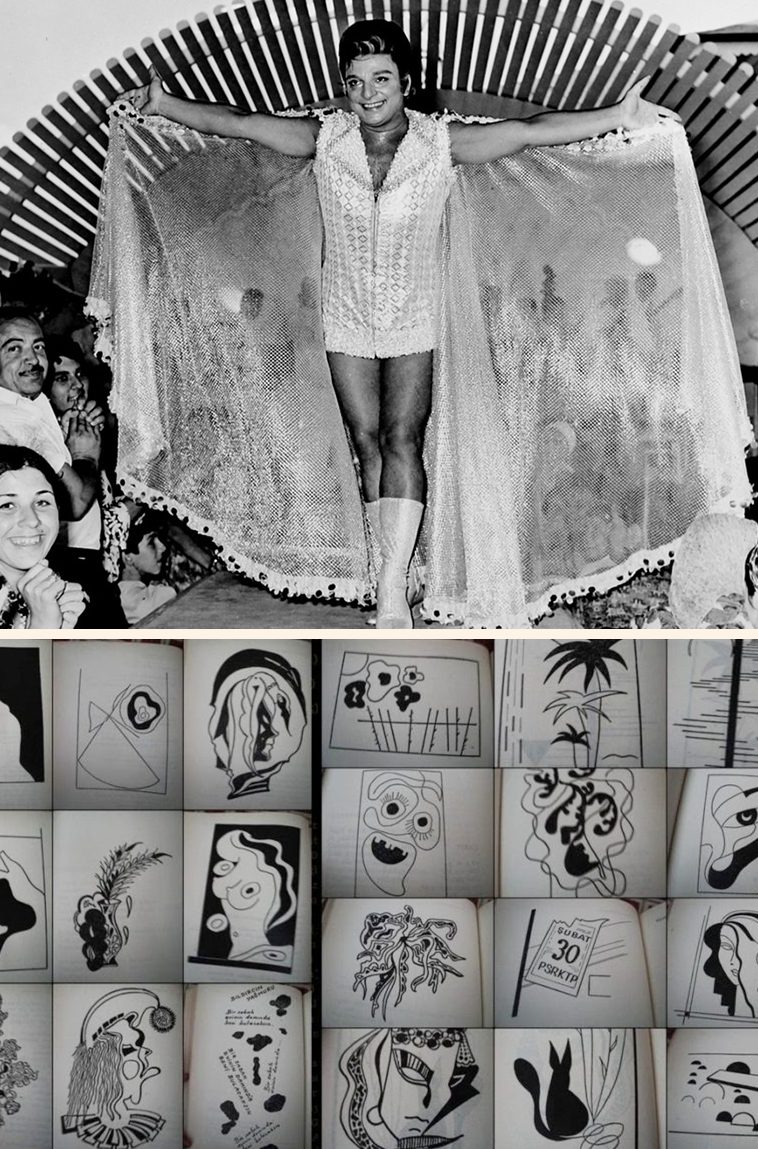
Top: Zeki Müren performs on stage, Bottom: Müren’s Artworks
What He Drew
He designed them for his own houses, on the Bosphorus, and later in Bodrum, where he kept a villa on the Aegean and retreated from public life into what he called listening to himself. They were knotted in the workshops of Sivas and Anatolia from designs he set down by hand: medallions abstracted past recognition, fields of pure geometry in the high colour of the mid-century, motifs that read like Léger filtered through an Ottoman sensibility and a personality of extravagant originality. He wrote, in a newspaper column in the 1980s, of the first time he saw his drawings translated into carpet, that the designs, enlarged and knotted and bearing his signature, struck him as his children, and brought him to tears. The remark is entirely characteristic. Müren never separated the work from the self. The floor, like the costume, like the voice, was autobiography.
The Milan dealer David Sorgato gave the rugs their first serious international exhibition at the Sartirana Textile Show in 2018, and HALI took notice; the museum in Bodrum keeps the costumes and a few framed drawings but, tellingly, almost none of the carpets, which long ago dispersed into the collections of those who understood them earliest. At Rug & Kilim, the examples in our Mid-Century Pasha collection are offered in full knowledge of what they are: not rugs decorated in a famous man’s manner, but cartographies of one of the century’s most complete artistic minds, charted in wool. The Sun of Art designed his own ground to stand on. It has lost none of its heat.
The Signed Hand
He designed the rugs in the 1950s and 1960s, originally for his own residence on the Bosphorus, and he wrote of them with the openness that marked everything he did. The moment I saw my designs enlarged in the form of a carpet, he recorded in a newspaper column in the 1980s, tears of joy came to my eyes. These seven designs with my signatures were like my children.
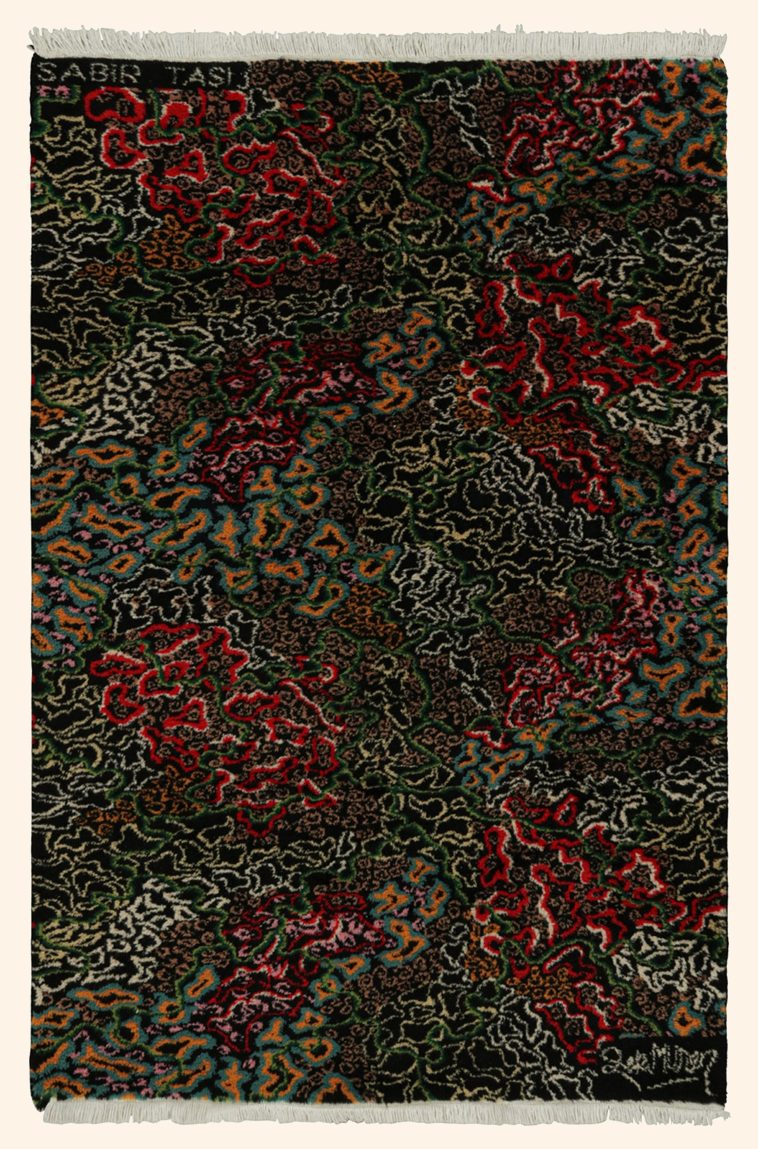
The children survive, and the connoisseur should know them by name. Sabir Taşı, Patience Stone, a black field carrying polychromatic curved geometry, the signature knotted into the lower-right corner, the title into the upper-left. Bayram Yeri, Fairground, title and signature both worked into the weave, the most fully documented of the originals, identified by HALI in 2019 as the centrepiece of Kaplan’s collection and the primary reference against which all Müren attribution is now measured. These are the authenticated anchors of the corpus, the pieces against which everything else is judged.
Then come the titled works, named in his hand but unsigned, and held to be definitively his on the strength of that naming practice, the same instinct that gave poetic titles to his costumes and his songs. Leopar. Aşk Şarabı, Love Wine. The COVER investigation of 2020 confirmed both as his beyond reasonable doubt.
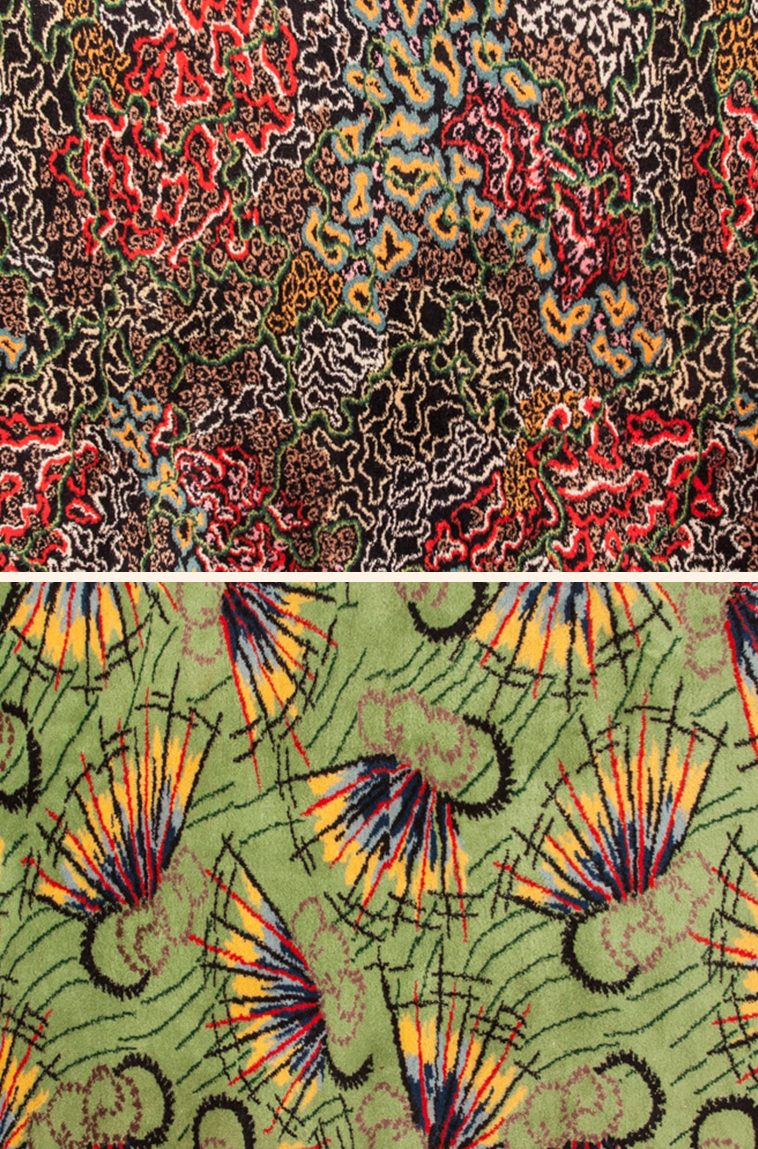
Top: Signed and titled Sabir Tasi (Patience Stone) rug (detail) by Zeki Müren, Bottom: The signed and titled Bayram Yeri (Fairground) rug (detail) by Zeki Müren. Read More
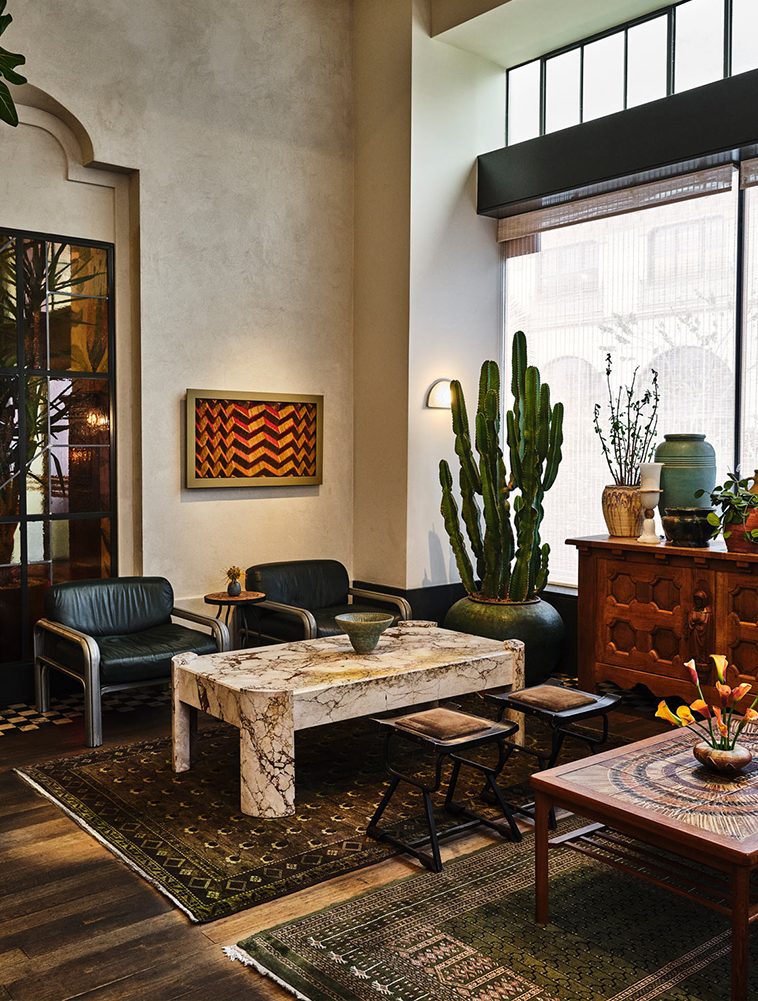
Designed by Kelly Wearstler for the Downtown L.A. Proper Hotel. Featuring Rug & Kilim’s Zeki Müren.
The School of the Floor
Beyond the signed and the titled lies a wider territory the trade attributes to him on the evidence of the vocabulary itself, patterns that recur across the corpus and speak unmistakably his language, whether or not his hand set down every drawing. There is the havuçlu, the so-called carrot-like design: a kaleidoscopic abstraction of colour that COVER magazine identified, acutely, as kin to Fahrelnissa Zeid’s 1954 painting Abstract Parrot. The resemblance is no coincidence. Zeid and Müren moved through the same Istanbul Fine Arts milieu in the same years, she of the D Group, the Turkish avant-garde, and of the École de Paris, her work shown at the ICA London in 1954, the very year Müren completed his training, her canvases later reaching nearly a million pounds at auction in the wake of her Tate Modern retrospective. Two artists drawing on the same Islamic, Byzantine, and Persian visual inheritance and filtering it through mid-century abstraction; one onto canvas, one onto wool.
The trade design extends further: optical geometric fields of diamond lattice and mosaic diagonal that read as Op Art a decade before the term was fashionable; floral medallions in which his gift for reimagining the Persian tradition in his own high colour is most plainly visible; reinterpretations of Anatolian and tribal pattern lifted into a vivid modern palette; the diamond-runner format that has become, in Kaplan’s phrase, the calling card of Müren’s rarest works.
To place him among his contemporaries is to understand the seriousness of the project. He belongs in the company of the D Group painters, Zeid, Abidin Dino, Nurullah Berk, reconciling Turkish visual tradition with European modernism, the precise ambition his carpets enact. And he belongs, internationally, beside Lucienne Day, whose Calyx defined the post-war decorative aesthetic from the Festival of Britain and whose work the V&A now holds; beside Robert Stewart, designing geometric textiles for Liberty of London; beside the Eameses, whose dot patterns share his structural sensibility. Müren was not weaving in isolation. He was weaving inside the central decorative conversation of his century, and he was its only voice who was also a national legend.
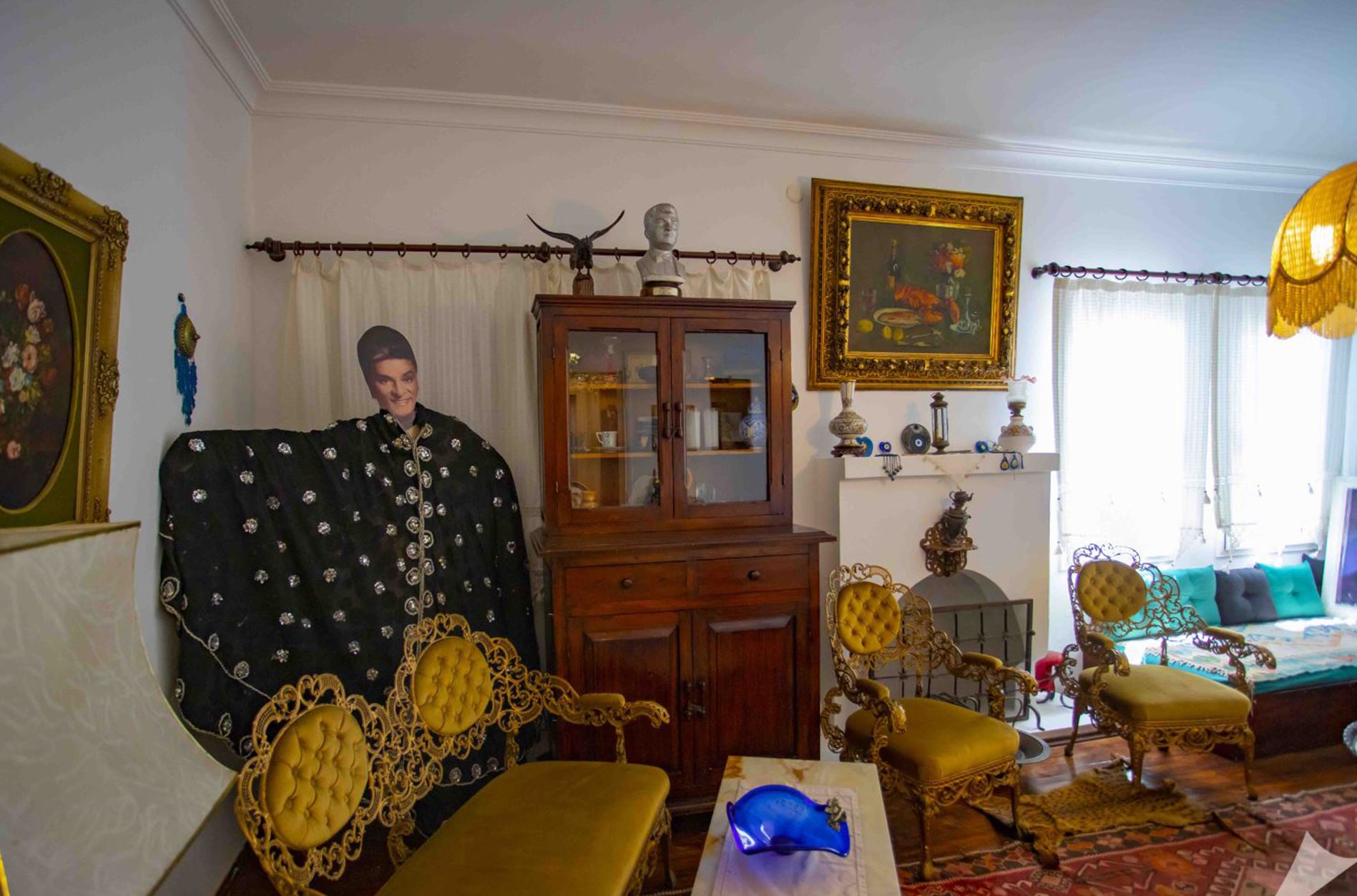
Bodrum Zeki Müren Art Museum – Muğla
What the Museum Does Not Keep
David Sorgato gave the rugs their first serious international exhibition at the Sartirana Textile Show in 2018, and HALI took notice. Tellingly, the house-museum in Bodrum, where Müren spent his final years on the Aegean, in what he called a time for listening to himself, keeps the costumes and a few framed drawings but almost none of the carpets, which long ago dispersed into the hands of those who understood them earliest.
At Rug & Kilim, the examples in our Mid-Century Pasha collection are offered in full knowledge of what they are: not rugs decorated in a famous man’s manner, but cartographies of one of the century’s most complete artistic minds, charted in wool and signed, where he chose to sign them, like the children he called them. The Sun of Art designed his own ground to stand on. It has lost none of its heat.