
Christian Bérard, Jean-Michel Frank, and the Making of Nelson Rockefeller’s Most Personal Room
August 19, 2026
The Total Art: Vienna’s Century, From the Gold Frieze to the Contemporary Era
August 28, 2026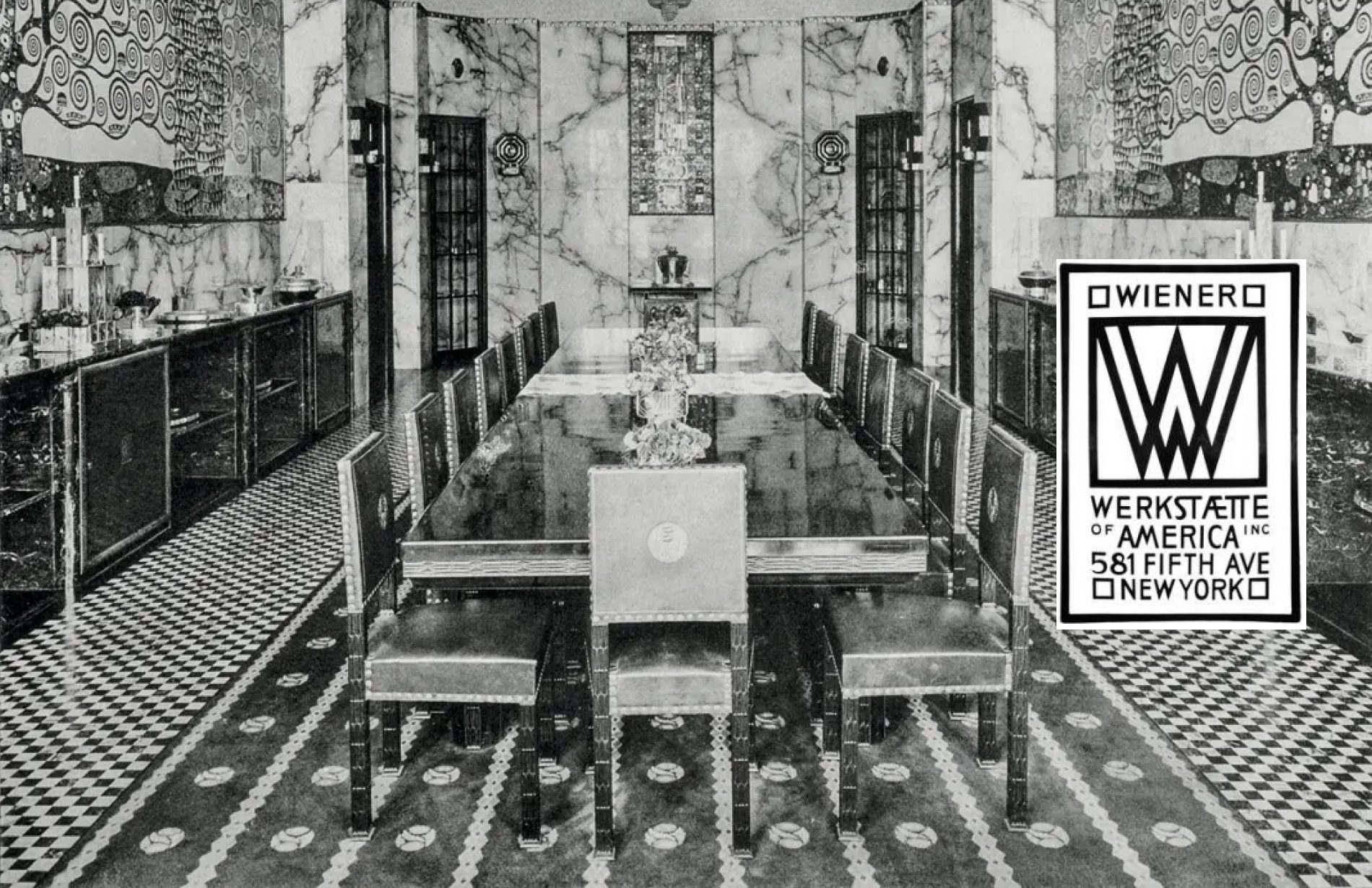
Photograph featuring Josef Hoffmann, dining room of the Stoclet Palace with the mosaic frieze by Gustav Klimt, Moderne Bauformen XIII, 1914
There is a particular authority that attaches to an object when one can trace its maker’s hand, teacher by teacher, back to a single revolutionary moment, and in the case of Leo and Gretl Wollner, that moment is the Wiener Werkstätte. To own a Wollner carpet is to hold the last living end of a thread that runs directly to Josef Hoffmann, to Koloman Moser, to the Vienna of 1903 that resolved, against the whole weight of European convention, that there should be no hierarchy dividing the fine arts from the applied ones. A painting and a carpet were to be judged by the same measure.
A century later, the Wollners are among the very last to have been taught that creed by the people who founded it.
A Pedigree Without Equal
They met at the Viennese Academy of Applied Arts during and just after the Second World War, and they studied under E. J. Wimmer-Wisgrill, the artistic director for fashion and textiles at the Wiener Werkstätte itself, the man responsible for clothing the most sophisticated city in Europe. To study under Wimmer-Wisgrill was to receive the Werkstätte’s discipline at first hand. But the more remarkable endorsement came from higher still: while the Wollners were yet students, Josef Hoffmann, co-founder of the Werkstätte, architect of the Palais Stoclet in Brussels, one of the defining figures of twentieth-century design, recognised their gift and invited them to work alongside him. One does not embellish a fact like that. Hoffmann saw what they were, and called them to him.
To rebuild an artistic life in the rubble of postwar Vienna required, as the Wollners themselves understood it, beginning again from almost nothing — and the single inheritance they carried out of the wreckage was the most valuable a maker can possess: a profound training in textile craft and a fully evolved understanding of design as art. By the 1950s and 1960s they had moved swiftly beyond Austria, to the United States, to Sweden, Germany, the Netherlands, Italy, and Great Britain, establishing themselves as designers of the first rank for industry and for the artistic original alike. Knoll International commissioned their work; the great German house JAB Anstoetz produced their carpets; and in 1958, in collaboration with the architect Clemens Holzmeister, Leo Wollner designed the stage curtain and the colour scheme for the Salzburg Festspielhaus, the theatre at the very centre of Europe’s most aristocratic musical festival.
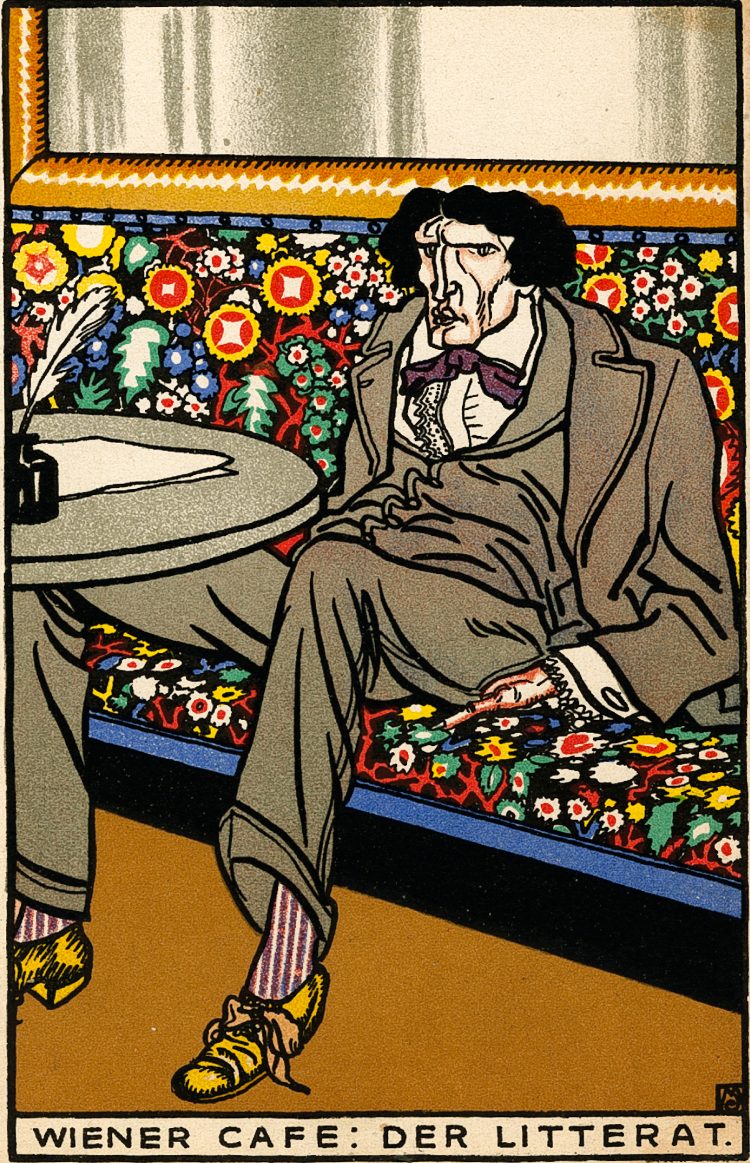
Moriz Jung (1885–1915). Viennese Café: The Man of Letters, Wiener Werkstätte Postcard 532, 1911. Chromolithograph. Leonard A. Lauder Collection. Neue Galerie New York
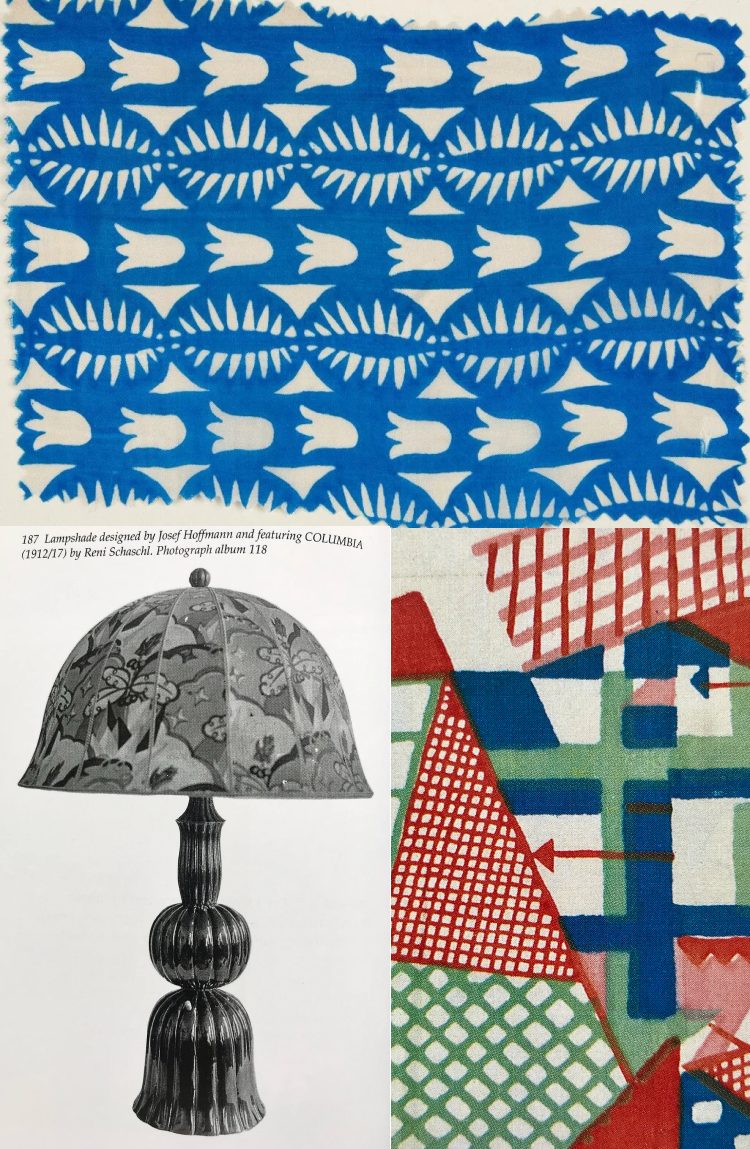
Top: Heron by Carl Otto Czeschka for Wiener Werkstätte, block printed silk, 1910-11. Image courtesy of Harvard Art Museums
Bottom Left: printed silk designed by Maria Likarz-Strauss, 1924. Image courtesy of MAK.
Bottom Right: design for Fidelio in gouache by Maria Likarz-Strauss, c.1928. Image courtesy of Cooper Hewitt.
The Verdict of the Museums
Wollner work resides in the permanent collections of the Museum of Modern Art in New York and the Victoria and Albert in London; in the Smithsonian’s Cooper Hewitt and the Museum of Fine Arts in Houston; in the MAK in Vienna, the museum that holds the material legacy of the Wiener Werkstätte itself, and whose collection of classical knotted carpets, drawn from the Safavid and Ottoman pinnacles once owned by the Austrian Imperial Court, is among the most valuable on earth. To enter the MAK as a modern maker is to be admitted to the company of the Imperial carpets. The Stedelijk in Amsterdam holds them, as does the Neue Sammlung in Munich and the Academy of Fine Arts in Stuttgart. This is not the record of a successful designer. It is the record of a permanent place in the history of the discipline.
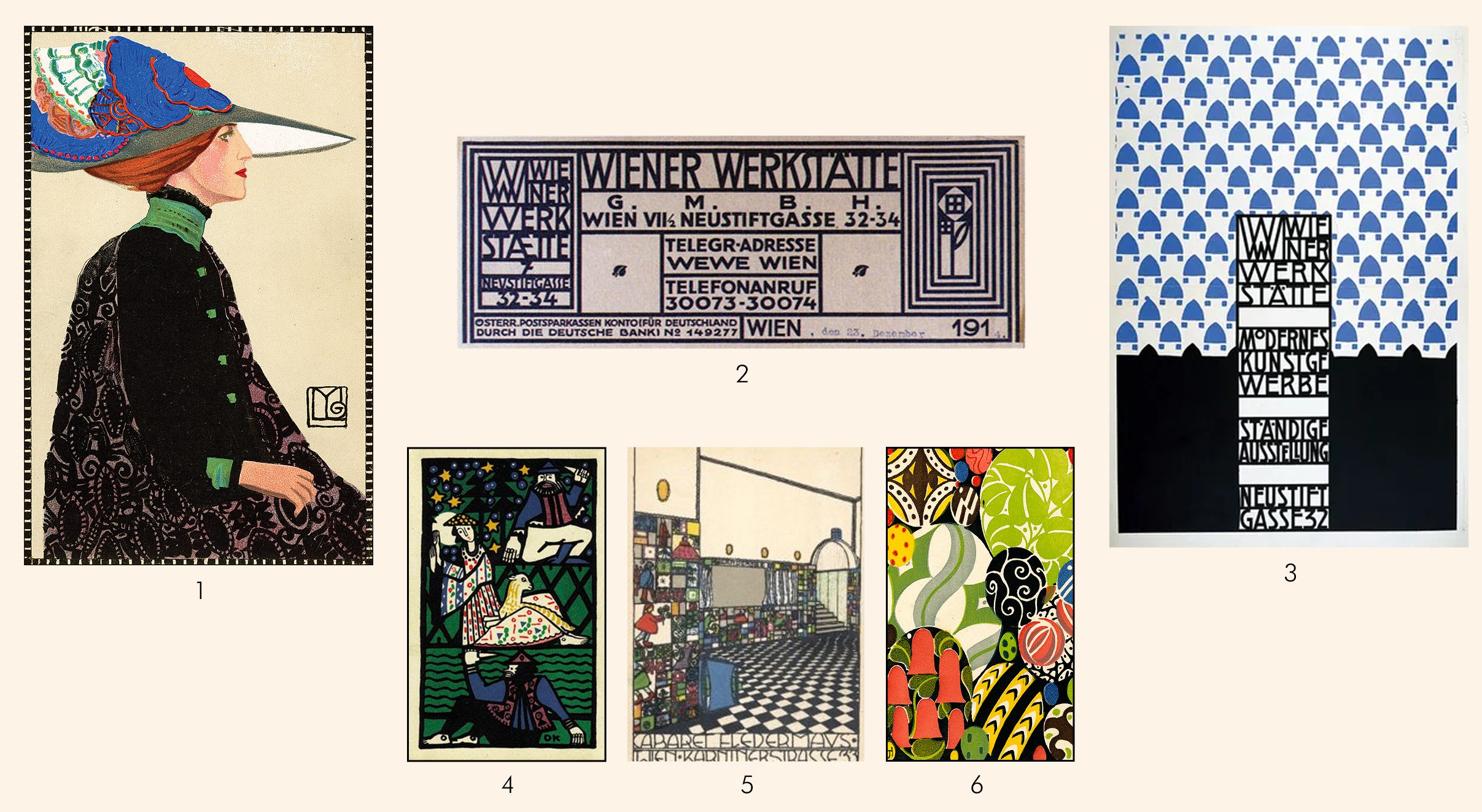
1: Maria Likarz (1893–1971). Fashion, Wiener Werkstätte Postcard 557, 1911. Chromolithograph. Leonard A. Lauder Collection. Neue Galerie New York
2: Wiener Werkstätte letterhead with flower motif by Koloman Moser.
3: Wiener Werkstätte exhibition poster, designed by Josef Hoffmann, c. 1905, promoting “Modernes Kunstgewerbe, Staendige Austellung Neustiftgasse 32” (an ongoing exhibition of modern arts and crafts at Neustiftgasse 32 in Vienna).
4: Wiener Werkstätte card #77 by Oskar Kokoschka.
5: Josef Diveky, Cabaret Fledermaus postcard (interior design by Josef Hoffmann; ceramic tiles by Bertold Loffler) (c. 1907).
6: Josef Hoffmann (1870–1956). Easter Card, Wiener Werkstätte Postcard 5, 1910. Chromolithograph. Leonard A. Lauder Collection. Neue Galerie New York
The Unique Work
What distinguishes their pieces, above lineage, is their nature as objects. Each is a Unikat, a unique work, singular, never repeated. Each was entworfen und handgeknüpft, designed and hand-knotted, by Leo Wollner himself, or in the close creative partnership he shared with Gretl, who worked beside him through every stage of design and resolution. The materials observe the highest traditional order and nothing else: Schafwolle, sheep’s wool; Leinen, linen; the warp itself of linen, Kette Leinen, strung as the old masters strung it.
And then there is the extraordinary exception, the pieces in which Zeitungspapier, newspaper, is worked into the warp structures itself. Here is the whole Vienna inheritance compressed into a single radical gesture: the maker who has mastered the most exacting traditional technique deciding, with complete authority, to introduce into the sacred foundation of the carpet the most ephemeral material imaginable. The daily paper, printed, discarded, forgotten, bound permanently into the structure of a work meant to outlast generations.
It is the Werkstätte’s deepest principle made literal. There is no material unworthy of art; there is only the question of whether the hand that uses it knows what it is doing. The Wollners’ hands always did.
For the collector and the designer working at the level where provenance is not a flourish but the substance of the thing, a Wollner carpet offers what almost nothing else on the market can: a unique, museum-held, hand-knotted work by an artist taught directly by the founders of modern design, laid on the floor of a room that understands exactly what it has been given.
The thread that began in Vienna in 1903 has not been broken. It runs, still, beneath the feet of those who know to look for it.