
Leo and Greti Wollner and the Vienna Carpet Inheritance
August 26, 2026
The Evolution of Floral Motifs in Antique Rugs and Kilims: Mapping the Pomegranate, Tulip, and Carnation
September 3, 2026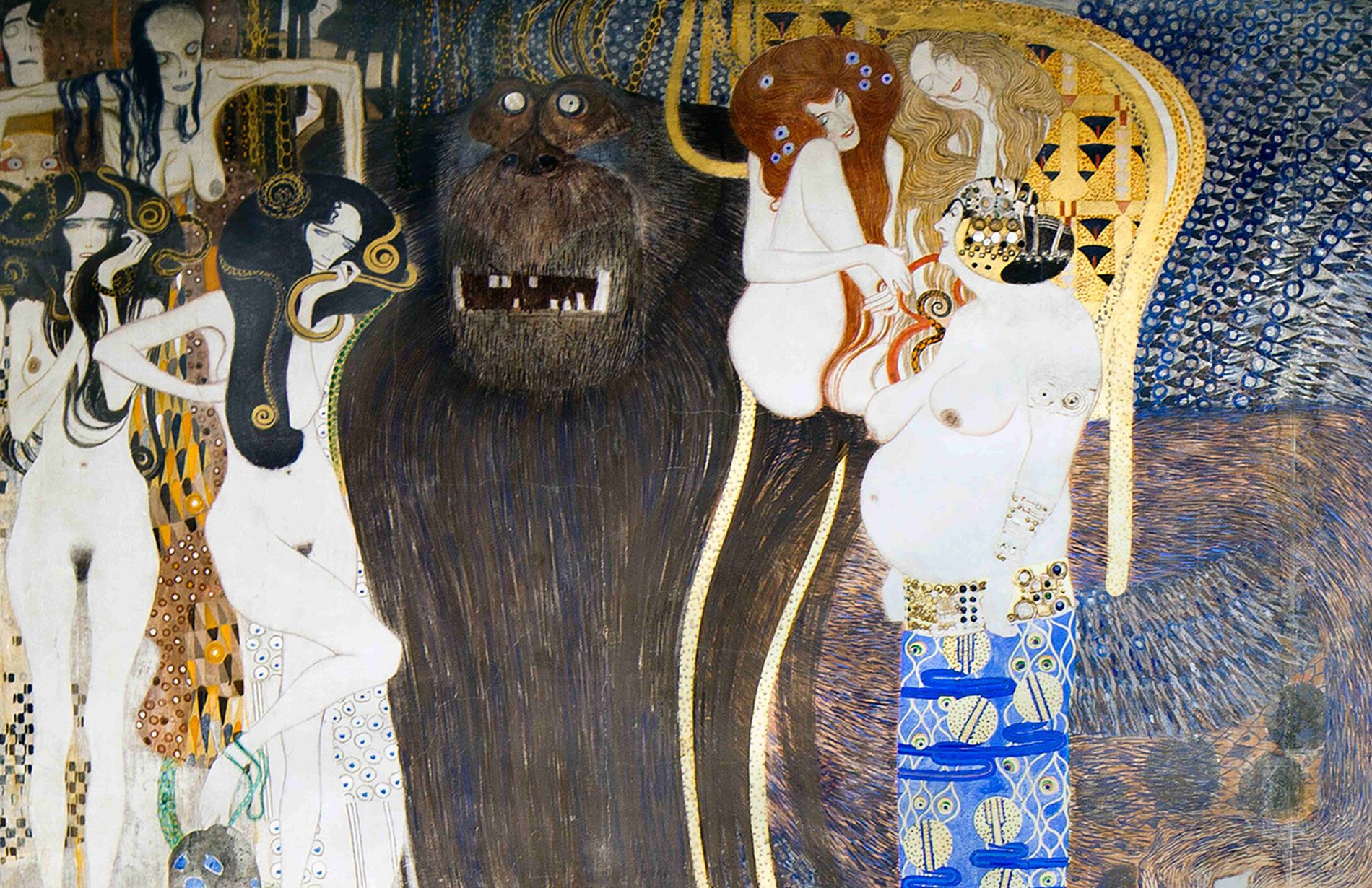
Beethoven Frieze, 1902 by Gustav Klimt, was painted for the 14th Vienna Secessionist exhibition
In the dining room of a banker’s house in Brussels there is a wall of gold. Klimt designed it; the Stoclet Frieze, a tree of life branching across marble and enamel and coral, a dancer on one side and an embracing couple on the other, the couple a direct rehearsal for the painting the whole world would later know as The Kiss. But to stand in that room, were one ever permitted to, is to understand that the frieze is not the point of it. The point is that the frieze, the marble, the cutlery, the door handles, and the carpet underfoot were all conceived as a single object by a single mind. The Palais Stoclet, built by Josef Hoffmann between 1905 and 1911 and now sealed as a UNESCO World Heritage Site, is the most complete surviving statement of the idea that organised an entire Viennese century: the Gesamtkunstwerk, the total work of art, in which nothing; not the spoon, not the dress, not the floor, ranks below the painting on the wall.
This is the idea that runs through everything Vienna made between the founding of the Secession in 1897 and the closing of the Wiener Werkstätte in 1932, and it is the connection that, for a house devoted to carpets, finally arrives underfoot.
The Painters and the Break
It began as a rebellion in paint. In 1897 Gustav Klimt led a group of artists out of the conservative Künstlerhaus to form the Vienna Secession, and from the start the movement insisted on something heretical: that the applied arts deserved equal standing with the fine. Klimt’s gold; the Beethoven Frieze, the Portrait of Adele Bloch-Bauer, the shimmering surfaces in which the human figure dissolves into ornament, was itself a kind of argument that the decorative and the profound were never opposites. Around him gathered the talent that would define the era: Egon Schiele, whose anguished line the Werkstätte sold when no dealer would touch it; Oskar Kokoschka, whose unsettling portraits the Workshop also supported before he left for Germany and Expressionism. The painters set the temperature. What the architects and designers did next was carry that temperature into every room of a life.
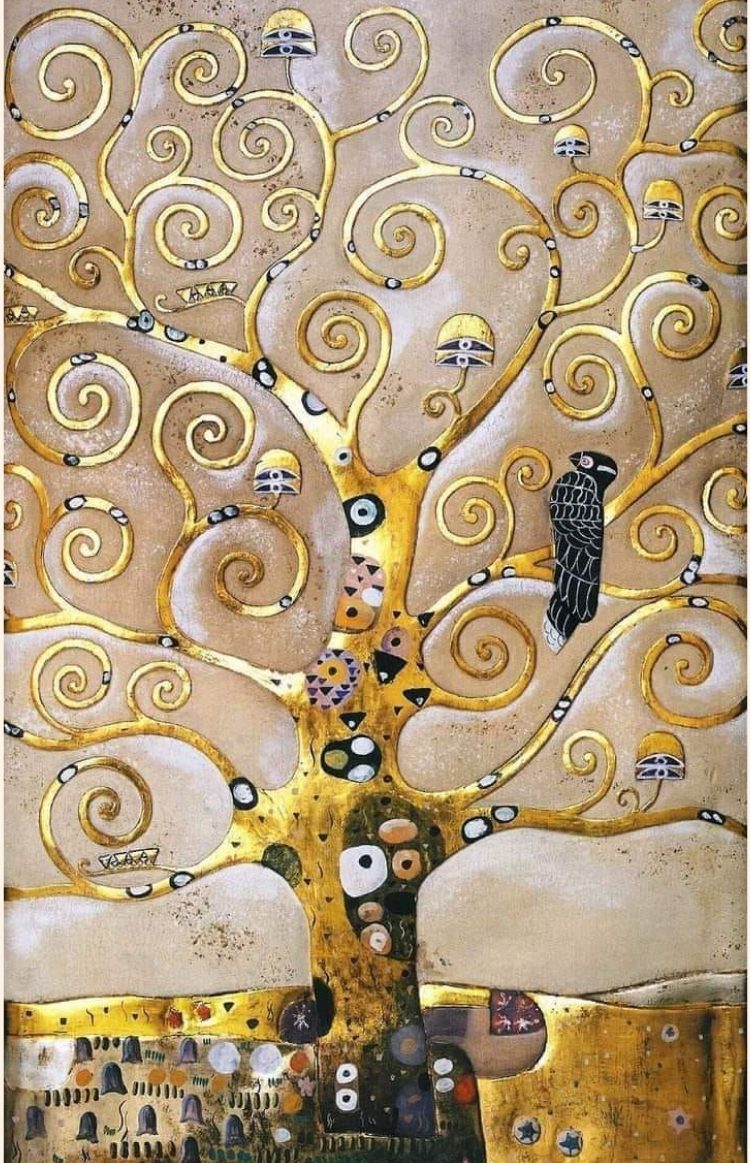
Gustav Klimt The Tree of Life, Stoclet Frieze (detail), 1909
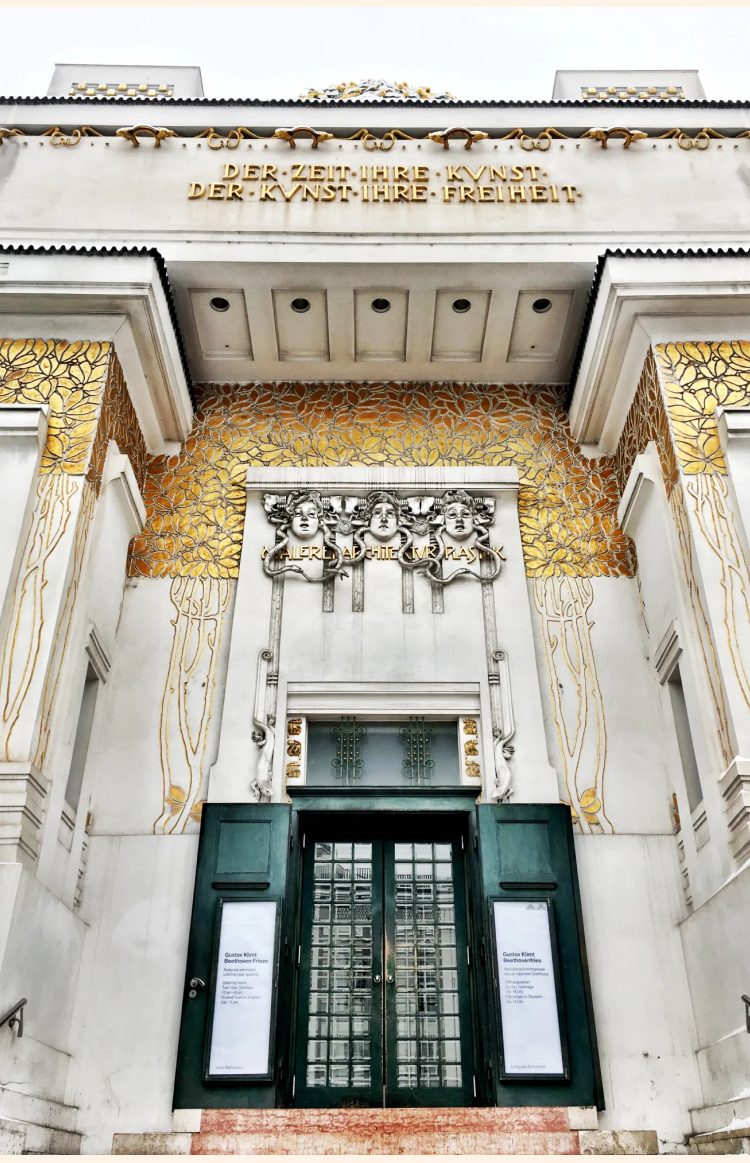
Secession, Vienna’s Center for Artistic Expression
The Architects and the Built World
The architecture came from Otto Wagner, the father figure, whose Postal Savings Bank and Majolica House dragged Vienna from historicism into the modern, and who taught both Hoffmann and Koloman Moser. From Wagner’s studio the line split. Adolf Loos took the road of pure austerity, “ornament is crime”, and his bare, perfectly proportioned interiors stand as the necessary foil to everything the Werkstätte believed; the two together, the plain and the patterned, are both unmistakably Viennese. Hoffmann took the other road, toward the Gesamtkunstwerk, building the Sanatorium Purkersdorf, the Stoclet, the country houses of the Primavesi family; total environments where he designed the building and then refused to stop, carrying his authority down to the textiles and the rugs. The next generation, Oskar Strnad and Josef Frank, softened this into a livable modernism; Frank would later carry the Viennese sensibility to Stockholm and the house of Svenskt Tenn, one of the quiet bridges between Vienna and Scandinavian design.
The Workshop and Its Two Tempers
The Wiener Werkstätte, founded in 1903 by Hoffmann, Moser, and the financier Fritz Waerndorfer, was the machine that turned all of this into objects. Its early aesthetic, governed by Hoffmann and Moser, was geometric and severe, the Gitterwerk, the grid of punched squares; Moser’s checkerboards; a beauty achieved by subtraction. Then in 1915 Hoffmann brought in Dagobert Peche, and the workshop’s whole temper changed. Peche reintroduced fantasy, spiky, theatrical, half-Rococo and half-future, and oversaw nearly three thousand designs before his death at thirty-six in 1923; the Metropolitan and the Neue Galerie now credit him as a direct forerunner of Art Deco. The tension between these two men, the grid and the flourish, the rivet and the vine, is the signature of Austrian design, and it is what separates Vienna from the lacquered cool of Paris and the chrome of New York.
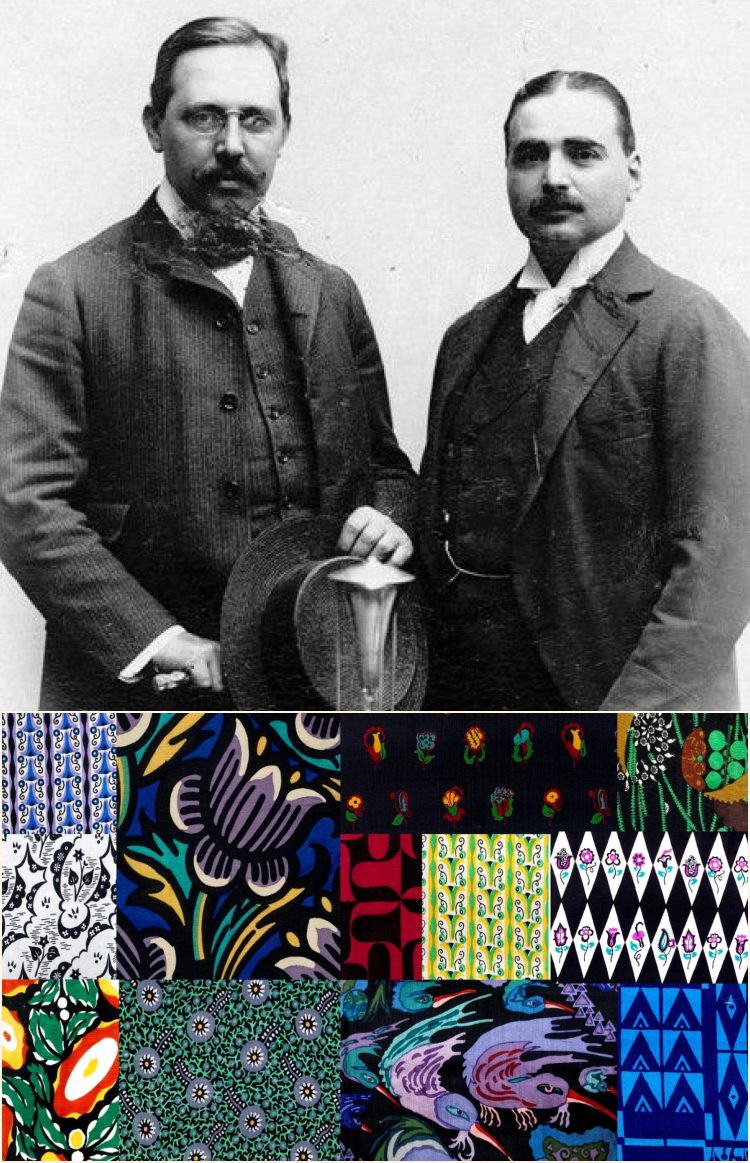
Top: Josef Hoffmann and Fritz Waerndorfer, Bottom: Wiener Werkstätte, textile patterns, 1920-1925. Dorotheum.
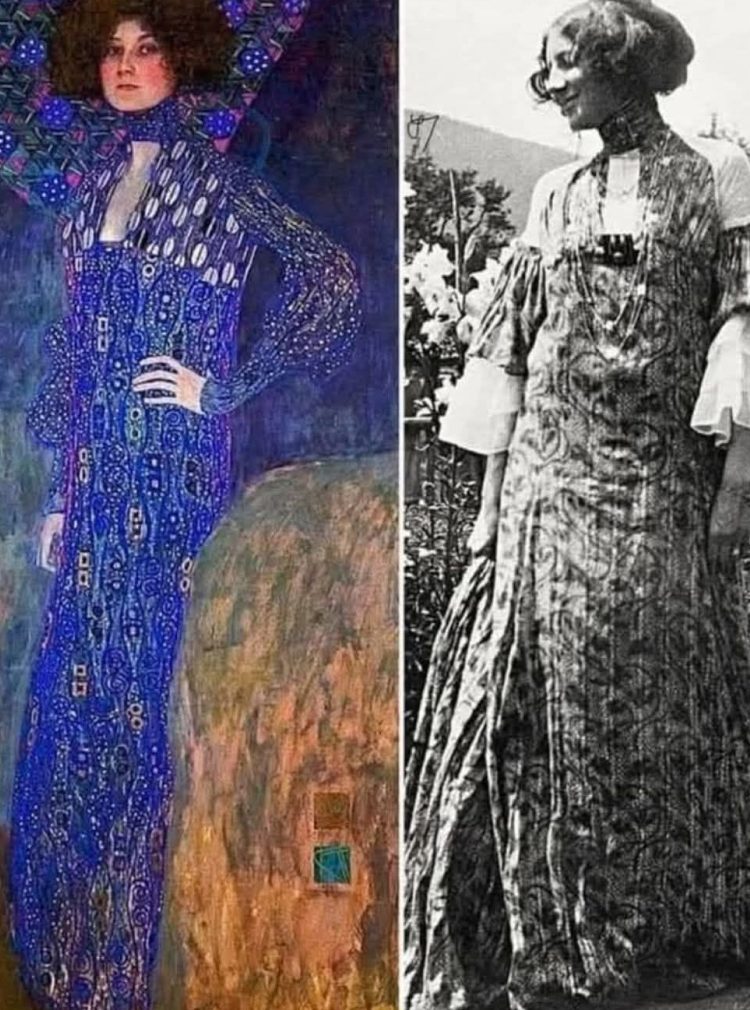
Portrait of Emilie Flöge, 1902, Gustav Klimt. Vienna State Museum.
The Fashion and the Body
No account of this world is complete without the dress, because in Vienna the body was simply another surface to be designed. The couture house Schwestern Flöge, opened in 1904 by Emilie Flöge, Klimt’s companion and muse, the probable woman of The Kiss; was outfitted by Hoffmann and Moser as a Werkstätte commission, down to the wallpapers and the labels, a corporate identity built as a total work of art. Flöge’s radical reform dresses, loose and uncorseted, were sewn from Werkstätte fabrics, and the chequerboard and spiral motifs that presaged the Workshop’s design appear in the very portrait Klimt painted of her in 1902. In 1910 the Werkstätte opened its own fashion department under Eduard Wimmer-Wisgrill, employing some eighty artists to design textiles, lace, hats, and bags. The same pattern that ran across a dress might run across a wall and across a knotted carpet, fashion, textile, and floor were one continuous fabric. The Workshop even designed the first loose, corset-free gown, a garment Paul Poiret admired and emulated in Paris.
The Floor That Finished the Room
And so to the carpet, which in this philosophy was never chosen last. From the beginning Hoffmann and Moser, who had shown his first hand-knotted rugs as early as 1898, treated carpets as inseparable from architecture. The weaving was carried principally by Johann Backhausen & Söhne, the firm that wove the Stoclet and Primavesi textiles and still holds the archive today, in two registers: machine-woven velour broadloom, and the prized hand-knotted “Smyrna” carpets, from hall runners to room-scaled pieces. Patterns were produced in alternate colourways to suit a given interior, and migrated freely between cloth and floor. Otto Prutscher translated Secessionist line into mosaic-like carpet geometry; the women of the Workshop; Maria Likarz, whose designs stayed in production until 1930, Felice Rix, Mathilde Flögl, defined the surfaces of everyday Viennese life, painting with cloth years before Paris caught the idea. Examples now reside in the MAK, the Neue Galerie, the Metropolitan, and the Art
Institute of Chicago, whose Moser carpet is woven in the Ghiordes knot of the classical Eastern tradition; Vienna speaking, through wool, the oldest language of the loom.
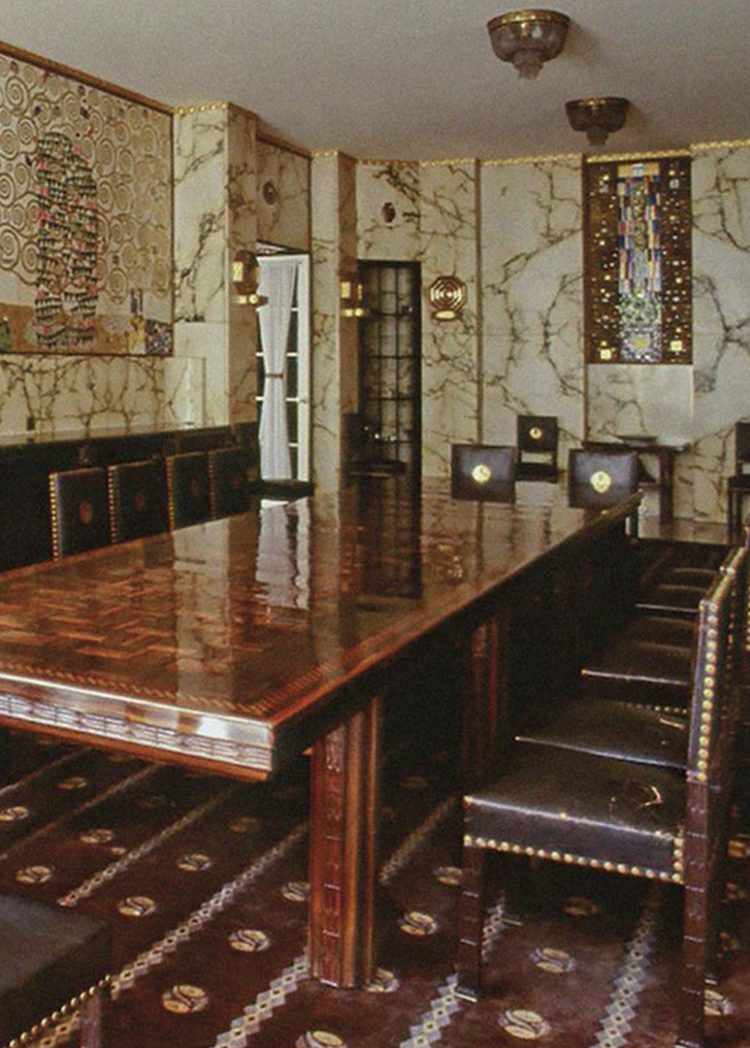
A Viennese rug in the dining room of Brussels’ Stoclet Palais. The Hoffmann “Bellflower” model, 1910, created for the Wiener Werkstätte and woven by Johann Backhausen & Söhne.
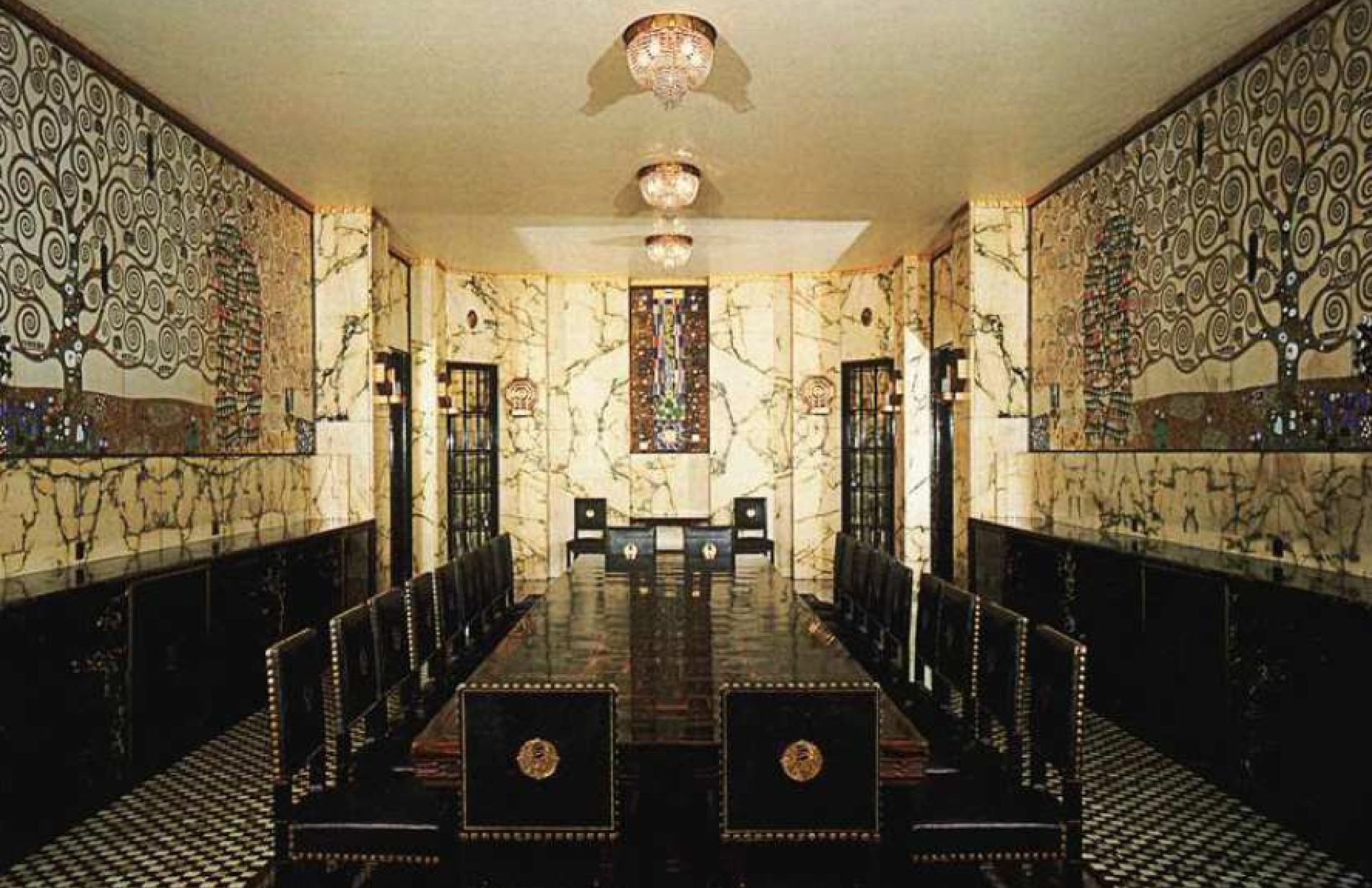
Palais Stoclet, Dining Room
The Fall, and the Long Afterlife
It ended quickly, and the brevity is part of the romance. The empire fell in 1918; hyperinflation gutted the economy; the Fifth Avenue showroom opened in 1922 closed within three years; the Workshop shut in 1932; and the annexation of 1938 scattered the survivors across the Atlantic, carrying the Gesamtkunstwerk idea into American Deco, into Hollywood set design, into the Bauhaus that absorbed and austerified it. Today the inheritance is everywhere once you learn to see it. Hoffmann’s lighting illuminates Pharrell Williams’s Goodtime Hotel in Miami; designers from Peter Marino to Ken Fulk reach for the Viennese vocabulary; the Dorotheum sold a single Hoffmann salon carpet, woven by Backhausen, against an estimate of forty to eighty thousand euros. The best rooms being composed now, the ones with intellectual weight, where the floor is made to agree with the walls; are still, knowingly or not, working from the Viennese conviction.
That conviction is the one a New York house is proudest to keep. A room is designed, not assembled. The painting, the dress, the chair, the gold frieze, and the carpet all belong to the same idea, and as Vienna understood better than anyone, the idea is only finished when the floor agrees.