
Provenance, Structure, Intelligibility: The Three Pillars of Serious Collecting
September 25, 2026
The Long Life of a Green: On Celery, Color of the Year, and the Four Centuries of Weaving That Anticipated It
October 2, 2026
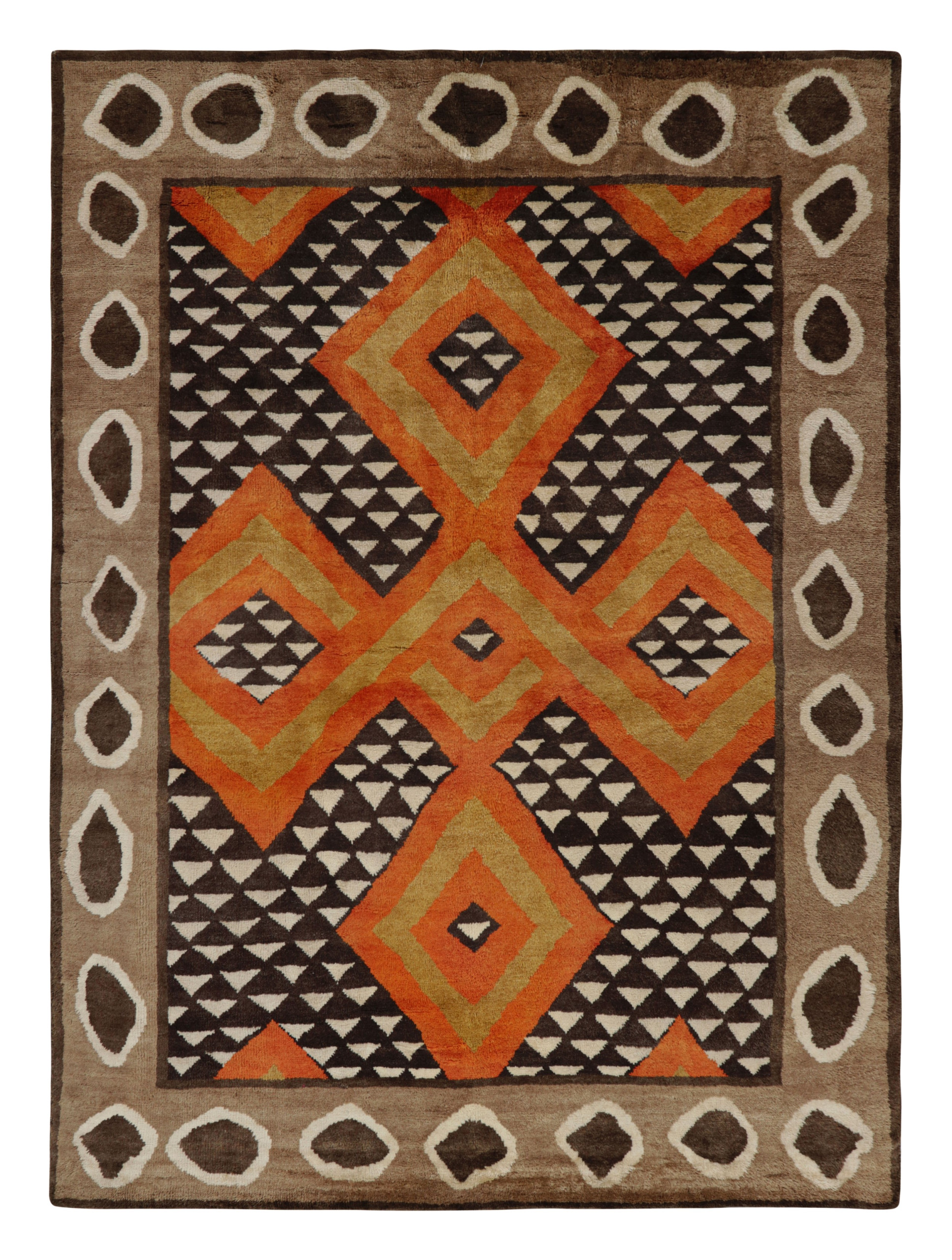
Navajo rugs occupy a singular position within the history of American textile art. Woven by
Diné artists across the American Southwest, these textiles represent far more than a regional
decorative tradition. They embody generations of knowledge surrounding sheep, wool,
spinning, natural materials, color, geometry, landscape, community, and cultural continuity.
From nineteenth-century blankets to the celebrated regional rugs of the early twentieth
century—and from Two Grey Hills and Ganado to sophisticated contemporary
works—Navajo weaving has continually demonstrated the ability of textile art to function
simultaneously as cultural expression, design, craftsmanship, and fine art.
For collectors, architects and designers, understanding Navajo rugs means looking beyond
the familiar geometric vocabulary. It means understanding the history of Diné weaving, the
development of regional styles, the role of trading posts, the extraordinary discipline of
hand-spinning and hand-weaving, and the continuing creative authority of contemporary
Diné artists.
Rug & Kilim: Our Perspective on Navajo Rugs
At Rug & Kilim, we approach Navajo rugs as works of textile art whose significance extends
beyond their decorative presence. Our interest lies in the relationship between weaving
tradition, material quality, design intelligence, cultural history and architectural application.
The finest Navajo rugs possess an unusual clarity. Their geometry can be remarkably
sophisticated, yet their visual language remains grounded in material and process. Every
decision—from the preparation of wool and the character of the yarn to the proportion of a
border or the rhythm of a repeated motif—contributes to the identity of the finished textile.
Our role is to help collectors, designers and private clients understand these distinctions and
place Navajo rugs within a broader vocabulary of historic and contemporary design. Whether
considered for a refined residential interior, hospitality project, gallery-like environment or
private collection, an exceptional Navajo rug can provide both visual authority and cultural
depth.
We believe the most successful interiors do not treat historic textiles as isolated antiques.
They allow them to participate in a larger dialogue between architecture, art, material and
history.
The Origins of Navajo Weaving
Diné weaving has a long and complex history. Navajo weavers developed important textile
skills through interaction with neighboring Pueblo communities, while Spanish colonization introduced sheep into the region, transforming the material possibilities of weaving. Wool
gradually became central to Navajo textile production.
Early Navajo textiles included blankets, garments, saddle blankets and other utilitarian and
ceremonial forms. During the nineteenth century, Navajo blankets became highly valued
throughout the Southwest, admired for their quality, durability and sophisticated geometric
compositions.
The transition from blanket weaving toward rugs accelerated in the late nineteenth century.
Expanding rail networks, tourism and trading posts created new markets for Navajo textiles.
Traders began encouraging particular designs that could be marketed to non-Native
consumers, contributing to the emergence of recognizable regional rug styles.
This commercial history is essential to understanding Navajo rugs. It reveals both the
pressures placed upon Indigenous artists and the remarkable ability of Diné weavers to
transform external markets while maintaining, adapting and eventually reclaiming their own
creative traditions.
From the Blanket Period to the Regional Rug
The history of Navajo weaving is often discussed through broad chronological periods,
including the Classical period, the Eye Dazzler period, the Early Rug period and the Modern
Regional period. The development of regional rugs in the late nineteenth and early twentieth
centuries was closely connected to trading posts and the growing market for textiles.
Among the most recognized regional traditions are Two Grey Hills, Ganado, Crystal,
Chinle, Teec Nos Pos, Wide Ruins, Burntwater and Klagetoh. Each developed a
distinctive visual vocabulary while remaining part of the larger Diné weaving tradition.
Two Grey Hills
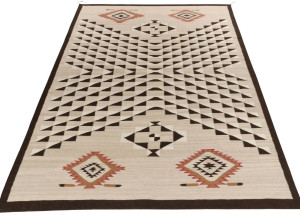
Two Grey Hills is among the most celebrated Navajo rug traditions. Developing around
1910–1915, it became known for extremely fine handspun wool, natural undyed colors and
complex geometric compositions characterized by symmetry and extraordinary precision.
The palette of natural black, white, grey and brown creates a sophisticated tonal language that
feels remarkably contemporary. Master weavers such as Daisy Taugelchee demonstrated the
extraordinary level of technical and artistic refinement possible within the style.
For today’s collectors, Two Grey Hills represents an especially compelling intersection of
Indigenous tradition, material intelligence and modernist abstraction.
Ganado
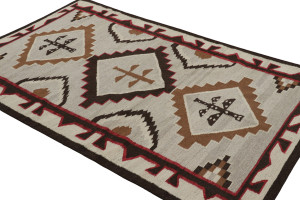
Ganado rugs are recognized particularly for their strong red fields, geometric organization
and bold dark borders. The style developed in association with the Ganado trading post and
the influence of trader Lorenzo Hubbell.
Its dramatic palette gives Ganado rugs considerable architectural presence. In contemporary
interiors, the saturated red can operate almost as a painting would—providing a concentrated
field of color against stone, plaster, wood or restrained modern furnishings.
Crystal
Crystal weaving developed around the Crystal trading post associated with J. B. Moore.
Moore played an important role in promoting Navajo rugs through catalogues and
commercial networks, although the designs marketed through his enterprise also reflected the
period’s fascination with Oriental carpets.
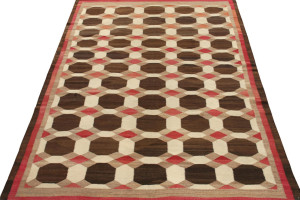
The history of Crystal therefore illustrates one of the central tensions in Navajo rug history:
the meeting of Indigenous artistic practice with external commercial expectations.
Teec Nos Pos
Teec Nos Pos rugs are distinguished by complex borders, elaborate geometric organization
and an energetic visual vocabulary. They belong to the broader family of regional styles that
emerged as the Navajo rug market developed during the late nineteenth and early twentieth
centuries.
For collectors, regional identification is valuable because it provides a framework through
which design, chronology, weaving technique and historical context can be understood.
Geometry as an Artistic Language
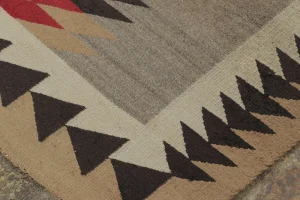
The power of Navajo rugs lies partly in their geometry. Diamonds, stepped forms, serrated
edges, crosses, bands and repeated geometric structures create compositions that can appear
both highly ordered and intensely dynamic.
This geometry has often been discussed in relation to Southwestern landscapes, pottery
traditions, cultural knowledge and inherited weaving practices. Yet it should not be reduced
to a simplistic system in which every geometric form is assigned a single universal symbolic
meaning.
The more important artistic observation is that Navajo weaving transforms geometry into
rhythm. Repetition becomes movement; symmetry creates balance; contrast produces depth;
and proportion establishes architectural scale.
This is one reason Navajo rugs have resonated so strongly with modern design.
Navajo Rugs, Art and Literature
Navajo textiles have long occupied a place between material culture and fine art. Museums
today preserve historic blankets and rugs alongside contemporary works, recognizing
weaving as an important form of artistic authorship rather than merely craft. The Heard
Museum, for example, documents both historic regional styles and contemporary Diné
textiles by artists who continue to innovate through color, composition and technique.
The literary and cultural history surrounding Navajo weaving is equally significant.
Publications devoted to Navajo textiles have examined the relationship between weaving,
trading posts, family knowledge, regional identity and individual makers. Smithsonian
holdings include major studies documenting the development of Navajo rugs, including the
roles of J. B. Moore, Lorenzo Hubbell, George Bloomfield and other figures in the evolution
of the twentieth-century rug market.
At its deepest level, Navajo weaving is also connected to memory and transmission.
Knowledge moves through generations—from mother to daughter, family to family, and
community to community.
Contemporary Diné weaver Kevin Aspaas describes weaving as inseparable from cultural
continuity, while practicing sheep-to-loom production that encompasses shepherding,
spinning, natural dyeing and weaving.
Navajo Rugs and Modern Design
The visual language of Navajo rugs has proven remarkably compatible with modern
architecture. Their geometric compositions can complement minimalist interiors, while their
handmade irregularities introduce warmth into highly controlled architectural environments.
A finely woven Two Grey Hills rug can sit naturally within a contemporary space dominated
by stone, oak, concrete or steel. A Ganado rug can introduce a concentrated chromatic
statement. A restrained natural-wool Navajo textile can function almost architecturally,
defining a room without overwhelming it.
This versatility explains why Navajo rugs continue to appeal to architects, interior designers,
collectors and institutions.
Their modernity is not accidental. Navajo weaving possesses many qualities valued by
modern design: abstraction, material honesty, repetition, proportion, structure and an intimate
relationship between process and finished form.
Pictorial and Contemporary Navajo Weaving
Navajo weaving has never been frozen in the past. Pictorial rugs became an important
creative tradition, while contemporary Diné artists continue to explore new compositions,
materials and conceptual approaches. The Smithsonian American Art Museum, for example, recognizes pictorial weaving as an established creative tradition and documents the
continuing importance of women weavers and their artistic and economic contributions.
Contemporary artists such as D. Y. Begay, Barbara Teller Ornelas, Marilou Schultz and
Kevin Aspaas demonstrate the breadth of contemporary Diné textile practice. The Heard
Museum’s collection includes works by these artists alongside historic Navajo textiles,
emphasizing the continuity between heritage and innovation.
This contemporary dimension is essential to understanding Navajo rugs today. They are not
simply historical objects reproduced from an established vocabulary. They remain part of an
active artistic tradition.
Navajo Rugs in Contemporary Luxury Interiors
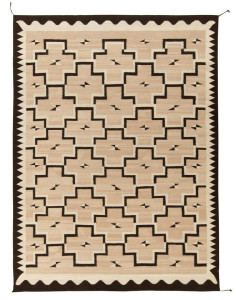
For today’s collector, the strongest Navajo rugs offer an exceptional balance of cultural
history and design clarity.
They can be used in sophisticated residences, libraries, studies, galleries, hospitality
environments and carefully curated commercial interiors. Their scale and geometric
discipline allow them to work alongside both antique and contemporary furniture.
The finest examples should be evaluated through multiple lenses: age, weaving quality, wool,
spinning, dye character, design, regional attribution, condition, provenance and overall
artistic integrity.
The value of a Navajo rug therefore lies not simply in its age. It lies in the relationship
between the hand that made it, the material from which it was created, the visual language it
embodies and the history through which it has survived.
Navajo Rugs as Living Heritage
The continuing importance of Navajo rugs is ultimately found in their ability to connect past
and present.
From early blankets and nineteenth-century textiles to the regional rugs of the twentieth
century and the innovative works of contemporary Diné artists, Navajo weaving demonstrates
that tradition is not the opposite of innovation. Tradition becomes meaningful when it
remains capable of being interpreted, questioned and carried forward.
For collectors and designers, an exceptional Navajo rug is therefore more than a beautiful
textile. It is a record of Indigenous artistic knowledge, material intelligence, cultural
resilience and evolving design.
At Rug & Kilim, we see this continuity as central to the significance of Navajo rugs. Our
approach is grounded in understanding the textile as both historical artifact and living design element—one capable of bringing extraordinary cultural and visual depth into contemporary
architecture.
FAQ: Navajo Rugs
1. What is a Navajo rug?
A Navajo rug is a handwoven textile produced by Diné weavers, traditionally using wool and
geometric or pictorial compositions. Navajo rugs developed from a broader tradition of
blankets and other woven textiles.
2. What are the most famous Navajo rug styles?
Major regional styles include Two Grey Hills, Ganado, Crystal, Teec Nos Pos, Chinle, Wide
Ruins, Burntwater and Klagetoh.
3. What makes Two Grey Hills rugs special?
Two Grey Hills rugs are particularly renowned for finely spun handspun wool, natural
undyed colors, intricate geometric compositions and exceptional technical precision.
4. Are Navajo rugs collectible?
Yes. Historic and exceptional Navajo rugs are highly collectible, with value influenced by
age, rarity, weaving quality, materials, regional style, condition, provenance and artistic
significance.
5. Are Navajo rugs still made today?
Yes. Diné weavers continue to produce both traditional regional styles and innovative
contemporary textiles.
6. What materials are traditionally used in Navajo rugs?
Wool is central to Navajo weaving, particularly wool associated with Navajo-Churro sheep.
Earlier weaving traditions also incorporated cotton before wool became predominant.
7. Can Navajo rugs work in modern interiors?
Absolutely. Their geometry, material richness and strong compositional structure make them
exceptionally effective in contemporary residential, hospitality and architectural
environments.
8. What should collectors look for in an antique Navajo rug?
Collectors should consider provenance, regional attribution, age, wool quality, spinning,
weave structure, design, dyes, condition, scale and overall artistic integrity rather than relying
on a single characteristic.
9. What is the difference between a Navajo rug and a Navajo blanket?
Historically, Navajo textiles included blankets, garments and other forms before the late
nineteenth-century development of a commercial rug market. The distinction is therefore
partly historical and functional rather than simply visual.
10. Why are Navajo rugs important to design history?
Navajo rugs demonstrate how Indigenous textile traditions can function as sophisticated
systems of geometry, color, material and composition. Their influence and visual relevance
continue to extend into contemporary architecture and interior design.