
Rug of the Week IV: Mandaroux’s Le Carnaval — A Mid-Century Aubusson Tapestry in the Age of Postwar Reinvention
September 5, 2025
Where Do Gallery Runner Rugs and Kilims Belong Today?
September 11, 2025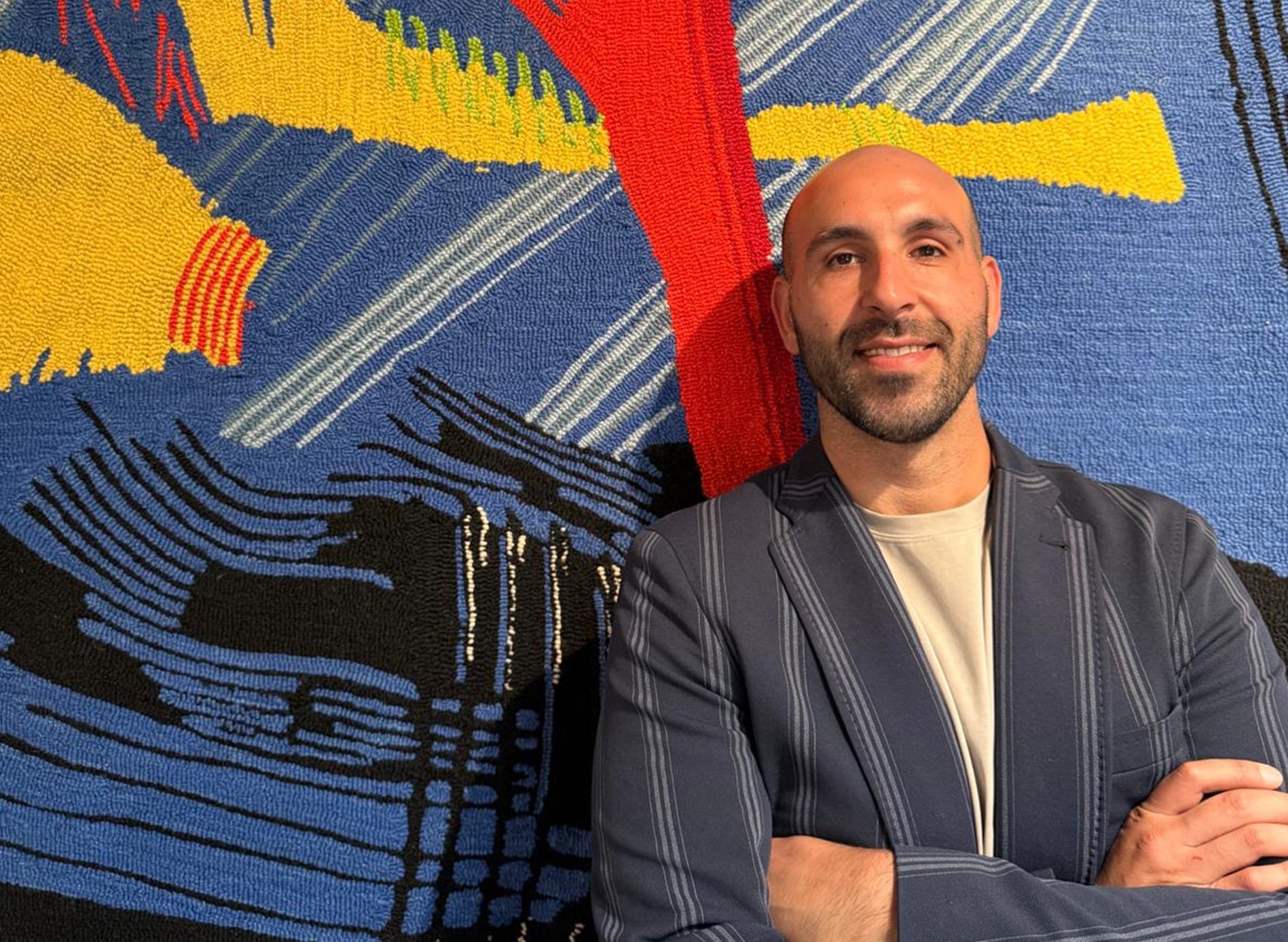
Sina Nazmiyal
Not many people walk away from an early legal victory to begin again. But for Sina Nazmiyal, the triumphs of successful advocacy never stirred his soul the way a single antique carpet could. For as long as he can remember, rugs have been the ground beneath his life—like tapestries underfoot, and figurative threads binding family, memory, and artistry.
His fingertips tracing the indigo threads with reverence, you begin to understand: this is no mere inheritance. This is stewardship—shaped by intuition, forged by introspection, and guided by a sensibility that quietly, but unmistakably, redefines luxury in our time.
“I didn’t grow up thinking I’d be here,” Sina tells me, his tone deliberate, reflective. “But I was always here—climbing over rugs as a child, listening to designers speak in hushed tones in our showrooms, absorbing far more than I ever admitted.” His father, Jahanshah Josh Nazmiyal, didn’t just run a rug business—he breathed it. He lived and loved design with such intensity that it filled the air around him, imprinting on his son the value of beauty, precision, and feeling.
Sina is the first to say his path was not preordained. He pursued law with vigor—drawn to argument, writing, research. He passed the bar and just a few years later, was working alongside career litigators in New York courtrooms. It was fulfilling. But it hardly resonated. “I realized I didn’t want to wake up to a fight every day,” he says. “I wanted to build something. To feel something.” The adversarial posture of practice ran counter to his energy and spirit. The choice arrived quickly—within a week of his early victory, he left law and walked into the family business with clear eyes.
Bridging Generations
Mediating between Josh’s legacy and Cyrus’s ambition.
“My father never pressured me,” he notes. “He simply made himself available—subtly, always with open arms. And I think that was the most powerful invitation of all.” What he found wasn’t a shadow to stand in, but a lineage to extend. With Cyrus Nazmiyal spearheading Rug & Kilim’s wholesale operations and Josh continuing his passionate acquisitions of rare antique and vintage pieces, Sina’s role emerged as something rarer still—a bridge. “For three years, I was the middle man,” he says. “Different personalities, different speeds—Cyrus eager to mark the future, Josh committed to the discipline that built the brand. My legal training taught me to hear both sides and resolve.” The result is a culture that argues less to win and more to refine.
Sina’s remit today is deceptively simple: grow the business by deepening trust. “Designers aren’t just picking rugs,” he says. “They’re managing entire atmospheres—marble, wallpaper, upholstery, furniture, hardware, light. My job is to understand that pressure, anticipate their needs, and never let them apologize on our behalf.” The phrase is a mantra inside his team: we do not give designers reasons to apologize. If a sample isn’t on hand, he prints a high-resolution, heavy-stock tearsheet at scale and has it on a desk within 48 hours. If a question can’t be answered on the spot, the answer is: “I don’t know yet—let me research and return.” He trains young salespeople not to push, but to listen—deeply, humanly—until the right piece reveals itself. “We don’t just sell rugs; we help people feel something, realize something, live better inside their spaces.”
The archive at Rug & Kilim has multiplied in recent years—what was once a fraction is now one of the most institutional, refined inventories in the country. Cyrus and Sina manage the day-to-day in the showroom; Josh, indefatigable, procures at scale, shapes new collections, and mentors the design team. The Burano collection, for instance, is emblematic of his instinct: a surface language and hand that allow new rugs to carry the soul and softness of age. Patterns he loves—Isfahan, and other storied traditions—gain a second life through new texture. “Our job is to maximize that will to create,” Sina says. “People come to us for it. The best designers rely on it.”
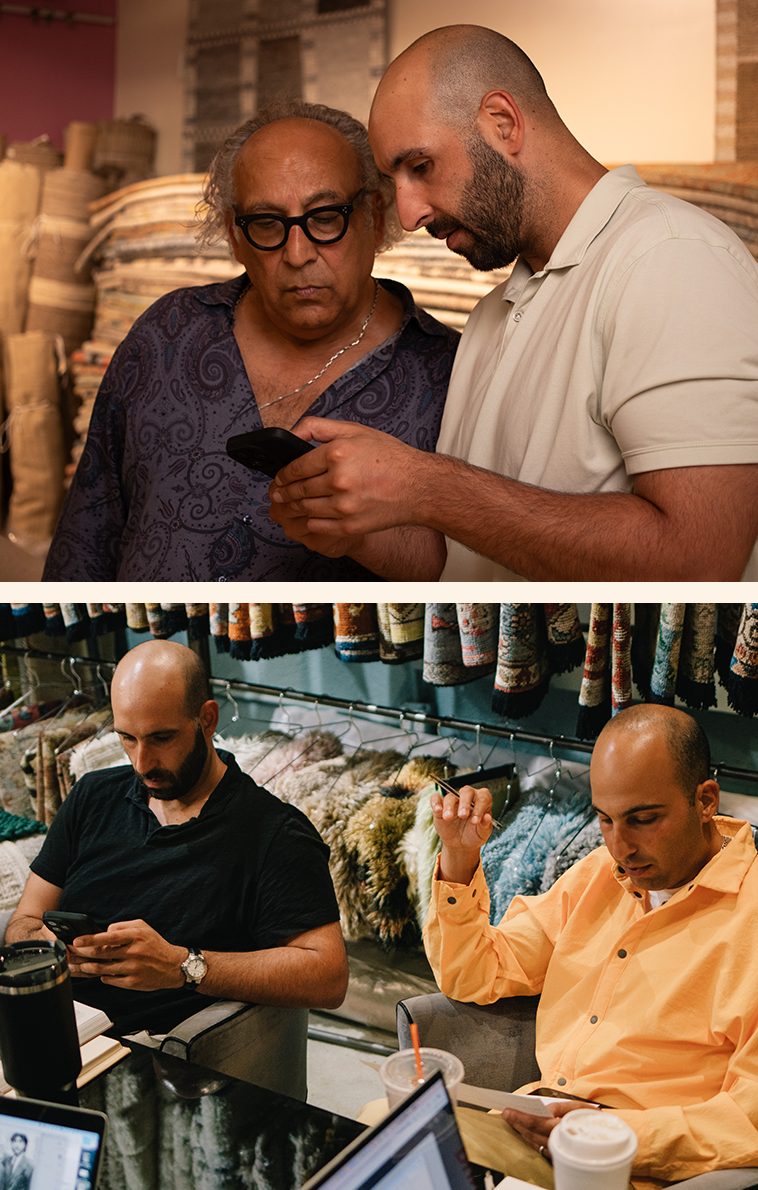
Top: Jahanshah Josh Nazmiyal (left), Sina Nazmiyal (right), Bottom: Sina Nazmiyal (right) Cyrus Nazmiyal (left)
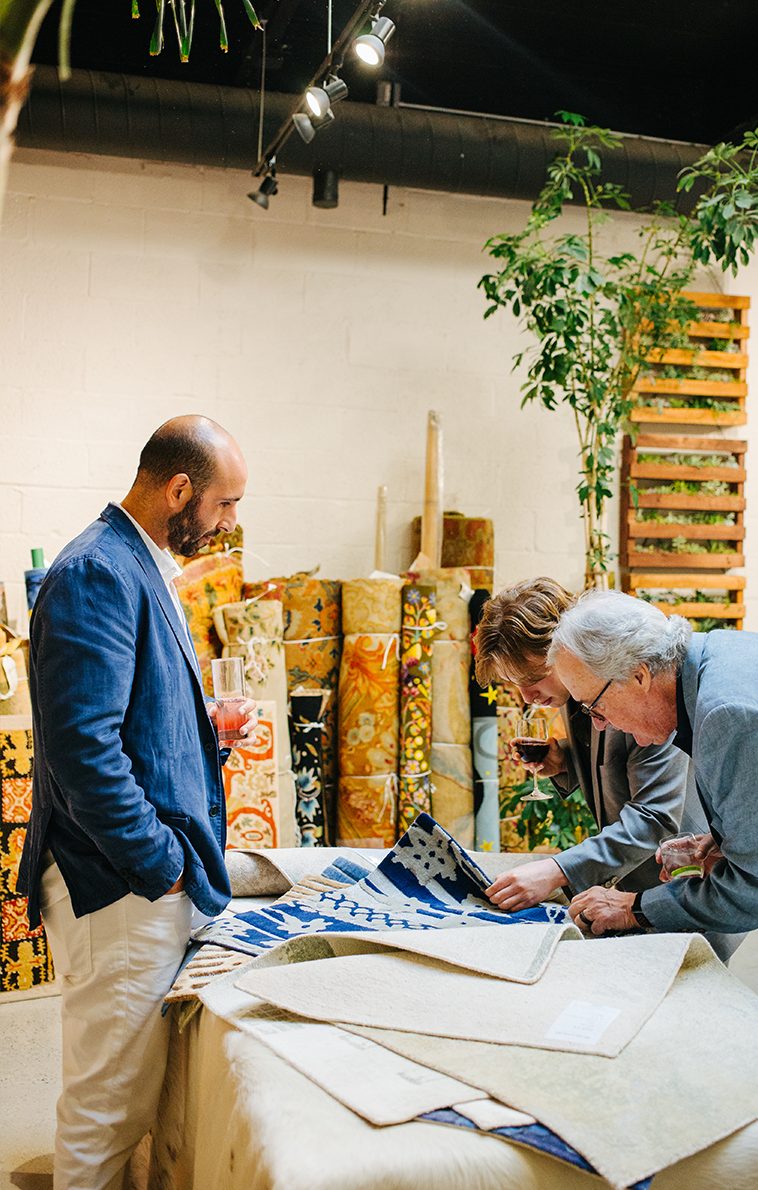
Sina with his clients
Luxury, Redefined
Antiques are where his voice lowers. European carpets, in particular, he treats not as décor but as fine art—pieces with provenance, presence, and patience. “These rugs challenge me,” he admits. “They demand your time, your study, your respect.” He is drawn to conversation with the historians of the field—people like his father, who have seen enough to separate the merely rare from the truly meaningful. And while the market’s center of gravity may tilt toward quieter, textural work, Sina remains committed to presenting the antique canon with context and care: pieces that reward the eye today and stand with authority tomorrow.
His modern affinities are equally clear. The Art Deco archive, seeded at the start of the custom era, has matured into an enduring pillar—Austrian to French to Chinese Deco, edited and expanded over decades. Approaching its centennial, the period reads newly strong: geometry with grace, color with restraint, versatility without compromise. It’s no accident that architects, collectors, and hoteliers return to these designs—there’s a clarity of line and mood that translates across interiors and cultures.
What distinguishes Sina, though, is not inventory; it’s an ethic. He calls it hospitality. “I see my role not just as sales, but as hospitality—true hospitality,” he says. “The kind that makes designers feel they’ve stepped into a home when they walk into our showroom. The kind that says: you’re safe here. Create boldly.” His other creative outlet—cooking—sharpens that instinct.
Cooking as a parallel discipline of refinement and joy.
He invests in restaurants, cooks seriously, and brings the discipline of service to the studio floor: refine, taste, refine again. “Every human needs a creative outlet,” he adds. “Cooking helped me do better—hospitality, refining craft, putting a smile on a face even for a short period.” The translation to rugs is direct: be willing to experiment, willing to fail, and committed to making it better next time. Much like the way a fine restaurant anticipates every detail of its guest’s evening, Sina believes true luxury lies in service: attentive, discreet, and deeply personal. Like the world’s finest restaurants, his approach is rooted in precision, warmth, and an almost obsessive attention to detail—ensuring that each rug, like each dish, is presented not just beautifully, but meaningfully.
Inside the business, that ethos is operational. Emails are written for clarity of tone and confidence. Questions from the sales floor are anticipated, not waited on. The team is encouraged to adopt a shared language and still keep their own voice. Above all, integrity governs. “My father is the most service-oriented person I know,” Sina says. “We go the extra mile.” The standard is love first—intentional, exacting care that begins with how you treat your colleagues and extends to how you hold a client’s vision. It is a simple rule with uncommon consequences. In an age where “luxury” is often diluted by immediacy and trend, Sina is restoring its soul.
Walk a project with Sina and the posture is consistent: relationship over transaction, education over persuasion. Over three years, he’s grown major accounts, stepped into sales leadership, and, by his father’s own measure, become the strongest early-career salesperson the company has seen.
“This business isn’t hard,” he says with a smile. “What’s hard is doing it right. But that’s where the magic is.”
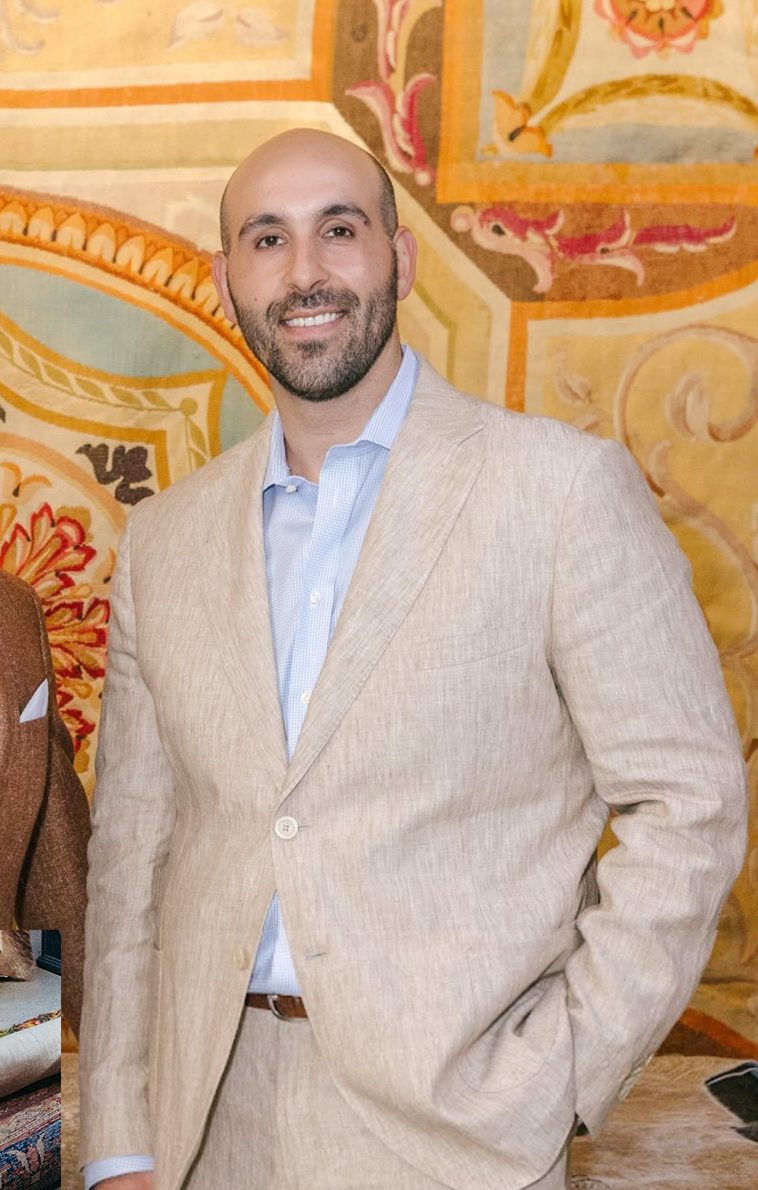
Sina Nazmiyal
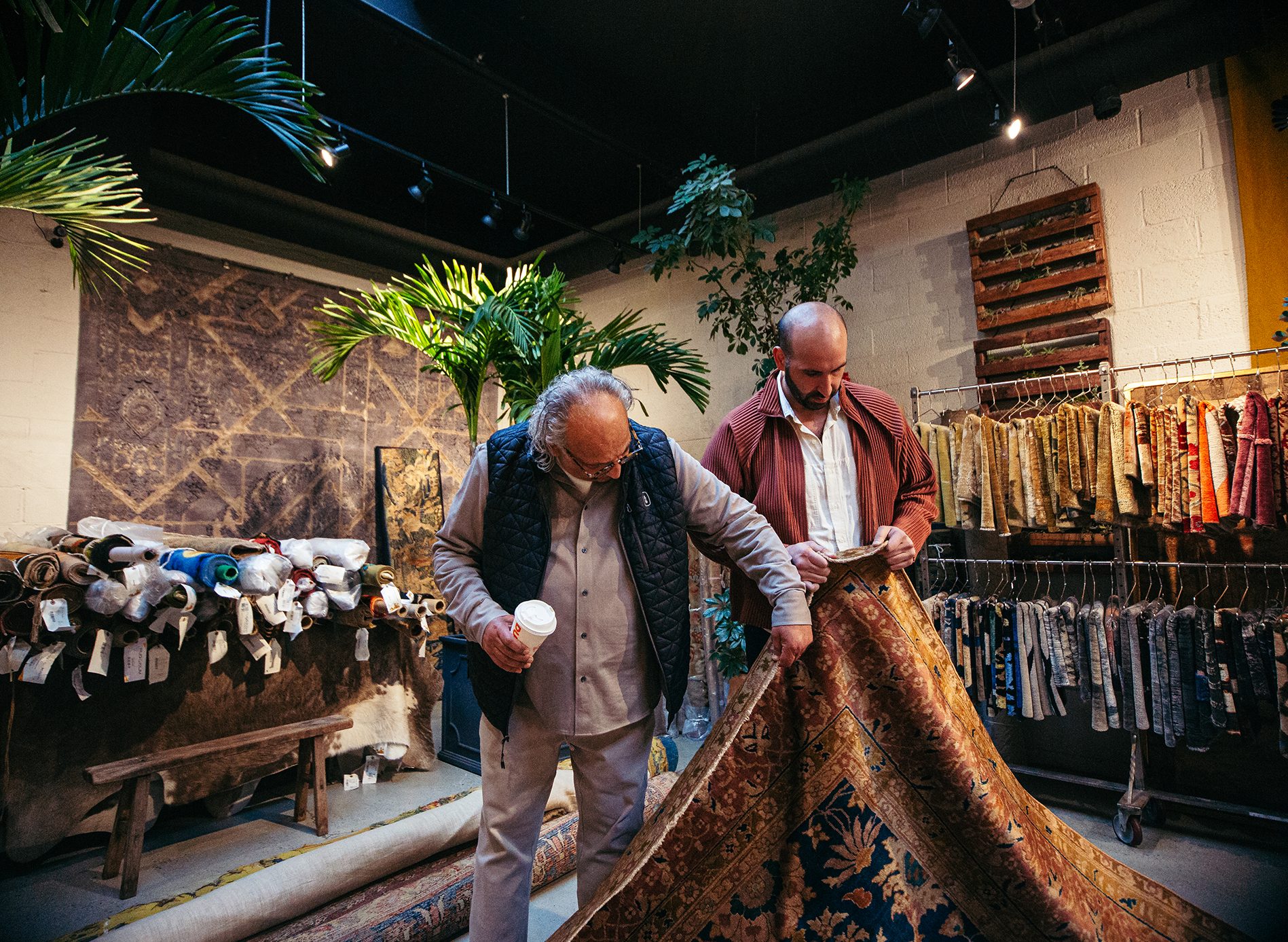
The Philosophy of Being a Nazmiyal
Love, integrity, and a lifelong devotion to craft.
When asked what it means to carry the family name, Sina pauses. “It’s more than a name—it’s a philosophy. Love first. Intentional passion. Integrity.” He challenges his team to embody that ethos, to refine their craft, to understand that rugs are not a career but a lifelong practice. “This industry gives back endlessly if you commit. It makes you worldly, it humbles you, it rewards you.” It’s a privilege to study under Josh, he says, and a responsibility to build something larger in his honor without losing the fundamentals that made it worthy in the first place. The goal is a lifelong legacy.
There is an unmistakable sense of return in his story. Not a retreat to safety, but a decision to choose what had always been present—to take the eye he formed through his father’s rooms and make it his own. “I’ve developed my taste through my father’s eyes, yes,” he says. “But I’ve made it my own. And I hope to continue honing that perspective, with the influence of my clientele in front of me.”
And so we end where we began: a hand on a field of indigo, a pause that signals more than ownership. In joining Rug & Kilim, Sina didn’t step into a role; he stepped into a conversation—between past and future, rigor and warmth, object and atmosphere. The verdict, this time, is feeling. The craft is hospitality. And the legacy is a home built one honest rug at a time.
A Son, A Story, A Signature
This isn’t just my father’s legacy — it’s the start of my own.