
The Politics of Color in Rugs and Kilims: Empire, Trade, and Exchange
September 4, 2025
A Walkthrough of Legacy, Design, and the Art of Understated Luxury with Sina Nazmiyal
September 8, 2025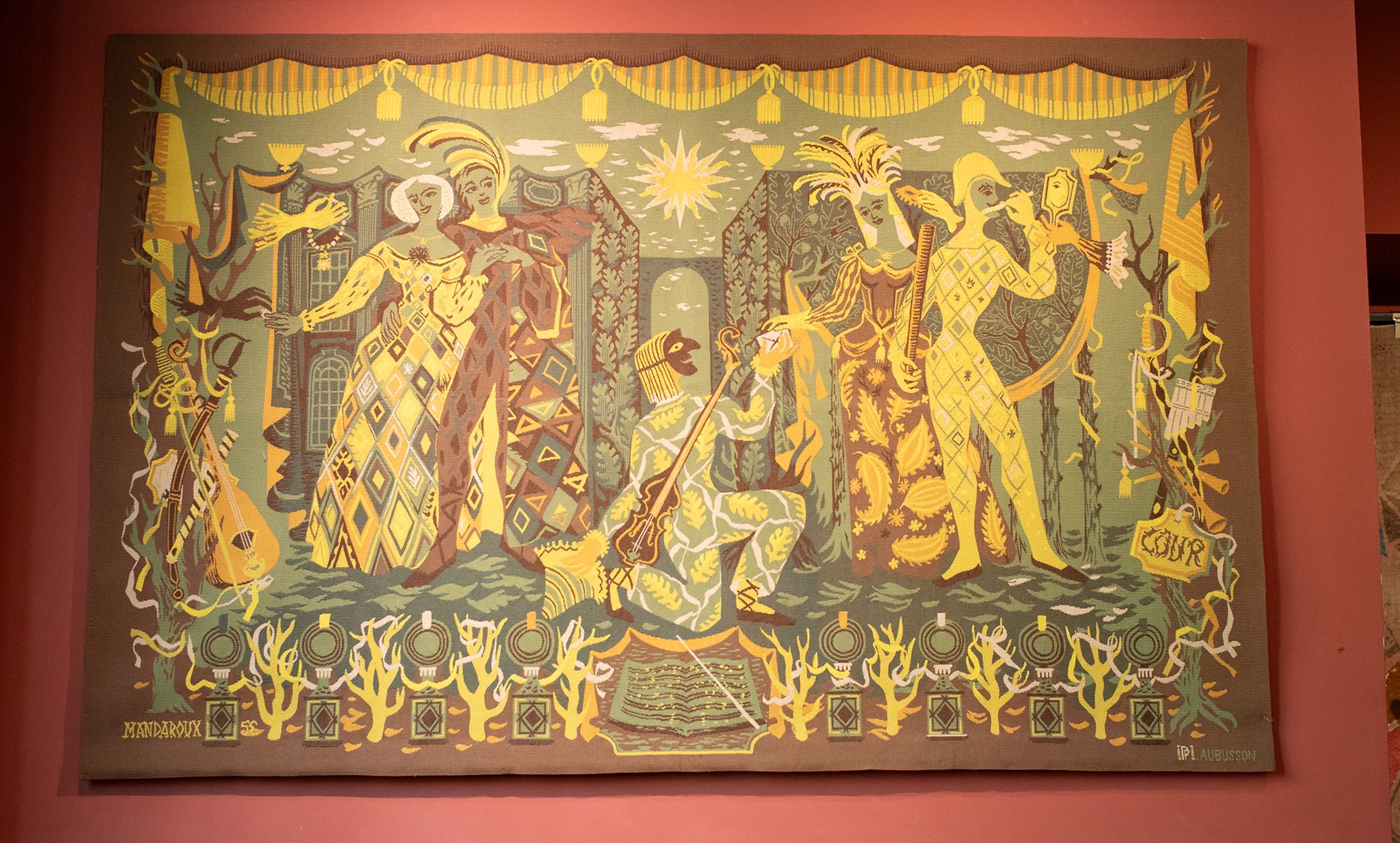
When the name Aubusson appears in a conversation among connoisseurs, it evokes an institution: five centuries of tapestry production that has furnished the courts of France, the grand hôtels particuliers of Paris, and the most ambitious interiors of Europe. Yet, the 20th century forced Aubusson into an existential shift. With the Second World War leaving both industry and identity fractured, the ateliers of central France were compelled to modernize. Painters, architects, and designers were invited to collaborate, transforming tapestry from historicist ornament into a modern art form.
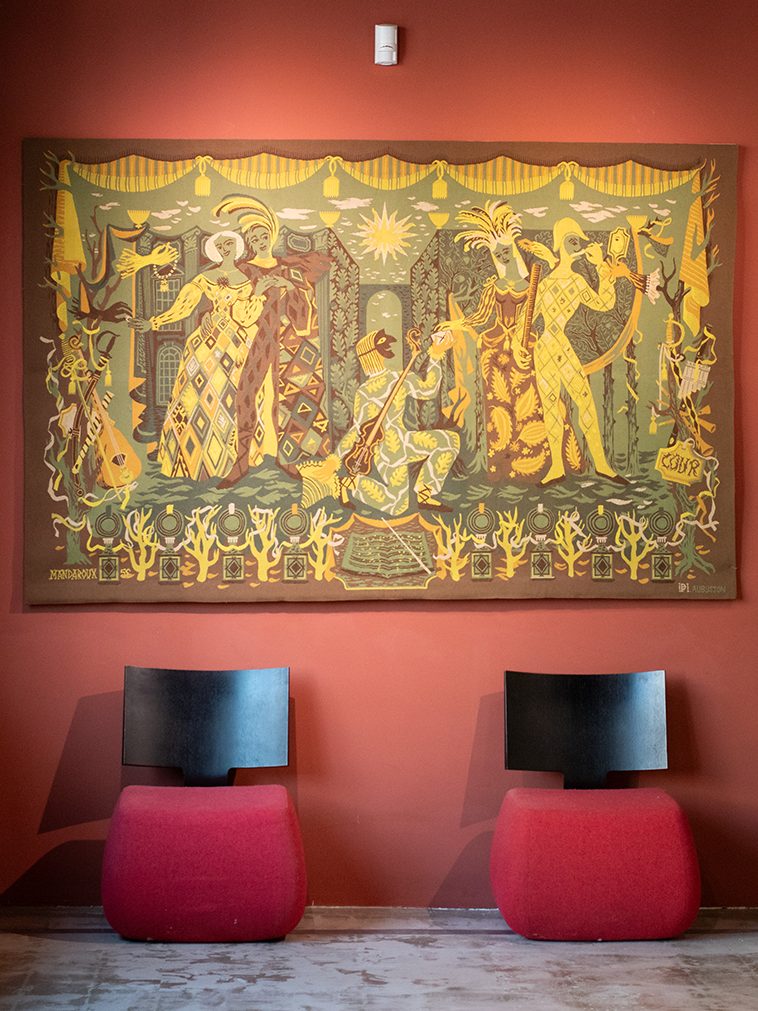
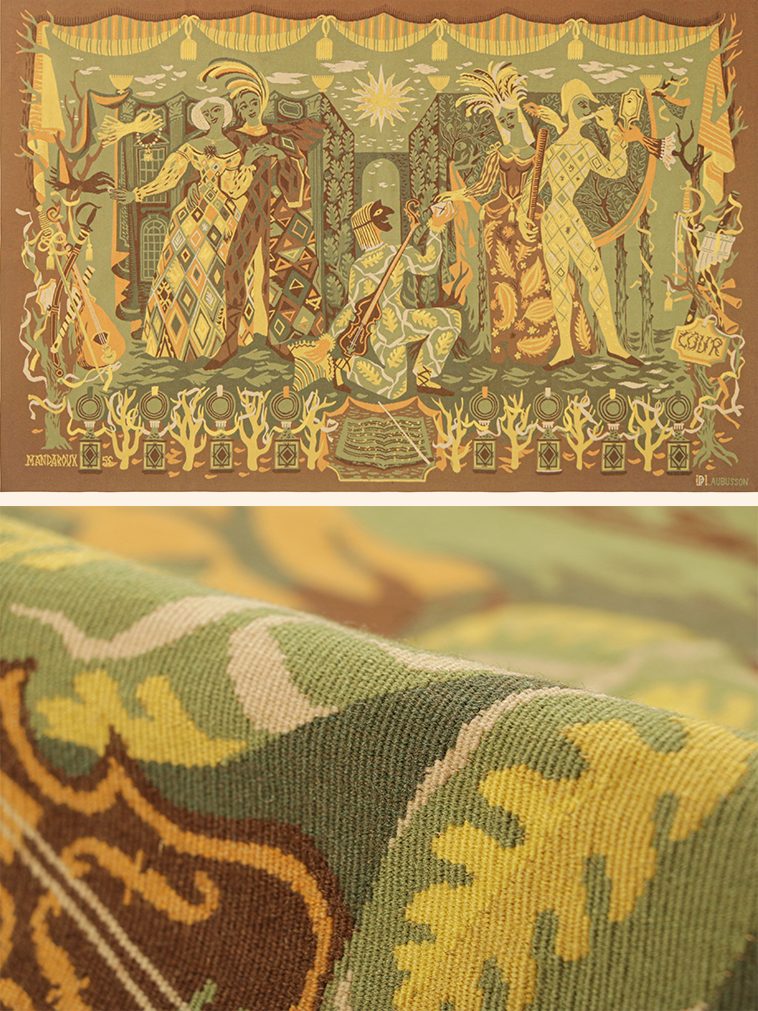
It is within this cultural pivot that Mandaroux’s Le Carnaval must be situated. Designed in the 1950s–60s, it embodies the ethos of the Aubusson revival under Jean Lurçat’s direction: bold figuration, simplified palettes, and compositions that embraced modernist geometry while retaining tapestry’s traditional monumentality.
Carnival as Allegory
The theme of carnival was not chosen lightly. For centuries, carnival in European culture represented temporary release from hierarchy and a sanctioned inversion of order. In postwar France, this allegory resonated with particular force. The country was negotiating liberation, reconstruction, and the memory of occupation. Carnival’s masks and theatrics offered a symbolic language for both liberation and the careful re-staging of national identity.
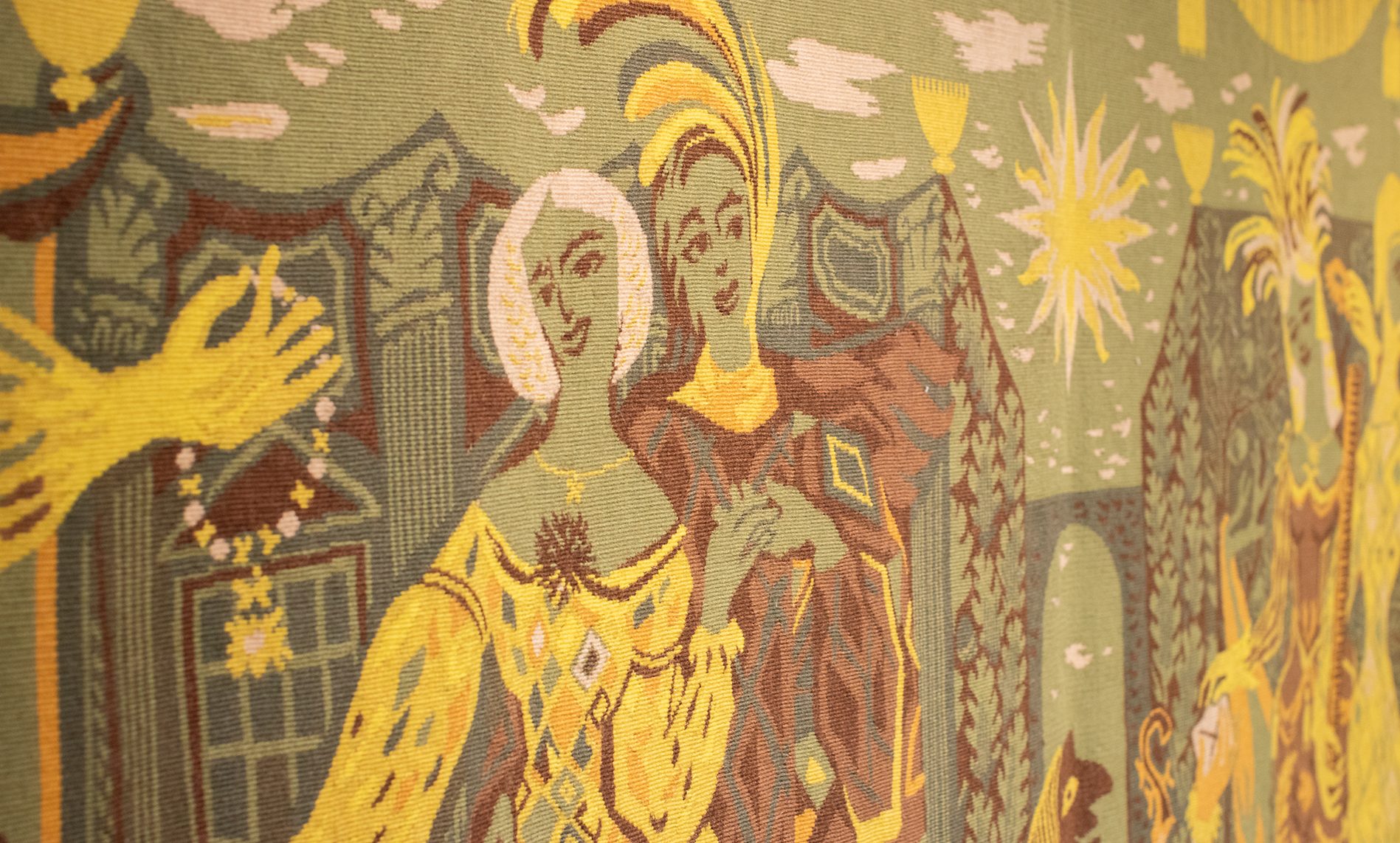
Mandaroux translates this allegory into elongated figures in harlequin costume, musicians, and stylized suns and swags. Unlike the pictorial realism of 18th- or 19th-century Aubussons, these figures are flattened, abstracted, and rhythmically arranged. They speak less to a specific narrative and more to archetype and performance.
A Language of Color and Form in Tapestry
Jean Lurçat’s reforms in the 1930s and postwar decades positioned Aubusson as a medium for fine art. Painters such as Picasso, Miró, and Le Corbusier would later have designs translated into tapestry. Mandaroux, though less internationally known, worked within this same ecosystem: an effort to preserve Aubusson as a living art while distancing it from its 19th-century association with aristocratic pastiche.
Thus Le Carnaval is not simply decorative—it represents a deliberate cultural strategy. France, facing competition from industrial design and the decline of aristocratic patronage, repositioned tapestry as both export and emblem of national creativity. Works like this were shown at international exhibitions and circulated through diplomatic channels to assert France’s relevance in the postwar cultural economy.
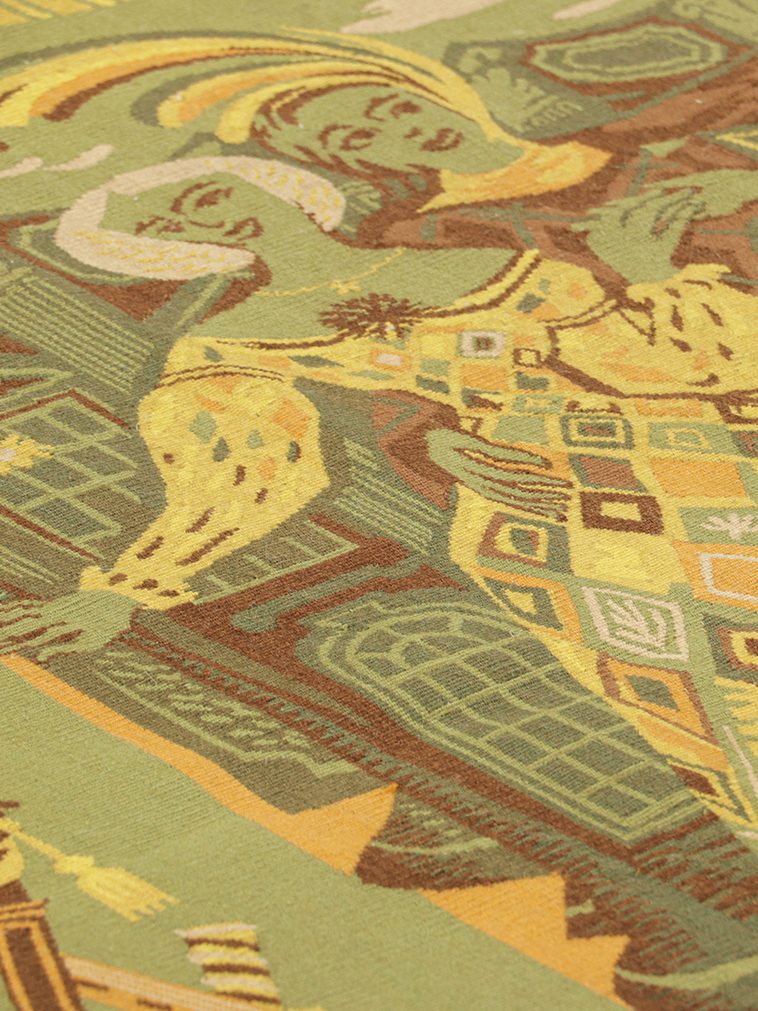
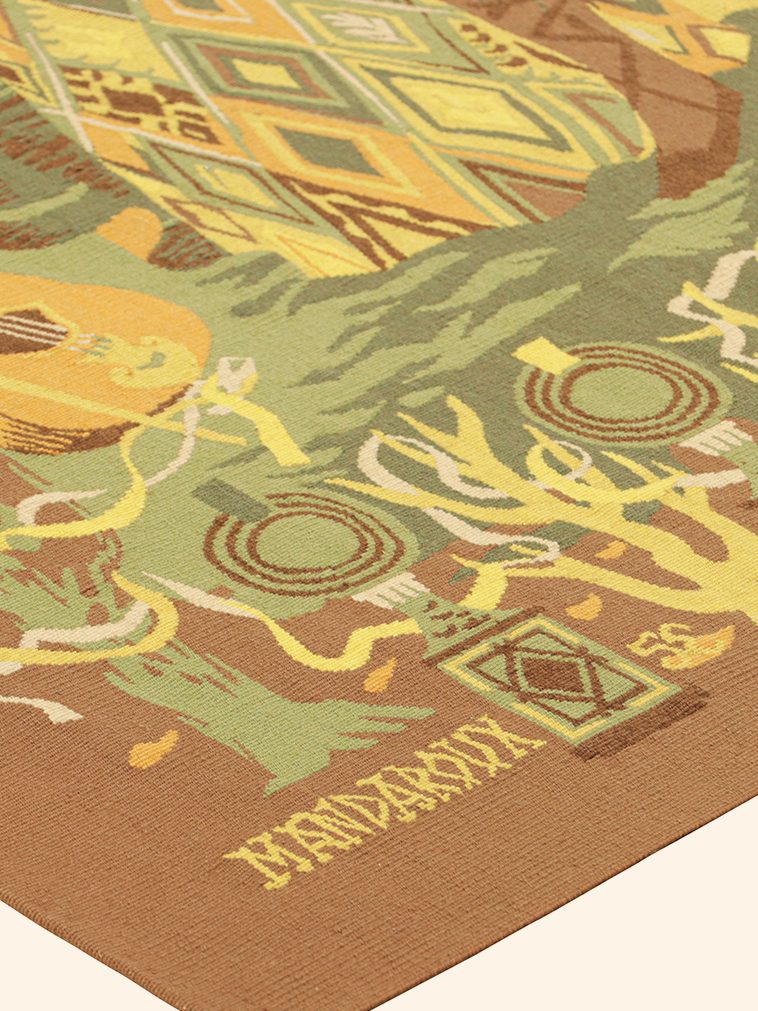
The palette is also a study in postwar French restraint: sage greens, golden ochres, and umber grounds that align with contemporaneous trends in both interior design and haute couture. Where 19th-century Aubussons once dazzled with florid realism, Mandaroux instead reduces the world to tonal harmonies and architectural scaffolds. The upper swags and lower flames serve as framing devices—modernized vestiges of theatrical décor—while the figures unfold across a rhythmic axis of symmetry and counterbalance.
This formal rigor is what situates Le Carnaval firmly within the high discourse of mid-century French textile art, in dialogue with Jean Lurçat and the broader Aubusson renaissance that sought to reposition tapestry as both fine art and applied art.
From Aubusson to the World Stage
It is worth recalling that postwar France turned deliberately to tapestry as a cultural export. In the 1950s and 60s, Aubusson works were presented at world fairs, international salons, and diplomatic venues to showcase France’s capacity for renewal. In this light, Le Carnaval transcends its decorative function: it is part of a national project to reclaim cultural authority through the marriage of tradition and modernity.
Collectors today should therefore read Mandaroux’s work as an evidence of a cultural strategy that used wool and warp as instruments of soft power. To acquire such a piece is to engage not just with a work of art, but with the political imagination of a country rebuilding its identity through design.
Stylistically, Mandaroux’s tapestry aligns with the School of Lurçat but carries echoes of Art Deco’s geometric elegance. Its theatrical motifs recall Léon Bakst’s Ballets Russes designs and, further back, the allegorical pageants depicted in 16th-century Flemish tapestries. Unlike the florid Aubussons of the Second Empire, which emphasized botanical density and trompe l’oeil realism, Le Carnaval is resolutely planar and graphic. It is, in essence, a bridge between Renaissance pageantry, 20th-century stage design, and mid-century abstraction.
Journal Edit
Journal Edit
The Modern Collector’s Lens
Today, mid-century Aubussons are gaining renewed recognition among serious collectors, particularly as museums reassess the 20th-century revival. While pieces by Lurçat and his close circle command the most visibility, works such as Mandaroux’s represent the wider ecosystem of artists who ensured Aubusson remained vital.
For interior designers, the tapestry offers both gravitas and adaptability. Its size and muted palette allow it to anchor a library, salon, or gallery wall without overpowering architectural detail. Yet its imagery ensures it remains a conversation piece—resonant with history, politics, and design discourse.
Renewal Woven
Mandaroux’s Le Carnaval is not simply a mid-century tapestry; it is a document of cultural reinvention. It marks a moment when Aubusson deliberately turned to modernism to remain relevant, when carnival was more than festivity—it was allegory for a society emerging from trauma into renewal.
To live with this tapestry is to engage with five centuries of tradition reframed for a modern world. For the collector, curator, or designer, it represents not only a decorative acquisition but a statement: that woven art, at its best, remains theatre, memory, and cultural strategy intertwined.