
Scandinavian Design and its Connection to Art Deco and Jugendstil Art Movements
June 26, 2024
Oushak Rugs – An Oriental Guide to History, Styles and Significance
July 1, 2024Belkıs Balpınar emphasizes that while many contemporary artists focus on the chaos and issues of the current world, she is drawn to exploring the essence of our being from a more universal perspective.
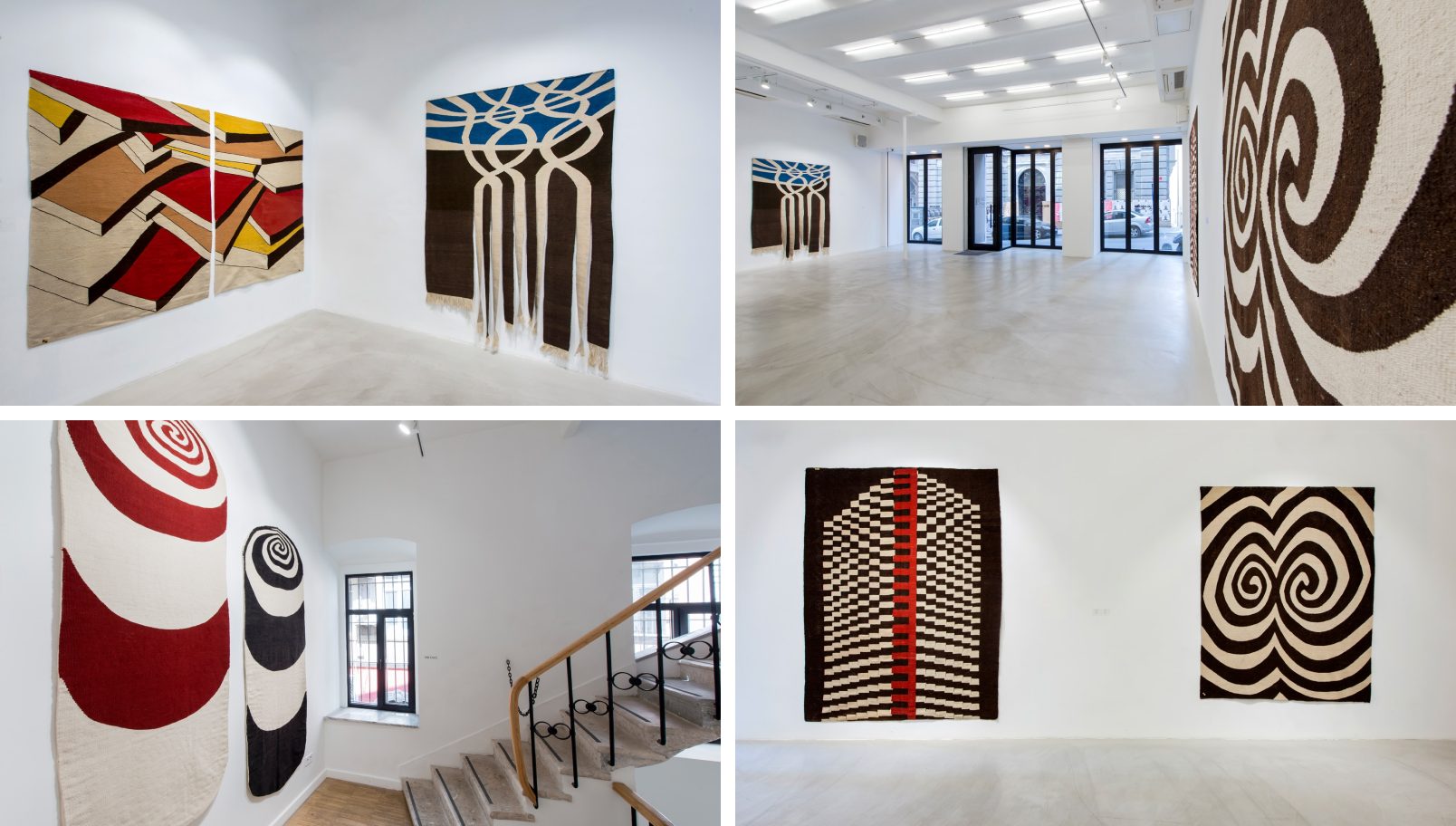
Belkıs Balpınar‘s latest works are on show at the Anna Laudel Contemporary Gallery in Istanbul’s Karaköy district. Balpınar’s fascination with micro and macro worlds is reflected in the names of her pieces, inspired by theoretical physics and experimentation with light. Her exhibition “Un-Weave” at Anna Laudel Contemporary featured new “unwoven parts” alongside a retrospective collection, showcasing her evolution from curator to creative practitioner. Balpınar considers her current work as artwork, emphasizing her transition from floor kilims to wall art.
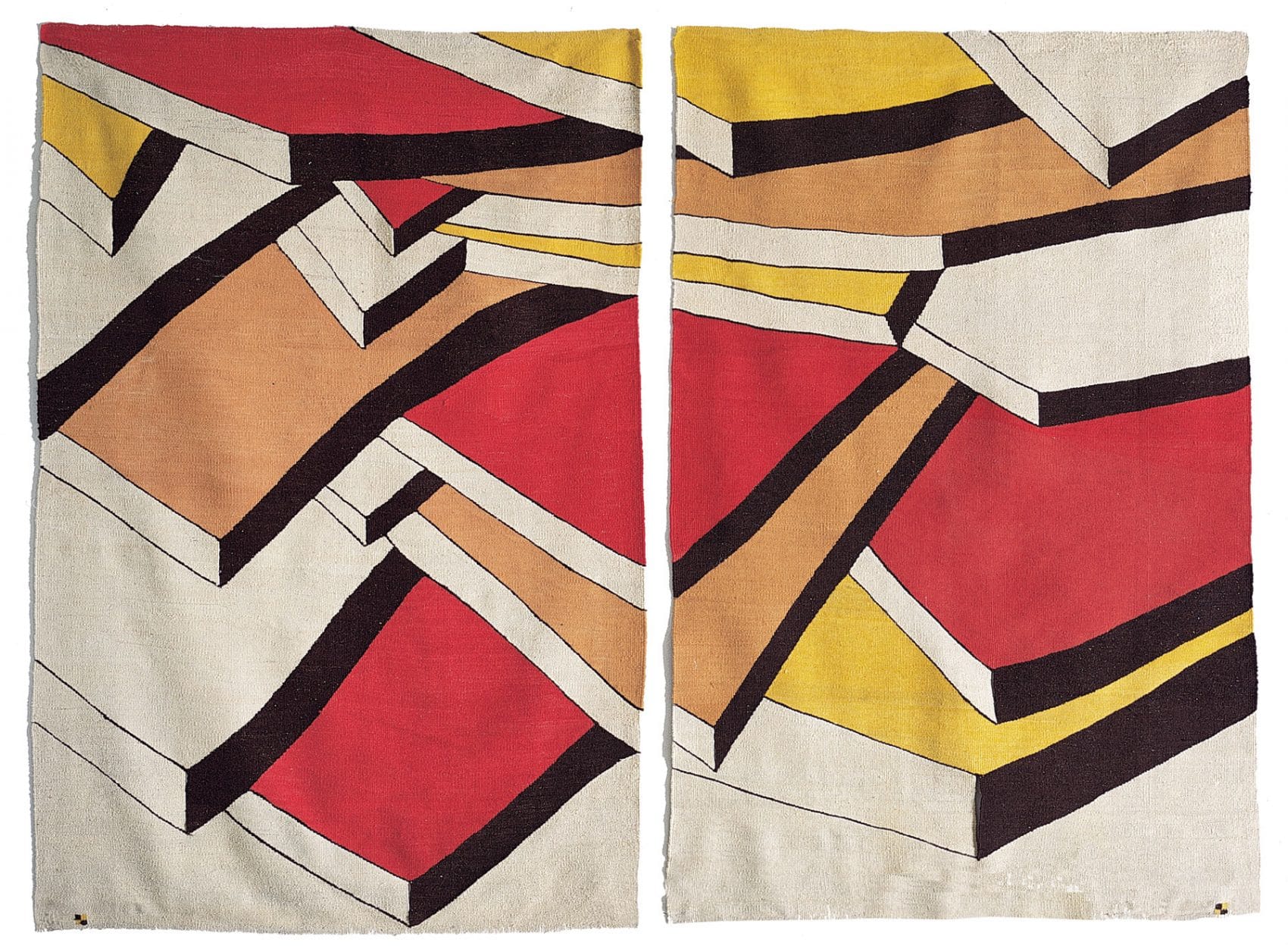
Belkis Balpinar Un Weave Anna Laudel Contemporary 2018
Contemporary artists utilize tapestry to delve into political themes, confront the harsh realities of modern conflict, and explore questions of identity and sexuality. The enduring craft of tapestry continues to evolve as a powerful medium for artistic expression and social commentary in the 21st century.
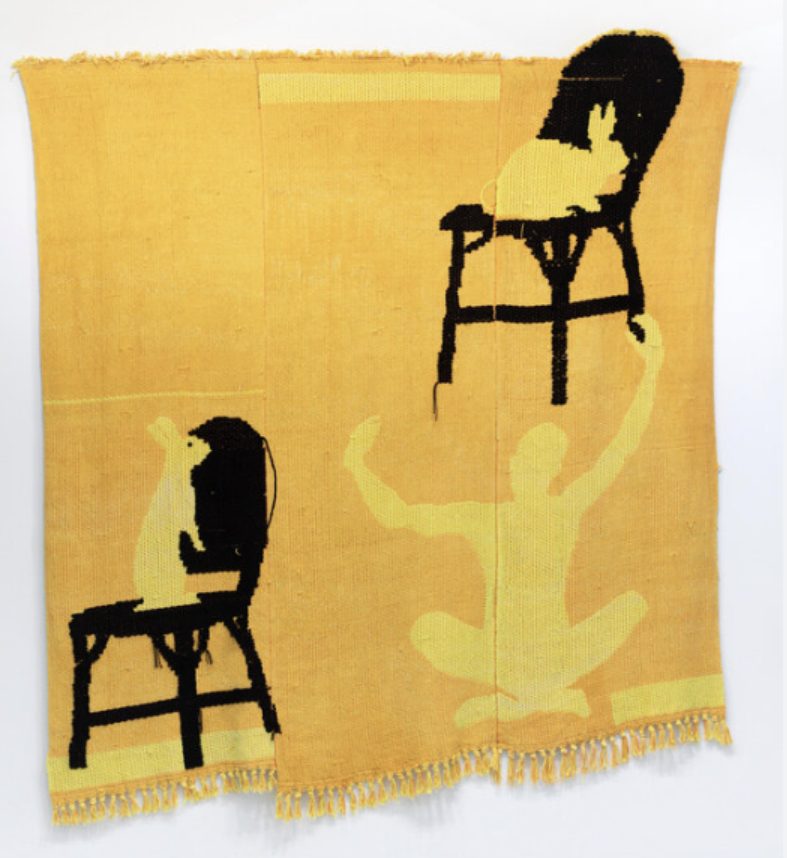
Read more about it here – https://rugandkilim.com/blogs/contemporary-tapestries-exploring-politics-and-modern-conflicts-in-light-of-diedrick-brackens-and-erin-m-rileys-work/
Belkis articulates her different approach and perspective by saying – “The world that human beings created is very complicated. However, in the billion-galaxy and billions of stars within them, we see a regularity and order which is a result of our perception of time. Many artists are trying to find and reflect on something from the chaos throughout the world. Yet, I try to capture images that imply spaces created by the movements of the galaxies and planets in the micro state, or particles in the micro-space that seem more ordinate in regards to our understanding of time.”
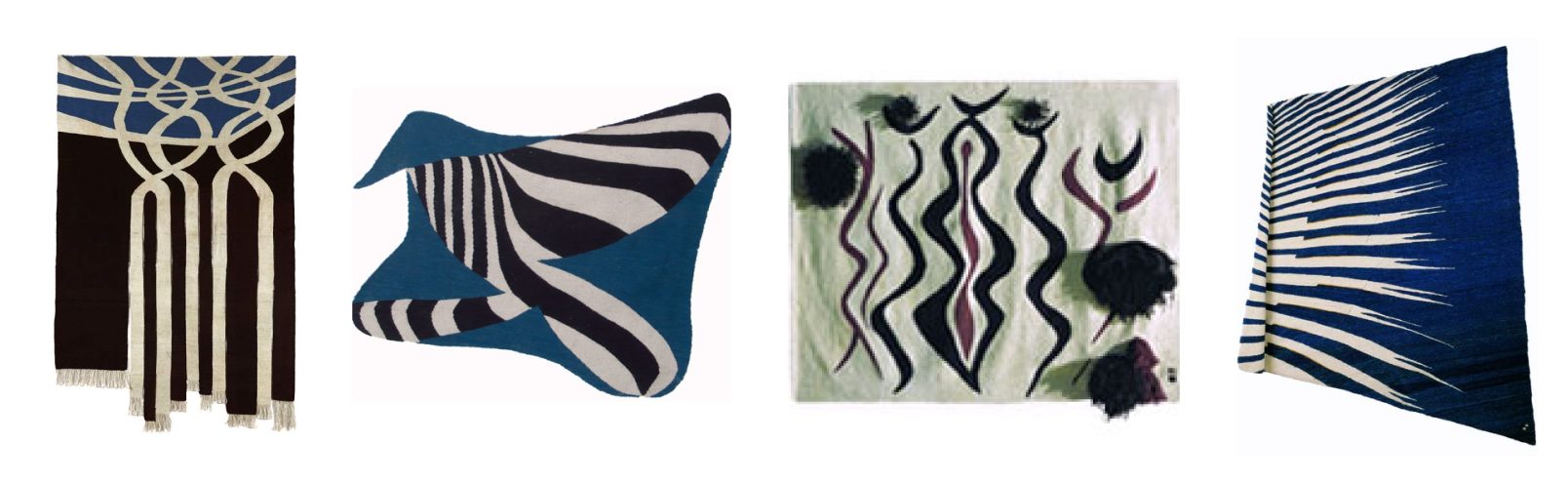
A traditionally feminine art, weaving and tapestry making has long been relegated to the realm of ‘craft’ rather than recognized as an artistic pursuit, largely because it has been considered ‘women’s work.’ Belkıs Balpınar has revolutionized this traditional art form, elevating it to new heights. She refers to her creations as ‘artkilim,’ a term derived from the ancient technique of flat-woven carpets known as kilim, which she uses to produce her intricate wall hangings. Balpınar’s engagement with tapestry goes beyond her personal artistic practice. She has served as both a curator and director of major museums and collections specializing in Turkish and Islamic carpets and kilims. Her expertise spans both traditional and modern methods and styles, making her a significant figure in the preservation and innovation of textile arts. Through her work, she bridges the gap between craft and fine art, demonstrating the potential of weaving and tapestry making.
Belkıs Balpınar is known for her unique abstract visual language, blending modernist aesthetics with contemporary thought and scientific concepts. Her intricate compositions feature circles, ellipses, and other geometric abstractions, mirroring the dynamic elements found in the universe. Through her art-kilims, she creates aesthetic representations and models of multidimensional realities, suggesting galaxies, planets, and particles in macro and micro states. Balpınar’s work transcends conventional visual perception and rational imagination, exploring interconnected spheres of micro and macro realms. Her rugs challenge linear world constructions, embracing pluralistic notions of time, space, and their complex relation to our reality.
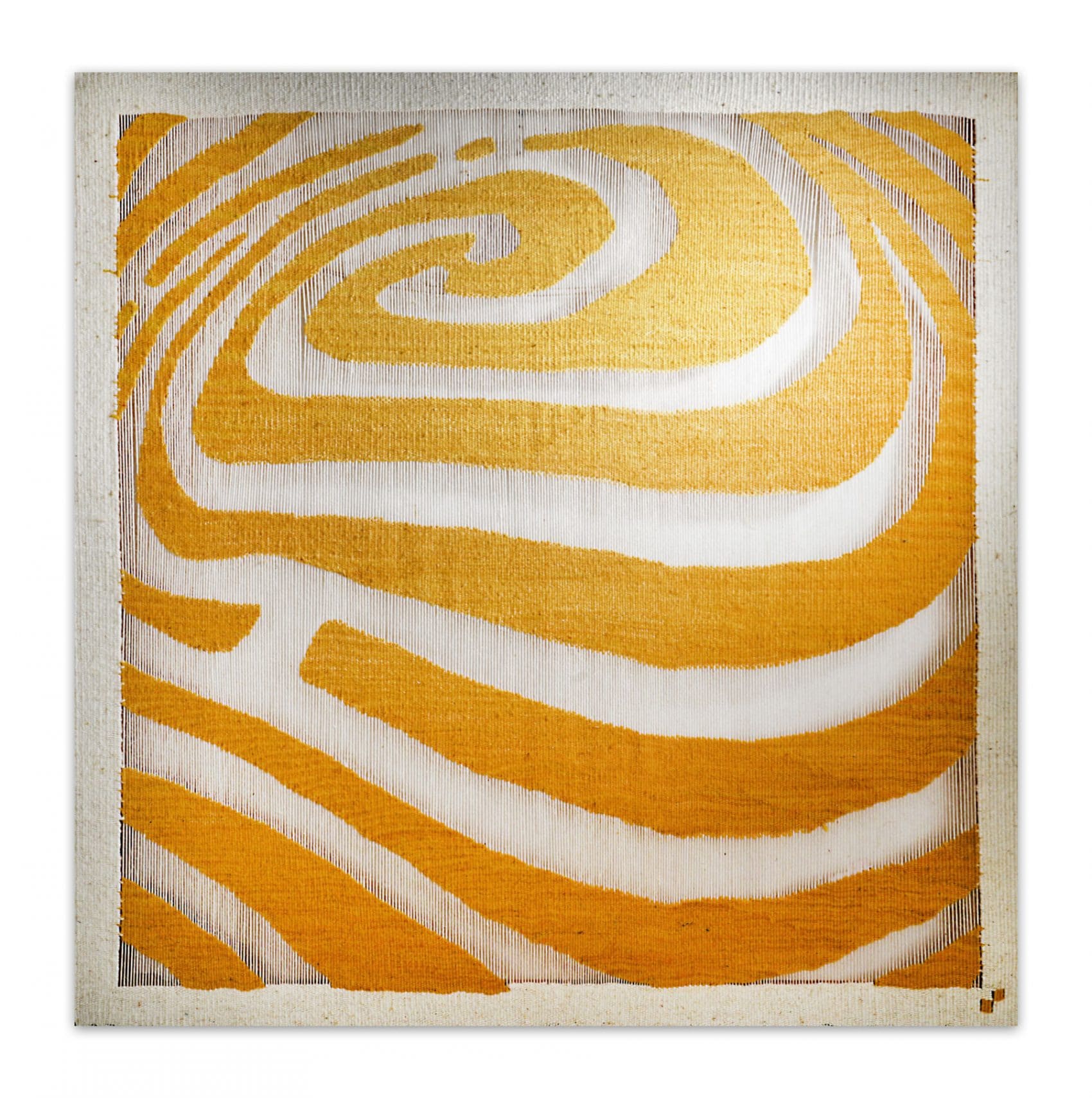
Belkis Balpinar Un Weave Anna Laudel Contemporary 2018
After completing her education at the State Fine Arts Academy in Istanbul, Belkıs Balpınar embarked on a distinguished career path. She started her journey as the curator of the Carpet Department at the State Museum of Turkish and Islamic Art. Following this, she took on the role of Founding Director at the Vakıflar Carpet and Kilim Museum in Istanbul. Balpınar’s expertise extends to being a researcher and author of numerous reference books and articles on traditional Turkish rugs and carpets. She continues to contribute to the scholarly community in this field, sharing her extensive research and insights. Since 1986, Balpınar has been channeling her artistic talents into creating her own art-kilims, drawing from the traditional techniques of ancient Anatolia to express her unique vision of the universe.
Belkıs Balpınar is renowned for her contemporary interpretations of traditional kilims’ patterns and weaving techniques. Through her abstract designs, she skillfully manipulates the perception of reality, pushing the boundaries of two dimensions to create a sense of depth and complexity, thereby engaging with a third dimension. This innovative approach allows her to craft artworks that embody an ambiguous and intriguing space, capturing the essence of her vision.
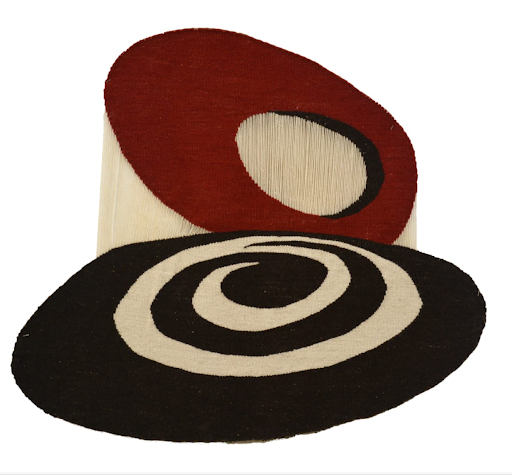
Her innovative works are deeply rooted in the textures of traditional rugs, yet they are profoundly inspired by scientific themes such as different spatial planes, the microcosm and macrocosm, quantum physics, and galaxies. These scientific fields are not only her artistic muse but also her area of scholarly inquiry, with her readings in physics and astronomy fueling her creativity. Balpınar’s creations on rug textures reflect movements in space, adding depth through motifs on plain rug warps. These motifs explore the relationship between space and the infinite nature of shadows, enhancing the dimensionality of her works. Influenced by Albert Einstein’s theory of the fourth dimension in space and time, Balpınar’s art exemplifies the symbiotic relationship between science and culture.
Globally, textile artists have emerged from regions without a textile tradition. In contrast, Turkey boasts a rich heritage of textile-weaving, famous for its distinctive rugs and kilims. However, contemporary art rarely intersects with traditional weaving in this region. Balpınar emerges as a prominent figure, bringing modern ideas to age-old techniques. Over the years, she has pioneered a unique method she calls “un-weaving,” which involves weaving the primary plane while leaving the background untouched. This technique better expresses forms in space, creating a three-dimensional pictorial plane akin to woven painting.
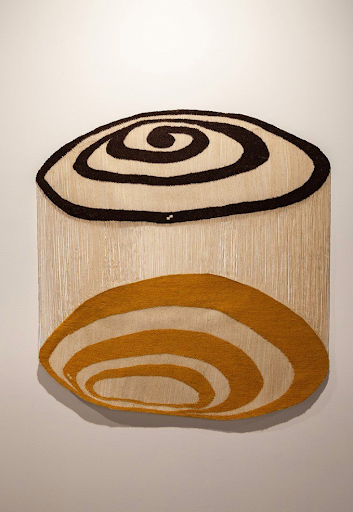
Belkis Balpınar has been a trailblazer in the realm of “art kilim” wall hangings since 1986, leveraging the traditional kilim structure to create stunning works of art. Her one-of-a-kind pieces, primarily crafted for exhibitions, showcase her mastery in weaving and her innovative approach to the art form. In addition to exhibitions, Balpınar takes on site-specific and corporate art commissions, exemplified by her notable works for the World Bank Building in Washington DC, the Aramco Center in Dhahran, Saudi Arabia, and the Marmara-Manhattan Hotel in New York. Her artistic reach extends globally, with exhibitions held in major cities such as Istanbul, Ankara, New York, Princeton, Tokyo, and Moscow, among others. Balpınar’s contributions to the art world have been recognized internationally, with her pieces displayed at prestigious events like the Modernist Exhibition in New York City and the Basel Art Fair in Miami, showcasing her artistry and creativity on a global stage.
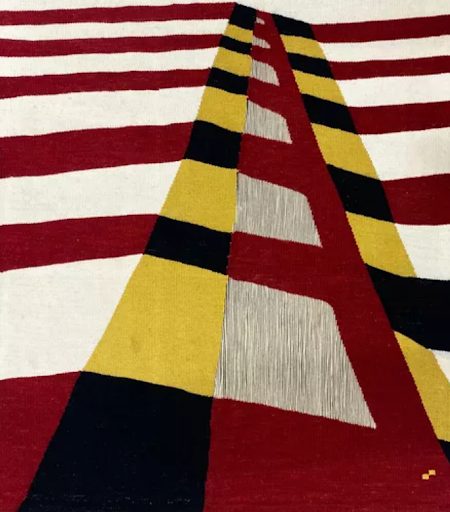
Belkıs Balpınar singles out symbolic motifs that are traditionally abundant in kilims. Through her minimalist art practice, she isolates these concepts and symbols, providing them with a fresh context.
Reinventing or even finding novelty in a tradition as old as tapestry is a challenging endeavor, yet Balpınar continues to innovate. Recently, she has shifted from the geometric shapes characteristic of traditional kilims to curvilinear forms, which more accurately reflect the shape of the universe. This new approach has enabled her to express ideas surrounding chaos and order more effectively. She has developed a technique she calls “not-weaving,” which involves leaving parts of the warp unwoven—a radical intervention in the medium. Balpınar’s deconstruction of traditional methods adds a new dimension to both the process and the form, pushing the boundaries of what tapestry can convey.
Find similar designs in our Mid-Century Modern Collection >>