
The Role of Jean Michel Frank in Defining Art Deco Luxury
March 26, 2025
Why the Rothschilds’ 17th-Century Persian Carpet Became a Record-Breaking Auction?
March 31, 2025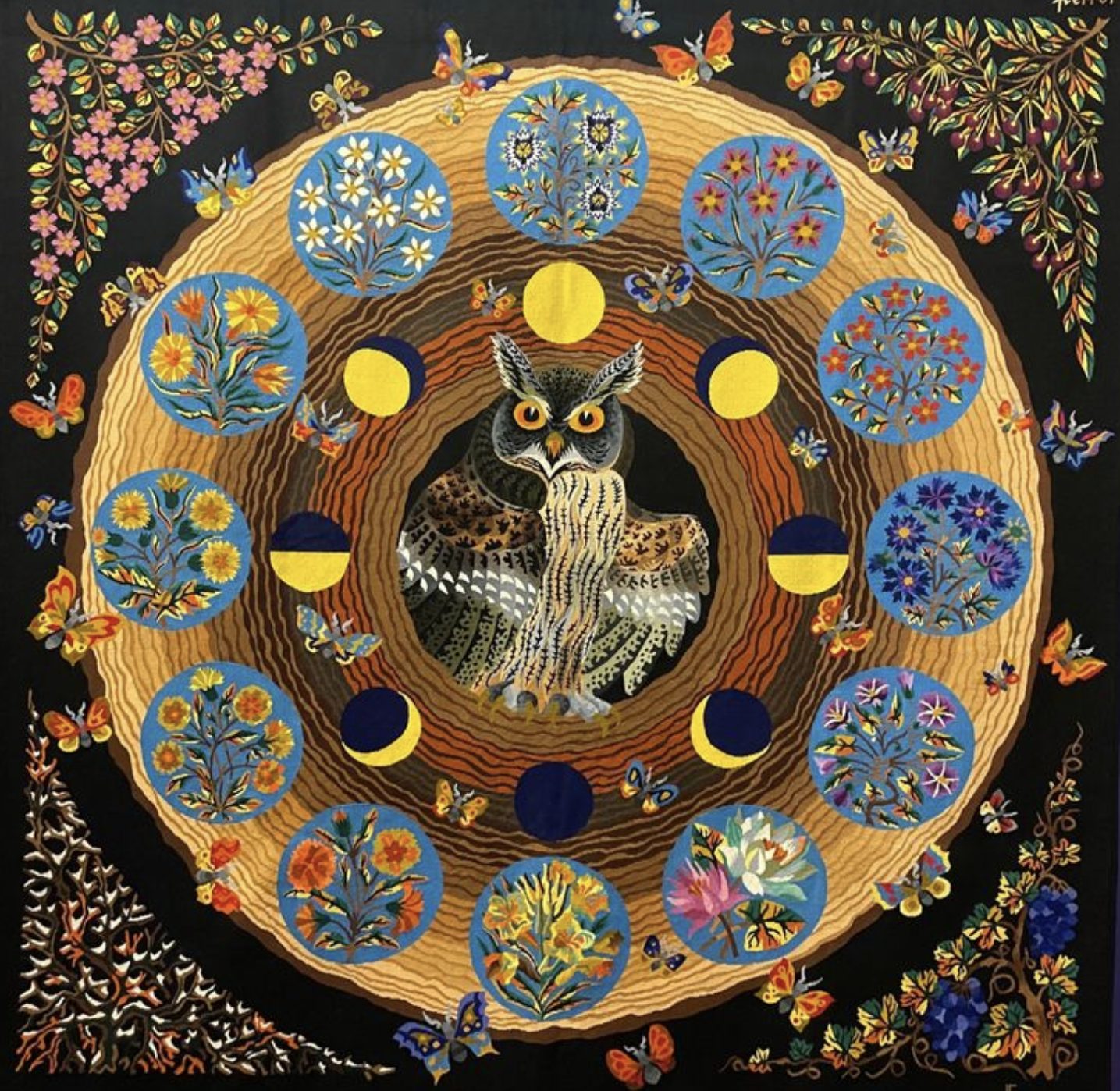
La nature mesurant le temps, René Perrot
The resurrection of French decorative arts after the devastation of World War II represents one of the most profound artistic revivals of the 20th century. At the center of this renaissance stands René Perrot (1912-1979), whose monumental tapestries encapsulate not merely a return to tradition, but a bold reimagining of France’s artistic identity amid the rubble of conflict.
When a nation’s cultural heritage lies in fragments, the artist becomes both archaeologist and architect. This sentiment echoed through the corridors of post-war French ateliers, where Perrot’s distinctive vision began to take shape.
After years of occupation and cultural suppression, France’s art community sought a path forward that honored heritage while embracing modernity—a duality Perrot mastered with exceptional finesse.
Early Formative Years of René Perrot
NO. 33799
Perrot’s journey began at the Gobelins Manufactory, where centuries of tapestry tradition resided in the very walls. Yet what distinguishes his work from mere continuation is his remarkable synthesis of classical technique with contemporary visual language.
The traditional Aubusson and Gobelins methods—painstaking, time-honored approaches to weaving—became in Perrot’s hands not relics but vessels for modern expression.
The historical context cannot be overstated. As France rebuilt physically, it simultaneously reconstructed its artistic identity.
The tapestry—historically a symbol of French cultural prestige since the reign of Louis XIV—became a potent vehicle for national renewal.
In the wake of destruction, we turn not to what is expedient, but to what is enduring.
This philosophy permeated the revival of decorative arts, with Perrot at the vanguard.
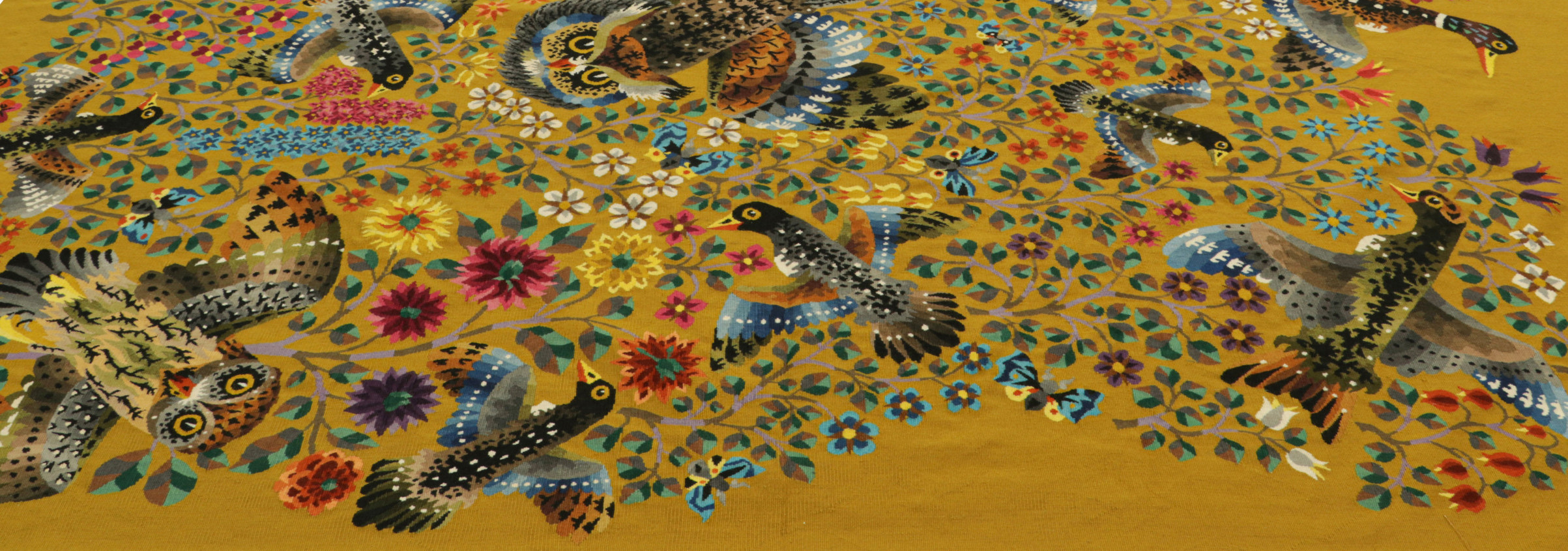
Distinguished Designs of Perrot
NO. 33799
His masterwork “Les Quatre Éléments” (1950) stands as testament to this philosophy. The four-panel sequence—depicting earth, air, fire, and water—merges abstract expressionist influences with classical allegorical traditions.
The composition recalls medieval narrative tapestries while incorporating color relationships that evoke Rothko’s emotional chromatic fields. Such juxtapositions define Perrot’s genius: the traditional medium becomes a canvas for distinctly contemporary visual exploration.
Perrot’s use of material deserves particular attention. While his predecessors relied almost exclusively on wool and silk, Perrot incorporated metallic threads, unusual synthetic fibers, and varying weave densities to create works of extraordinary textural complexity.
“The tapestry must not merely be seen; it must be experienced as a tactile reality in space.” This approach aligned with broader movements in French design, where Jean Prouvé and Charlotte Perriand were similarly reimagining relationships between material, form, and function.
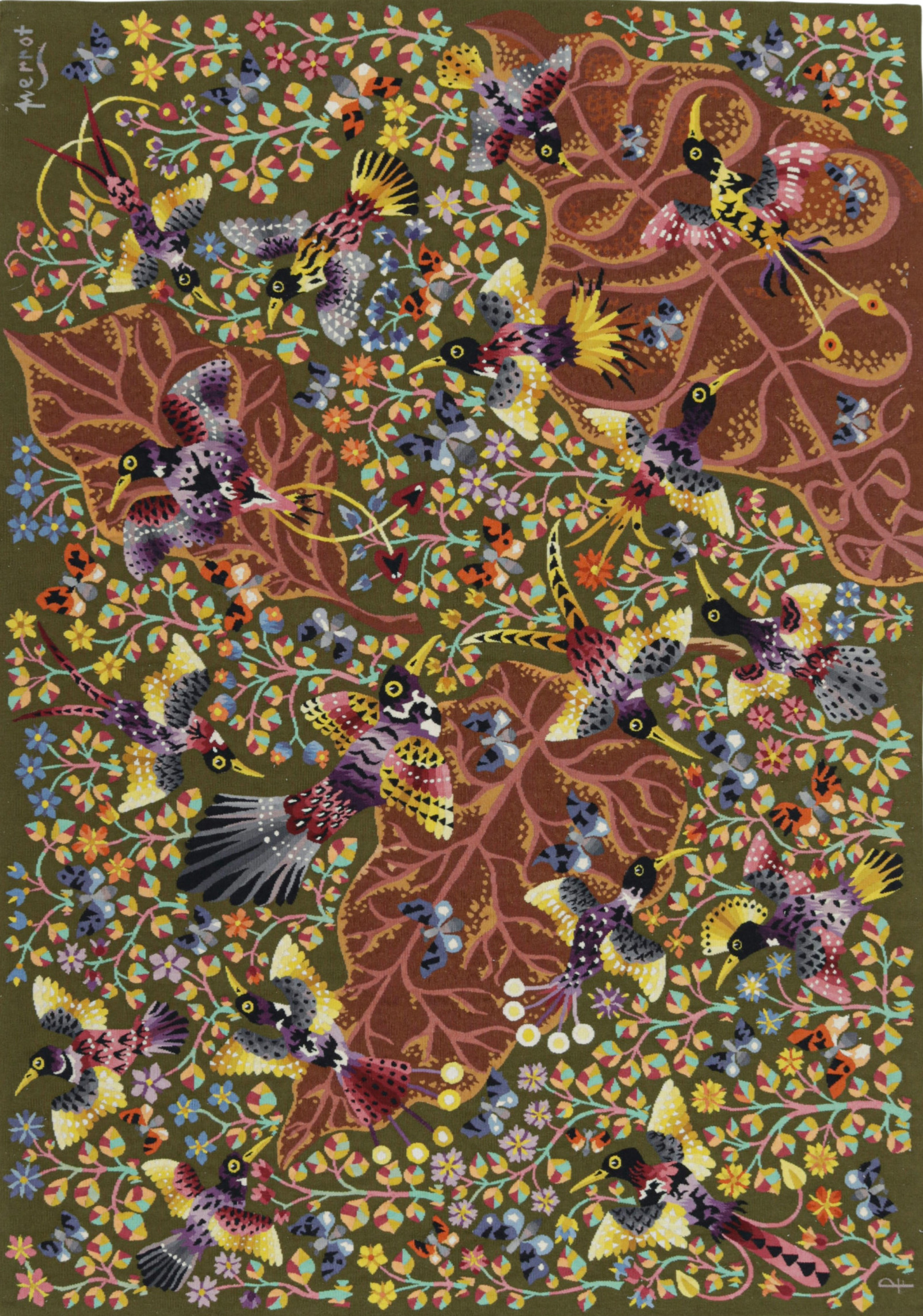
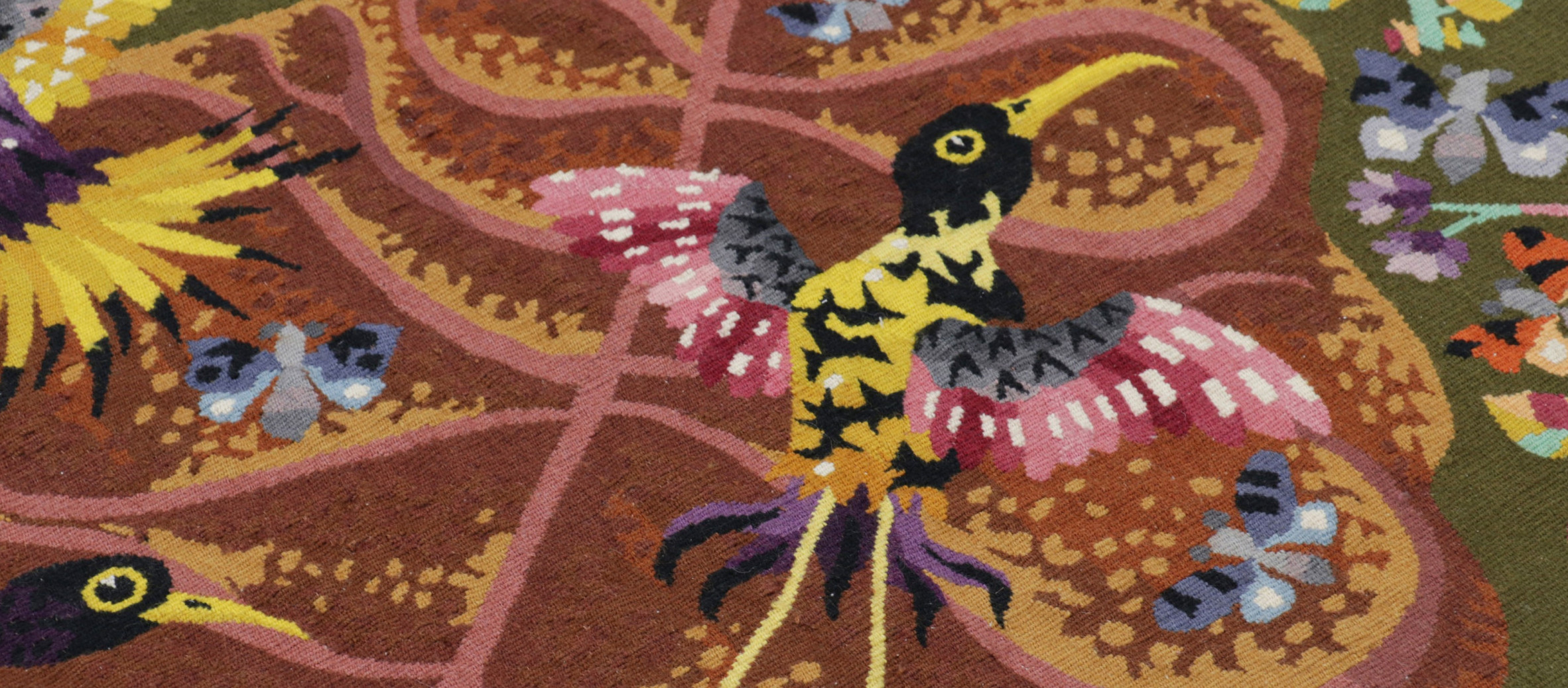
Post-war French decorative arts
The contextual significance extends beyond technique. Post-war French decorative arts faced the dual challenge of economic limitation and spiritual renewal. The government-sponsored “Mobilier National” initiative sought to revitalize French craftsmanship while creating employment for skilled artisans.
Perrot’s commissions through this program represent a deliberate national investment in cultural recovery. His monumental works for public buildings—including the UNESCO headquarters in Paris—demonstrate how decorative arts served not merely aesthetic functions but civic and diplomatic ones.
A nation speaks through its arts as clearly as through its politics.
This understanding drove the integration of Perrot’s works into architectural settings designed by modernist pioneers like Le Corbusier. The conversation between Perrot’s organic, textural tapestries and the clean, geometric lines of modernist architecture embodies the productive tension at the heart of post-war French design: tradition and innovation in constant dialogue.
International Recognition of René Perrot’s Works
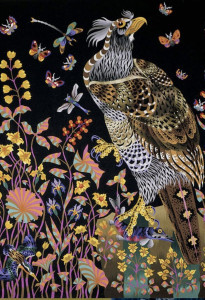
Au bord du lac, René Perrot
The international dimension of Perrot’s influence cannot be overlooked. As French decorative arts regained global prominence, Perrot’s works traveled to exhibitions in New York, London, and Tokyo.
His approach influenced American fiber artists like Lenore Tawney and Sheila Hicks, who encountered his work during formative visits to France. The exchange was reciprocal—Perrot absorbed influences from American Abstract Expressionism and Japanese textile traditions, transforming them through his distinctly French sensibility.
This cross-pollination parallels broader currents in post-war art. Just as Perrot navigated between figuration and abstraction in his tapestries, painters like Nicolas de Staël were exploring similar territory on canvas.
The arbitrary divisions between arts major and minor dissolve in the face of authentic creative vision.
The boundaries between “fine” and “decorative” arts—always more permeable in French culture than elsewhere—became increasingly fluid during this period.
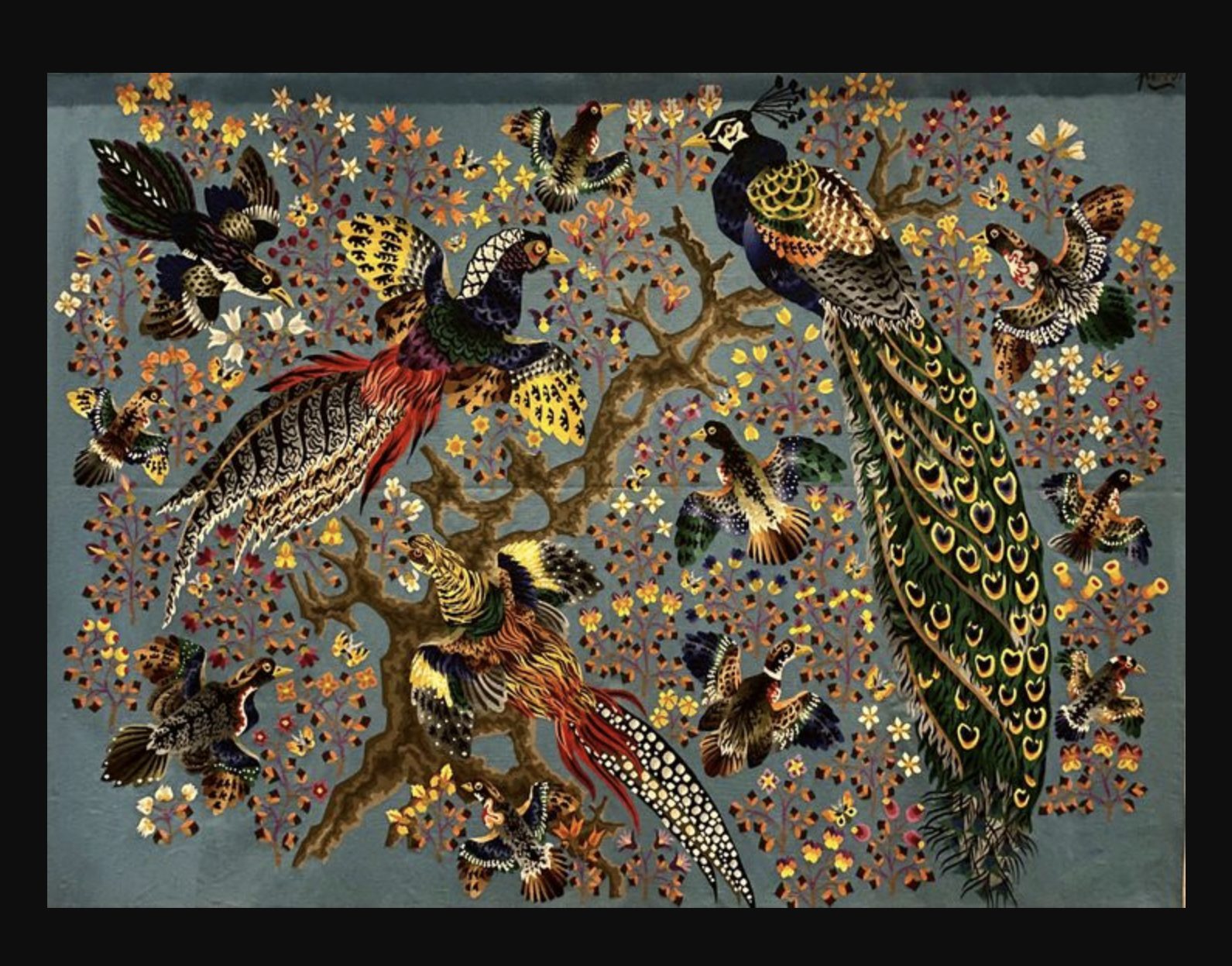
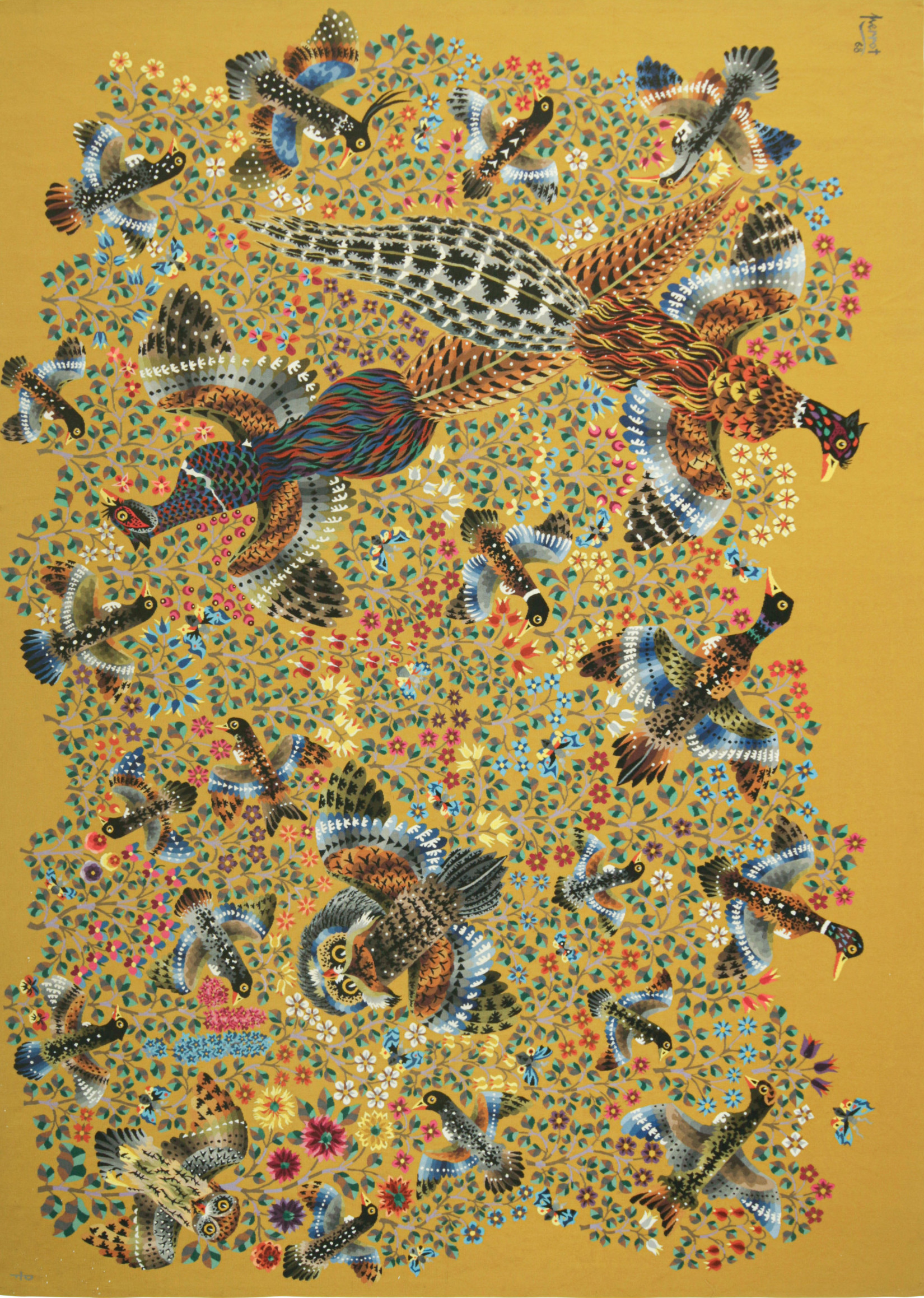
Si votre ramage, René Perrot
Legacy of Perrot’s work
Perrot’s color sensibility deserves particular recognition. His palette—often incorporating saturated blues reminiscent of medieval manuscripts alongside earthy ochres and unexpected flashes of modernist primaries—creates a distinctive visual signature. These chromatic choices reflect the broader French decorative arts revival, where color became increasingly bold after years of wartime austerity. The parallels with Matisse’s late paper cut-outs—another post-war flowering of French visual culture—are striking in their shared celebration of color’s emotional and symbolic potential.
The legacy of Perrot’s work continues to resonate. Contemporary French tapestry artists acknowledge his pivotal role in reimagining the medium for modern contexts.
He showed us that tapestry need not choose between honoring the past and engaging the present.
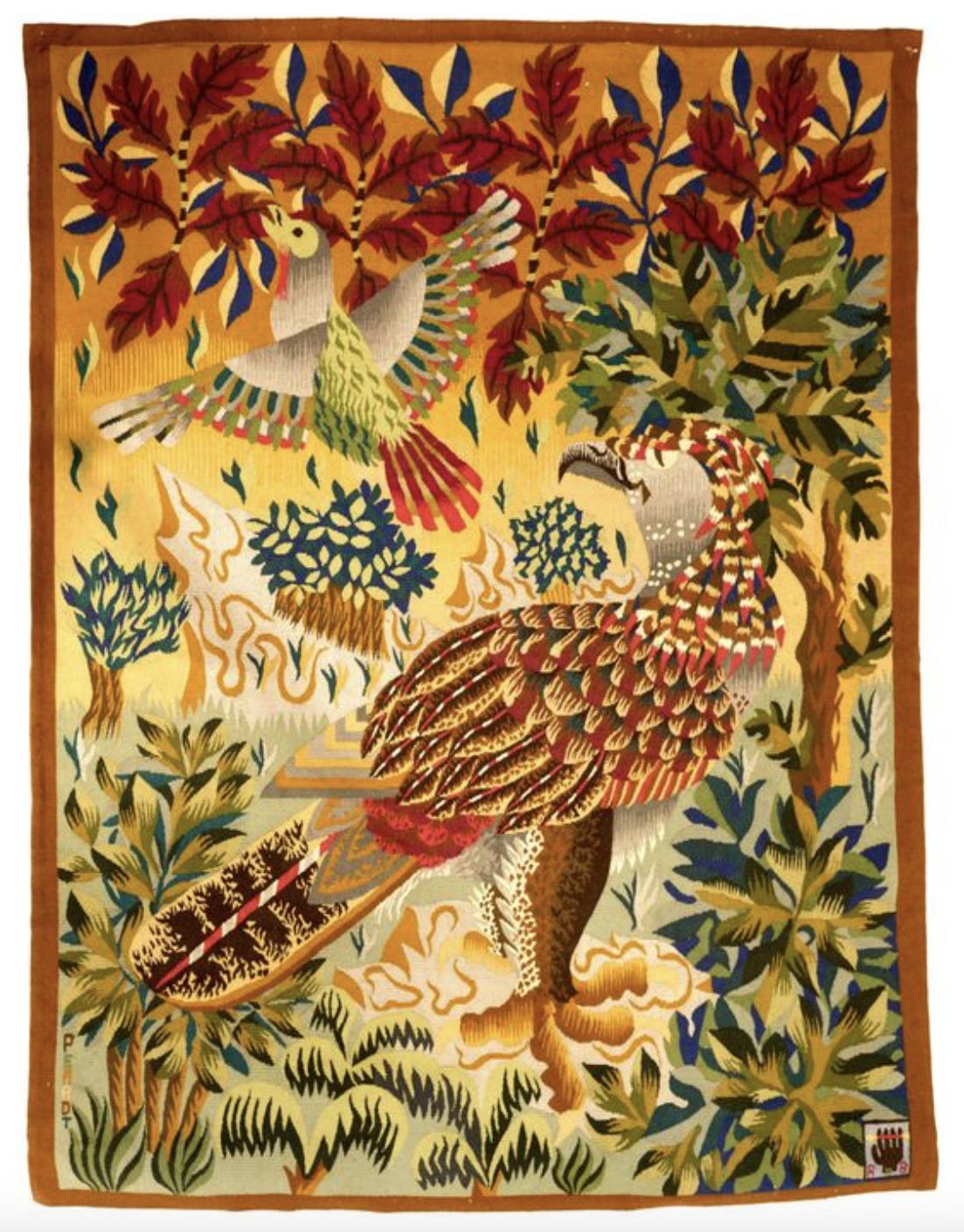
René Perrot – Arazzo Aubusson del XX secolo in lana policroma, uccelli, 1956
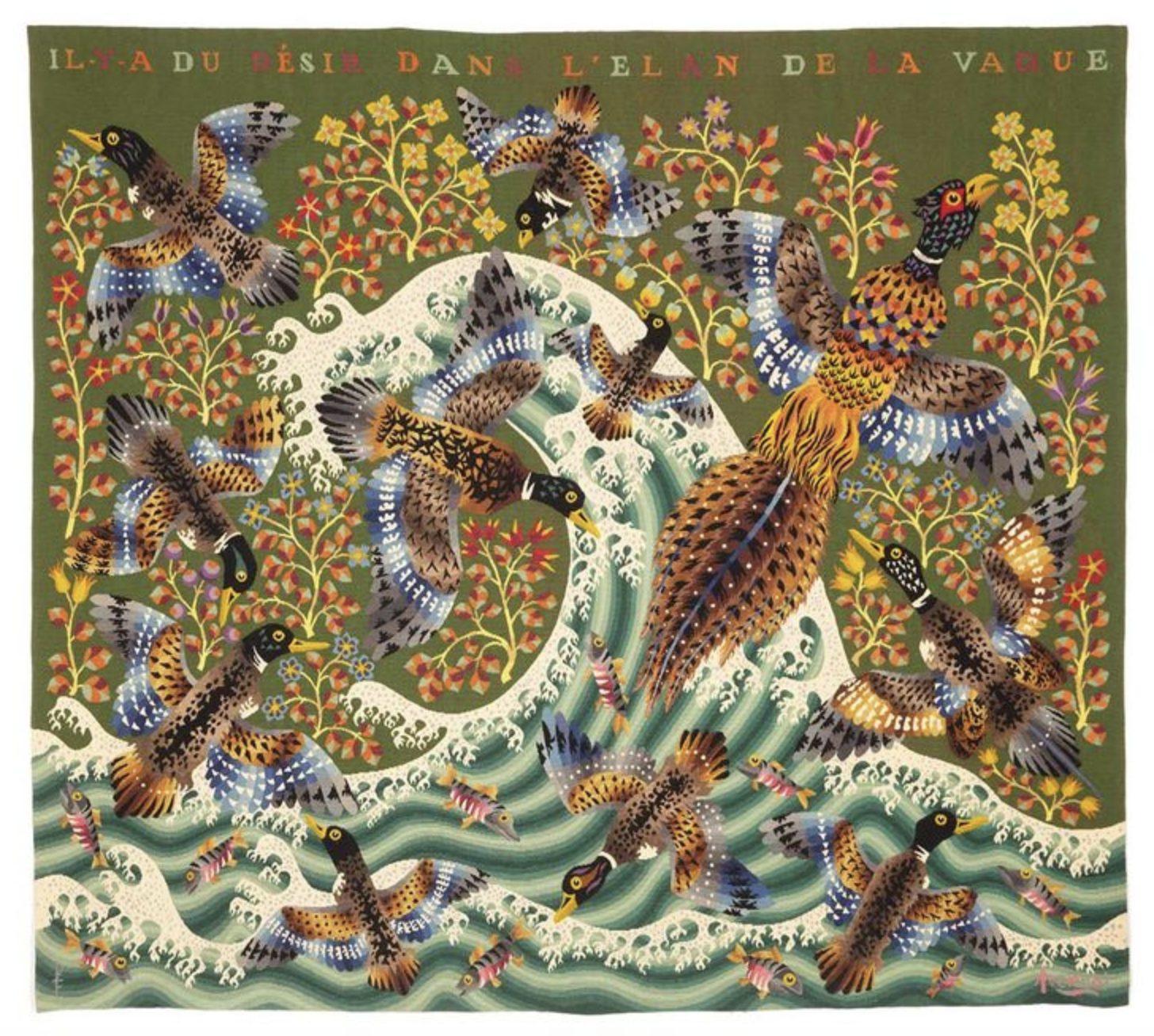
René Perrot – La vague
This balance—technically rigorous yet conceptually adventurous—epitomizes the broader achievement of post-war French decorative arts.
As we examine Perrot’s oeuvre today, we witness not merely beautiful objects but cultural artifacts that embody a nation’s artistic resilience. His tapestries, hanging in museums and public buildings worldwide, stand as woven testimonies to a crucial moment when French culture, emerging from darkness, reaffirmed its creative vitality through the transformation of tradition.
The story of René Perrot reminds us that decorative arts, far from being peripheral to cultural history, often serve as its most eloquent chroniclers.
In his tapestries, we see reflected not just the revival of French craft traditions, but the enduring human capacity for renewal through artistic expression.
~~~