

What William Morris, Paul Poiret, and the Bauhaus Each Understood About the Rug and What French Art Deco Proved
May 19, 2026
The Layered Home: 5 Ways to Rethink Floor Rugs and Wall Tapestries
June 1, 2026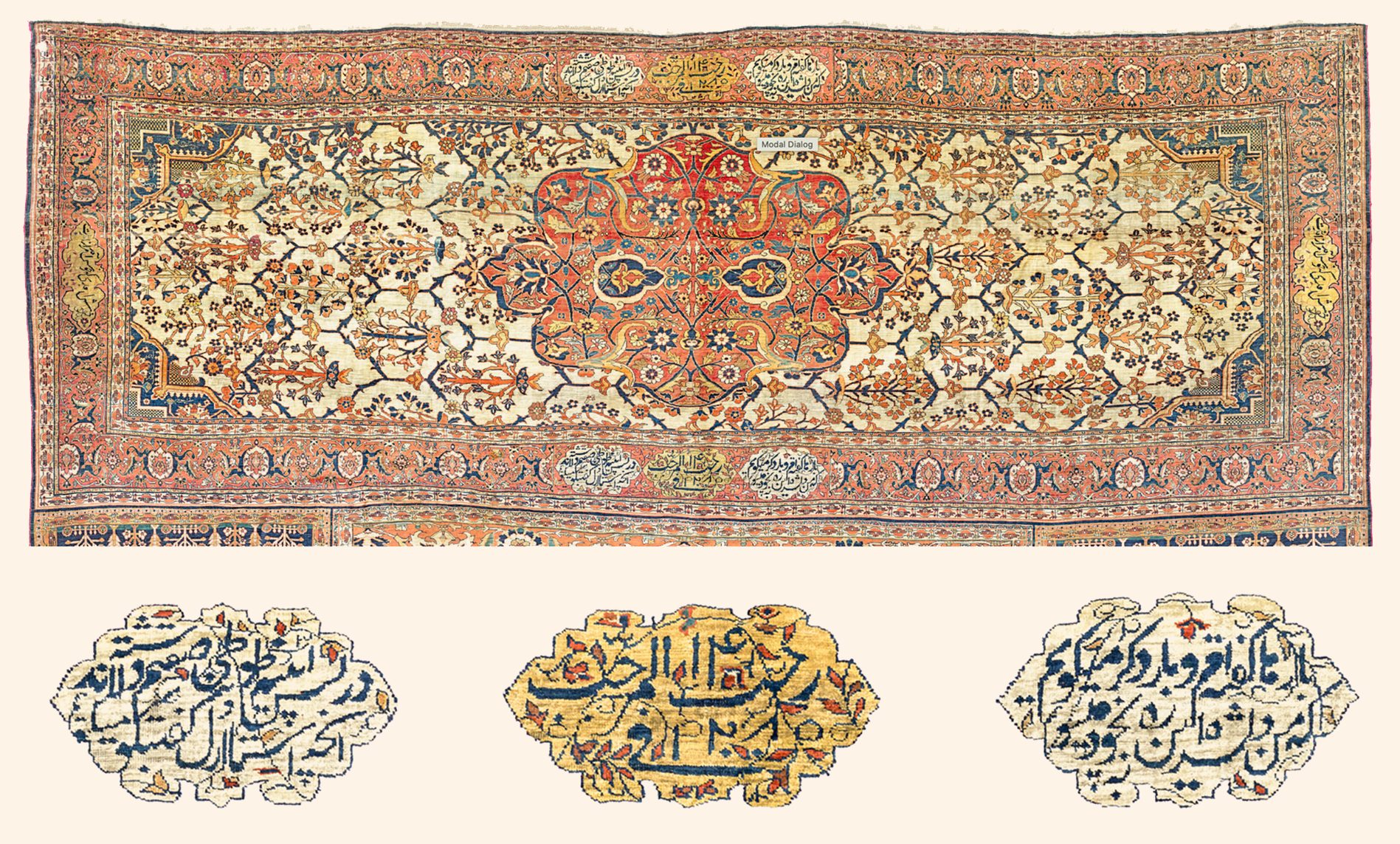
The Silk Heriz Triclinium Carpet of 1868
From the Rug & Kilim editorial and curatorial archive
Our founder and principal Jahanshah Josh Nazmiyal has been in the carpet industry long enough to have learned that the great pieces announce themselves before one has understood what one is looking at. The light catches the silk a particular way. Some quiet, almost biological recognition runs through the room, the way a wine of consequence stills the table before anyone has spoken its vintage. One has the sense of having interrupted a conversation already in progress. The carpet was here first; one is being received by it.
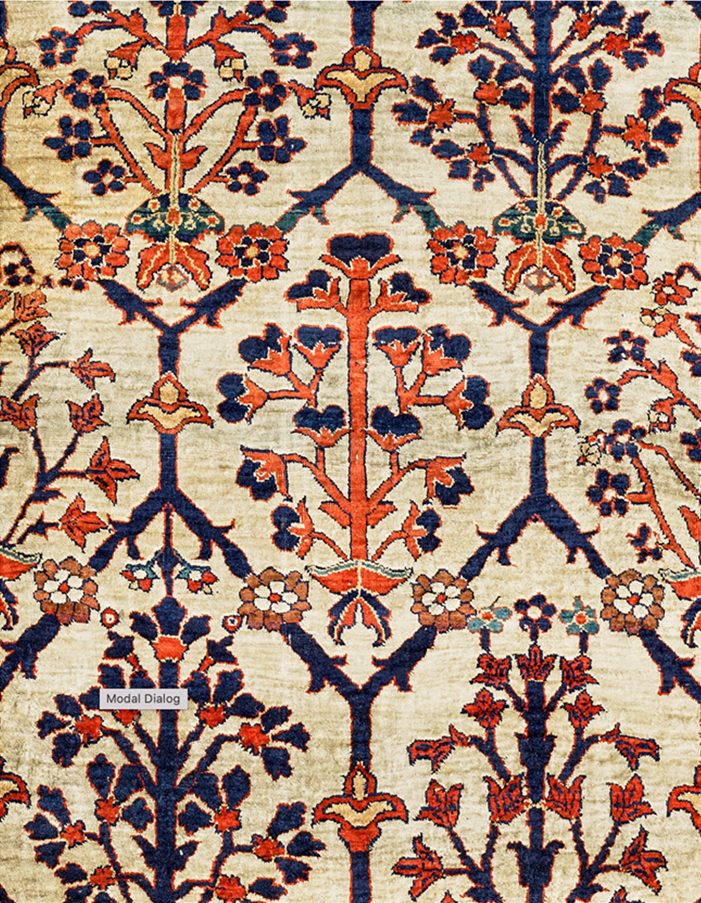
The team welcomed this silk Heriz, the way Jahanshah had unrolled perhaps forty thousand carpets across the better part of his life, and we will tell you honestly that we sat down beside it for a long time before any of us said anything. There is a particular gold in the mian farsh; the great central field, that we all have seen perhaps rarely before in a quarter-century of looking. It is the gold of late-October sun on the dome of the Shah Mosque in Isfahan, the gold the Safavid silk weavers of the seventeenth century pursued and very nearly lost, the gold that the Heriz workshops of the 1860s recovered for a brief generation of patrons before the world turned and they were forgotten. To kneel beside it is to be quiet in the presence of something that does not require your understanding to be what it is.
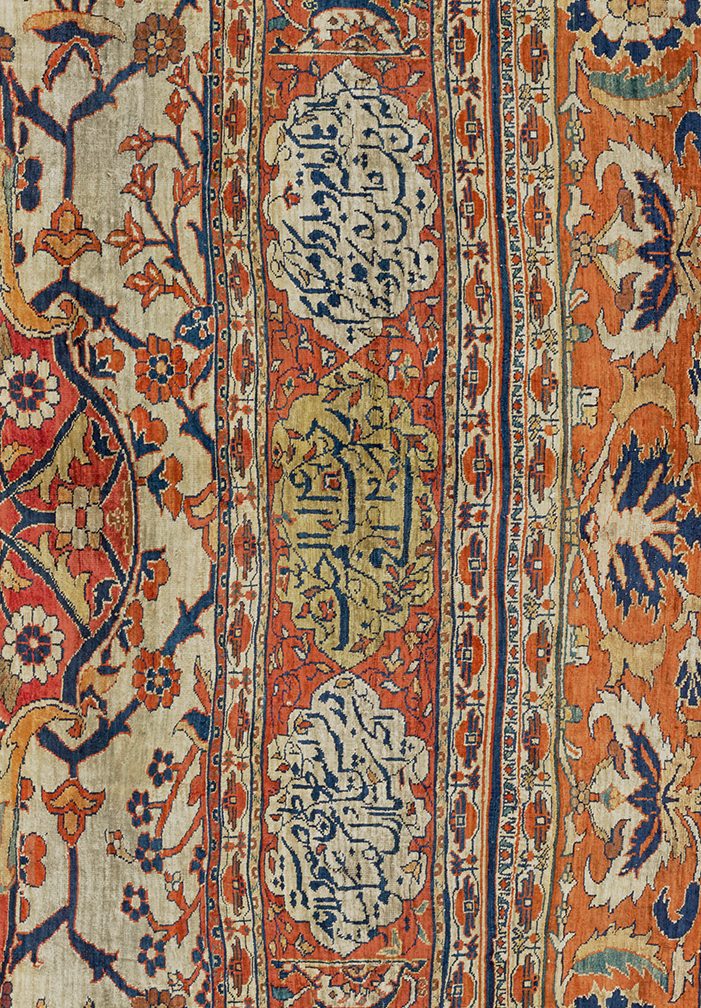
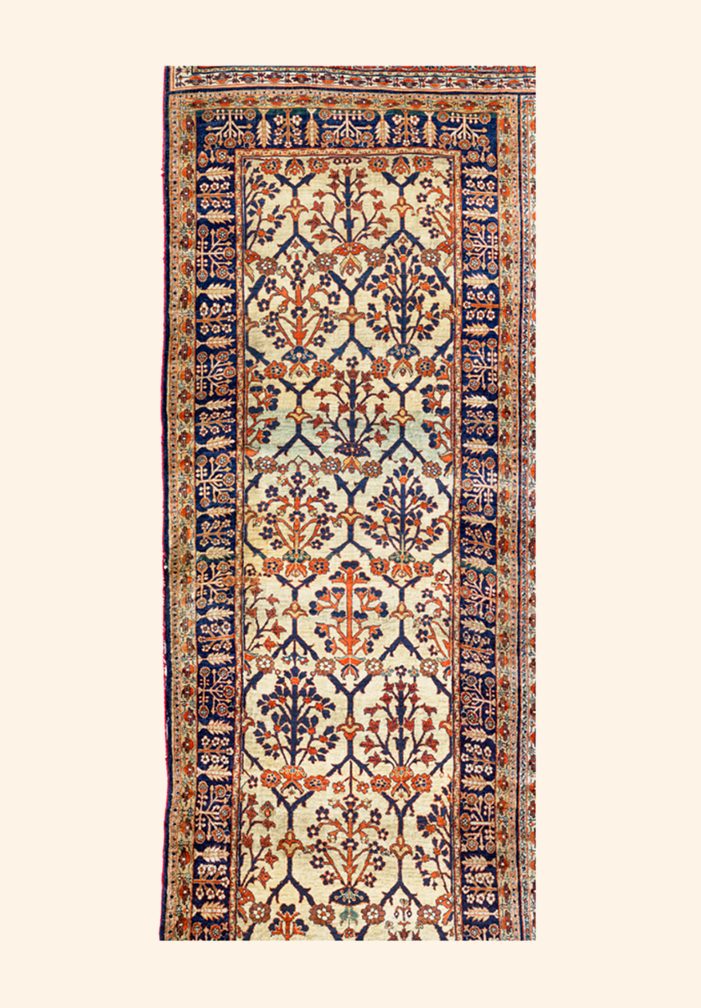
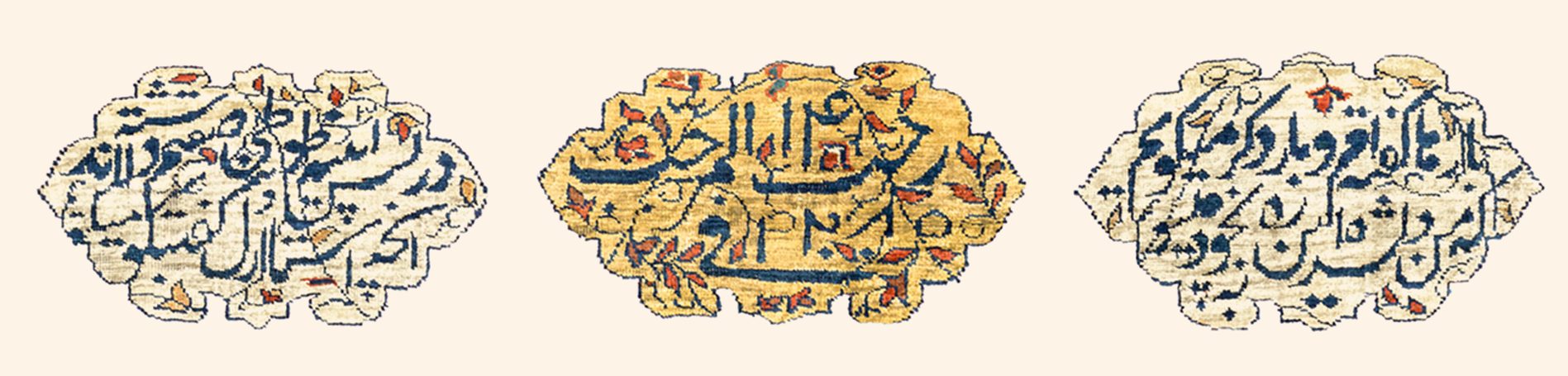
And then, slowly, the carpet begins to disclose itself. The borders, when one leans in, are inscribed; eight cartouches in scalloped silk, framed in the calligraphic register of a Qur’anic frontispiece, and they carry, in a hand of considerable refinement, two ghazals of Hafez of Shiraz. The date cartouche tells you, with the matter-of-factness of a man recording a wedding in a parish ledger, that the carpet was finished on the fourteenth of Rajab in the year 1285 of the Hijra; the thirty-first of October, 1868. The verses on either side translate, in Wilberforce Clarke’s 1891 Calcutta edition, to: “Times I have said: and again I say — that, here bereft, not of myself, have I gone this path of love.” The upper cartouche, placed above where the host would have sat to receive his guest, simply reads: “Welcome, for your arrival has pleased me.”
Our team has handled inscribed Persian carpets before; most of us in this trade have, eventually, if we live long enough and are fortunate. We have not handled one that greets the entering guest. That is a thing of a different order.
What you are looking at, when you look at this carpet, is the floor of a room that no longer exists; a Qajar reception hall in northwest Persia in the autumn of 1868, with its couches arranged in the triclinium manner, its windows giving onto a walled garden of pomegranate and cypress, its samovar somewhere out of view and the floor of that room has been preserved, as if by some accident of history that we have stopped trying to explain, intact, on its silk foundation, with its inscriptions clear, with its colors miraculously alive, for a hundred and fifty-eight years. The room is gone. The host is gone. The verse remains. The welcome remains.
The team will spend the rest of this essay attempting to describe to you what we will have in front of us. We will mention the Sabbagh silk Heriz at Sotheby’s in 1984, and the Lady Dudley Shrub Lattice now in the Museum of Islamic Art in Doha, and the companion silk Heriz of garden design woven in the same workshop on the same day and sold at Christie’s in 2001 because the scholarship is part of the object’s truth, and at this register one does not separate the two. But we want to say first, before any of that, the thing that is hardest to say in a market that has grown accustomed to speaking only in figures: that there are perhaps three or four moments in a serious collecting life when an object enters the gallery and you understand, before you have priced it or photographed it or written a single line about it, that you are not its dealer. You are its temporary custodian. It will outlast you. It will outlast the next person, and the one after.
This is one of those moments. The carpet is here. It is greeting you.
Sit with it for a while before we go any further.
On the Architecture of Hospitality
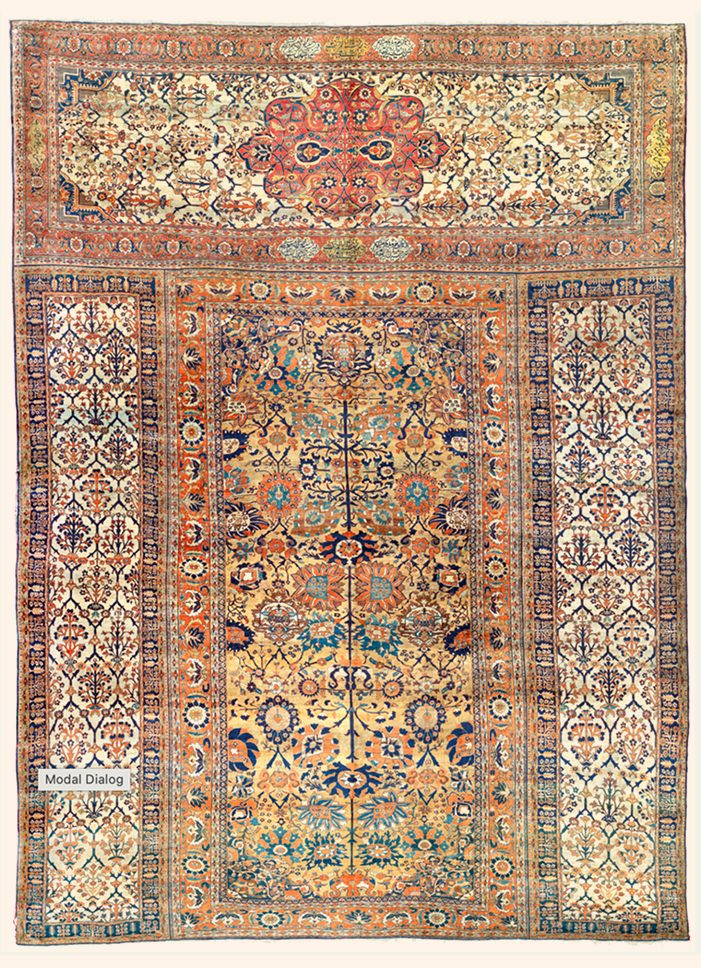
The triclinium format is the most architectural of all Persian carpet conventions. The term, borrowed from the Roman dining room of three couches arranged about a central space, describes a textile composed of four discrete carpets woven as a single program: the mian farsh, the great central carpet that holds the room; two kenareh, the long narrow runners that flank it; and the kalleghi (or kelleh in the Western literature), the head carpet placed at the short end where the host or honored guest is received. Together, these four pieces line the floor of the reception room of the great Persian house, the talar or formal otaq, and translate the architecture of hospitality into wool, silk, and silver-wrapped thread.
It is one of the most sophisticated decorative programs ever conceived for a domestic interior, and one of the rarest. As Jennifer Scarce documented in her 1984 study for HALI on the role of carpets within the nineteenth-century Persian household, the complete triclinium ensemble has survived in only a handful of examples. Most have long since been broken up, their components dispersed across separate collections; a runner here, a head-carpet there, the great central field passing through estate sales while its companion pieces were absorbed by museums or vanished entirely.
To find a triclinium intact, on a silk foundation, dated to the day, and inscribed by Hafez, is the kind of survival that defines a collector’s career.
The Workshop and Its Hand
This carpet was almost certainly in its sensibilities produced in the same or a similar workshop that wove the celebrated Sabbagh silk Heriz sold at Sotheby’s New York in May 1984; a piece bearing the same scalloped cartouche profile, the same quality of calligraphic execution, the same chromatic appeal. A second silk Heriz of garden design, completed on precisely the same day as the present carpet; the thirty-first of October, 1868, and sold at Christie’s in May 2001, bears the identical ghazals of Hafez within the identical scalloped cartouches.
The golden-yellow ground of the mian farsh is drawn from the Safavid “vase” carpet tradition of the seventeenth century; a deliberate citation, by a nineteenth-century master, of the dynastic high style two hundred years prior. The single-plane lattice of flowering shrubs that organizes the kelleh and kenareh draws upon the same Safavid sources but from a particular and rarer subgroup, of which the only substantial complete survival is the early seventeenth-century Lady Dudley Shrub Lattice carpet; formerly in the collection of Prince Stanislaw Radziwill, sold at Sotheby’s London in October 1990, and now in the Museum of Islamic Art in Doha. The present carpet places itself, in other words, in the direct lineage of the most important Safavid silk weaving in the world.
The Voice of Hafez
What elevates this carpet from masterpiece to document is its inscriptions. Within the borders, mirrored on either side of the date cartouche, are two couplets from a ghazal of Khwaja Shams-ud-Din Muhammad Hafez-e Shirazi; the fourteenth-century mystic-poet of Shiraz whose Divan remains, six hundred years after its making, the most influential single body of verse in the Persian language. Hafez wrote of love and wine and the corruption of religious authority; he is recited at weddings and births, consulted by fal-e Hafez divination on questions of the heart, and quoted in conversation across the Persian-speaking world from Tehran to Tajikistan to the diaspora salons of Los Angeles and London.
The verses on this carpet, in H. Wilberforce Clarke’s 1891 Calcutta translation, read: “Times I have said: and again I say — that, here bereft, not of myself, have I gone this path of love. Behind the pure mirror of the holy traveller’s heart, me, they have kept like the parrot: what the teacher of eternity without beginning said, ‘Say,’ I say.”
The upper cartouches add a further line: “Welcome, for your arrival has pleased me.”
It is, in essence, a textile that speaks. To stand in the room for which this carpet was woven would have been to stand within a poem; to enter through a doorway whose threshold greets you in verse, to recline on couches arranged according to a fourteenth-century lyric, to take tea on a floor that quotes the mystical tradition of Shiraz at the precise moment of one’s arrival.
Few objects in the history of the decorative arts achieve this fusion of architecture, literature, and ceremony. The Pazyryk carpet at the Hermitage is older. The Ardabil carpets at the V&A and the LACMA are larger. But neither speaks to the entering guest in the voice of Persia’s most beloved poet.
A Moment in History
The carpet was woven in 1868; the year Disraeli first formed his government in London, the year Louisa May Alcott published Little Women in Boston, the year of the Meiji Restoration in Japan, and the eighth year of the reign of Nasir al-Din Shah Qajar in Tehran. The Qajar court at the time was at the height of its complex engagement with European modernity; the Shah would shortly make the first of his three celebrated tours of Europe, returning with cameras, photographic albums, and a taste for French furniture that would transform Persian palace interiors for the next half-century. The silk Heriz workshops of the late 1860s were produced for this exact moment of cultural negotiation: deeply traditional in their citation of Safavid precedent, exceptionally refined in their materials, and intended for the great houses of a class that was simultaneously Persian and cosmopolitan, rooted and worldly.
It is the same generation of patronage that built the great Qajar gardens of Shiraz and Isfahan, that commissioned the lacquer bookbindings now in the Khalili Collection and the Sarikhani Collection, that filled the salons of Tehran with cut glass from Bohemia and silver from Tula and silks from Lyon while preserving; in the talar, the formal reception hall, the ceremonial heart of the house, a floor program of unbroken Safavid descent. This carpet is the floor of that room.
In the Lineage of the Great Persian Carpets
Within the canon of inscribed and dated Persian silk carpets, the triclinium of 1868 belongs to a register that includes the Ardabil carpet of 1539–40 (now divided between the Victoria and Albert Museum in London and the Los Angeles County Museum of Art); the various Safavid silk Kashans of the sixteenth century in the Metropolitan Museum, the Gulbenkian, and the Hermitage; the Mughal pashmina prayer rug at the Met; and the small handful of nineteenth-century inscribed Heriz silks that have appeared at auction over the last forty years. To collect at this level is to collect alongside the Rothschilds, the de Menils, the Aga Khan, Calouste Gulbenkian, and Nasser Khalili. It is to acquire not a textile but a chapter of cultural history.
The recent record at the higher reaches of this market is instructive: the silk and metal-thread Polonaise carpets of seventeenth-century Isfahan have crossed seven million dollars at Christie’s; an Antique Persian carpet from the William A. Clark estate realized over thirty-three million dollars at Sotheby’s in 2013; the Pearl carpet of Baroda, encrusted in pearls and precious stones, achieved over five and a half million dollars at Sotheby’s Doha. These figures locate the inscribed silk Heriz of major scale and museum-caliber survival within a particular and very small market; the market of objects whose acquisition transforms a collection.
The Collector’s Question
For the contemporary designer specifying at this register; the New York apartment overlooking the Park, the Mayfair townhouse, the Holmby Hills estate, the private museum in Riyadh or Hong Kong or São Paulo; the question is not whether to use a triclinium. It is whether the room can rise to meet it.
The carpet wants its proper architecture: a reception room of generous proportion, with the kalleghi placed where guests are received and the kenareh lining the long axes of the room as the original program intended. It wants quiet walls; perhaps a soft trompe-l’œil in the manner of the Borghese, perhaps a Mark Rothko in deepening reds, perhaps the unbroken plaster of a Peter Marino interior, that allow the carpet to do its full work. It wants natural light at low lux, controlled and museum-grade. It wants company of the same caliber: a Safavid lacquer Qur’an box, a piece of late-Qajar enamelwork, perhaps a Persian miniature from the Houghton Shahnameh. It wants to preside.
The conversation that the carpet sustains across the room between the calligraphy of its borders, the gestural authority of the Twombly, and the cut crystal of the Viennese light is one of the most refined private interiors we know in the world. That is the company this carpet keeps.
Provenance and Custody
The present carpet emerges from an important private European collection, where it has been preserved for decades in conditions that explain its remarkable survival. It is offered now with full provenance documentation, scholarly authentication, and the institutional support that a piece of this consequence requires. Acquisitions of this kind are acts of custody. The next collector to live with this carpet will, in turn, eventually pass it to the one after and the ghazal of Hafez will continue to greet the entering guest, in silk and gold, as it has done since the autumn of 1868.
It is in this sense that the silk Heriz triclinium of 1868 is being released. The privilege of the next custodianship is available, for now, to the collector or institution prepared to receive it.
Jahanshah Nazmiyal and the team at Rug & Kilim would be honored to receive you in our New York showroom, by private appointment, to share this exceptional carpet in person.