
The Layered Home: 5 Ways to Rethink Floor Rugs and Wall Tapestries
June 1, 2026
Rug & Kilim’s Tapestry Artists’ Series: In Dialogue with Jeni Ross
June 10, 2026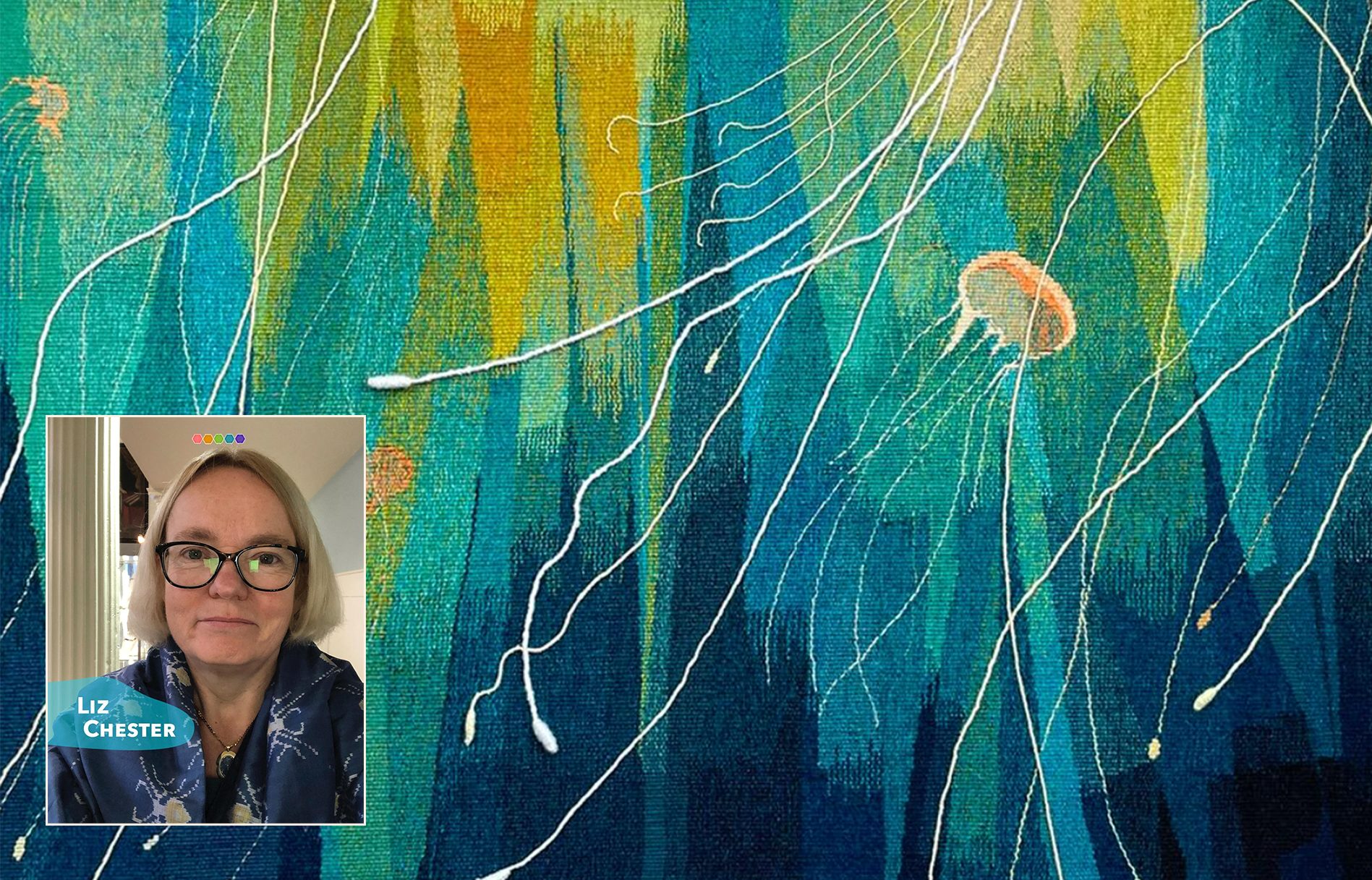
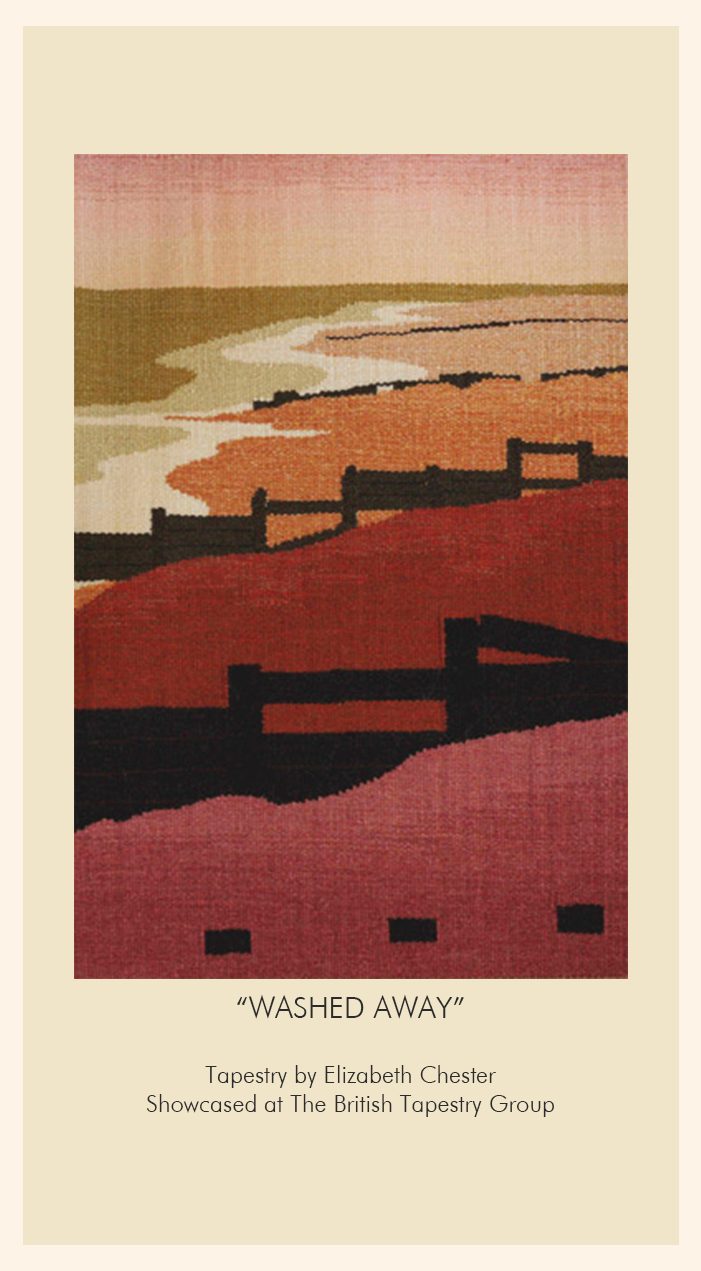
Tapestry by Elizabeth Chester
There is a particular kind of looking that a great tapestry demands, slower than painting, more physical than sculpture, closer to reading than to seeing. The eye must travel. It must follow the thread, understand the structure, and then, having understood it, surrender to the illusion that the structure has been designed to create. The greatest European tapestries have always operated this way: technically transparent to the scholar and visually overwhelming to everyone else simultaneously. It is the most demanding of the textile arts, and the one that rewards sustained attention most completely.
Two artists in the Rug & Kilim European collection are working at precisely this level and doing so from directions so different that their proximity in the archive feels less like coincidence than like curatorial argument.
The vintage abstract tapestry by Etienne Poirier that occupies a singular position in the Rug & Kilim European collection does not simply lie on its foundation. It moves. Or rather and this is the distinction that separates a merely accomplished tapestry from a work of genuine intellectual ambition it creates, through a mastery of material that takes decades to acquire, the precise and calculated illusion of movement in a medium whose defining characteristic is stillness.
Poirier calls this optical kinetics. It is an apt term for what he achieves: a visual experience of rhythm and vibration produced not through any mechanical means but through the weaver’s complete command of wool’s capacity to absorb and reflect light differently across its surface. By graduating weft yarns with extraordinary care, blending colors across the width of a passage with a precision that mimics the artist’s brushstroke without ever pretending to be one; Poirier creates transitions of such subtlety that heavy and matte fibers appear to pulse against one another, generating a kinetic energy that the medium, by every rational account, should not be capable of producing.
To make wool vibrate is a technical accomplishment of the first order. It requires not only skill but a theoretical understanding of how color, fiber, and light interact across a woven surface, the kind of understanding that connects Poirier’s practice directly to the great European tapestry tradition of the Gobelins and Aubusson workshops, where the cartoon painter and the master weaver worked in sustained dialogue to produce effects that neither could have achieved independently. Poirier collapses that dialogue into a single practice. The result is an object that holds its ground in any company — historical or contemporary without apology.
A Conversation with Elizabeth Chester
When did you first weave? Tell us about the spark that made you want to weave.
I began weaving at 15 years old when a community project was launched which needed local people in my town in Scotland to learn to weave a contribution to a large tapestry commemorating local historic figures. We were all taught by a small tapestry collective in the far north of Scotland. I wove my contribution and was hooked. When I came home I got some wood out of my Dad’s garage and nailed together my own loom. I have never stopped weaving since then. Tapestry combines my love of art and construction. I started out as a hobbyist weaver, but took it up professionally in 2008 after taking redundancy from my IT career.
Who are your textile heroes? Name the weavers or artists you relate to most.
When I began weaving, Archie Brennan was still a major force in tapestry. I loved his technical brilliance and sense of humour. I still love his work, although I now also appreciate the work of other weavers such as Joan Baxter and William Jeffries. Like painters, they all have their own unique style and subject matter, but the quality of the woven surface is always there.
What gets you to the loom every morning?
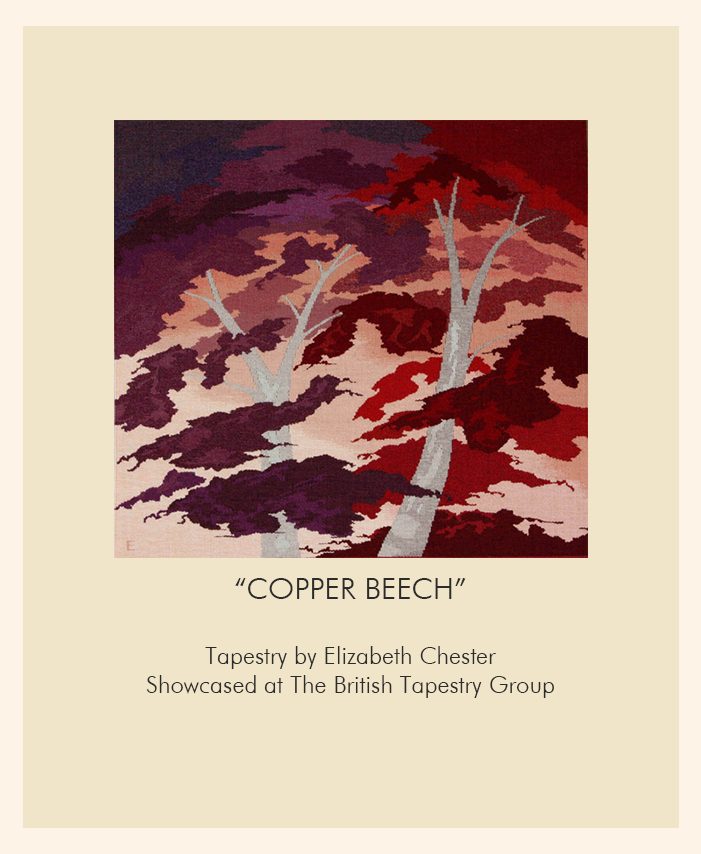
Weaving is my meditation. I am in my happy place when choosing the next colour, blending just the right shades together and weaving them into place in just the right order. When we go away on holiday and I cannot weave, I can start to get a bit edgy. The first thing I want to do when I get home is always to find my place once again in the current weaving project. Designing for a new piece is not so stress-free and I need to carve out a good few hours on my own to really put my mind in the right place. I have several times drawn up full-scale cartoons ready to weave only to decide the next day that it is not good enough. I sketch ideas which I then work up into full scale designs. My style is quite graphic, rather than painterly.
How do you choose your yarn?
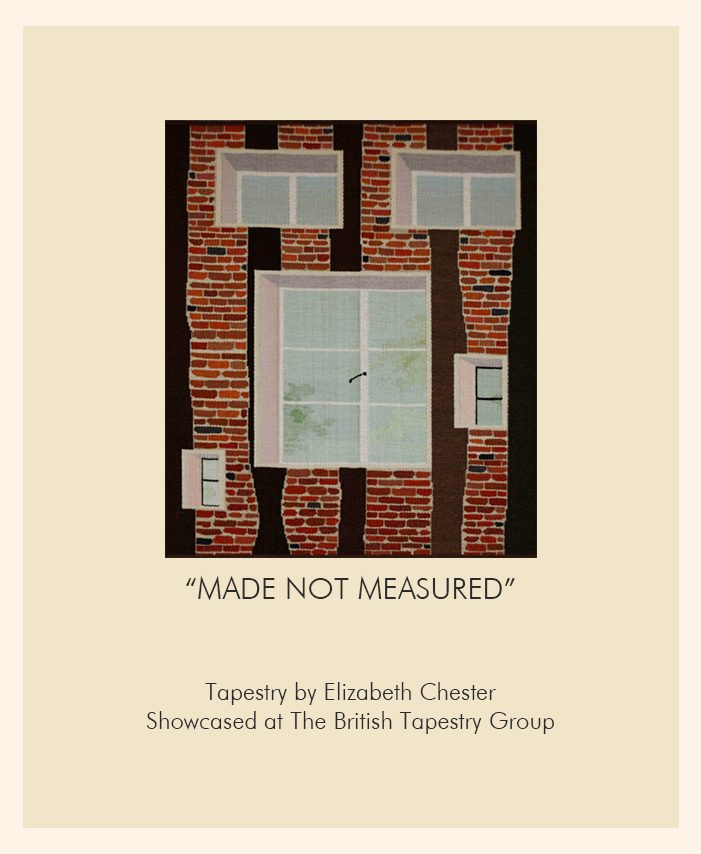
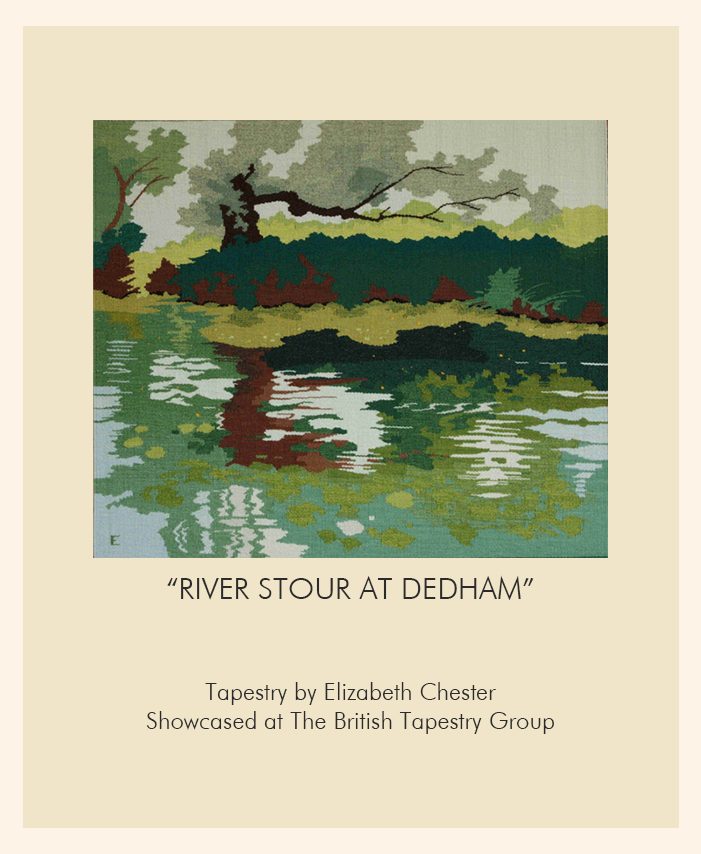
My warp is mostly pure cotton, tightly spun, specifically for weaving. This has a slight elasticity, but does not sag while you are weaving. I have very occasionally used linen, because it is finer, but it is very harsh on the fingers and can strip the skin off the knuckles if you weave for a long time. I buy mostly coloured fine yarns. If the yarn is fine, I can blend multiple shades together and so blend from one colour into another more gently. I use mostly pure wool but if I see a colour I want with other natural fibres I will buy them. Silk is used for highlights or where I particularly want a shimmer on the surface. I will also use textured yarns like a mohair, yarns with a slub or woollen gimps where I want to create a surface texture. I also have a large collection of acid dyes which I use to dye fine wools into the shades I cannot buy. As the sources of spun wool have gradually reduced over the years, I have had to dye more of my own colours. This allows me to get more grades in a single shade and to produce more subtle shades than those which are commercially dyed.
What are you depicting through the interlacing of your threads? Is your work a personal story or a study in structure?
When I am designing for tapestry, I need something which will hold my attention for weeks or even months. There has to be sufficient detail to give me interest. Historically, tapestries were made to show off the great wealth of their owners and they were filled from corner to corner with detail. My modern eye does not appreciate all the clutter and while I am looking for a composition which has enough variation, I am also looking for some still space in the overall image where the eye can rest. I am always looking for ideas on every walk, people watching and peering into the forgotten corners of life. Landscapes lend themselves well to weaving and I am trying to get the feel of the place, the space and the distance. When I am doing figurative work, I am looking for body language which speaks of peoples’ mood and self-image. Sometimes there is humour in a situation and I will try to put that across. It’s not about the place, it’s about the feeling that place gave me that I am trying to communicate.
The Sea on the Loom
What Chester’s conversation reveals and what her work confirms with the authority of someone who has spent decades earning the right to make difficult things look inevitable is a practice built on the same foundational understanding that has distinguished the greatest European tapestry weavers from their merely accomplished contemporaries: that the medium’s constraints are not limitations to be overcome but instruments to be played.
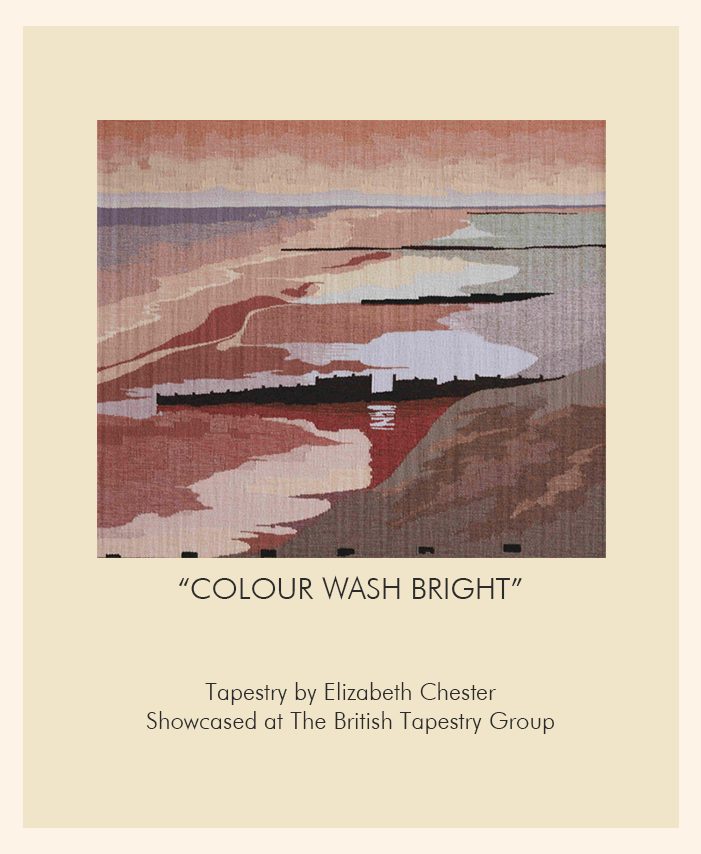
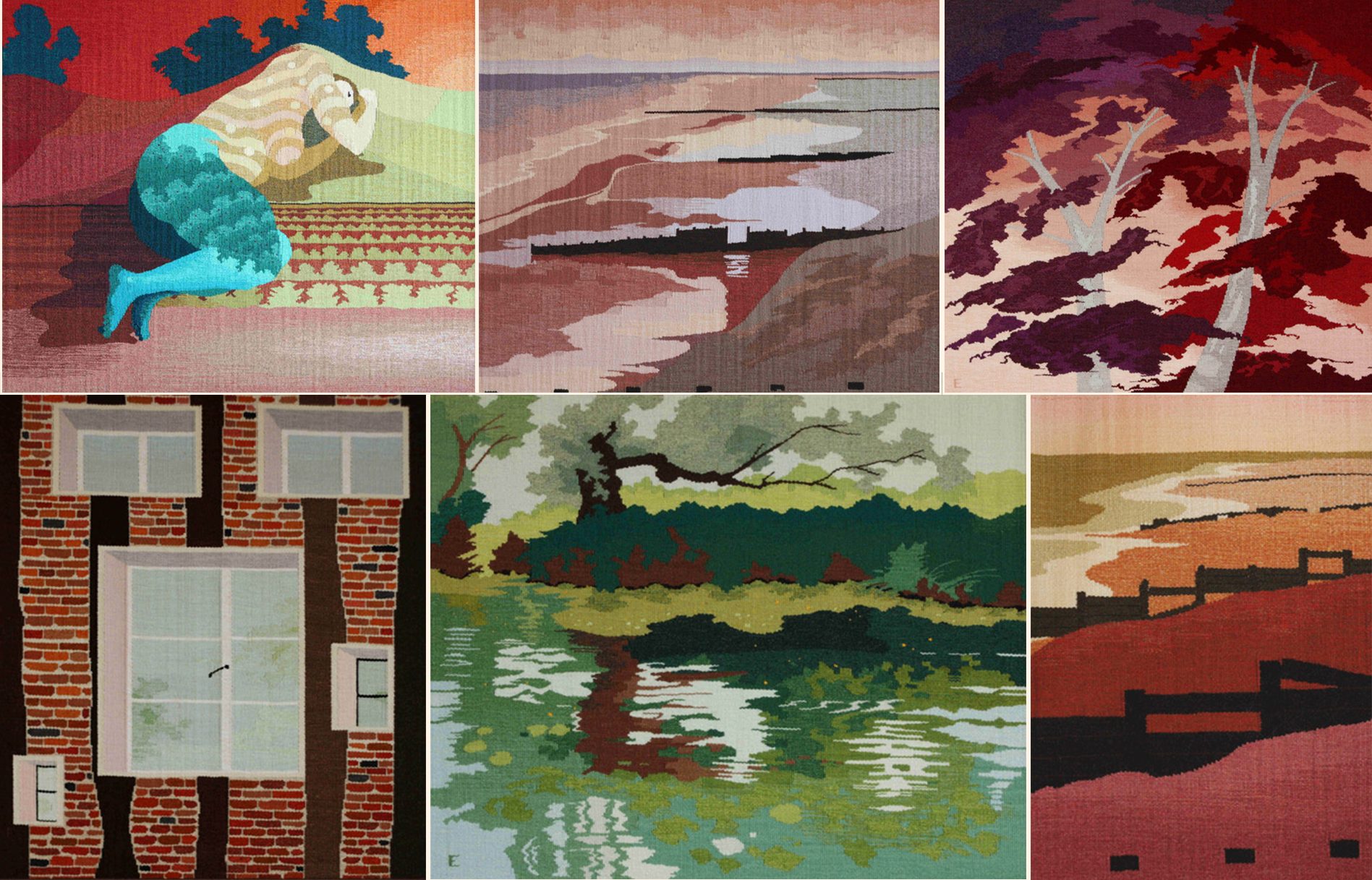
The irreversibility of tapestry, the fact that a color committed to the weft cannot be taken back, that every decision is permanent in a way that paint on canvas, with its capacity for overpainting and revision, is not is, in Chester’s hands, not a technical difficulty but a philosophical position. She uses the permanence of the medium to speak directly to the impermanence of her subject. The sea that she weaves in works such as Harlyn Bay, Breaking the Banks, and Through a Glass Darkly is an ocean that is always already gone, captured at the precise moment of its greatest energy and held there, in wool and cotton and silk, with a stillness that the water itself has never known.
The technical means by which she achieves this are as disciplined as Poirier’s and as deliberately chosen. Her weft-interlacing — tightly packed, densely worked, granting what she describes as total pictorial freedom within a structure of absolute formal constraint — produces surfaces of a vibrancy that the medium’s historical association with the static and the monumental makes all the more remarkable. The light that reflects on water, absorbed and transformed by yarn into something that is neither light nor water but carries the memory of both — this is the problem she has set herself, and the solution she has found is one that no painter working in any other medium could have arrived at by the same route.
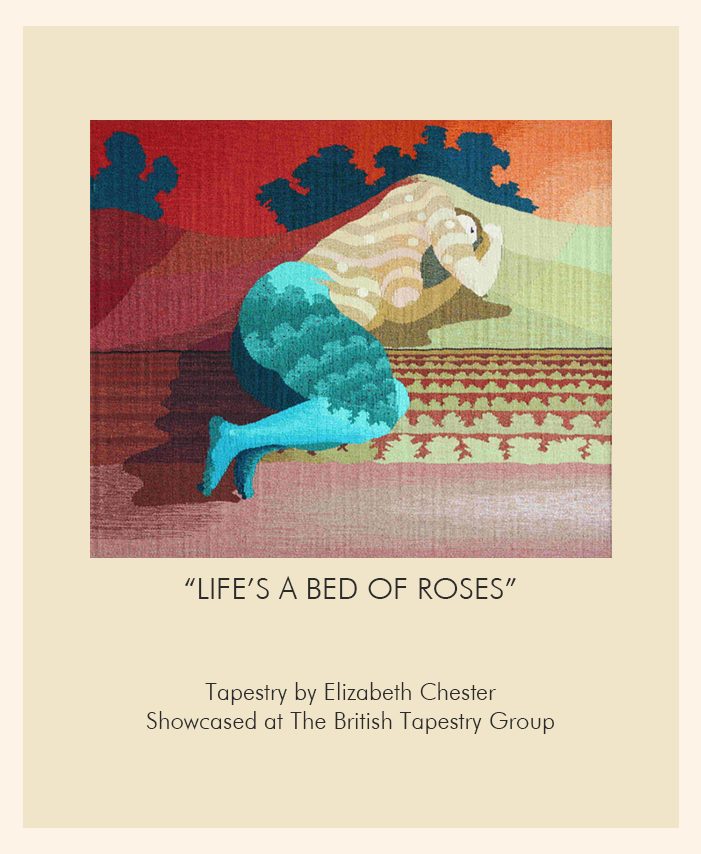
Her smaller works — Washed Away, Fish Ladder, Jazz for Squares, Life’s a Bed of Roses, demonstrate that the discipline she brings to her large-scale coastal pieces does not depend on scale for its authority. The tightly weft-interlaced structure is present in every format, at every dimension, because it is not a technique she applies to her work but the method from which her work proceeds.
What Rug & Kilim Recognizes
The appraisal of fiber art at Rug & Kilim has always extended beyond age, origin, and market position to the question that matters most in any serious evaluation of a handmade textile: does this object demonstrate a complete command of its own material?
Does the maker understand not only what the medium can do but what it alone, uniquely, irreplaceably is capable of doing that no other medium can?
In Etienne Poirier’s optical kinetics and Elizabeth Chester’s woven ocean, the answer is unambiguous. These are works that could not exist in any other form that are not translations of a painterly or sculptural idea into textile, but ideas that are native to the loom, that arise from the specific intelligence of weft and warp and the particular way that fiber carries light. This is the standard by which Rug & Kilim has always evaluated the European tapestry tradition from the Gobelins cartoons of Charles Le Brun to the Bauhaus weaving workshop of Gunta Stölzl, from the Aubusson ateliers of the eighteenth century to the contemporary practice of artists who understand that the loom is not a historical instrument but a living one.
The thread that connects all of them — Poirier, Chester, Stölzl, the great French royal manufacturers, the medieval Flemish workshops whose pictorial ambition set the standard that five centuries of European weaving have been measuring themselves against is the understanding that tapestry is not decoration applied to a surface. It is a surface that thinks. At Rug & Kilim, that is the only kind of textile we have ever been interested in.
By Sana for Rug & Kilim, Tapestry Specialist
Edited by Bhavna for Rug & Kilim, Editor