
Rug & Kilim’s Tapestry Artists’ Series: In Dialogue with Elizabeth Chester
June 8, 2026
Rug & Kilim’s Tapestry Artists’ Series: In Dialogue with Joanne Soroka
June 23, 2026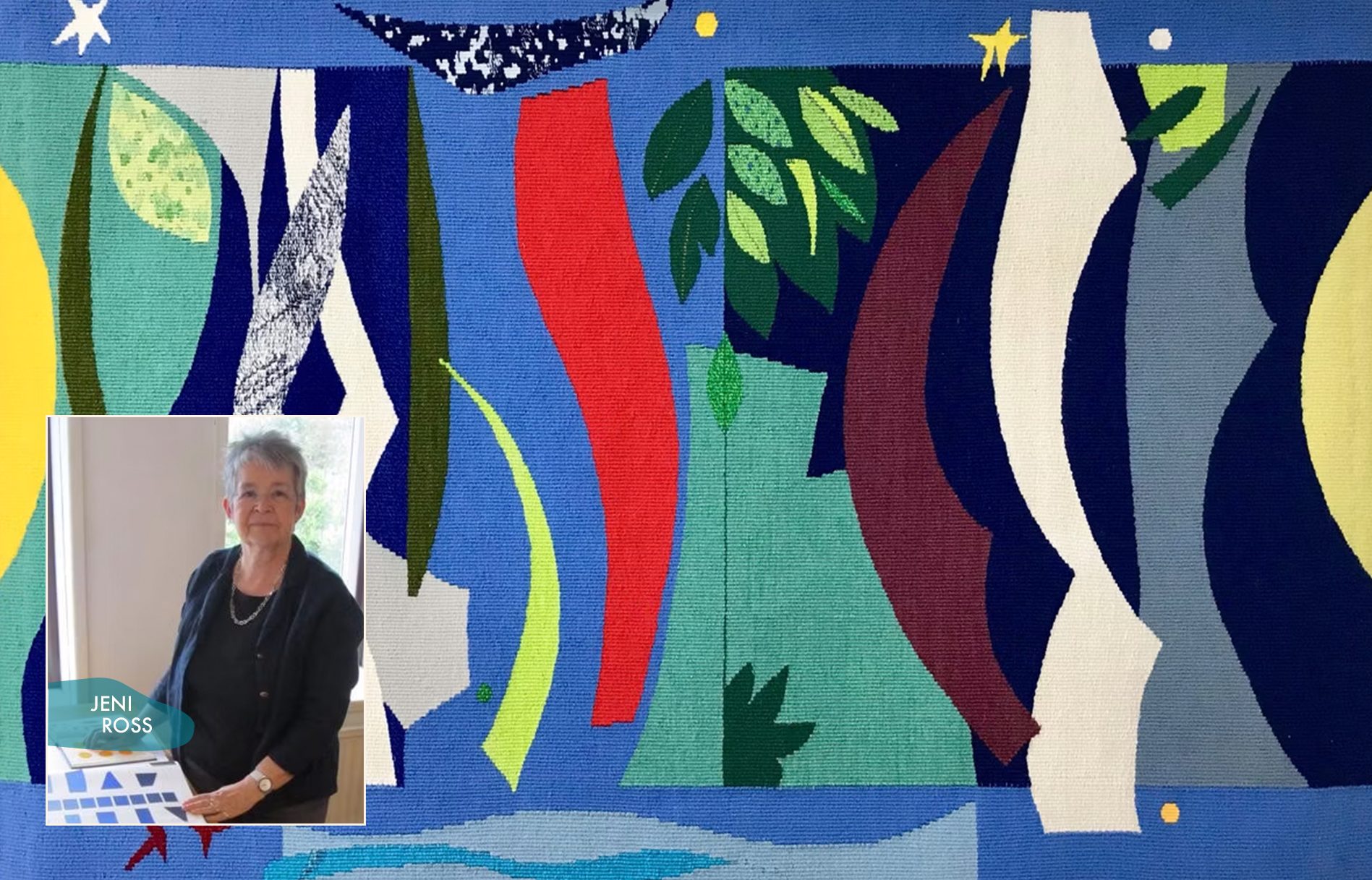
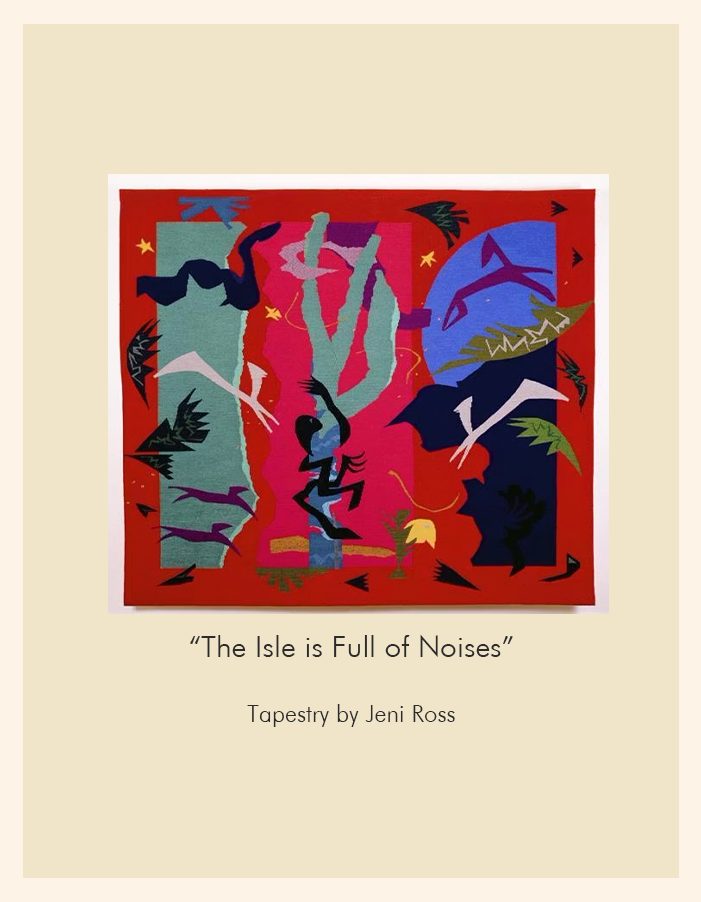
Tapestry by Jeni Ross
There is a moment, familiar to anyone who has stood inside a Jeni Ross installation, when the room stops being a room. Not because the work overwhelms the space in the manner of spectacle not because it shouts, but because it restructures. A Ross textile does not hang on a wall so much as claim it, establishing a gravitational field of color and material density that reorganizes everything around it with the quiet authority of a load-bearing element. You do not look at a Jeni Ross. You adjust to it. You find your position in relation to it. The room, in the most literal architectural sense, has acquired a new wall.
This is a rare accomplishment in any medium. In tapestry art, it is almost without precedent.
The Formation of a Practice
Ross did not arrive at the loom through the conventional route. She trained as a sculptor at Farnham School of Art, an education in mass, volume, and the physical relationship between an object and the space it displaces before moving through stitchery and collage toward a practice that would eventually demand a medium capable of containing everything she had learned from all of them simultaneously. The loom, when she returned to it, was not a retreat into craft. It was the only structure large enough to hold the full complexity of what she wanted to make.
The formation of her visual sensibility was equally unconventional. Surrounded in early life by the rich visual environment of exotic bird aviaries and the powerful experience of live Shakespearean performance, Ross developed a fascination for form, texture, and the dynamics of observation that no single artistic tradition could have produced on its own. The avian world, its color, its movement, its structural variety, gave her an eye for the relationship between pattern and energy. The theater gave her something rarer still: an understanding of how a space is charged, how an audience is directed, how presence is manufactured through the deliberate accumulation of effect.
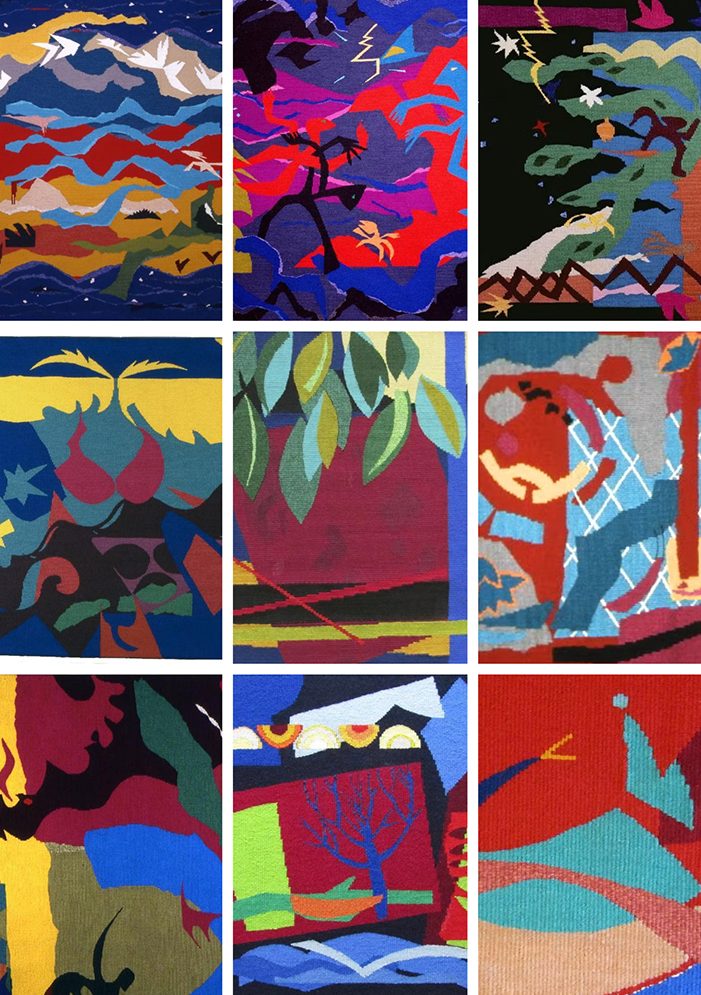
Both of these formative experiences are visible in the finished work, in the chromatic intensity that operates, as Ross herself has described it, like a colored gel pulled across a stage spotlight, directing the viewer’s eye with the precision of a technical director who has planned every moment of the encounter in advance.
Her aesthetic inheritance is specific and demanding. Francis Davison’s torn paper collages — bold, dynamic, compositionally fearless — gave her a model for working with color as mass rather than line. Josef Albers’ color theory gave her the analytical framework to understand what she was already instinctively doing: that color is never a single thing, that every chromatic decision alters every other chromatic decision in its vicinity, that the relationship between colors is more significant than any color considered alone. To these modernist foundations, Ross adds what neither Davison nor Albers quite possessed: the theater. The drama of material accumulation. The weight of yarn as narrative.
At Rug & Kilim, this is precisely the intersection we seek; the point where architecture and textile meet not as metaphor but as structural fact.
In Conversation with Jeni Ross
On the transition from paper to the loom:
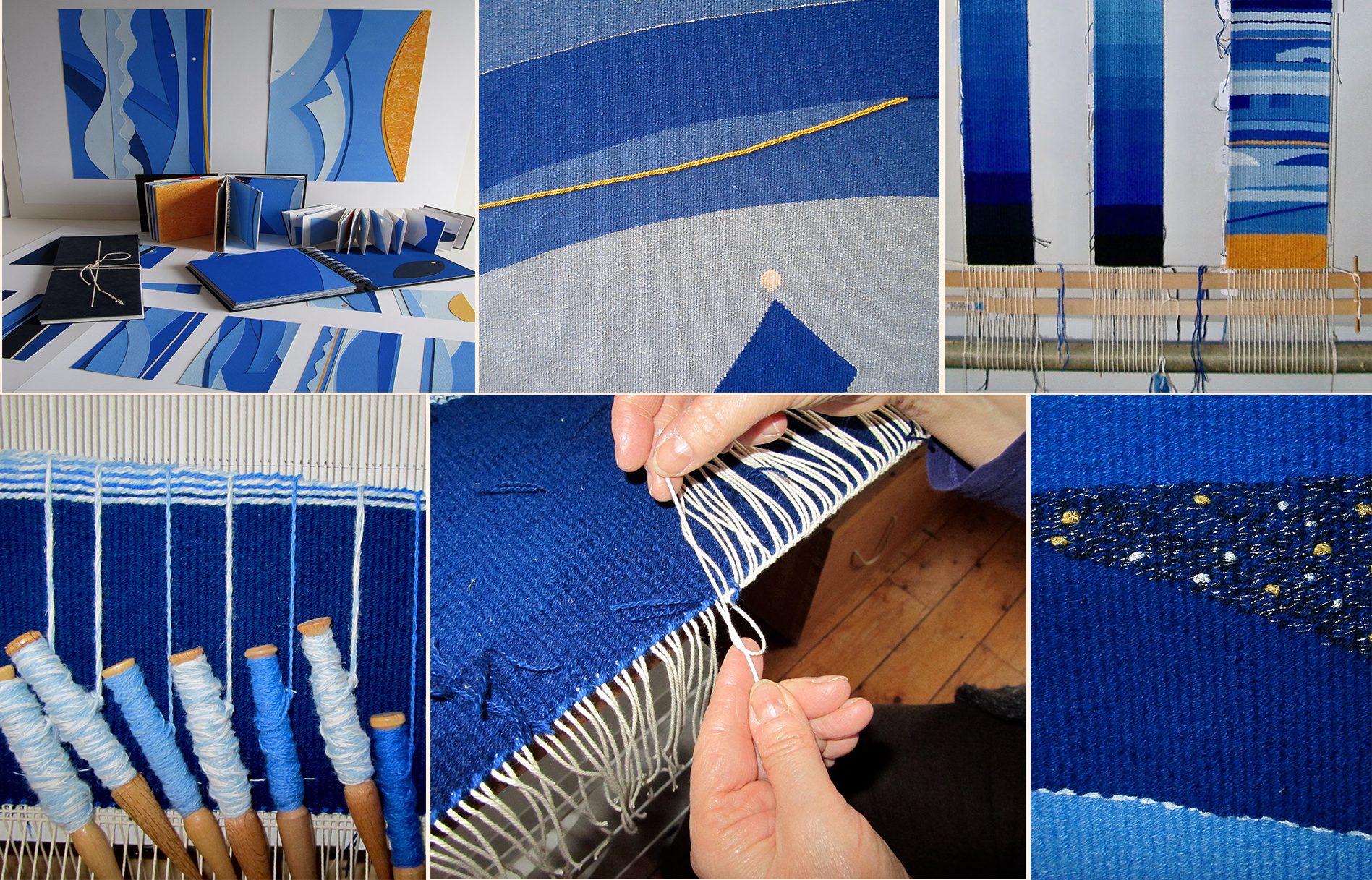
Tapestry brings inherent, rigid constraints. It demands absolute resolution before the weaving even begins. Ross develops her compositions on paper first, treating them as independent works of art. “The shifts in colour and detail emerge through a process,” she notes, allowing the initial fluid collages to solidify into structural blueprints.
On what drives the relentless labor of weaving:
The physical act of throwing the shuttle and beating the weft is exhausting. Yet, her motivation is beautifully simple. “I can’t resist it,” she admits. Every piece has its own background, demanding her attention. “The image making, and a desire for the viewer to occupy the space… a lot of it is just the yarn. It feels right in my hands.”


On navigating influences and the wider tapestry community:
While her aesthetic roots dig deep into Art Deco and mid-20th-century painters like Patrick Heron and Henri Matisse, her contemporary awareness is razor-sharp. She frequently points to the works of Susan Maffei and Mary Farmer as points of reference. Ross maintains a highly receptive mind, constantly looking at the wider landscape of skilled makers.
Tensioning, Time, and the Norwegian Spelsau
The material intelligence behind a Ross textile is as deliberate as its visual one. She works primarily in Norwegian Spelsau wool — a fiber chosen not for its softness but for its structural authority: exceptionally sturdy, with luster properties that allow it to carry light across a weft-faced surface in ways that more common wools cannot replicate. She dyes her own yarn, combining multiple shades on the bobbin to produce color fields of a complexity that commercially dyed yarns, with their uniformity, are constitutionally incapable of achieving. Merino, silk, linen, and cotton enter the weft weave at specific moments — each chosen for the precise textural effect it produces against the Spelsau ground, each a decision made with the same deliberateness that a painter brings to the selection of a medium.
The time required to produce a Ross textile is not incidental to its meaning. It is structural. The physical accumulation of yarn — the relentless, exhausting repetition of throwing the shuttle and beating the weft — is the process by which tension is built into the object itself, not as metaphor but as measurable physical property. The finished textile is heavy because it has earned its weight. Every gram of it is the record of a decision made and committed to without the possibility of revision — because tapestry, unlike painting, unlike sculpture, unlike collage, does not permit correction. What is woven is woven. The irreversibility of the medium is, in Ross’s practice, the source of its authority.
Her weft-faced construction — demonstrated with particular force in Red Alert, where the density of the weave physically alters the spatial properties of the room it enters — produces surfaces that are not merely visually dense but architecturally so: warp-faced structures that require physical space, that push back against the room that contains them, that establish boundaries as tangible as any built partition.
This is what the theater director’s instinct produces when it is applied to the loom rather than the stage: not a performance that disappears when the curtain falls, but one that remains — permanently, physically, irrevocably — in the structure of the object.
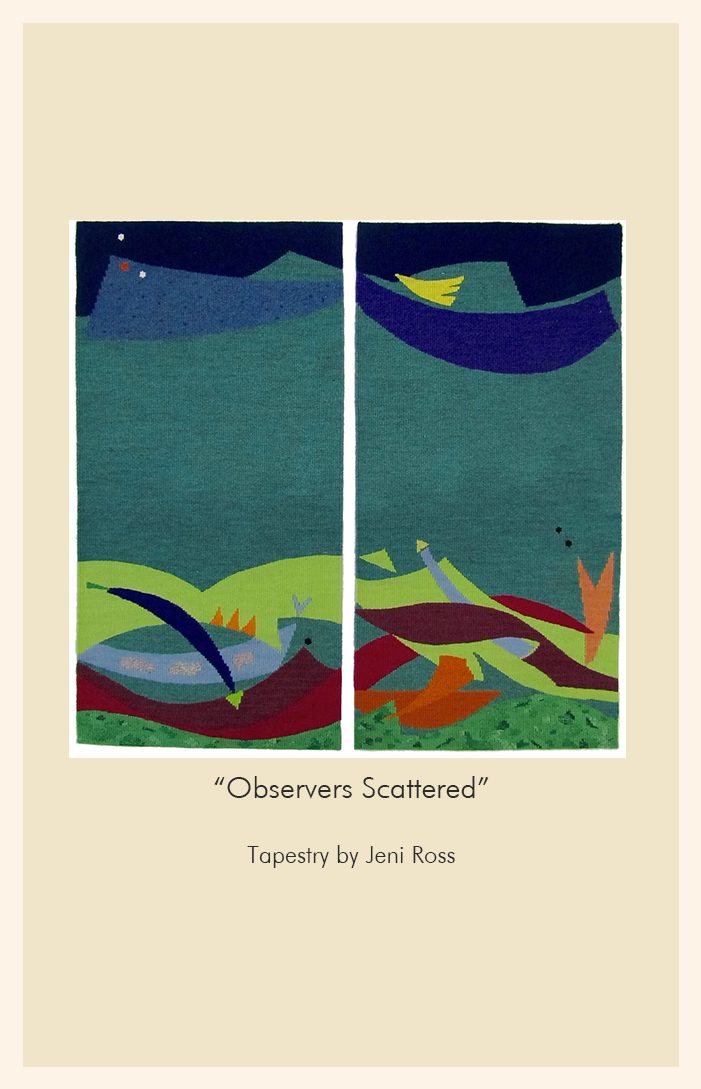
Tapestry by Jeni Ross
What Rug & Kilim Recognizes
The custom kilim tradition at Rug & Kilim has always proceeded from the conviction that a handmade textile, conceived and executed with genuine structural intelligence, is not a decorative object but an architectural one, an element that defines space rather than adorning it, that organizes a room’s visual and physical life rather than responding to decisions made elsewhere.
Jeni Ross’s practice is the most rigorous contemporary demonstration of this conviction we have encountered. Her insistence on total physical engagement with the loom, on the loom as an active site of directorial decision-making rather than a passive instrument of execution — produces objects whose weight, density, and chromatic authority place them firmly in the lineage that runs from the great Flemish tapestry workshops of the fifteenth century through the Bauhaus weaving workshop of Gunta Stölzl to the most serious contemporary fiber practice working today.
The thread connecting all of them is the understanding that the handmade textile reaches its highest expression not when it imitates another medium not when it tries to be painting, or sculpture, or architecture but when it fully becomes itself: structured, irreversible, materially honest, and possessed of a presence that no other object in the room can replicate or diminish.
At Rug & Kilim, that presence is what we have always been looking for. In Jeni Ross, we have found it completely.
By Sana for Rug & Kilim, Tapestry Specialist
Edited by Bhavna for Rug & Kilim, Editor