

Where Do Gallery Runner Rugs and Kilims Belong Today?
September 11, 2025
Zeki Müren, Da Silva Bruhns, and Leleu: How These Artists Transformed Rugs into the Language of Modernism
September 19, 2025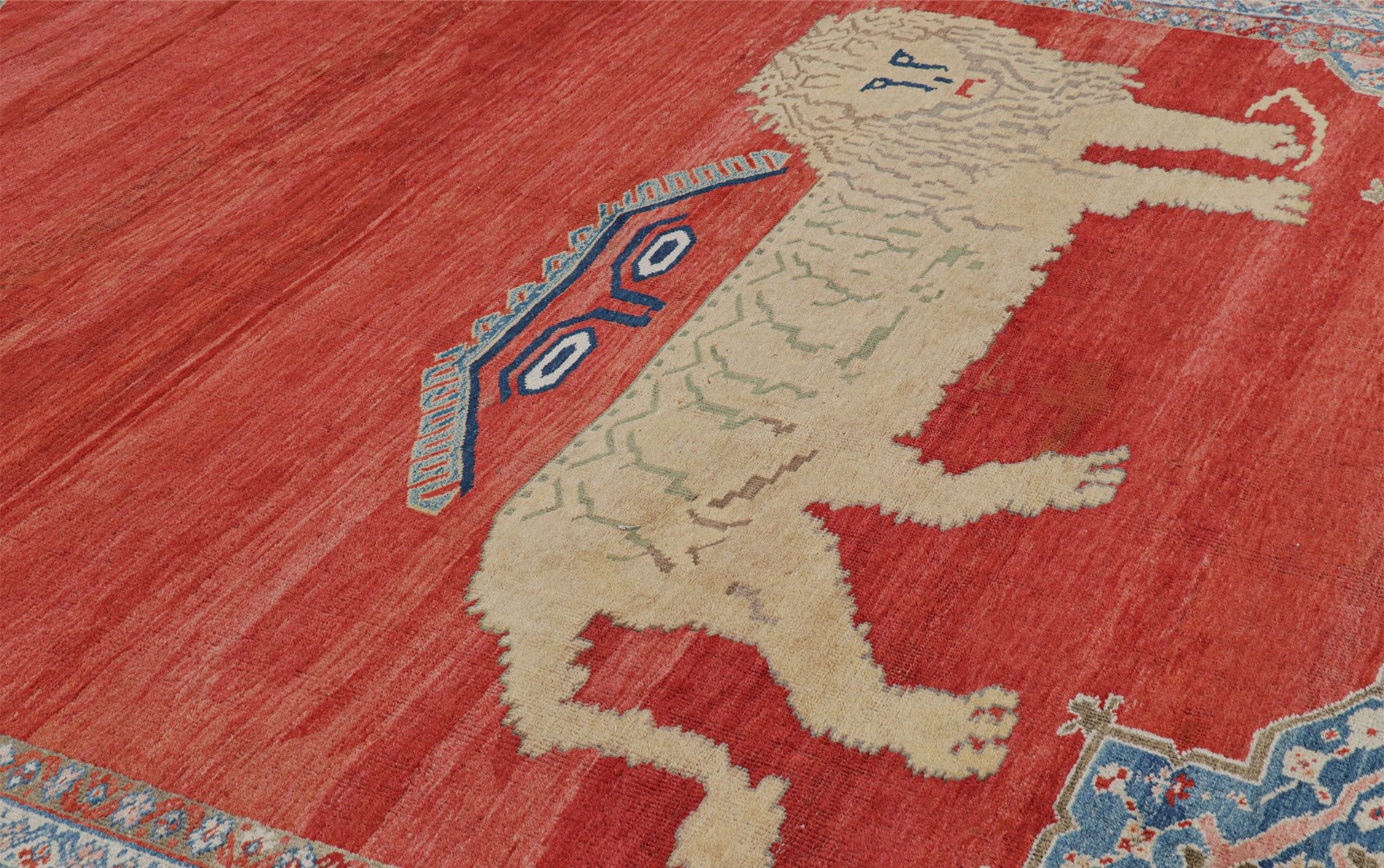
An Antique Persian Carpet That Refuses Silence
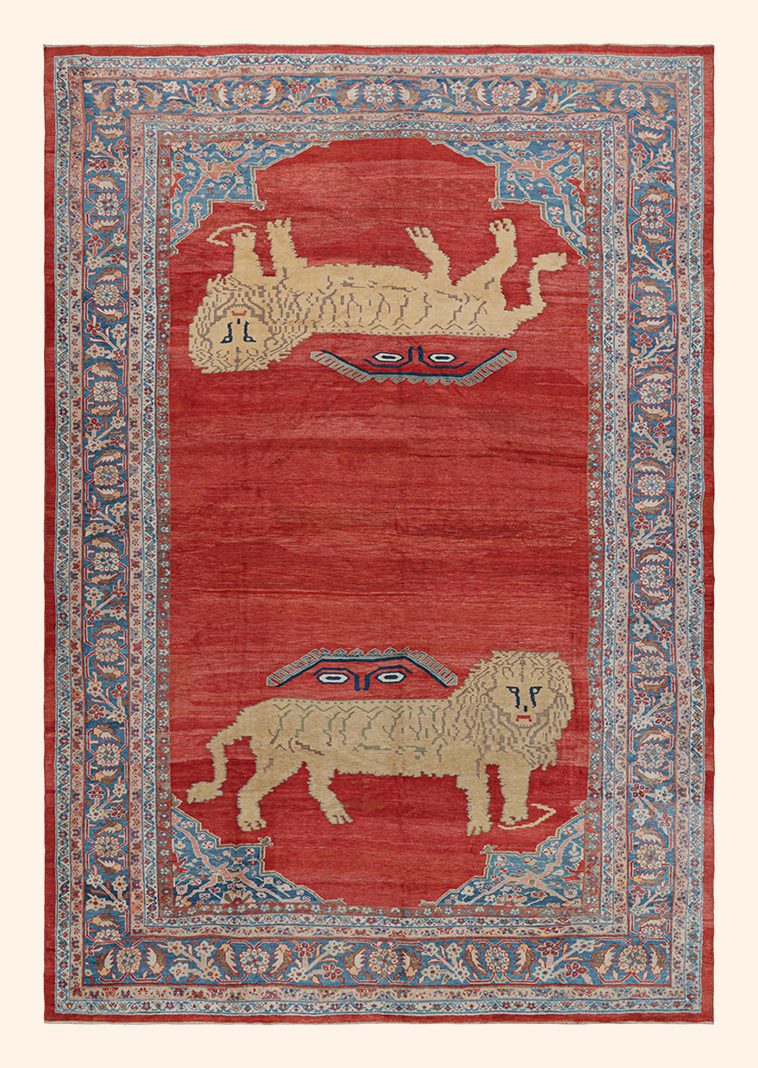
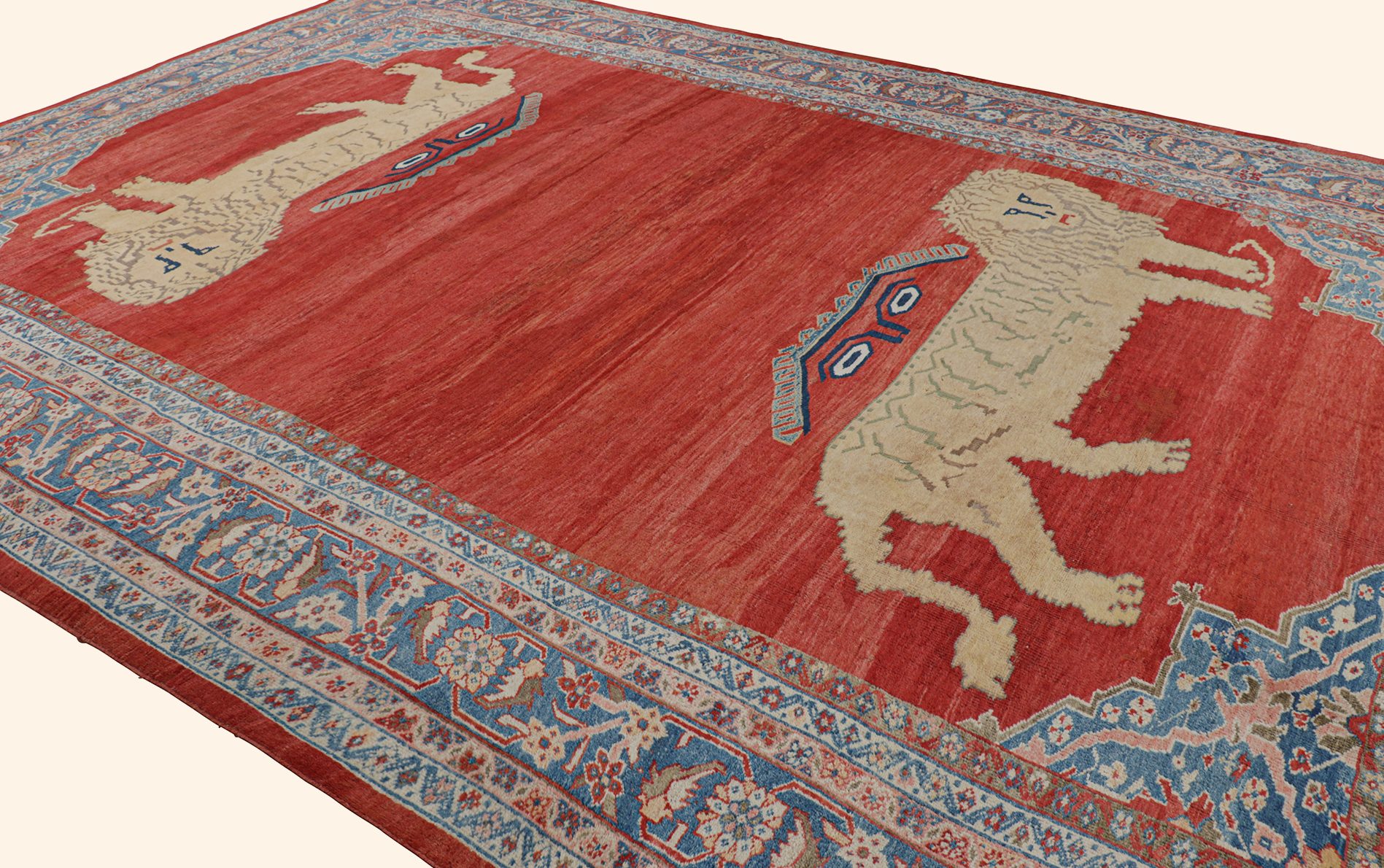
Not all rugs whisper beauty. Some confront, some provoke, and some stand strong of their age. This 1920–30 Persian Mahal lion carpet belongs emphatically to the latter. Its scale alone commands attention, but it is its audacity of imagery—two lions poised across a crimson ground, punctuated by talismanic eyes—that distinguishes it from its peers.
What could have been another workshop carpet for export markets instead asserts itself as an emblem of power, politics, and folk poetics. It is not only a rug to be admired, but one to be read.
The Provenance: Mahal as a Crossroads
Mahal rugs occupy a fascinating place in Persian weaving history. Located in northwestern Iran, the Mahal region became particularly significant during the late 19th and early 20th centuries as European demand reshaped Persian textile production. Western markets craved large-scale carpets for townhouses and institutions, and Mahal—situated near Sultanabad, a major weaving hub—supplied. These rugs often combined refined city-border designs with the looser, more organic hand of village weavers.
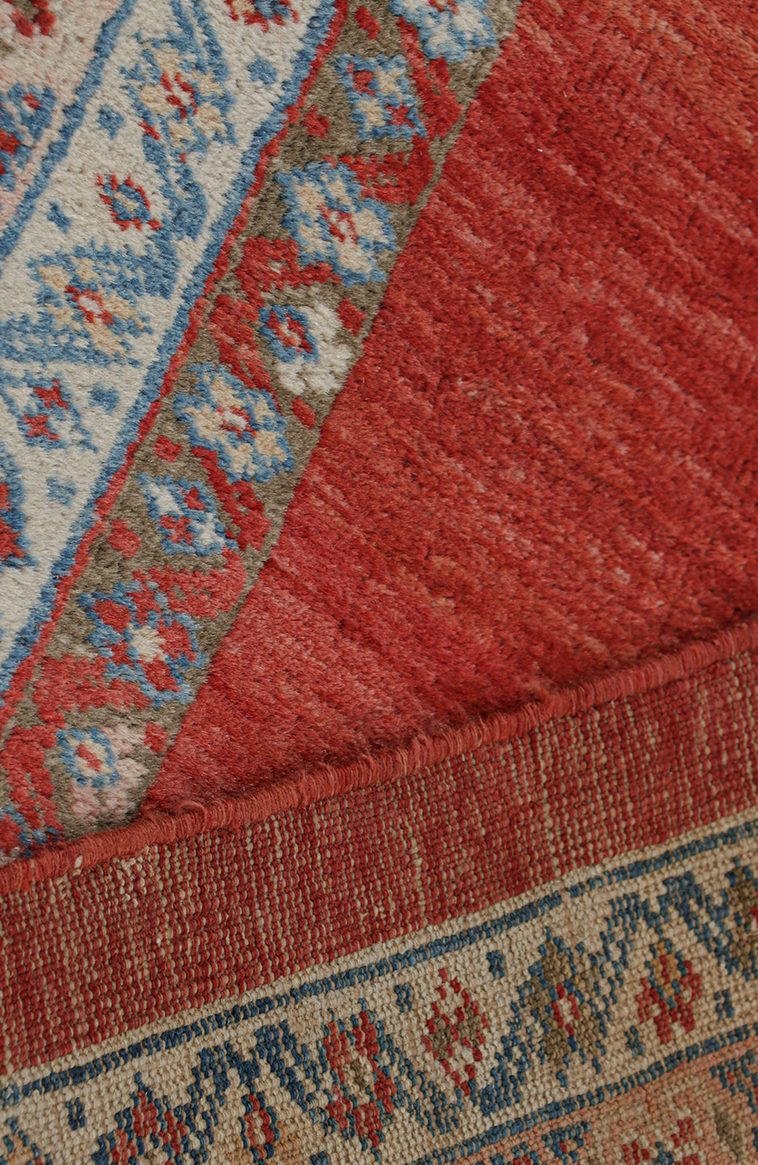
This lion carpet exemplifies that hybridity. Its finely articulated floral border, replete with scrolling vines and blossoms, belongs to the idiom of urban workshop design—meant to display technical sophistication and meet export expectations. Yet its pictorial field—spacious, raw, and almost defiant—leans into folk expression.
This negotiation between city and village styles makes the piece not just rare, but conceptually important: it embodies the cultural tug-of-war in Persian rug production between tradition and global commerce.
Lions and Eyes: Persian Politics in Design
The lions are not mere ornament. In Persian visual culture, the lion carries centuries of meaning—courage, sovereignty, divine sanction. From Safavid manuscripts to Qajar flags, the lion often appears beside the sun as Persia’s imperial emblem. By the early 20th century, the “Lion and Sun” had become a contested symbol: once a unifying national device, it grew politically fraught in the face of constitutional reforms and modernist aspirations.
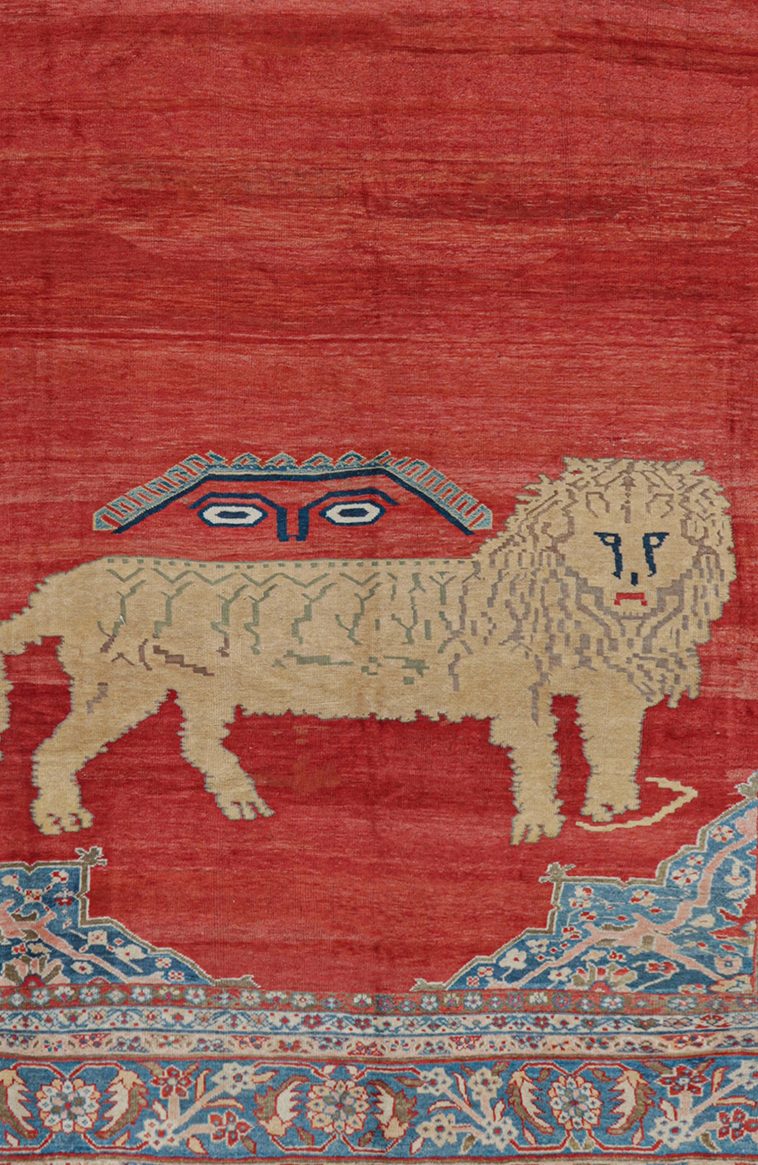
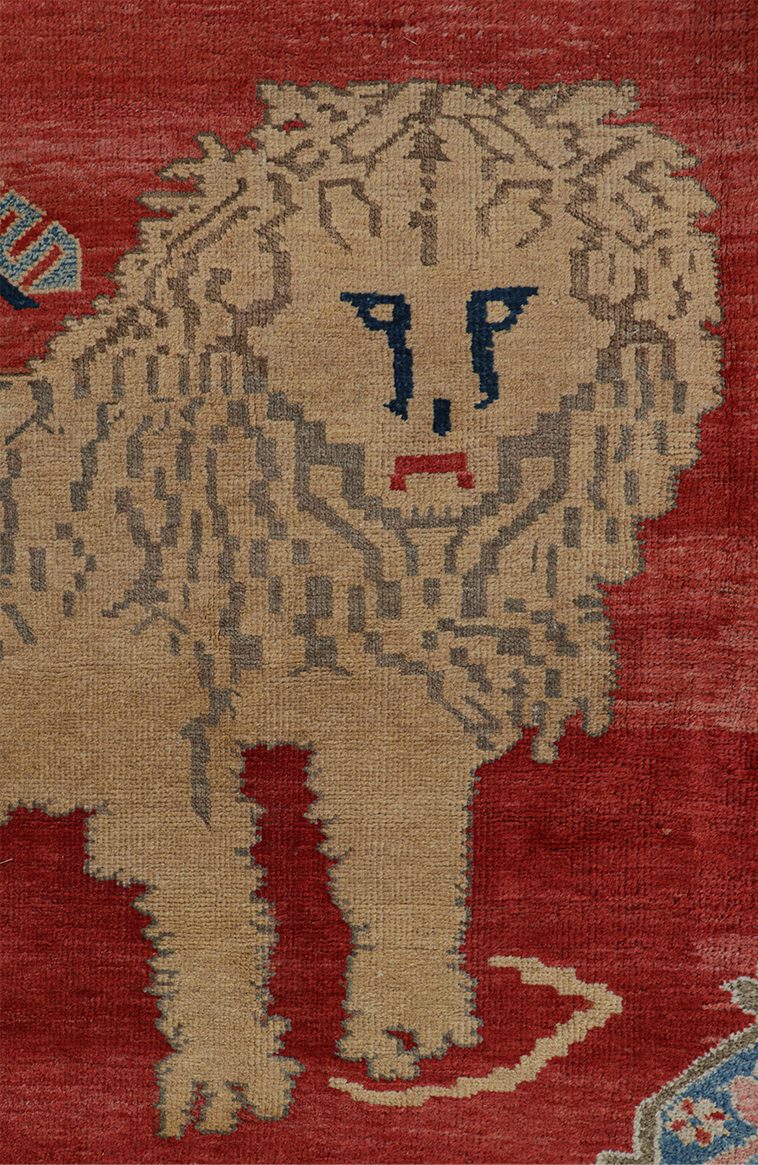
Here, the lions are rendered not with courtly grandeur but with rustic charm—elongated bodies, stylized manes, almost cartoonish candor. This disarming simplicity does not dilute their significance; rather, it reframes it. These are not lions of empire but lions of the people, woven with the immediacy of folk art.
Between them appear large talismanic eyes. In Persian culture, the eye can signify divine watchfulness, protection against the evil eye, or the omnipresence of authority. Placed above the lions, they amplify the carpet’s political undertones: power is not only embodied but surveilled, safeguarded, and spiritualized. This duality—sovereignty and protection, empire and folk talisman—renders the carpet deeply layered, resisting a single interpretation.
The Red Field: A Color of Meaning
Red, in Persian carpets, carries associations of vitality, wealth, and auspiciousness. In this piece, it functions as theatre—a stage on which lions and eyes enact their silent drama. Unlike the intricate allover patterns typical of Mahal production, the openness of this field is radical. It forces the viewer to reckon with the imagery, unmediated by floral distraction.
The choice of red here also resonates politically. In the context of early 20th-century Iran—caught between tradition and reform, monarchy and constitutionalism—red could signify blood, revolution, or renewal. For a village weaver, perhaps it was simply the most powerful color at hand.
For us, nearly a century later, it reads as a field of urgency, of life lived under watchful eyes and contested sovereignties.
Between Workshop and Folk: A Rare Synthesis
What makes this lion Mahal exceptional is not only its imagery but its synthesis of design traditions. The borders—complex, curvilinear, sophisticated—speak to city-trained designers and the demands of export patrons. The lions, however, belong to another lineage: that of Qashqai, Gabbeh, and other tribal pictorial rugs, where animals, talismans, and open fields dominate. To find these vocabularies in one carpet is profoundly rare.
This hybridity suggests a special commission or a workshop with unusual artistic latitude. It is not merely a rug to decorate floors, but a conscious act of weaving identity—a carpet that insists on preserving folk symbolism even within the trappings of commercial production.
A Collector’s Carpet: Where It Belongs
For today’s collector or designer, this rug offers more than aesthetics. It is a cultural text, a political relic, a folk-art masterpiece in monumental scale. Unlike purely decorative carpets, it resists anonymity. It demands a space that can acknowledge its gravitas: a library where history is lived, a gallery where art and politics converse, a room where design is not passive but dialogic.
To live with this rug is to live with contradiction—the ornamental and the symbolic, the imperial and the folk, the market and the village. It is a carpet that holds the century’s tensions in wool and dye.
Ultimately, this lion Mahal argues that rugs are not passive luxuries but active participants in history. That design is never neutral but always political. That the loom, even in a small village workshop, can articulate sovereignty, resistance, and hope.
This is why it deserves not only admiration but study. In its lions and eyes, its borders and field, it condenses a world of meaning—Persia’s world between tradition and modernity, empire and folk, ornament and politics. Few rugs achieve such synthesis, and fewer still survive at such scale and clarity.
It is, quite simply, one of the most important lion rugs we have seen in decades.