

Rug & Kilim Went to Italy: Tapestries and Art That Still Shape the Rooms We Build
August 1, 2025
Rug of The Week Series I: Gérard Schneider and the Power of Mid-Century Tapestry
August 7, 2025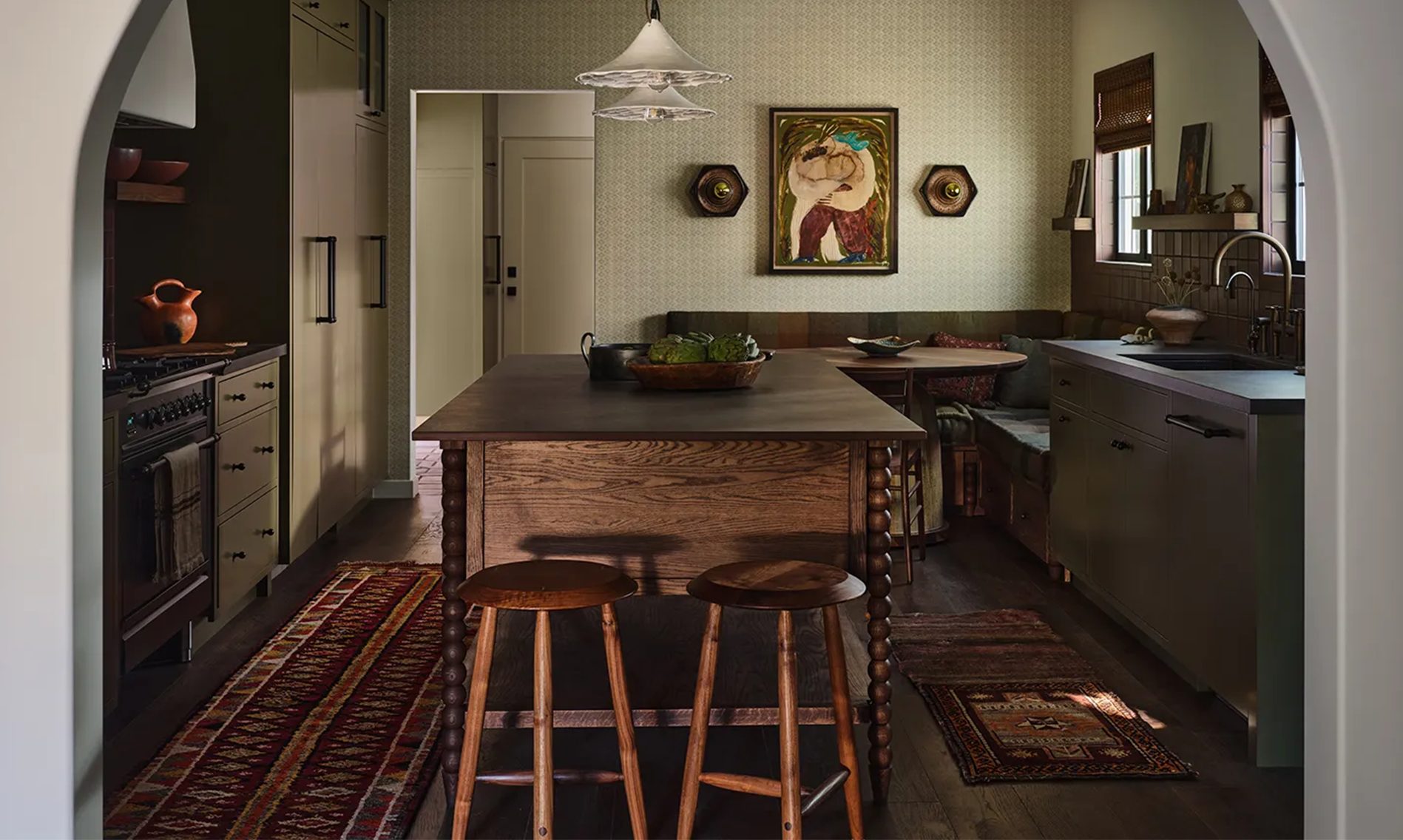
As seen in Domino Magazine, featuring our Kilim rug, designed by Los Angeles design firm A1000XBetter, founded by Kirsten Blazek.
Over the last four decades of collecting, studying, and preserving Kilims and Flatweaves, we have come to understand them not simply as tribal textiles, especially Qashqai kilims, which are documents authored by women whose names we will never know, yet whose design decisions resonate across centuries.
Every kilim in a collection is a fragment of a larger ethnographic narrative of movement, negotiation, and encoded survival. What begins as a study in tribal design inevitably becomes a reflection on how memory operates in material form. As collectors and custodians, we have come to understand these pieces less as possessions and more as conversations—between past and present, utility and abstraction, territory and transcendence. They speak to the same values that define the most forward-thinking design philosophies: sustainability, material honesty, visual intelligence, and narrative depth.
Among Persian flatweaves, Qashqai Kilims—produced by the Qashqai (or Qashgai) tribes of southwestern Iran—stand out for both continuity and evolution. As curators of one of the most important institutional collections of Kilims and Flatweaves, our engagement with these textiles is not decorative, but archival and historical.
Historical Backdrop of Qashqai Kilims
The Qashqai people are a Turkic-speaking confederation of nomadic and semi-nomadic tribes historically settled in the Fars Province, around Shiraz. Their migration patterns traditionally stretched across the Zagros Mountains—from the summer pastures of the highlands to the winter grazing lands near the Persian Gulf. This geographical mobility profoundly influenced their weaving practices, ensuring that their textiles remained portable, functional, and yet richly symbolic.
Qashqai kilim weaving flourished between the 18th and 20th centuries, peaking in quality during the late 19th and early 20th centuries. The Qashqai were never isolated; their weavings absorbed motifs and styles from Persian court carpets, Caucasian tribal art, and even Indian and Ottoman aesthetics brought through trade routes.
Far more than floor coverings, these flatwoven textiles are living documents of migration, survival, and aesthetic innovation—objects of both utilitarian purpose and ceremonial prestige. Like their North African Berber and North American Navajo counterparts, the Qashqai did not weave simply for trade—they wove to preserve memory, territory, mythology, and meaning. The Qashqai kilim retains its hand-hewn presence, anchoring design to the physical act of storytelling.
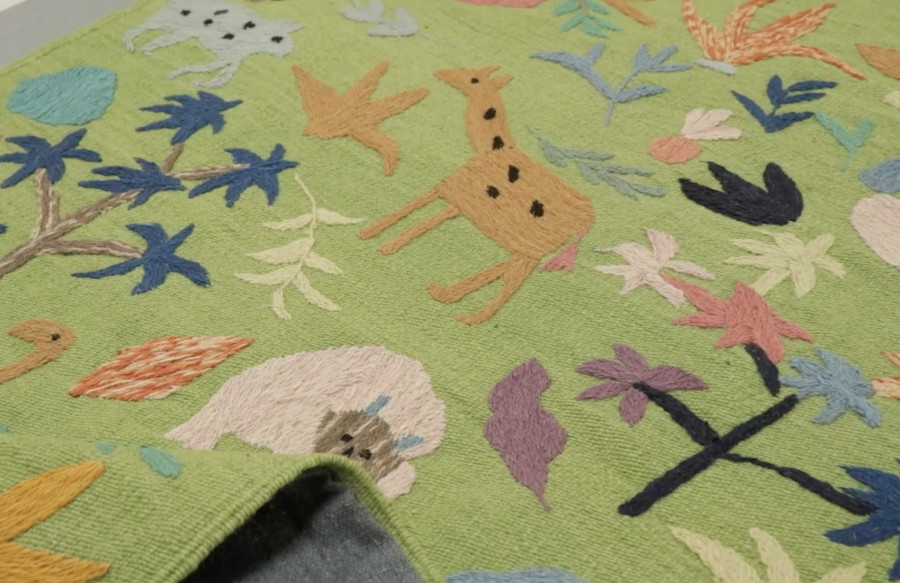
Qashqai kilims are flatwoven using a slit-weave tapestry technique that allows for bold geometry and color-blocked expression. Wool sourced from tribal herds, dyed with madder, indigo, walnut, and pomegranate, is hand-spun and hand-dyed—imbuing the kilim with tonal complexity that no synthetic dye can replicate. Their iconography—hooked lozenges, floral medallions, totemic birds, tree-of-life arrangements, and stepped diamonds—communicates protection, fertility, cosmology, and kinship. Each symbol, often passed down through generations of female weavers, acts as both protective charm and tribal insignia, inflected with spiritual resonance and encoded memory.
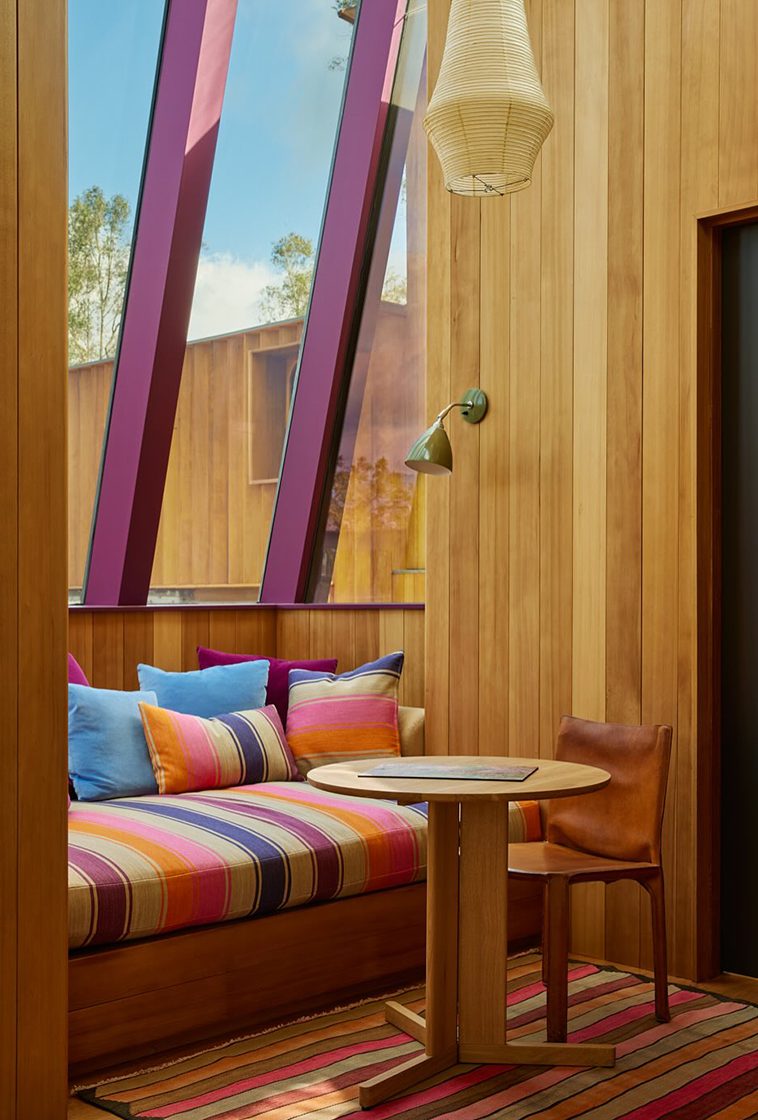
As seen in AD, featuring our Kilim rug, designed by Zeb & Crunk—an interiors studio led by Jazmyne Crunk and Zeb Knudsen, based in Los Angeles and Salt Lake City.
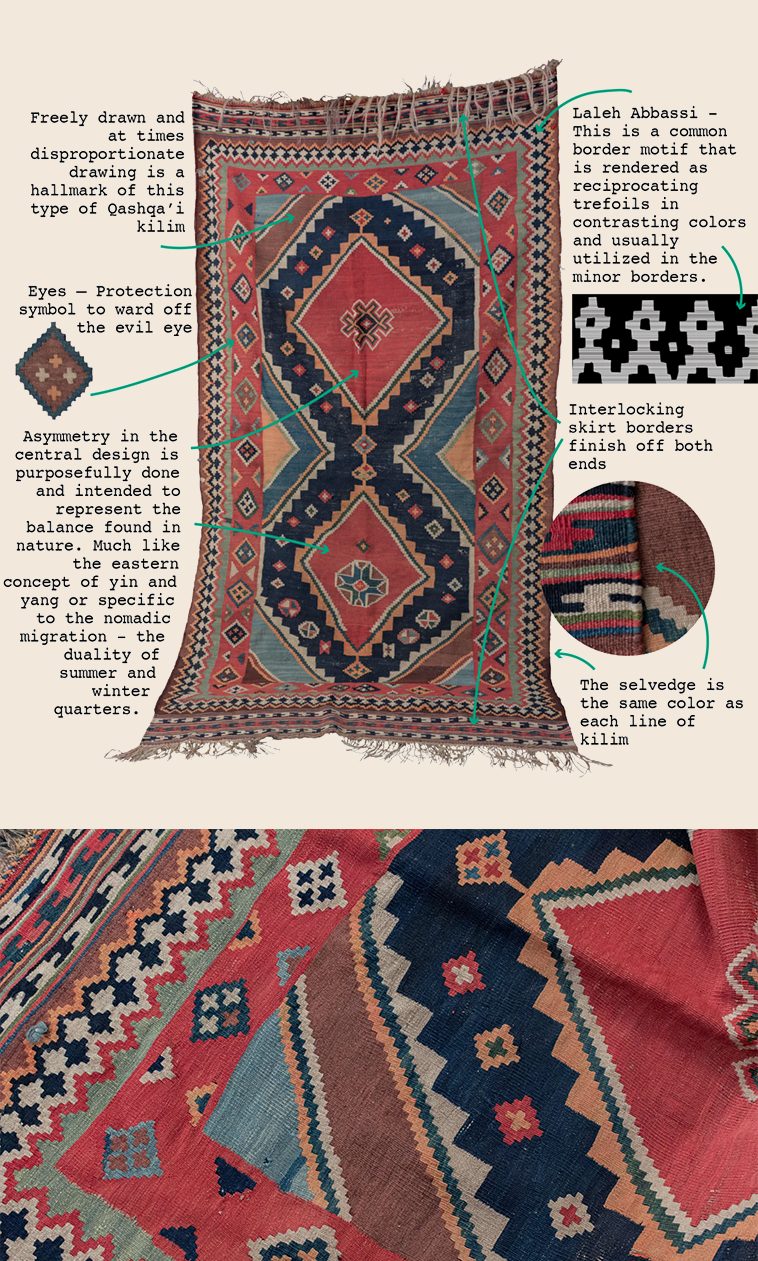
An Early History of the Qashqai motifs.
Influences and Inspirations: Cross-Pollination Across Civilizations
Historically, the Qashqai operated in seasonal migration between the highland summer pastures and the lowland winter quarters, a cyclical rhythm that not only shaped their economic life but also their aesthetic temperament. The movement between geography, climate, and encounter gave rise to a visual language that was both distinct and porous. Qashqai kilims absorbed motifs from the Safavid court traditions of Persia, the structural clarity of Caucasian weavings, and color sensibilities that echo Anatolian and Ottoman palettes. Yet, what distinguishes the Qashqai from others is their synthesis. Their kilims became a unique interface between nomadic life and artistic vision, simultaneously closed and cosmopolitan, local and transregional. In much the same way that Moroccan Berber rugs evolved with exposure to Arab, French, and Sub-Saharan styles, Qashqai kilims are the result of centuries of borderless visual exchange.
From the mid-19th to early 20th centuries—the acknowledged golden age of tribal weaving in Iran—Qashqai kilims were central to both domestic life and cultural diplomacy. Dowry kilims were woven with heightened attention to balance and symbolic potency, and were never intended for sale. Others were gifted between tribes, used as partition panels within tents, or employed in seasonal rituals. This imbued each piece with singular purpose. Today, authentic antique Qashqai kilims are exceedingly rare. Their appearance in global markets or institutional collections, such as the Victoria and Albert Museum or the Carpet Museum of Iran, reflects their ascent from tribal utility to textile legacy. The finest examples are identifiable by their original vegetable dyes, handspun yarn, coherent field structures, and unsullied tribal motifs, unmarred by the symmetry of later commercial workshop rugs.
Modern Styling and Contemporary Appeal
The modern appeal of Qashqai kilims has only intensified. With the rise of sustainable, handmade, and culturally rooted design, these kilims are no longer confined to ethnographic museums or private collections—they are making a quiet return as minimalist art objects in contemporary interiors.
Designers from Copenhagen to Kyoto now curate them as wall-hung tapestries, framed textile compositions, or focal points beneath glass floors in gallery-like living spaces. Their asymmetric symmetry and chromatic richness resonate with current sensibilities that prioritize imperfect beauty, material honesty, and artisanal origin. In this sense, the Qashqai kilim now stands shoulder to shoulder with Japanese boro textiles and Bauhaus-era modernist designs—united by their devotion to structure, function, and formal integrity.
Yet, as their market value climbs, so too does the risk of misattribution and dilution. The term “Qashgai-style” has become an umbrella label for mass-produced textiles that mimic geometric patterns but lack the provenance, craftsmanship, or cultural encoding of authentic tribal work. As such, stewardship now becomes critical. Collectors, curators, and institutions must engage with rigorous documentation, from carbon dating and dye analysis to oral histories from weaving communities. Increasingly, this responsibility extends to ethical engagement with living Qashqai artisans—supporting cooperatives, workshops, and preservation programs that ensure not just the survival of motifs, but the survival of meaning.
The parallels with other tribal textile traditions are telling. Just as Navajo rugs were once woven to navigate identity during colonization and later commodified into Southwest chic, the Qashqai kilim walks a similar tightrope—between sacred tradition and aesthetic consumption. Like Berber Beni Ourain rugs, which have found favor in international design circles yet suffer from over-commercialization, Qashqai kilims are at risk of becoming decontextualized artifacts if stripped from their cultural grammar. The challenge is to honor their past while allowing for evolved expressions—be that in contemporary reinterpretations by Iranian artists or co-designed pieces that marry tribal tradition with global demand.
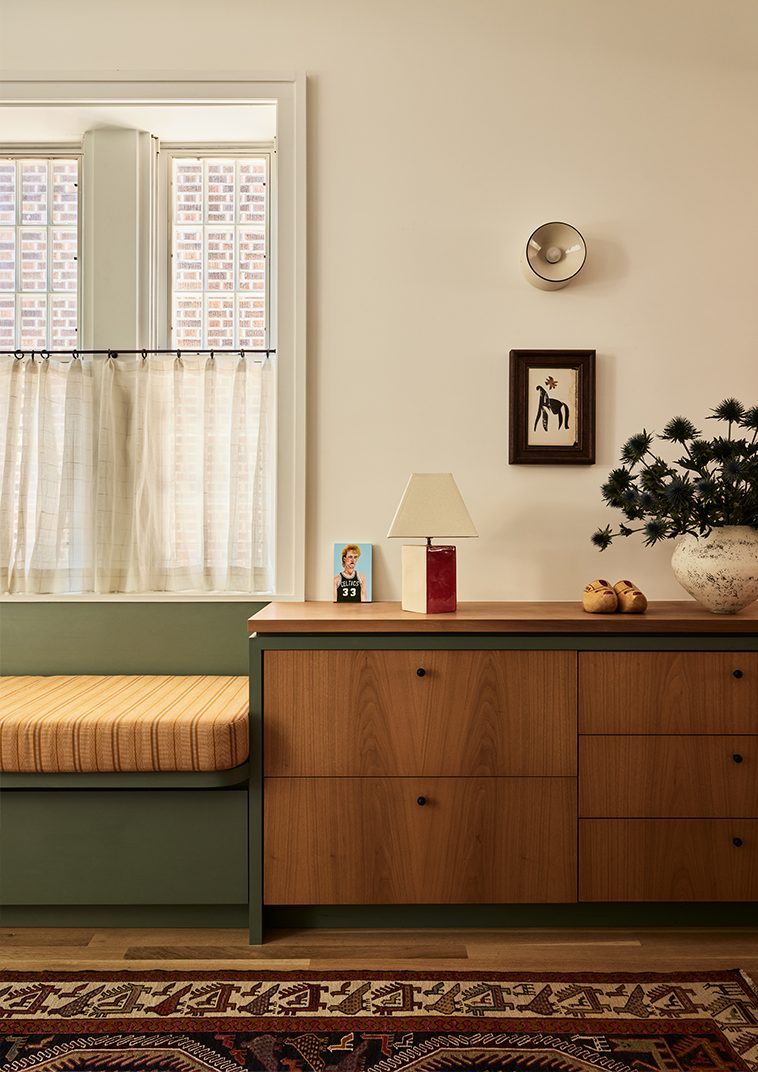
Designed by Jesse Parris-Lamb, is an interior design studio based in Brooklyn, NY. Featuring our Kilim rug.
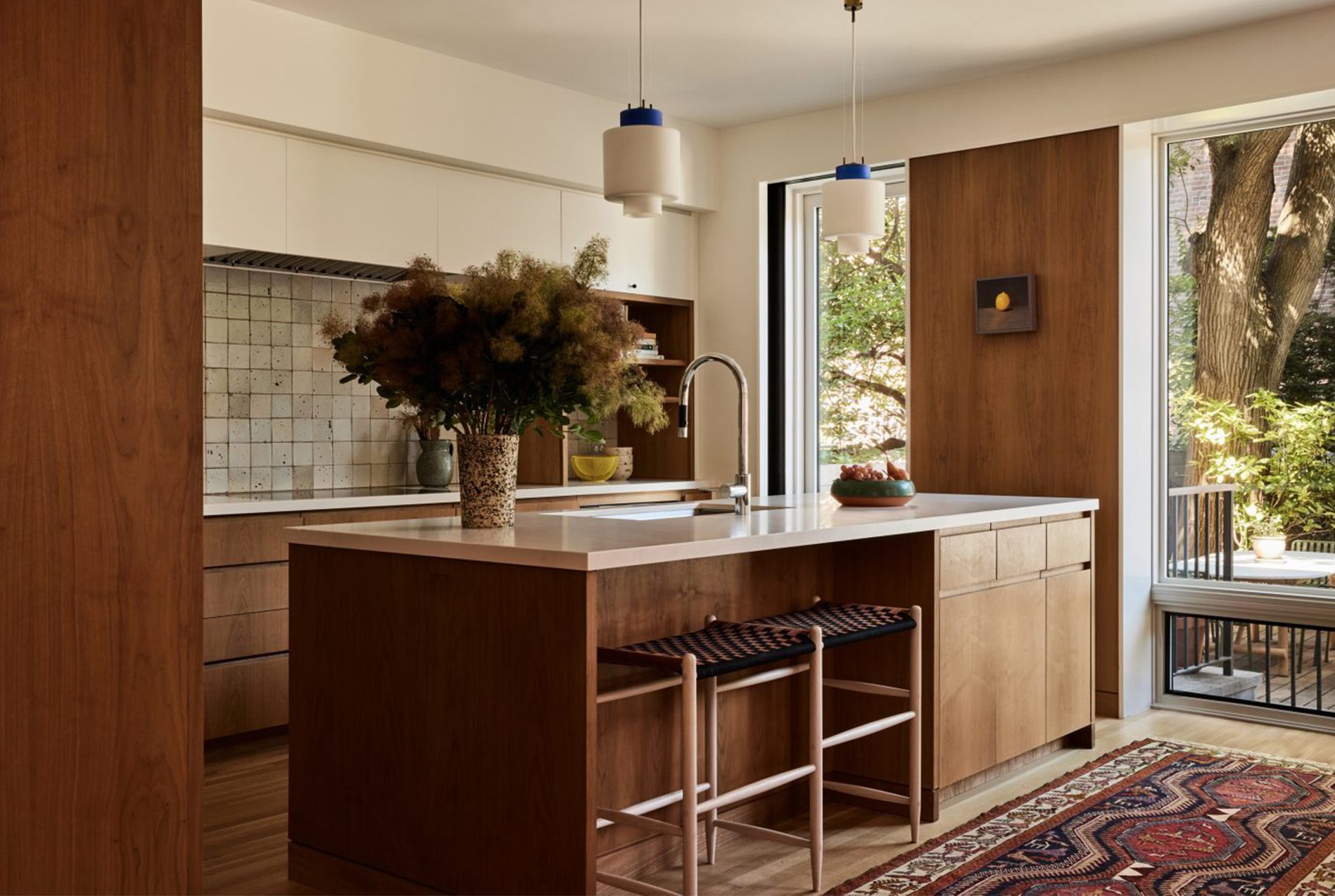
Designed by Jesse Parris-Lamb, a Brooklyn-based interior design studio, featuring our Vintage Persian Shahsavan Kilim in a Neo-Tudor townhouse.
Living Heritage of Persian Qashqai kilim, Evolving Narrative
Ultimately, a Qashqai kilim speaks of movement—across mountains, across time, across influence. It is the tangible expression of a people who have refused to be reduced by borders or assimilation. Their designs are not just beautiful—they are intelligent. They carry information, cosmology, worldview. And in doing so, they remind us that true luxury lies not in replication, but in the integrity of origin, the labor of the hand, and the depth of encoded memory.
In our institutional collection, each Qashqai kilim is documented not only for its aesthetic qualities but for its narrative placement within tribal migration, colonial entanglement, and market evolution. As stewards of one of the most extensive and academically curated archives of Kilims and Flatweaves, we view each piece not as an artifact of the past but as a document for the future trends.
Whether in a museum archive, a private collection, or a contemporary home, the Qashqai kilim endures as both object and oracle. It teaches us how to see with care, how to read what is not written, and how to live—rooted and yet mobile. And perhaps that is the final lesson they offer: that culture is never static, but always moving, and that in movement, we find not loss—but continuity.
~~~
Rug & Kilim’s Kilims & Flat Weaves >>
Rug & Kilim’s Qashqai Kilims >>