
What Makes Qashqai Kilims Unique? Inside the World of Persian Tribal Rugs and Flatweaves
August 7, 2025
How Rugs Frame and Define the Modern Open Interior: Defining Spaces From Palace Halls to Loft Living
August 14, 2025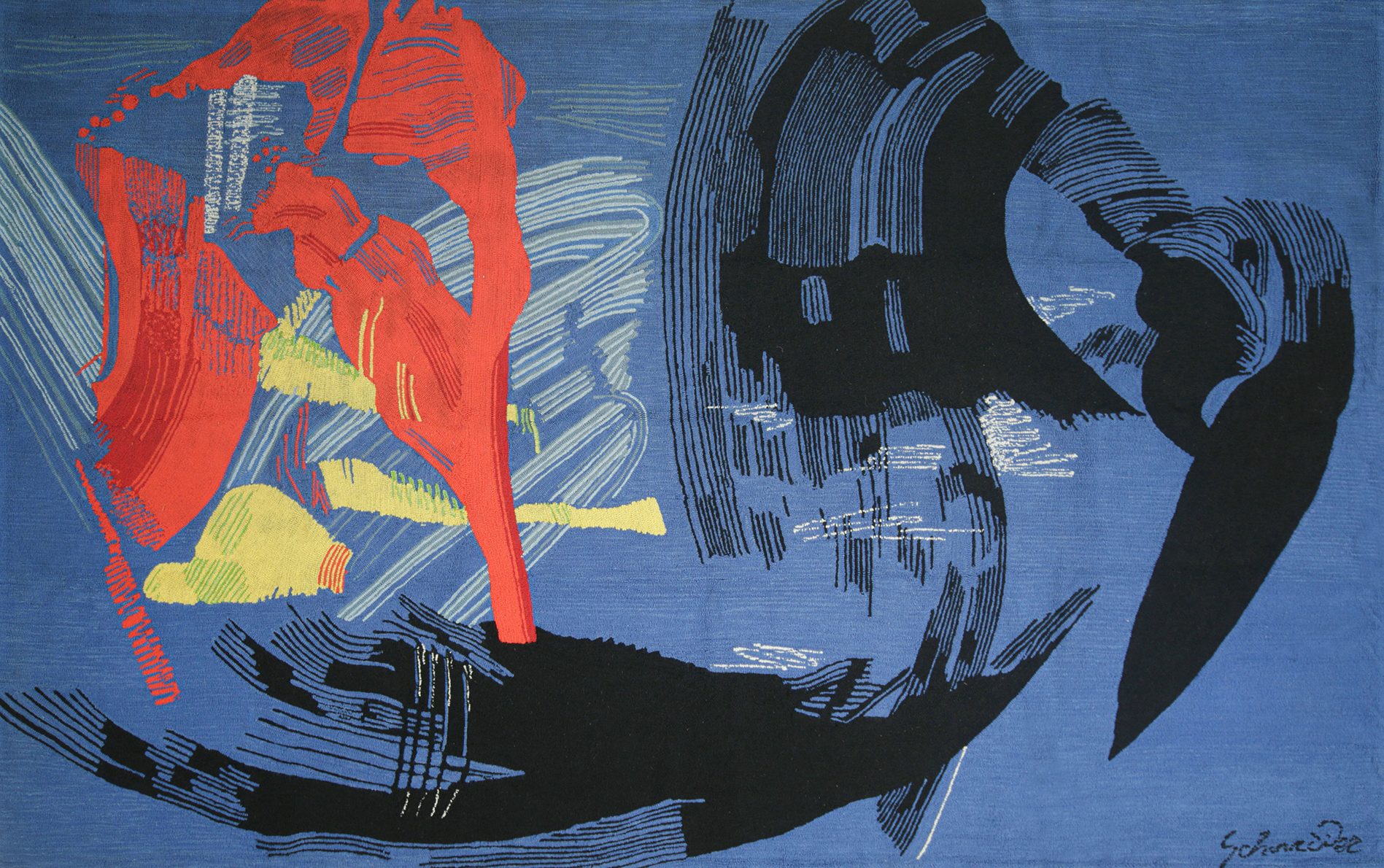
There are objects you acquire, and there are objects that acquire you. This tapestry by Schneider is of the latter kind—an inheritance of ideas, forged in color and conflict.
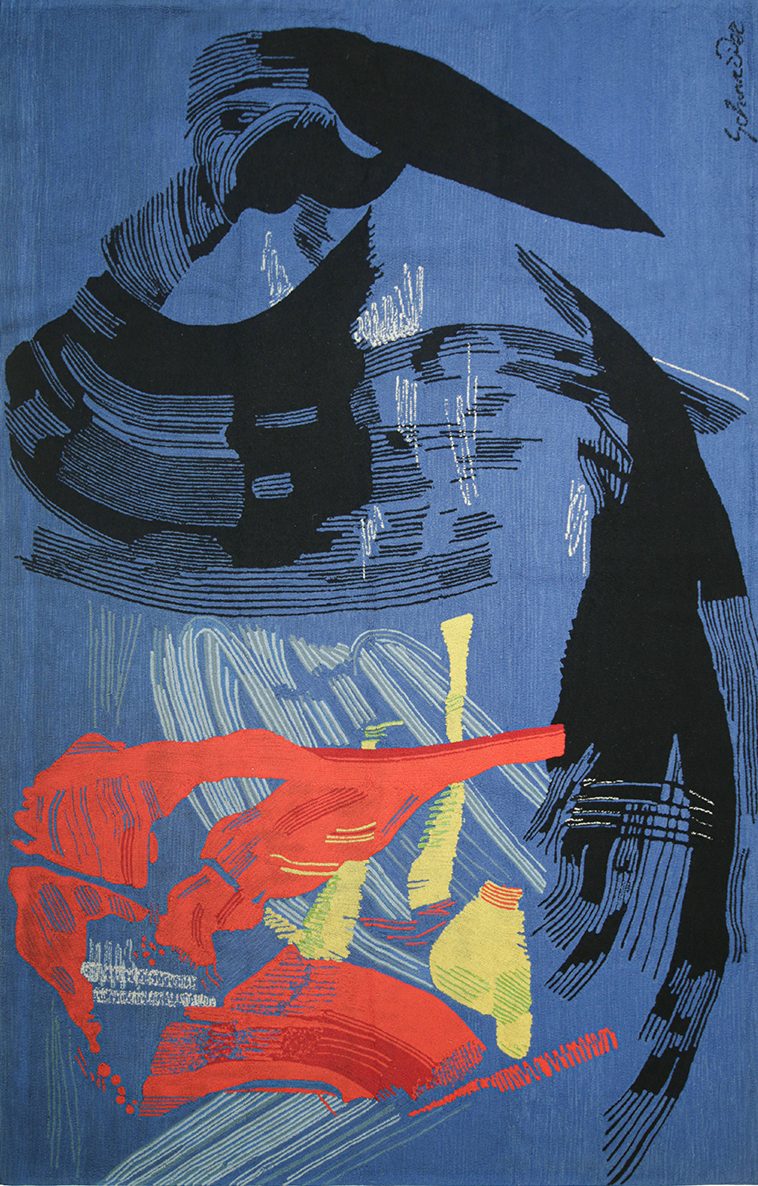
Amidst the trends of over-curated spaces and algorithmic aesthetics, it’s rare to encounter an object that resists easy categorization—something that asserts itself in a room with presence, not polish. Gérard Ernest Schneider’s mid-century tapestry, handwoven in France during the 1950s, is exactly that kind of object. It doesn’t merely live on a wall; it claims the wall, and with it, the cultural, architectural, and emotional context of the room.
This tapestry is not decorative—it is declarative.
To understand what makes this piece extraordinary, we must situate it within both the personal history of the artist and the broader evolution of modernist textiles. Born in 1896 in Switzerland, Schneider rose to prominence not as a textile artist, but as one of the pioneering figures of Lyrical Abstraction—an art movement that rejected the calculated rationality of geometric abstraction in favor of gestural freedom, emotional immediacy, and improvisational energy.
In the wake of World War II, Schneider—like many of his contemporaries—abandoned figuration not as a rebellion against form, but as a search for language after trauma. When the past is unutterable, the gesture becomes the message.
Tapestry as Political Space
Though Schneider is best known for his paintings, this tapestry represents a rare and exceptional venture into woven form—a medium with its own ancient lineage of storytelling, symbolism, and power. In pre-modern Europe, tapestries weren’t just decoration; they were mobile architecture. They warmed cold stone halls, demarcated space, told mythological tales, and signified cultural capital. They were also inherently political—often used to signify allegiance, conquest, or dominion.
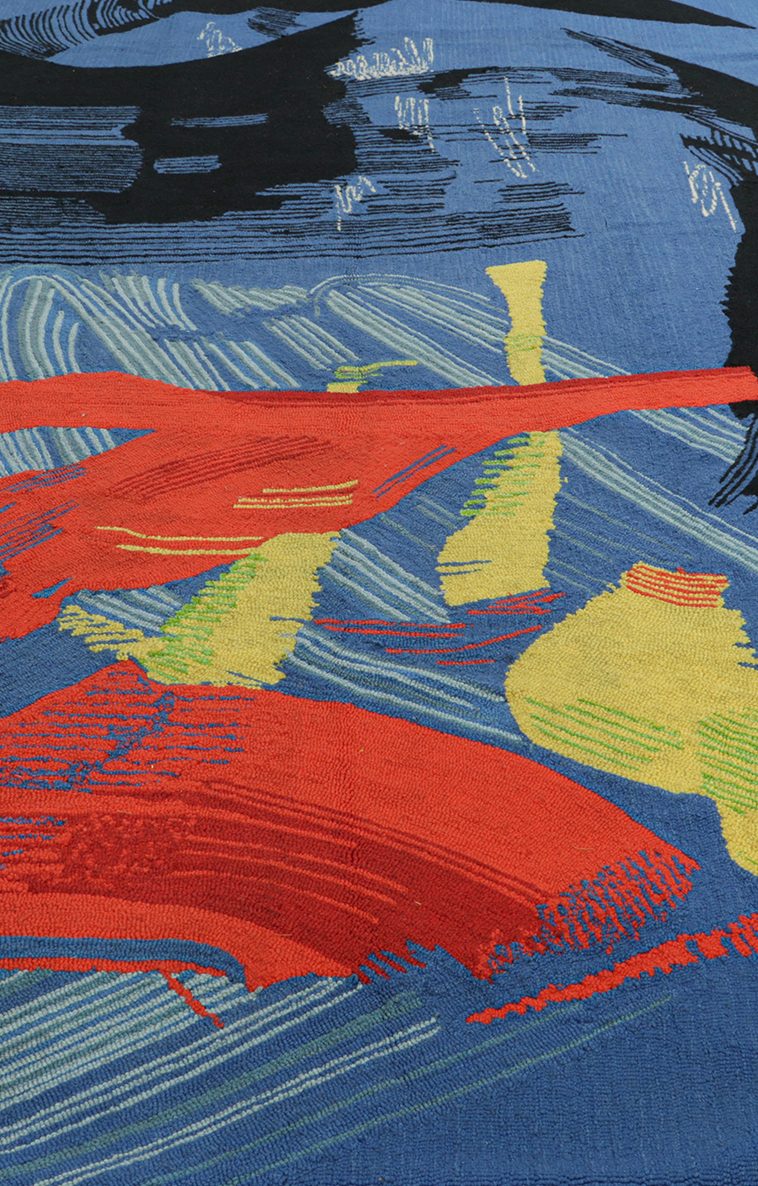
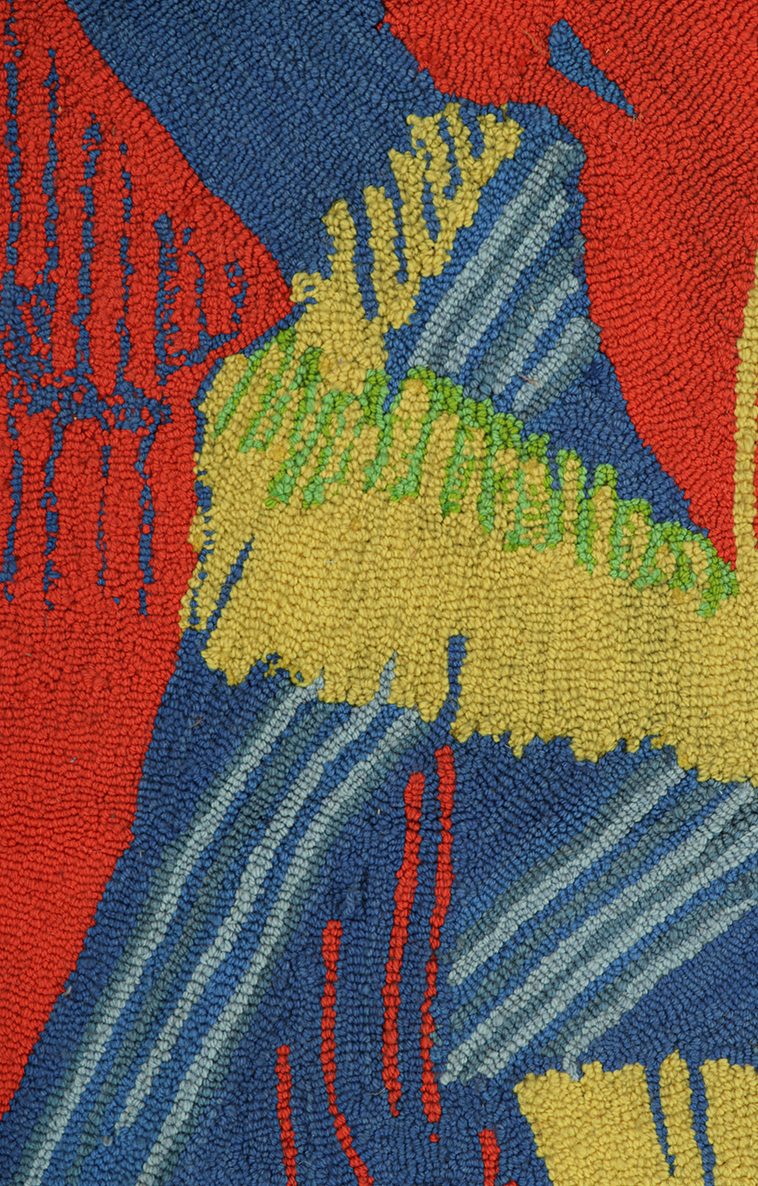
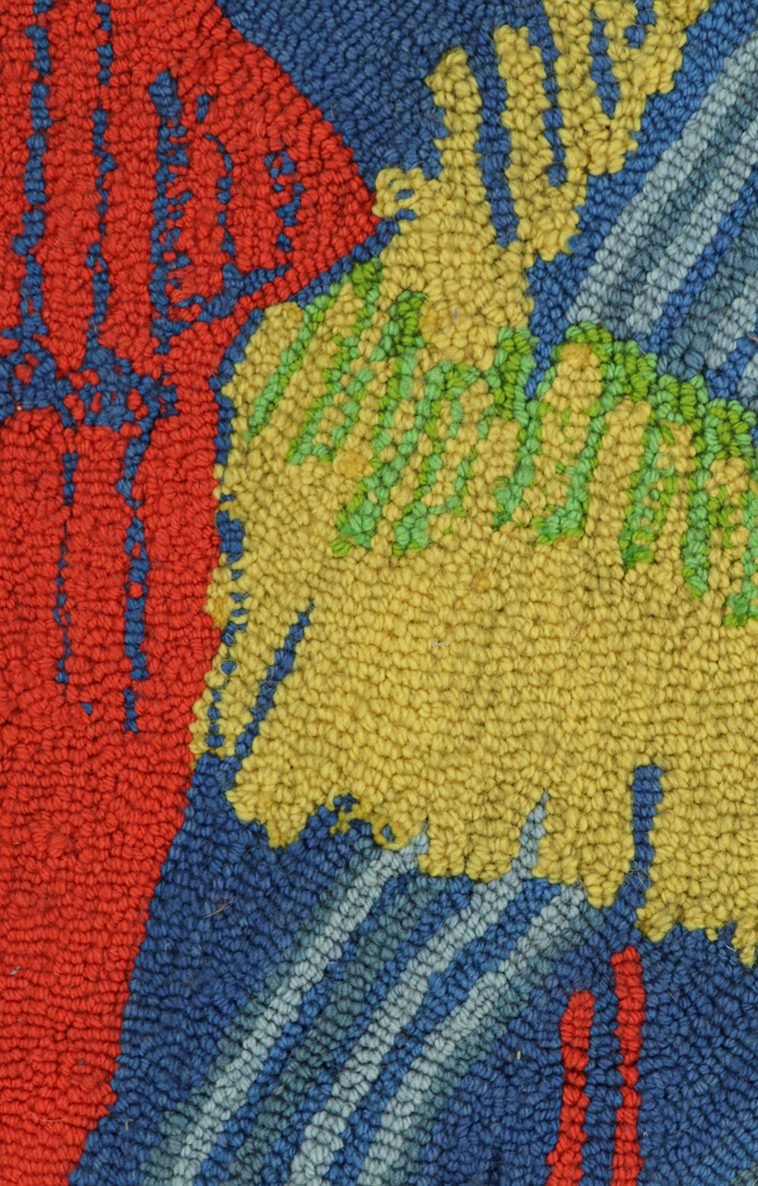
In Schneider’s case, the choice to translate his painting into a tapestry is profound. Wool is slower than paint. Where brushwork flows in seconds, tapestry is months in the making. Every gesture must be planned, yet appear spontaneous. And here lies the mastery: Schneider’s painterly style—the thick, impulsive strokes of red, black, yellow—are preserved in woven form without losing their urgency.
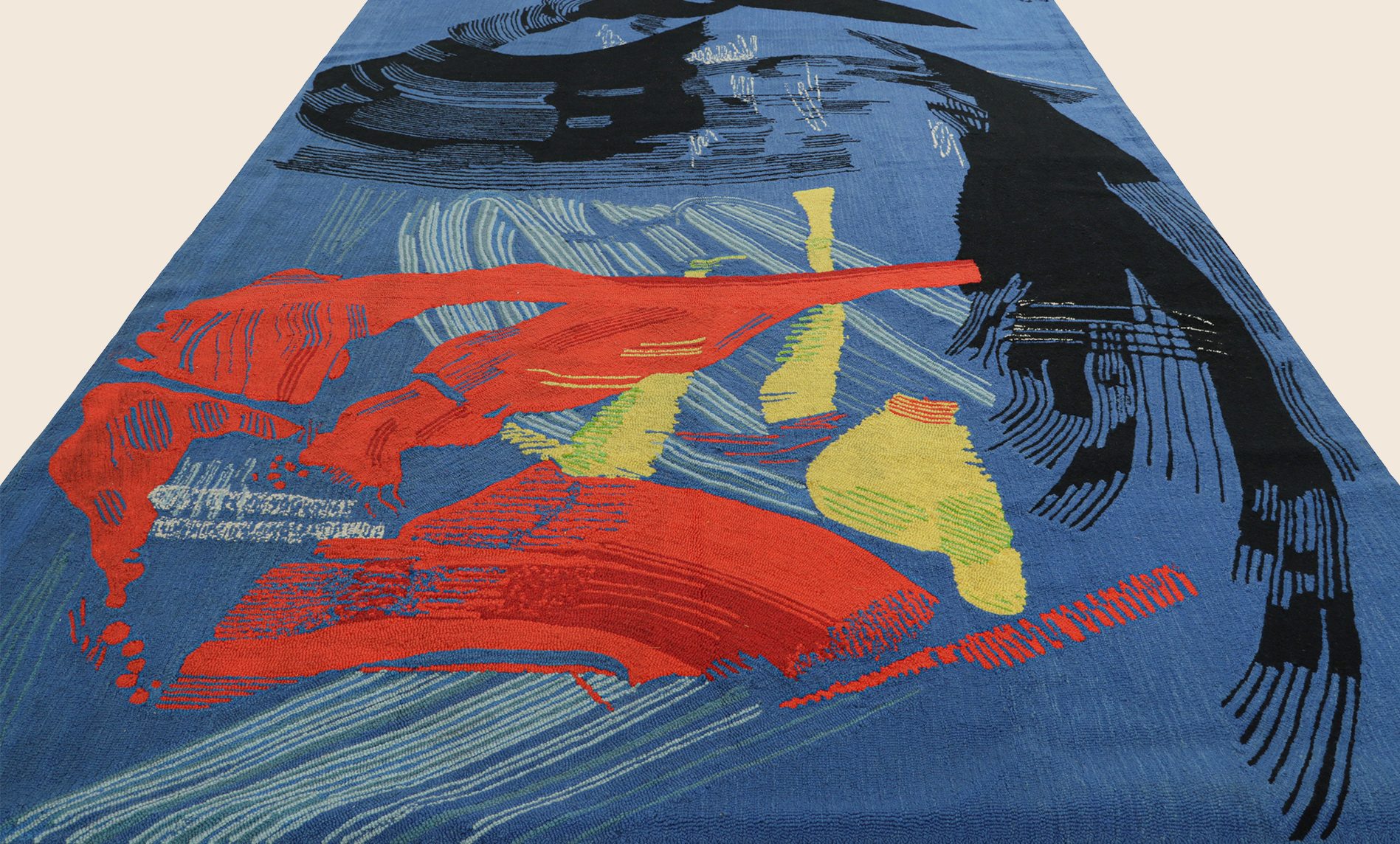
The color palette alone is a study in itself. The tranquil, cool expanse of blue sets the stage—suggesting a horizon, a mental space, or perhaps a silence—into which bursts of saturated red and heavy black explode. Yellow punctuates the design like alarm. These are not shapes; they are events. Their asymmetry is intentional, their scale confrontational. Together, they create what feels like a controlled detonation.
The Spatial Intelligence of Gesture
This piece does not offer a central composition or traditional balance. And that is precisely its strength. In the age of symmetry-driven luxury and Pinterest-perfect interiors, Schneider’s tapestry challenges the viewer—and the space—to engage in active perception. There is no obvious top or bottom. It breathes differently from every angle, creating a sense of visual movement that extends beyond its physical borders.
Interior designers of a certain caliber—those who understand the architecture of silence—know that such pieces are not merely installed. They are given space to resonate.
This is not a work to be squeezed between furniture or reduced to backdrop. It requires a gallery wall, a tall stairwell, a contemplative corner. Paired with raw concrete, natural woods, or patinated metals, it sings. Placed in proximity to works by Jean-Michel Frank, Le Corbusier, or even Donald Judd, it asserts its own vocabulary—more improvised jazz than classical orchestration, but no less sophisticated.
Mid-century European tapestries
Mid-century European tapestries—especially those made by or after the hand of fine artists—are increasingly rare in the market today. What distinguishes Schneider’s work from other postwar textiles is its philosophical density. Where many designers explored the boundaries of abstraction for aesthetic ends, Schneider’s work insists on meaning through emotion. He viewed color not as filler, but as language. Each form is a unit of emotion, each rupture a form of protest.
As such, this tapestry is not simply a relic from the past. It is a material memory—one that resists commodification. In a time when so much of our visual world is optimized for speed and scroll, a work like this demands slowness. Stillness. It is anti-ephemeral. It doesn’t decorate; it declares.
The Modern Collector’s Challenge
Collecting in this century is no longer about accumulation; it is about alignment. Who are you, and what does your collection say about your convictions?
For discerning collectors—particularly those who commission architectural homes, build interdisciplinary collections, or curate spaces with a philosophical bent—this tapestry answers a rare need: the need for objects that disrupt the obvious and open a conversation.
This is why works like Schneider’s are returning to prominence in salons and museums across Europe and the U.S. They serve as counterpoints to the decorative minimalism of the last two decades. They don’t follow trends—they question them. In that sense, this tapestry is as relevant now as it was in the 1950s. Its message, though abstract, is unwavering: Beauty must have backbone.
Final Reflections
There is a difference between surface and substance. In design, as in art, this difference often defines whether a space is merely photogenic or truly transformative.
Schneider’s tapestry is a premise. It opens a room to memory, ideology, vulnerability, and defiance. It is not art for the eye alone—it is for the intellect, for emotion, and for the architecture of memory.
For those who understand that to live with art is to live with thought, this is a rare opportunity.
To hang such a piece is not just to beautify a space—but to articulate a belief.