
Thomas Witty and the Growth of European Axminster Carpets
June 5, 2024
The Imam Reza Shrine in Mashhad – World’s Finest Collection of Persian Carpets
June 10, 2024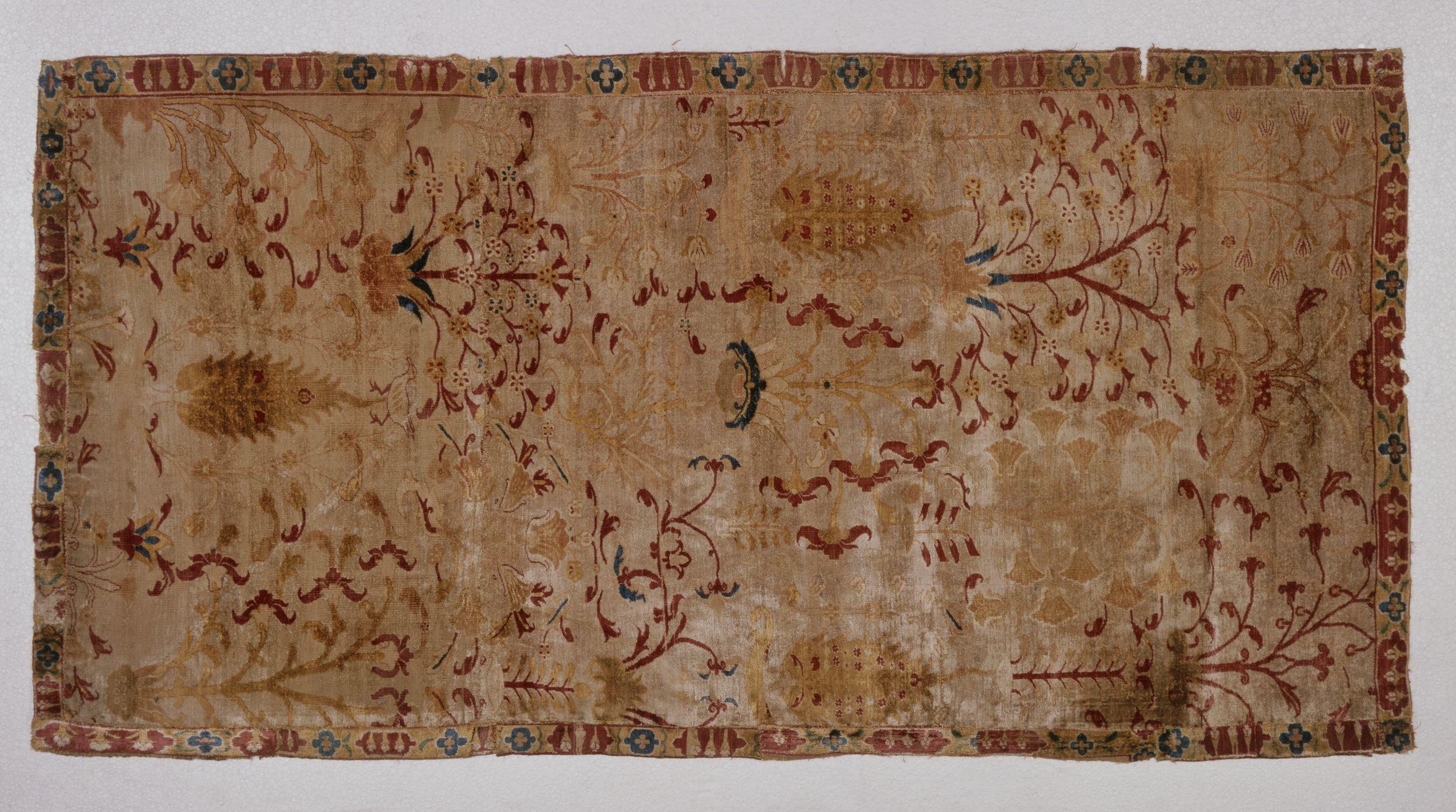
Victoria and Albert Museum’s Epic Iran exhibition offers a comprehensive exploration of 5,000 years of Iranian art, design, and culture, showcasing over 300 objects from ancient, Islamic, and contemporary Iran. Despite being the cradle of one of history’s great civilizations, Iran’s monumental artistic achievements often remain unfamiliar to many. This exhibition delved into Iran’s rich cultural legacy and its evolution into the 21st century, from the advent of writing, marking the start of recorded history in Iran, through the 1979 Revolution and beyond. The exhibit featured an array of works, including sculpture, ceramics, and carpets, as well as textiles, photography, and film. These pieces highlighted Iran’s vibrant historical culture, architectural splendors, and myth, poetry, and tradition that have been central to Iranian identity for millennia.
One such tradition that has contributed to a distinct ‘Iranian’ identity is carpet weaving.
Carpet-weaving, a tradition practiced for millennia in the region, reached its zenith of opulence in 16th-century Iran due to the competitive patronage of both the royal court and ambitious regional governors.
These magnificent carpets, preserved in noble and religious collections across Europe and West Asia, gained storied reputations as specialized textile collecting flourished in the 19th and 20th centuries. Long before this, Iranian carpets had begun to appear as prized exports in the oil portraits of early modern Europe. One such genre of Iranian carpets that has achieved fame above and beyond are the Kerman carpets.
What are Kerman Persian Carpets ?
Since the seventeenth century, Kerman has stood as a prominent center for weaving some of the finest Persian carpets, with its legacy traced back to the Safavid period. Notably, the Vase Carpets from this era are hailed as masterpieces of Persian weaving, showcasing exquisite craftsmanship and intricate designs. As Persian rug production surged in the nineteenth century, Kerman reemerged as a leading producer of exceptional carpets, particularly the Lavar type renowned for its fine weave and classical-inspired designs.
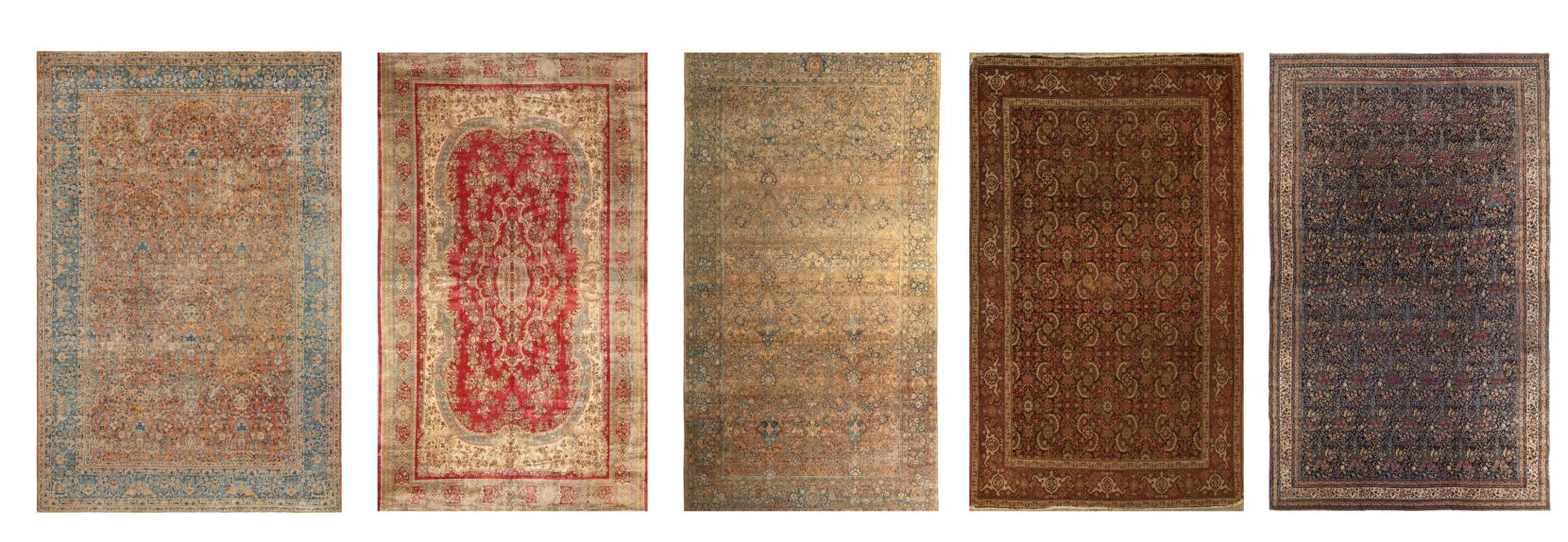
Kerman played a pivotal role in the rug renaissance of the late nineteenth century, renowned for its extensive array of dyes that endowed its rugs with stunning color effects.
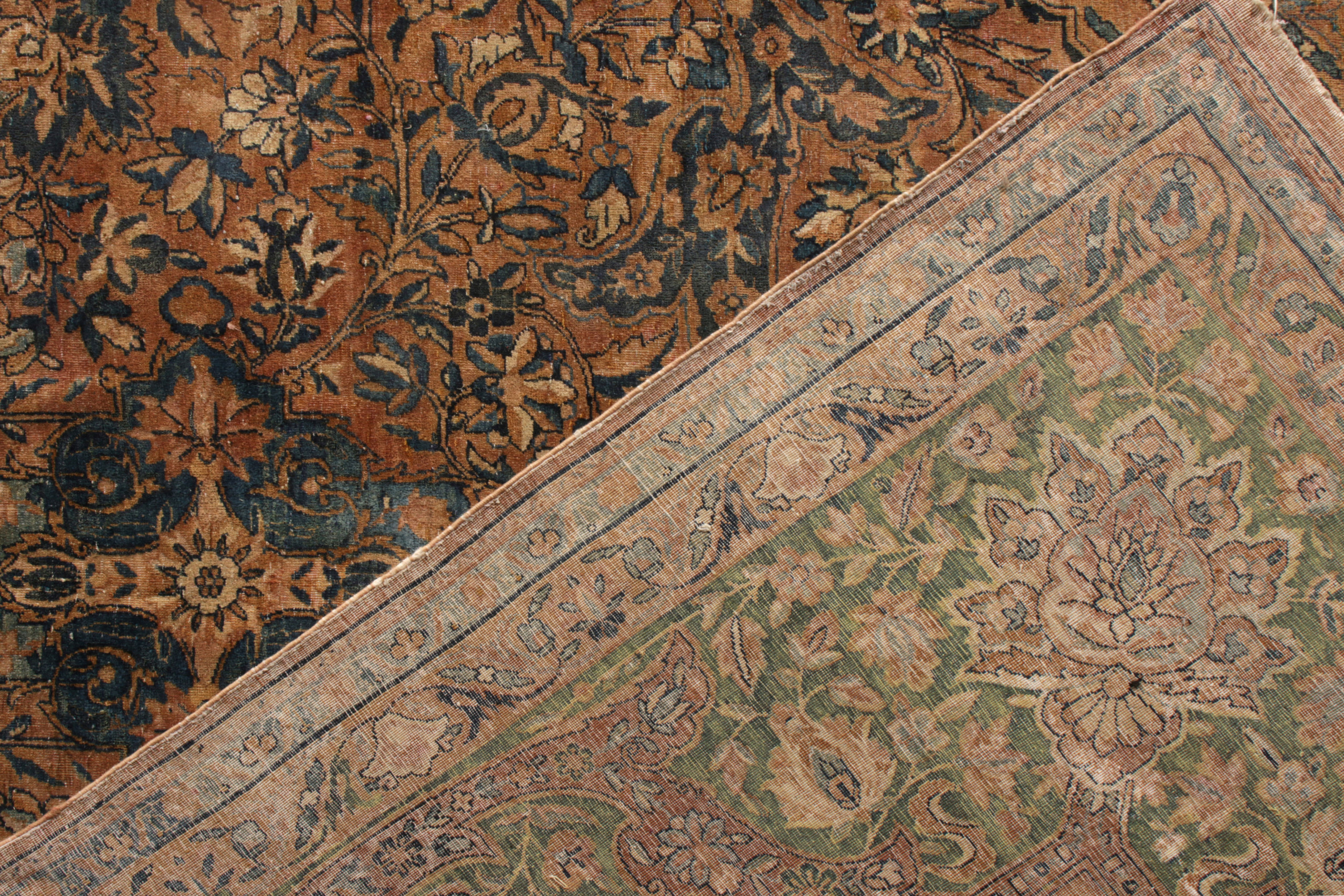
Kerman rugs are distinguished by their ornate, curvilinear designs and meticulous patterns, showcasing a harmonious fusion of floral and geometric motifs. Read more about our profile on Kerman Lavar Persian rugs here – https://rugandkilim.com/blogs/an-abbreviated-guide-to-kerman-lavar-rugs/
16th-Century Persian Kerman Rugs from Iran
More than four hundred Persian carpets from the Kerman Iran region are known to have been produced during the 16th and 17th centuries. Among these are the Sanguszko carpets, which represent just one of the many distinguished groups from this region. Kerman carpets have been likened to some of the most exquisite knotted pile masterpieces created in the 16th century in the capital cities of Tabriz and Qazvin, as well as the magnificent silk carpets attributed to Kashan. The Sanguszko group is likely among the oldest surviving carpets from Kerman, a region with a rich history of carpet weaving that spans many centuries.
History of Sanguszko Carpets
Carpets, much like paintings, are mobile luxuries.
However, none of the renowned carpets of the Sanguszko type appear in those early oil portraits, indicating that they were likely precious or exclusive commissions not typically meant for export.
According to Sanguszko family lore, an ancestor seized their famous carpet from the tent of a defeated Ottoman soldier at the Battle of Khotyn in 1621.
In 1928, collection consultant Royall Tyler recounted this mythology to his clients, the diplomatic power couple Robert Woods Bliss and Mildred Barnes Bliss, urging them to acquire the “most beautiful carpet in the world.” He extolled its “powerful, rich, delicate, tender, violent” color scheme, asserting that it “sends one clean off one’s head.”
That carpet now resides in the Miho Museum, an I.M. Pei-designed temple-like structure built into a mountain in the Shiga prefecture of Japan. Interestingly, the museum once sent a life-size, vinyl print-out of the carpet to display in Genoa in its stead.
The Sanguszko family’s prized possession is a fitting addition to its new owners, a foundation devoted to the Shinji Shumeikai spiritual sect, which values the appreciation of beauty through art.
In the 1920s, Royall Tyler estimated a six-figure price tag for the Blisses; however, the Miho Museum ultimately purchased it in 1994 for a reported price of over $4 million.
The carpet was displayed in 1949 for the visit of the Shah of Iran to the Pope’s Asia Institute in New York. In 1951, Pope saw a picture of the war vest of Toyotomi Hideyoshi (1536-1598) that was made from a Kashan flat weave, featuring the figure of a tiger attacking an antelope. Pope recognized the design as originating from the same cartoon used for this carpet. When the Institute closed down in 1954, Pope advised Prince Roman Sanguszko to place the carpet on loan to The Metropolitan Museum of Art, where it was displayed until 1995, when it was sold. For four hundred years, the vicissitudes of history kept the Sanguszko carpet on a long pilgrimage from place to place. The name of the carpet comes from its former owner.
A group of about fifteen carpets of a similar type, woven in the sixteenth and seventeenth centuries and now in collections in the United States and Europe, have come to be known as Sanguszko carpets.
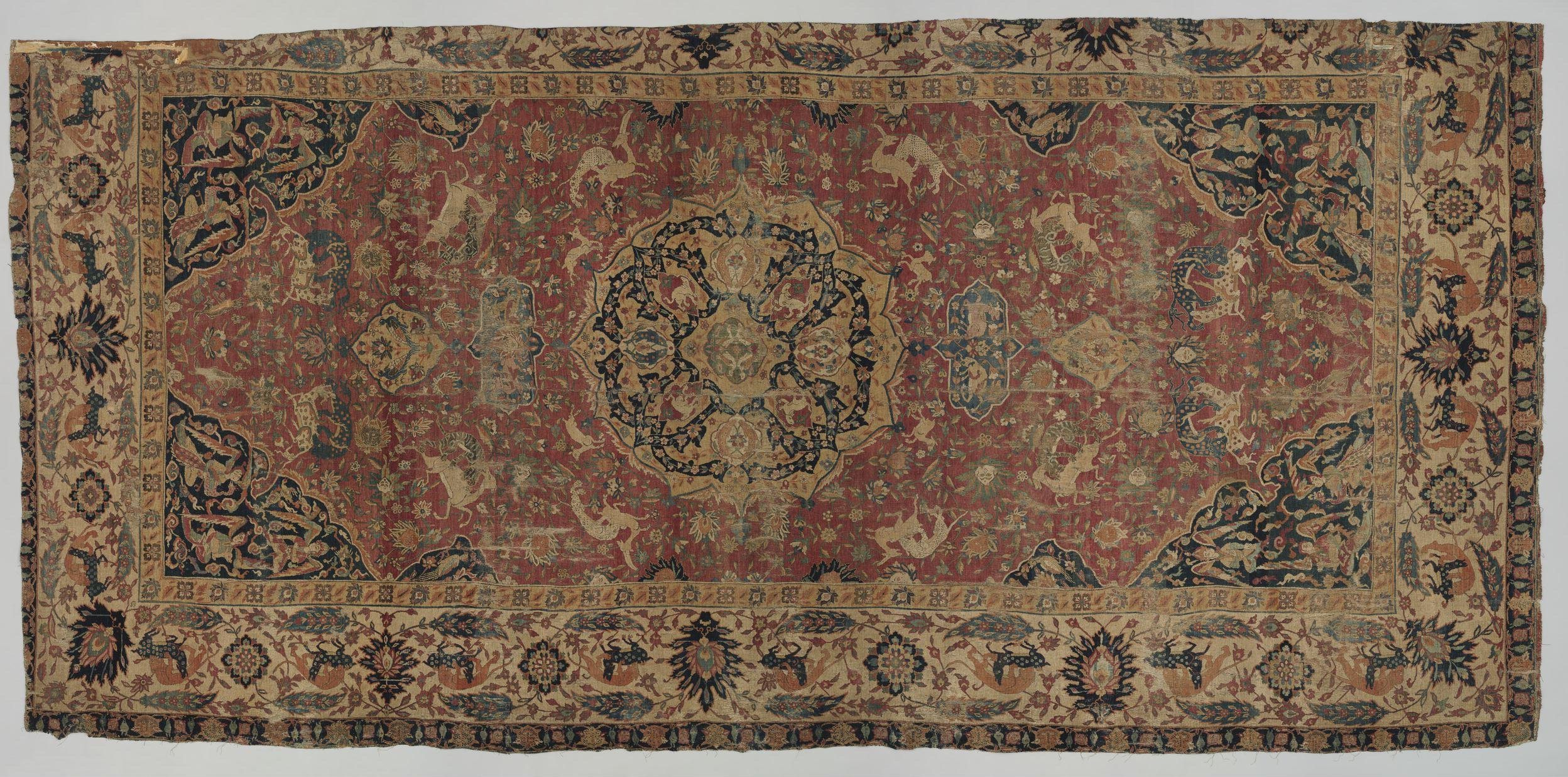
Sanguszko carpet at Victoria and Albert Museum.
This well-worn medallion carpet is a striking example of sixteenth-century Iranian craftsmanship, belonging to the remarkable category known as “Sanguszko” carpets preserved at Victoria and Albert Museum.
Named after the Polish aristocratic family who owned one such carpet (now housed in the Miho Museum in Japan), this group is renowned for its intricate designs featuring human figures and animals.
The carpet’s red central field is dominated by a dramatic yellow medallion, embellished with smaller cartouches and pendants along the central vertical axis. The four corners are marked by quarter-medallions in dark blue. The border, with a cream ground, showcases large leafy scrolls and flowers. The red field teems with meticulously detailed hunting scenes: tigers and leopards pursuing deer, lurking wolves, and mythical creatures locked in combat.
Hidden among the lotus flowers are faces—some angelic with beauty spots, others snarling like lions.
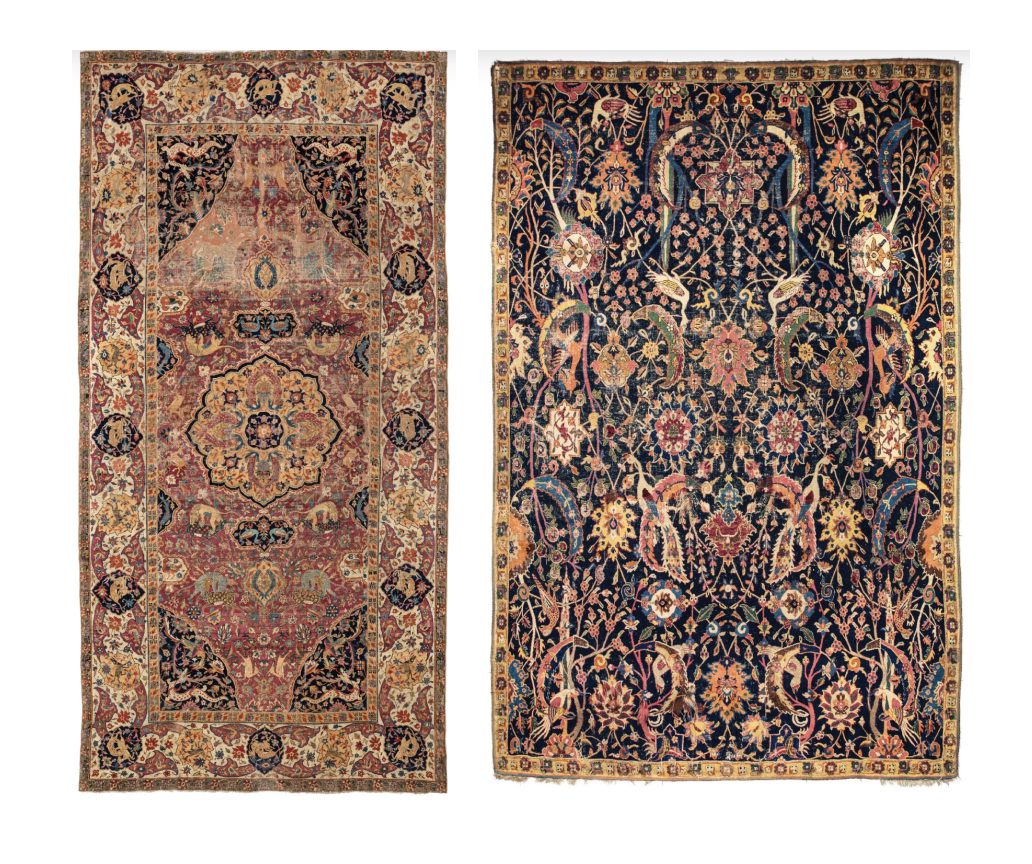
HALI
It is believed that this Persian carpet was crafted during the reign of Shah ‘Abbas I (r. 1588-1629), the fifth Shah of the Safavid dynasty, during a period when arts and crafts flourished. At that time, cultural exchanges with the East were common, leading to the incorporation of motifs like the phoenix and dragon from China. It is interesting to note that this carpet shares identical designs with a battle vest reportedly belonging to the warlord Hideyoshi, which is part of the collection at the Kodaiji Temple in Kyoto. This stunning battle vest, created from a kilim woven in Iran, and the Sanguszko carpet, likely made around the same time and possibly in the same workshop during a pinnacle of Persian culture, have now reunited in modern-day Japan.