
A Guide to Oriental Antique Mughal Rugs: History and Significance of Court Carpets
May 30, 2024
A Guide to Sanguszko Safavid Carpets: Oldest Surviving Carpets from Kerman, Iran
June 7, 2024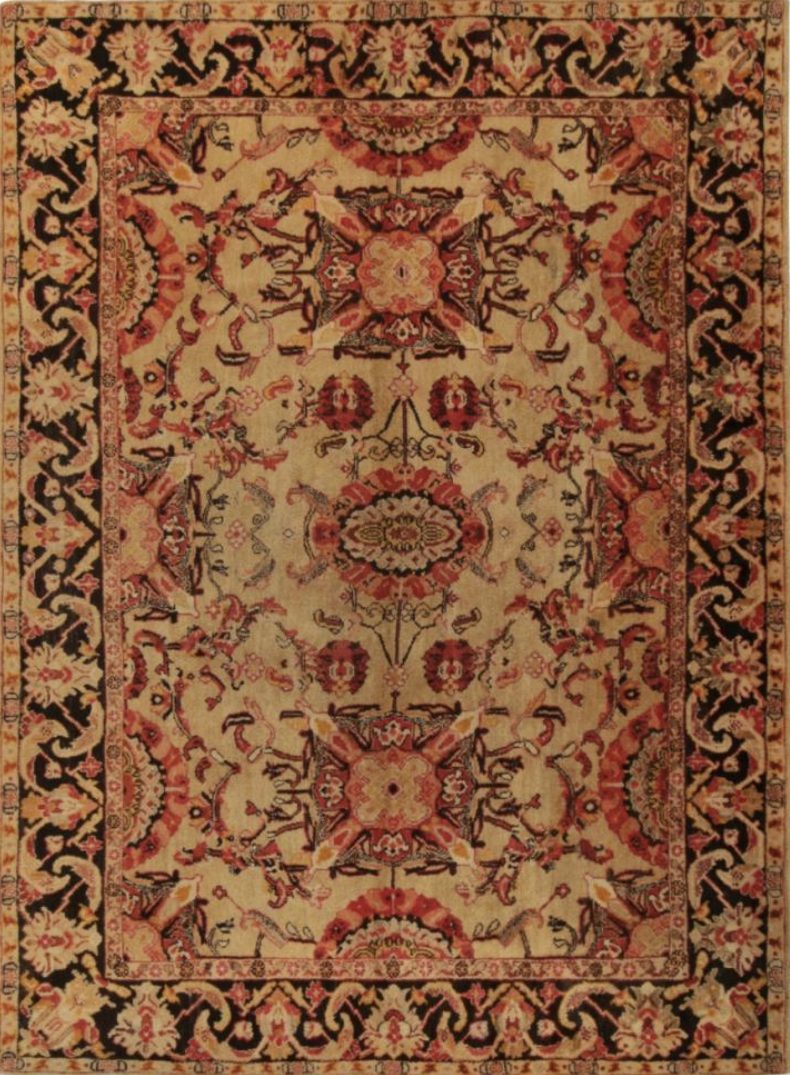
What are Antique English Axminster Carpets ?
Axminster carpets were highly esteemed in English country houses during the late 18th and early 19th centuries, adorning rooms designed by prominent architects like Robert Adam and James Wyatt. They were often part of decorative schemes of renowned designers such as Chippendale or Crace for their discerning clientele.
Axminster carpets have a rich history dating back to their founding in 1755 by Thomas Whitty in Axminster, Devon, England. These carpets were hand-knotted with wool, featuring symmetrically knotted designs similar to Savonnerie carpets from France.
They often showcased Renaissance architectural motifs, floral patterns, and Oriental-inspired designs, reflecting the influences of their time.
How are Axminster Carpets Made?
Axminster carpets are crafted using a traditional weaving technique where individual needles insert a row of pile tufts into the carpet’s foundation. This meticulous and labor-intensive process ensures exceptional durability and allows for intricate, detailed designs that distinguish Axminster carpets from other types of carpeting. Typically made from high-quality, natural materials like wool, Axminster carpets are known for their durability and aesthetic appeal. The natural luster and rich texture of wool create a luxurious and inviting ambiance that is difficult to replicate with synthetic materials.
Significance and Influence of Axminster Carpets
Aside from Axminster, similar carpets were crafted in Exeter, Moorfields in London, and Fulham in Middlesex during the same period. In the second half of the 18th century, carpets became fashionable as floor coverings in English stately homes and country houses. The owners of these grand residences often knew one another and shared similar tastes in decoration.
To fit their homes’ decorative schemes, architects frequently designed key carpets themselves, with Thomas Whitty being a preferred manufacturer. Renowned architects such as Thomas Leverton, James Wyatt, Robert Jones, and the Adam brothers often collaborated with Whitty for this purpose.
Many of the carpets they commissioned can still be found in the rooms for which they were originally made. Examples of these bespoke carpets are preserved in historic houses such as Blickling Hall in Norfolk, Chatsworth House in Derbyshire, Dumfries House in Ayrshire, Harewood House in Yorkshire, Kingston Lacy in Dorset, and Saltram House in Devon.
These carpets not only reflect the design of the period but also the collaborative efforts between architects and manufacturers like Whitty in enhancing the aesthetic appeal of English country homes. They were even commissioned for the Sultan of Turkey in 1800. King George III and Queen Charlotte were among the notable figures who purchased Axminster carpets and visited the factory, contributing to the brand’s dominance in the English carpet market from 1755 to 1835.
Axminster Carpet and Sultan of Ottoman Empire
In 1800, Witty’s company produced a 74-by-52-foot (23 m × 16 m) carpet for Mahmud II, the Sultan of the Ottoman Empire, which is now recognized as the most famous Axminster Carpet ever made. This magnificent piece depicted a blazing sun, moon, and a constellation of stars, costing £1000 at the time (equivalent to approximately £101,984 in 2023). The carpet’s grand size required thirty men from the local Congregational Church to carry it out of the factory. Initially placed in the Topkapi Palace, it was later moved to the Defterdar Palace, where it became the property of Esma Sultan, the daughter of Sultan Mustafa III. This extraordinary carpet highlights the exceptional prestige associated with Axminster Carpets during that era.
What makes Antique Axminster carpets so special and unique?
While many antique rug styles originated in the Orient, the Axminster rug style is a notable exception, developed in the Western world, specifically England.
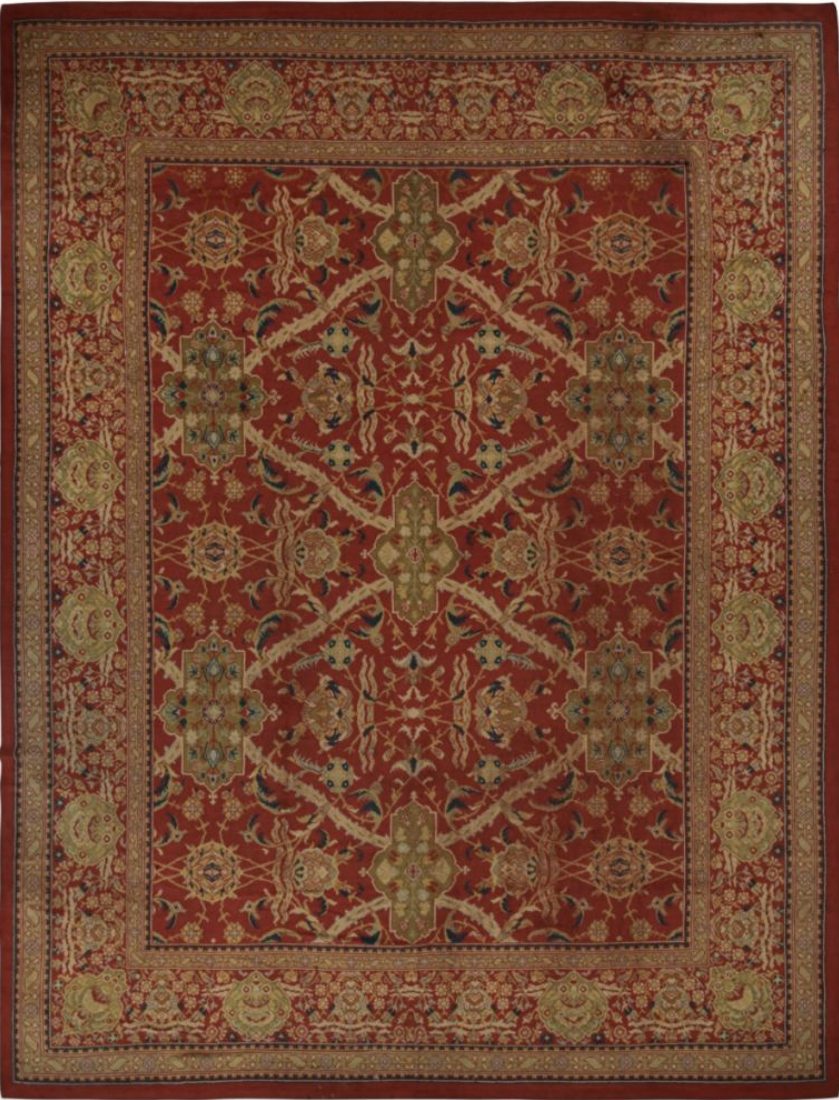
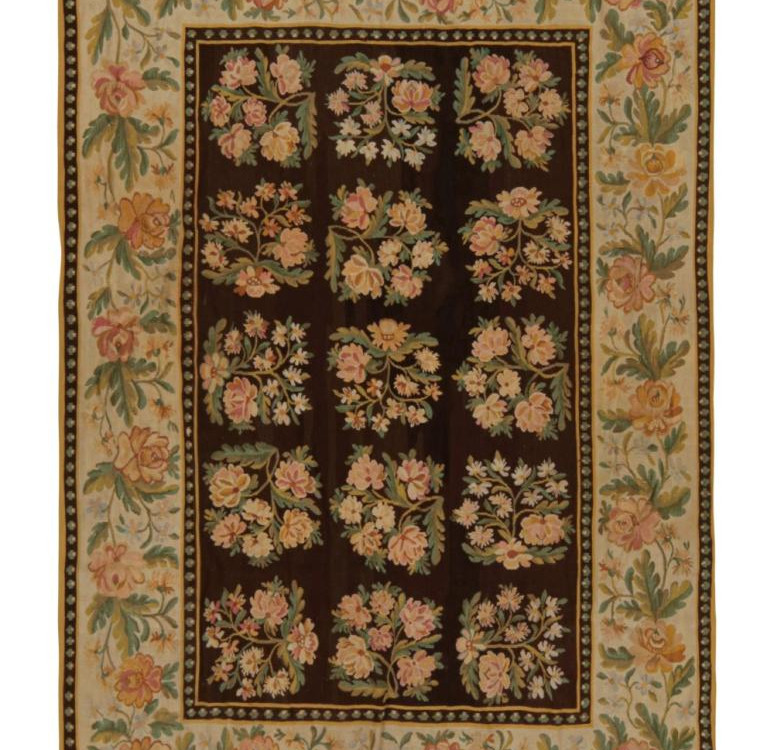
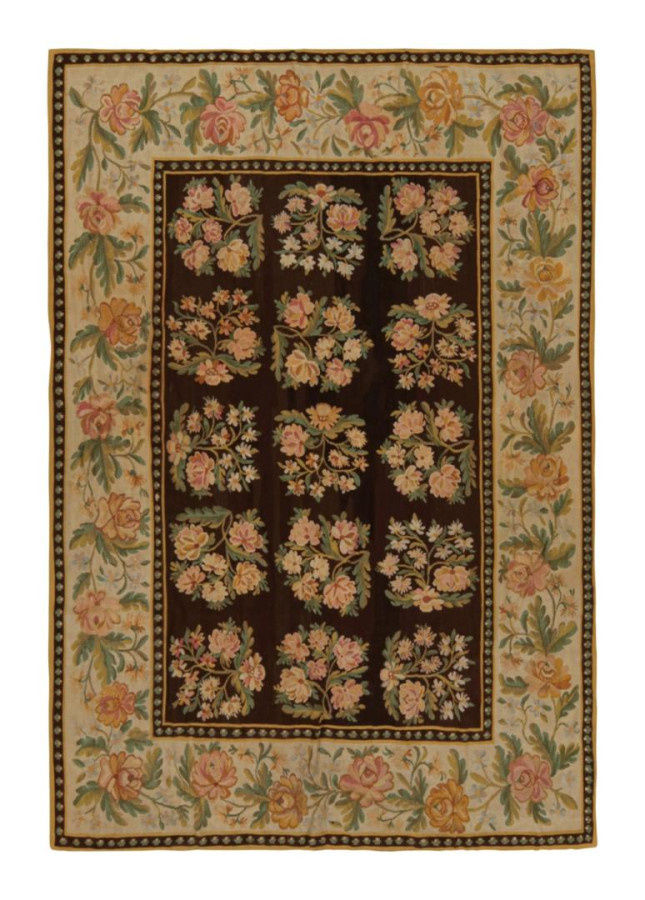
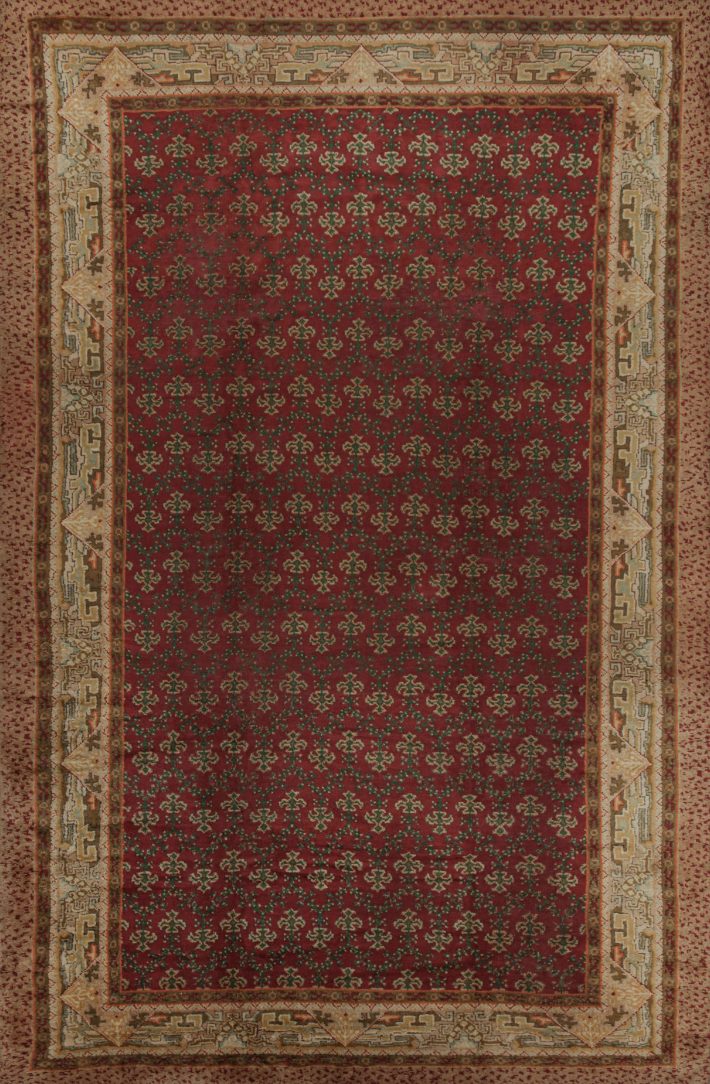
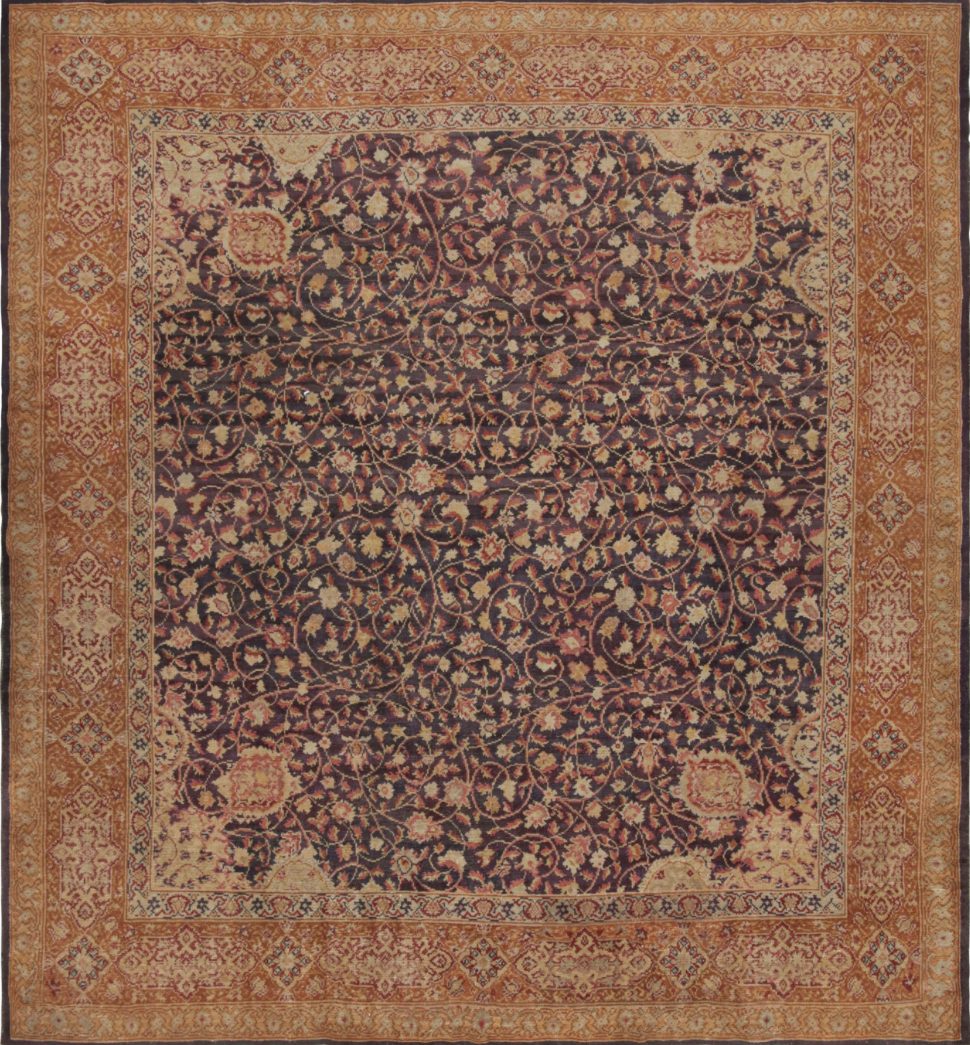
These nineteenth-century English rugs offer a luxurious counterpart to the grand Neo-classical designs of French Aubusson and Savonnerie carpets. Axminster rugs are distinguished by their monumental frames and cartouches, which are richly adorned with naturalistic floral details typical of the European tradition. They also exhibit a penchant for soft, pastel color palettes that add to their refined elegance. However, as Oriental rugs began to regain prominence in the European market during the late nineteenth century, Axminster carpets started to incorporate elements of Oriental design.
Despite this influence, Axminster rugs retained their unique European identity, characterized by their gentle hues and realistic floral motifs, creating a harmonious blend of European sophistication and Oriental charm.
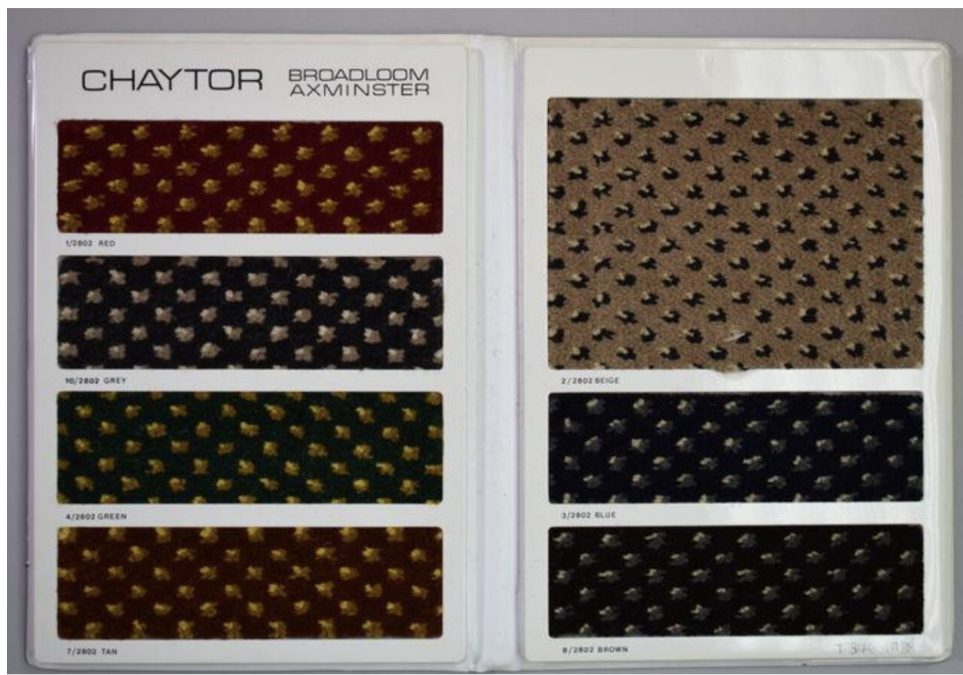
Featured above is a pattern book of Axminster carpets, made by Brintons Ltd., Great Britain, 1970 featured at the Victoria & Albert Museum.
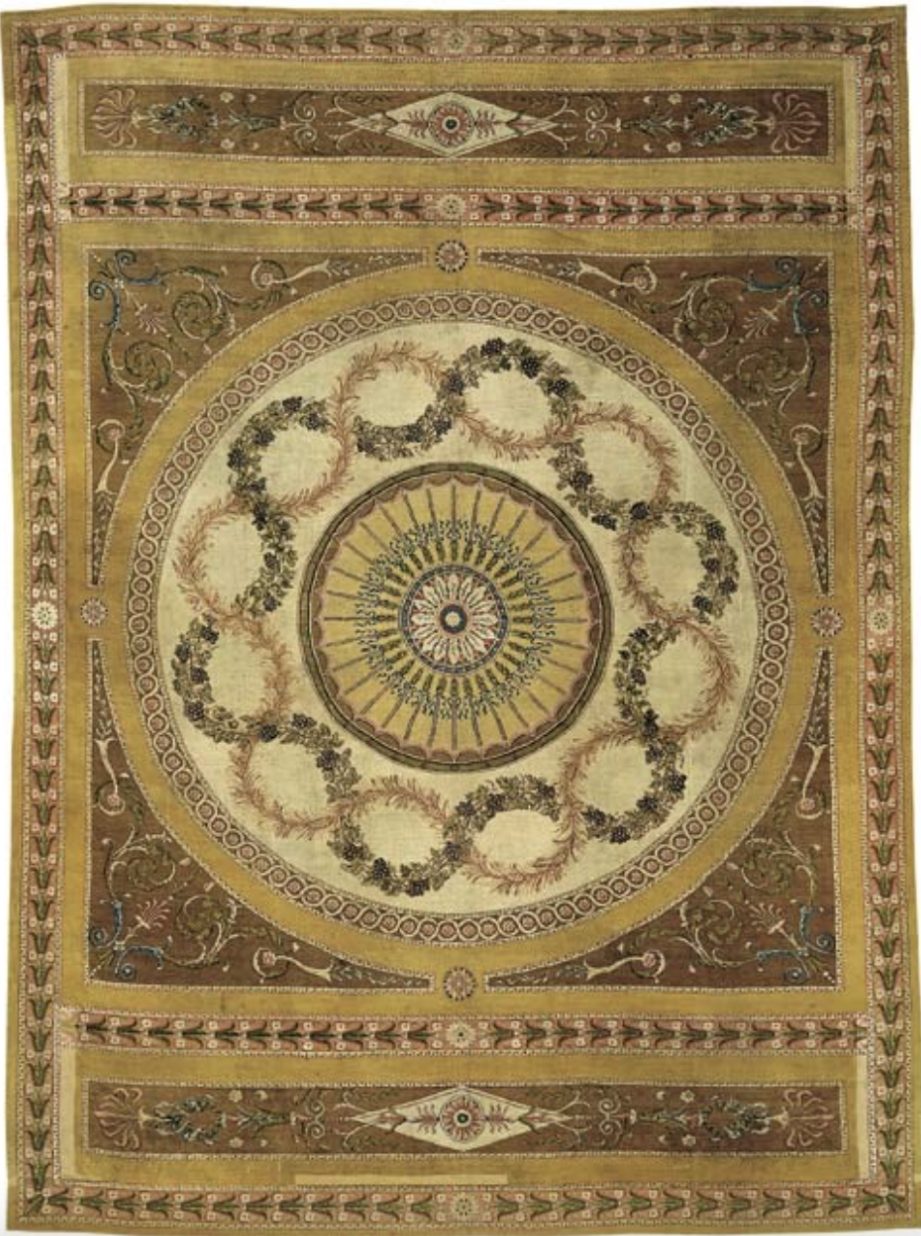
A GEORGE III AXMINSTER CARPET auctioned at Christie’s
This magnificent carpet was crafted for Sir Thomas Rumbold at Woodhall Park. Rumbold embarked on a lucrative career with the East India Company at the age of sixteen, amassing significant wealth before retiring to England in 1780. Upon his return, he commissioned architect Thomas Leverton to reconstruct his newly acquired Woodhall Park in Hertfordshire. Leverton, much like Robert Adam, incorporated Classical Greek designs into his architectural work, making Woodhall a prime example of his enduring country-house style. The design of this carpet is steeped in Classical mythology.
At its center, a sunflower medallion, inspired by the ornamentation of the Temple of Apollo at Palmyra, is prominently featured. This design was widely popularized by Robert Wood’s influential publication, “Ruins of the Temple at Palmyra” (1753). The medallion is framed by a foliated ribbon-guilloche pattern, adorned with Bacchic vines and wheat, symbols sacred to Ceres.
The continuous intertwined vegetation motif around the medallion is a hallmark of the most celebrated Axminster designs of the eighteenth century, indicating the popularity and prestige of this particular pattern.
The design of this carpet draws significant inspiration from the one Robert Adam designed for Saltram House around 1775. Both carpets, woven at Axminster, share a similar structural design with a central roundel flanked by narrow end-panels. True to form, Thomas Whitty, the master weaver behind these creations, produced a second version of the Saltram House carpet, which now resides in the Rijksmuseum, Amsterdam. This carpet not only exemplifies the height of Axminster craftsmanship but also attests to the classical influences that permeated English country house interiors in the late eighteenth century.
What are some key characteristics of Antique Axminster Carpets?
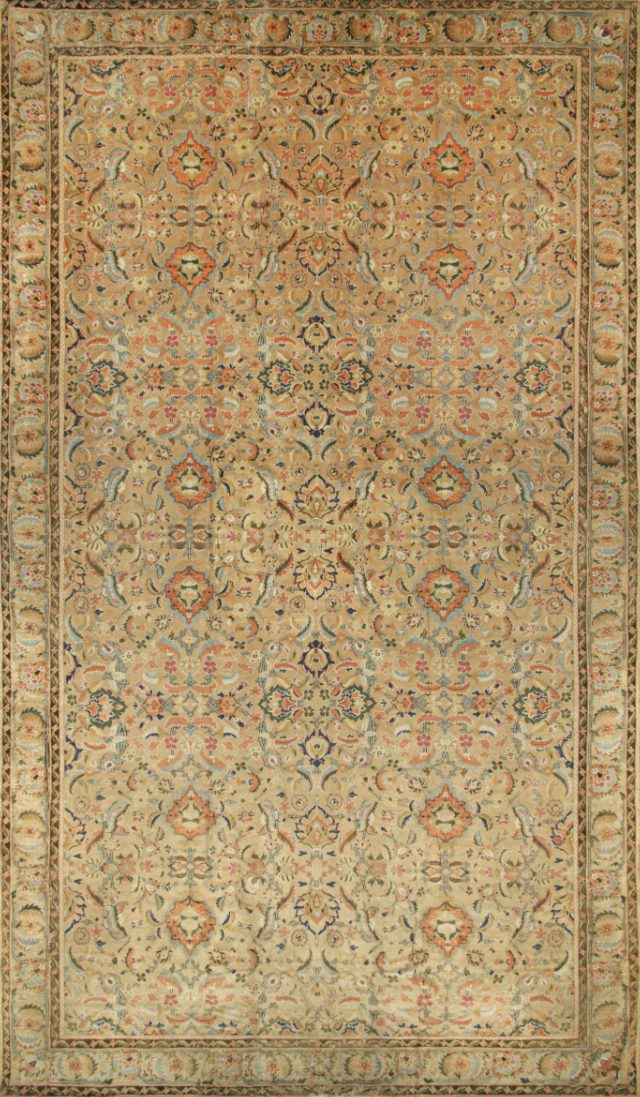
Thomas Whitty I, known for his botanical interests, infused many Axminster carpets with a love for flowers, showcasing realistic depictions of blooms in various arrangements like baskets, swags, and sprays. This floral motif continued under his son, Thomas Whitty II, who maintained the tradition of incorporating intricate garden flower designs into the Axminster carpets.
In this context, the carpets drew inspiration from the renowned Savonnerie carpets of the 18th century, particularly evident in the incorporation of acanthus scrolls and the use of a ‘rose moresque‘ motif, popularized by Savonnerie carpets. Axminster Carpets thus demonstrated a commitment to weaving carpets that were not just functional but also artistic and aligned with the prevailing design aesthetics of their time.
Thomas Witty and Growth of Axminster Carpets
The best known and most successful carpet weaving workshops in England were the looms established at Axminster in Devon by Thomas Whitty in 1755. Whitty recognized the growing demand for carpets among the aristocracy and wealthy merchant classes during the second half of the 18th century.
Inspired by popular “Turkey Carpets” (a generic term for hand-knotted pile carpets from both the East and West), the self-taught Whitty set out to make hand-knotted seamless carpets on a large upright loom. Whitty was the first Englishman to successfully use the techniques of pile carpet weaving by creating extremely high-quality carpets at an economically feasible price.
Witty’s Axminster carpets, looking much like horizontal tapestries, quickly gained recognition as the best English-produced carpets available.
Whitty’s achievements were acknowledged through several prestigious awards: he won the prize for carpet weaving offered by the Society of Arts in 1757 (shared with Thomas Moore of Moorfields), in 1758 (shared with Peter Parisot of Exeter), and outright in 1759.
The peak of Whitty’s recognition came in 1783 when King George III visited his workshop, acknowledging Whitty’s significant contributions to the craft. However, the history of British carpet designers during the Regency and George IV periods remains somewhat obscure.
While the third quarter of the eighteenth century is relatively well-documented, by 1800, only Axminster remained active in handwoven carpet production. Following the fire, hand-woven carpet manufacturing shifted to Wilton in 1838, where production continued into the twentieth century.
The loss of Axminster’s records and design books in the fire has posed challenges for historians, who now rely heavily on studying carpets made for specific interiors to understand Axminster’s design legacy and influence.