A Guide to Amritsar Rugs: History, Craftsmanship, and Contemporary Luxury Design
October 26, 2026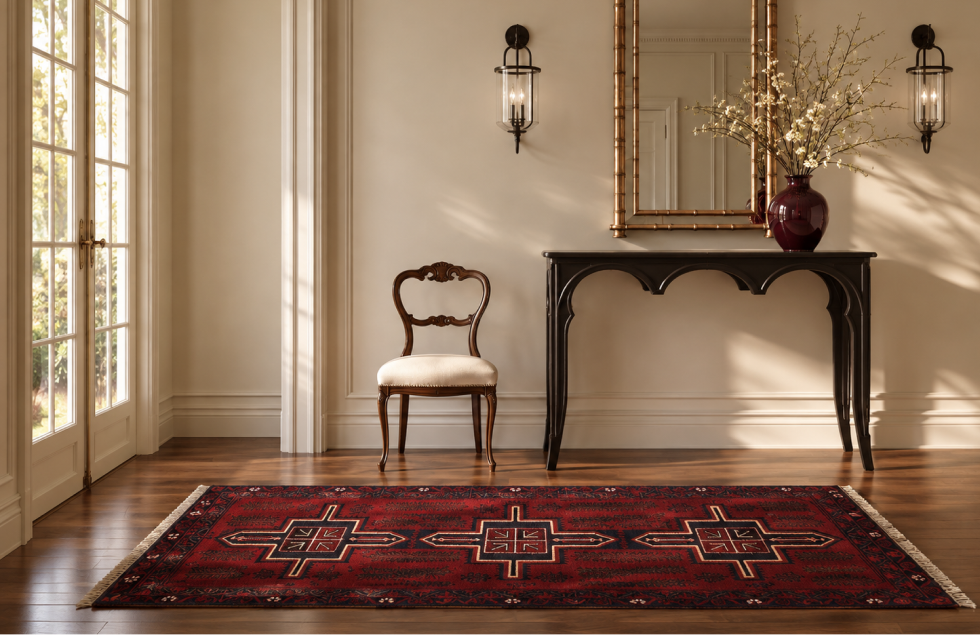
There is a certain kind of design confidence that reveals itself not in the grand room but in the modest one. Anyone with means can lay a great carpet beneath a grand piano or across the floor of a double-height salon. The room does half the work; the scale flatters the object. It takes a far subtler eye to bring a jewel of a weaving into the kitchen, along the narrow run of a hallway, beneath the feet at a bedside, into the threshold where guests first stand, the working, in-between, unglamorous spaces of a home that most people surrender to practicality without a second thought. The designers whose interiors endure understand that these are precisely the spaces where taste declares itself most clearly. The small rug is the connoisseur’s signature.
It is also, quite simply, among the most rewarding objects a person can own, and among the most giftable, which is no small thing in a field where the finest pieces are so often beyond casual acquisition.
The gift-sized rug as the accessible masterpiece
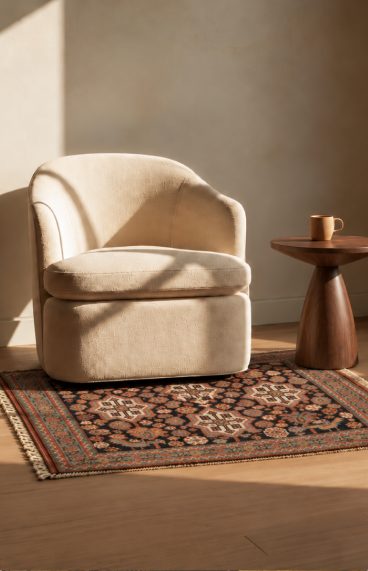
The economics of the handmade carpet are unforgiving at scale. A great room-sized antique represents years of labor and, accordingly, a serious commitment. But the same hand, the same wool, the same dye, the same centuries of inherited technique can be found in a piece of two by three feet, a scatter rug, a small tribal weaving, a fragment of something once larger, a fine runner. Here the collector encounters an unusual and delightful truth: the small rug is where museum-quality craftsmanship becomes attainable. A jewel-toned Persian tribal mat, a small Caucasian prayer rug, a length of Anatolian kilim, these can be acquired for a fraction of what a great carpet commands, and they lose nothing of the artistry. They are, in the most literal sense, the same art in a smaller frame.
This is why the small rug makes the incomparable gift. To give a hand-knotted weaving is to give something made by a human being over weeks, in wool dyed from madder root and indigo, carrying the visual language of a specific people and place, an object that will outlast the giver, the recipient, and very likely the room it first enters. There is no candle, no bottle, no ordinary luxury that carries that kind of permanence. The small rug is the rare gift that becomes an heirloom.
The kitchen: design’s last frontier
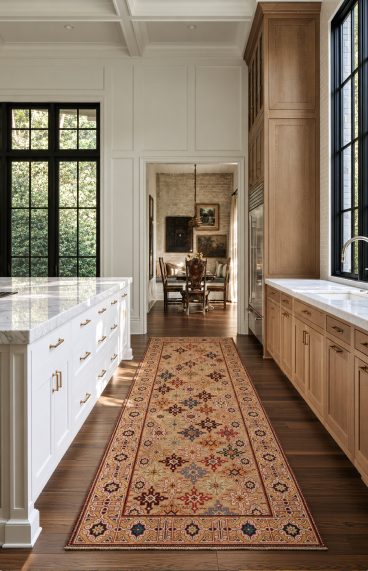
The kitchen, which the design world spent a century treating as a purely functional space and has only recently begun to reclaim as a room worth composing. Nothing transforms a kitchen faster, or with more quiet authority, than a runner of genuine character laid before the range or along the island. The instinct to reserve such a space for something disposable, a rubber mat, a machine-made length of nothing, is precisely the instinct the serious eye resists.
A vintage runner in the kitchen does something no new object can: it introduces age, warmth, and the evidence of the hand into the most technological room in the house, softening the hard geometry of steel and stone. The concern most people raise, that a fine rug cannot survive a kitchen, misunderstands the material entirely. Wool, rich in natural lanolin, is remarkably resistant to soil and spill; a good tribal weaving was made to endure the floor of a tent, the traffic of a nomadic life, generations of use. It will outlast the kitchen it is placed in. And a vintage piece, already bearing the beautiful patina of decades, has nothing to fear from the life of a room. It has seen worse, and grown handsomer for it.
The runner, and the architecture of movement
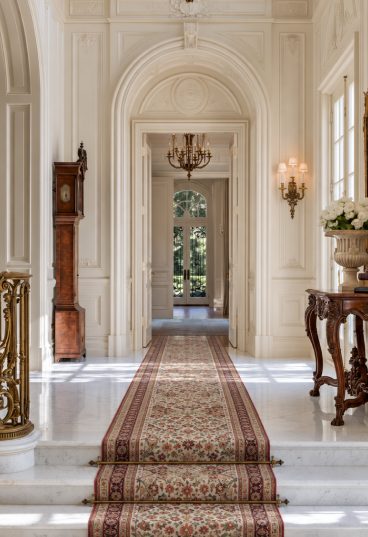
The runner is the most architectural of all rug formats, because it does not merely occupy a space, it directs the body through it. A great runner in a hallway turns a corridor from a passage into a procession. On a staircase, a fine runner transforms the most purely functional element of a house into one of its most considered. In a gallery hall lined with art, the runner draws the eye and the foot forward, choreographing the visitor’s movement the way a landscape architect choreographs a garden path.
The nineteenth-century Persian gallery carpets and long Caucasian runners were made for exactly this purpose, for the long reception halls of great houses, where the carpet’s rhythm carried a guest toward the seat of the host. That logic translates perfectly to the contemporary home. Place a runner where the body travels, and the space acquires intention.
Where else the small rug belongs
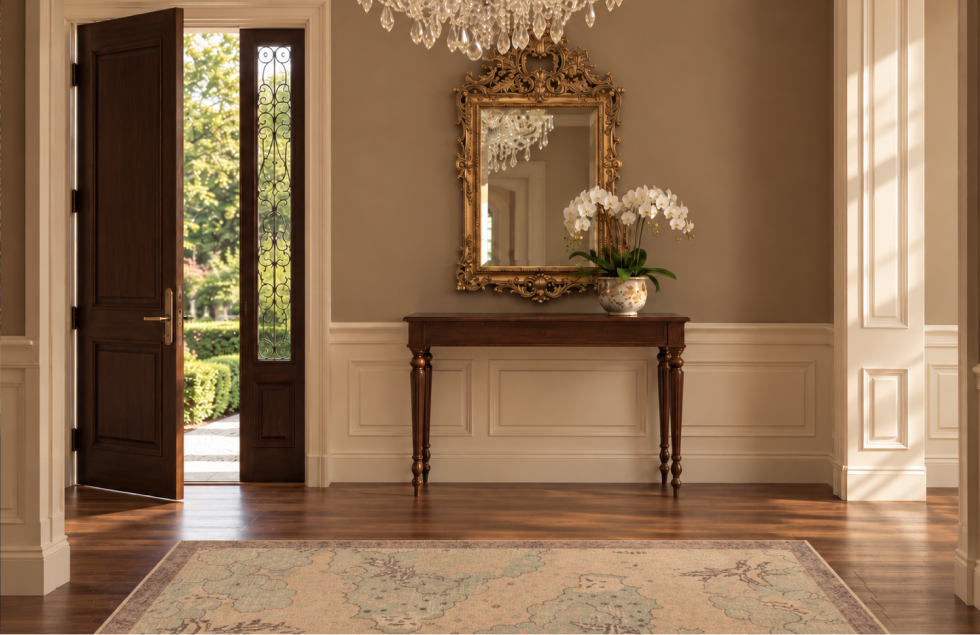
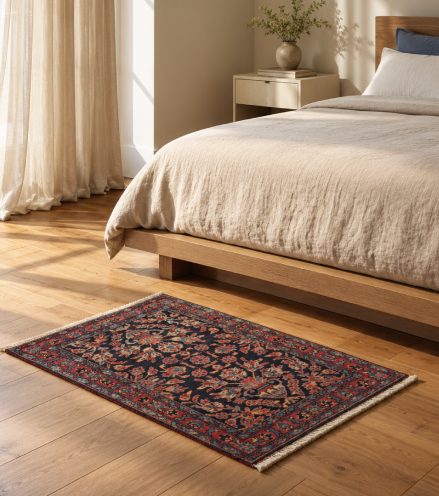
The possibilities multiply once the eye is trained to see them. A small antique rug at the bedside, so the first sensation of the morning is wool underfoot rather than cold floor. A fine weaving in the entry, where it becomes the first statement a home makes — the design equivalent of a firm handshake. A jewel of a piece layered atop a larger neutral rug, a practice the galleries perfected and the best interiors have adopted: the small, intense weaving reading like a painting placed upon a quieter ground. A rug in the bathroom, on a heated stone floor, producing an effect of almost unreasonable luxury. A single beautiful mat in a study, a dressing room, a windowseat, the small, deliberate grace note that tells anyone who notices that the person who lives here was paying attention.
The lesson of the small
There is a philosophy in all of this, and it is worth stating plainly.
The measure of a beautifully made home is not what happens in the rooms built to impress. It is what happens in the rooms that had no obligation to be beautiful and were made so anyway, the kitchen, the hall, the stair, the threshold. These are the spaces where design becomes character, where one sees not a decorator’s budget but a genuine eye at work.
The small rug is how that eye speaks. It asks little of a room and gives it everything: warmth, age, artistry, and the unmistakable sense that here is a home composed by someone who understood that beauty is not a matter of scale, but of intention, and that the finest things are often the ones that arrive in the smallest package.
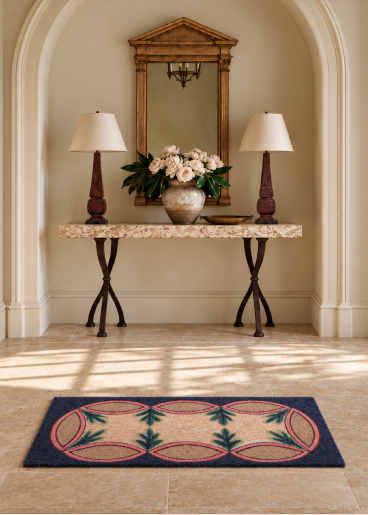
Signed Vintage Abstract Tapestry Spring by the Sea in Oceanic Hues – Rug & Kilim