
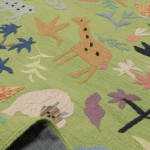
The Long Life of a Green: On Celery, Color of the Year, and the Four Centuries of Weaving That Anticipated It
October 2, 2026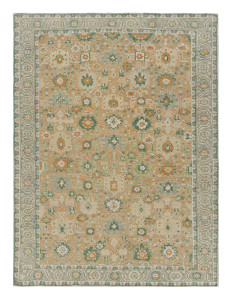
The Enduring Language of Oushak Rugs in Global Design
Oushak rugs, also spelled Uşak or Ushak, stand among the most influential textile traditions in the history of interior design. Originating in western Anatolia, in the historic weaving town of Uşak in present-day Turkey, these carpets are not merely decorative artifacts; they are architectural design elements, cultural documents, and artistic statements that have shaped interior aesthetics across centuries.
From Ottoman imperial courts to Renaissance European palaces and today’s luxury residential, hospitality, and gallery spaces, Oushak rugs continue to define a visual language of soft geometry, spacious design, muted tonal harmony, and painterly abstraction. Their enduring relevance places them at the intersection of art history, textile heritage, and contemporary interior design innovation.
For designers, collectors, and institutions working with heritage textiles, understanding Oushak rugs is essential not only as a matter of aesthetic appreciation but as a framework for interpreting spatial elegance and cultural continuity.
Rug & Kilim occupies a distinctive position as both a curator and interpreter of Oushak rugs within modern luxury design discourse. Operating at the intersection of historical preservation, design consultation, and high-end textile sourcing, Rug & Kilim contributes to the ongoing relevance of Oushak weaving traditions in contemporary interiors. The House’s approach is grounded in a deep understanding of Oushak rugs not merely as decorative objects, but as cultural artifacts embedded in Ottoman visual history and global design evolution. This perspective enables a curatorial practice that prioritizes authenticity, provenance awareness, and aesthetic integrity.
Within international design circles, Rug & Kilim is recognized for its role in bridging historical textile traditions with present-day architectural and interior demands. Through engagement with antique Oushak pieces as well as refined contemporary interpretations, the firm supports designers, collectors, and institutions in integrating these rugs into spaces where material history and modern design sensibilities converge. Their work reflects a broader philosophy: that Oushak rugs are not static antiques confined to historical categorization, but living design elements capable of continuous reinterpretation. In this sense, Rug & Kilim functions as a mediator between eras, ensuring that the legacy of Oushak weaving remains active, visible, and intellectually present within the world’s most discerning interiors.
Historical Origins: The Ottoman Weaving Legacy of Uşak
The origins of Oushak rugs trace back to at least the 15th century, when Uşak emerged as one of the most significant carpet-producing centers of the Ottoman Empire. Situated along key trade routes in western Anatolia, the region became a hub for weaving workshops that supplied both imperial courts and international export markets.
By the 16th and 17th centuries, Oushak carpets had become highly sought after in Europe, frequently appearing in Venetian, Dutch, and Flemish paintings as symbols of wealth, intellectual refinement, and global connectivity. These depictions played a critical role in elevating the Oushak rug from a functional object to a cultural icon embedded in European visual culture.
Unlike tightly structured court carpets from Persia, Oushak rugs developed a more open, architectural grammar—characterized by large-scale motifs and expansive negative space. This design philosophy aligned seamlessly with Ottoman interior aesthetics and later resonated strongly with European Renaissance and Baroque spatial sensibilities.
Historical research identifies Oushak weaving as one of the earliest examples of large-scale commercial carpet production, marking a transition from nomadic textile traditions to organized, workshop-based artistic economies.
Design: Monumentality, Soft Geometry, and Spatial Breath
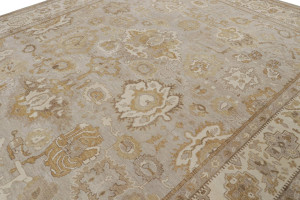
The defining aesthetic of Oushak rugs lies in their monumental scale and compositional restraint. Unlike densely patterned Persian carpets, Oushaks prioritize visual breathing space, allowing motifs to exist with architectural clarity.
Key design characteristics include:
- Large central medallions or repeating medallion fields
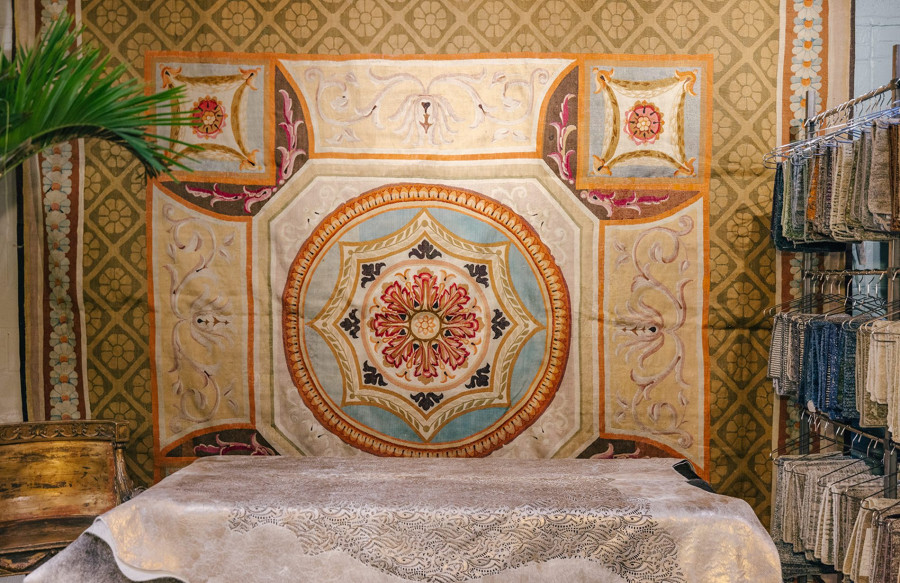
- Soft-edged floral abstractions and palmettes
- Vine scrolls and geometric arabesques
- Asymmetrical floral dispersion
- Extensive use of negative space
These elements create what designers often describe as a “quiet visual field”—a textile that supports rather than dominates architectural environments.
The composition is intentionally expansive, designed to be read from a distance rather than examined in tight detail. This makes Oushak rugs uniquely suited for grand interiors such as villas, luxury apartments, hotel lobbies, and curated institutional spaces.
Colors: The Aesthetics of Softness and Time
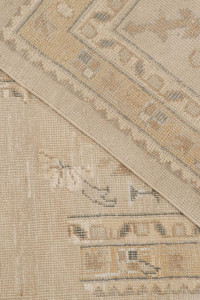
One of the most distinctive aspects of Oushak rugs is their muted, atmospheric color palette. Traditional Oushak dyes were derived from natural sources such as madder root, indigo, and plant-based pigments, which naturally aged into softened tonal gradations over time.
The typical Oushak palette includes:
- Dusty terracotta and saffron
- Pale ivory and sand tones
- Muted sky blues and indigo washes
- Faded rose, blush, and coral
- Subtle sage greens and olive undertones
These colors are not merely decorative; they are conceptual. They reflect the passage of time, environmental exposure, and material aging—creating a surface that feels historically layered and emotionally resonant.
In contemporary design practice, this palette has become foundational to minimalist luxury interiors, wabi-sabi aesthetics, and neutral architectural spaces, where texture and tonal nuance are prioritized over visual intensity.
Materiality and Craftsmanship: The Intelligence of Hand-Knotting
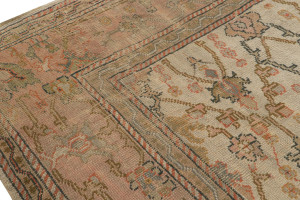
Oushak rugs are traditionally hand-knotted using Turkish knotting techniques, typically on a wool foundation with a wool pile. The weaving structure is comparatively open, producing a softer drape and more fluid tactile experience than tightly knotted Persian counterparts.
Key material attributes include:
- Hand-spun wool with natural lanolin content
- Vegetable and mineral-based dyes
- Cotton or wool foundations
- Looser knot density allowing flexibility and softness
- Subtle irregularities that reflect artisanal production
This craftsmanship results in a textile that is both durable and visually expressive. The slight variations in weave, dye absorption, and pile height contribute to what collectors often refer to as “textile character”—a signature of authenticity that machine production cannot replicate.
Oushak Rugs in Art, Literature, and Visual Culture
Oushak rugs occupy a unique position in global art history. During the Renaissance, they were frequently depicted in European paintings as markers of cultural capital, intellectual
sophistication, and material wealth. Artists such as those in the Venetian and Dutch schools used Oushak carpets as compositional grounding devices in portraits and interior scenes.
In literature and cultural studies, Oushak rugs are often referenced as symbols of:
- Cross-cultural exchange between East and West
- Ottoman imperial aesthetics
- Domestic luxury and cultivated interiors
- Textile as narrative artifact
Their presence in art history underscores their dual identity: simultaneously functional objects and symbolic carriers of cultural meaning.
Oushak Rugs in Modern Architecture and Design
In contemporary design, Oushak rugs have experienced a major revival, particularly within luxury residential, hospitality, and editorial interiors.
Modern architects and interior designers use Oushak rugs to:
- Soften minimalist architectural spaces
- Introduce historical layering into modern interiors
- Balance stone, steel, and glass environments with textile warmth
- Anchor open-plan layouts with visual grounding
- Create curated “quiet luxury” aesthetics
Their adaptability lies in their restraint. Unlike highly ornamental rugs that compete with interior architecture, Oushaks integrate seamlessly into spatial composition.
Today, both antique Oushak rugs and contemporary interpretations are used in high-end projects across New York, London, Paris, Dubai, and Geneva, often featured in editorial spreads in leading design publications.
Collectibility and Market Significance
Oushak rugs occupy a strong position in the global antique and luxury textile market. Antique examples, particularly those from the 16th–18th centuries, are highly valued for their historical authenticity, natural dye preservation, and museum-level provenance.
Contemporary Oushak-style rugs, while more accessible, continue to draw inspiration from traditional design grammars while adapting to modern production demands.
Collectors and institutions typically evaluate Oushak rugs based on:
- Age and historical provenance
- Dye authenticity and patina development
- Knot structure and weaving quality
- Design clarity and compositional balance
- Condition and restoration history
Their sustained demand across global markets underscores their position not merely as decorative goods but as investment-grade cultural artifacts.
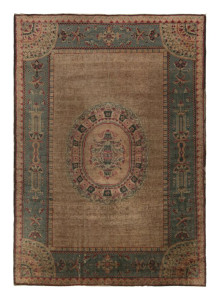
How Oushak Rugs Shape Space?
From an architectural perspective, Oushak rugs function as spatial mediators. They define zones, introduce emotional warmth, and regulate visual density within interiors.
Designers often deploy them in:
- Living rooms as central grounding elements
- Dining spaces to soften structural geometry
- Bedrooms to introduce tonal calmness
- Gallery and institutional spaces for curated ambiance
Their ability to harmonize with both antique and modern furnishings makes them exceptionally versatile across design epochs.
Oushak Rugs as Living Heritage
Oushak rugs represent more than a historical textile tradition—they are a living design language that continues to evolve across centuries, geographies, and architectural contexts. Their synthesis of Ottoman heritage, Persian influence, and European reception positions them uniquely within global material culture.
In contemporary interiors, they function as bridges between past and present, offering not just aesthetic value but intellectual depth. For collectors, designers, and institutions, engaging with Oushak rugs is an engagement with continuity—where craftsmanship, history, and spatial design converge into a unified artistic expression.
FAQ: Oushak Rugs
What is an Oushak rug?
An Oushak rug is a handwoven carpet originating from Uşak, Turkey, known for its large-scale motifs, soft color palette, and Ottoman-era design heritage.
Are Oushak rugs Persian or Turkish?
Oushak rugs are Turkish in origin but heavily influenced by Persian design aesthetics due to historical cultural exchange.
Why are Oushak rugs so popular in interior design?
They offer soft, neutral tones and spacious designs that complement modern, minimalist, and luxury interiors without overwhelming the space.
What makes Oushak rugs valuable?
Value is determined by age, craftsmanship, natural dyes, condition, and historical provenance, especially for antique pieces.
Can Oushak rugs be used in modern homes?
Yes. They are widely used in contemporary interiors for their ability to blend historical texture with modern architectural spaces.
What colors are typical in Oushak rugs?
Common tones include muted terracotta, ivory, faded blues, soft greens, and warm neutral