

Luxury Coastal Rugs: Styling High-End Interiors from the Hamptons to the French Riviera
April 10, 2026
Rooms of Power: Rugs, Art, and the Architecture of Global Interiors
April 15, 2026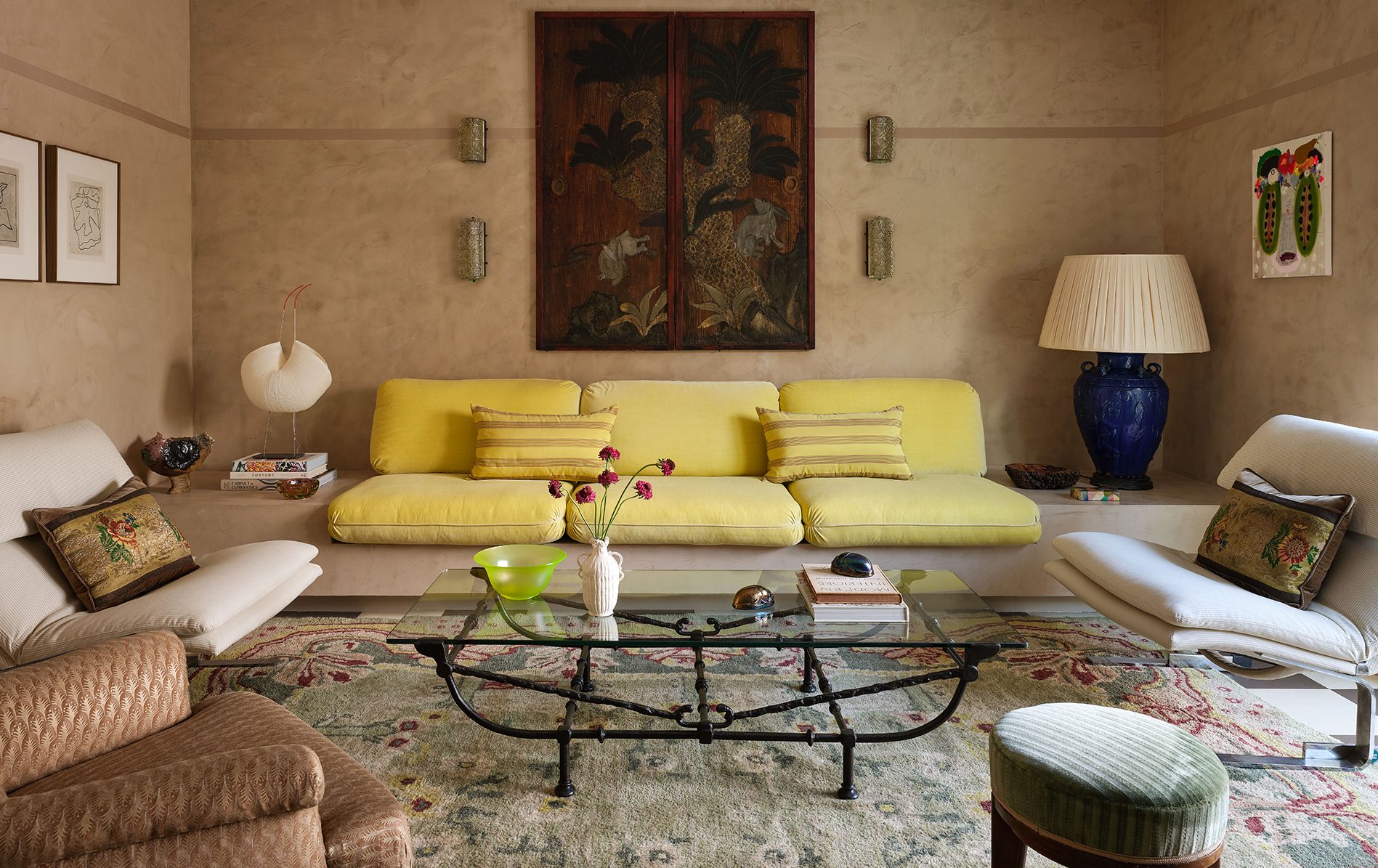
As seen in Galerie Magazine, the 2026 Kips Bay Decorator Show House Palm Beach features a rare and exceptional curation from the antique rugs in Rug & Kilim’s European Collection. Read More >>
Design, at its highest level, has always preferred to appear untouched by politics.
A room in the Hamptons. An apartment overlooking Central Park. A villa along the French Riviera. These spaces present themselves as resolved worlds; self-contained, insulated from the volatility of markets, policy, and power.
And yet, over the past year, something unusual occurred.
Tariffs, as abstract instruments of economic policy, began to leave visible traces within interiors. Not dramatically, not theatrically, but with the quiet persistence of something structural. Lead times shifted. sourcing recalibrated. Materials reconsidered. Conversations that were once aesthetic became quietly strategic.
The design industry did not collapse ofcourse, but it adapted.
But beneath that adaptation lies a more consequential shift: a redefinition of how design, trade, and global power intersect.
The Rug as a Global Object
Few design objects are as globally entangled as the rug.
A single piece may begin as wool in Central Asia, be dyed in India, woven in Morocco, finished in Turkey, shipped through European ports, and finally placed in a Manhattan residence or a Malibu home. It is not merely an object but a map of interdependence.
For decades, this system functioned with relative fluidity. Designers selected freely. Importers sourced broadly. Clients remained largely unaware of the logistical choreography behind what appeared, quite simply, as beauty.
Tariffs disrupted that illusion. They revealed the rug not only as an artifact of craft, but as an artifact of policy, geography, and negotiation.
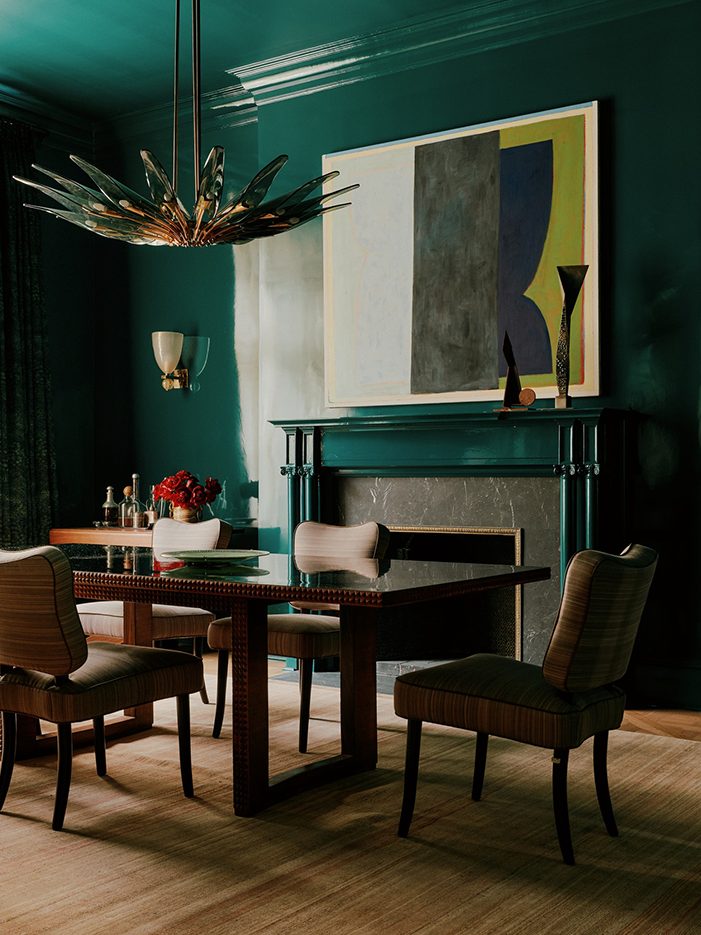
As seen in ELLE DECOR, an NYC Upper West Side townhouse designed by Chused & Co. features a custom textural rug by Rug & Kilim in the dining room. Photos courtesy of William Jess Laird.
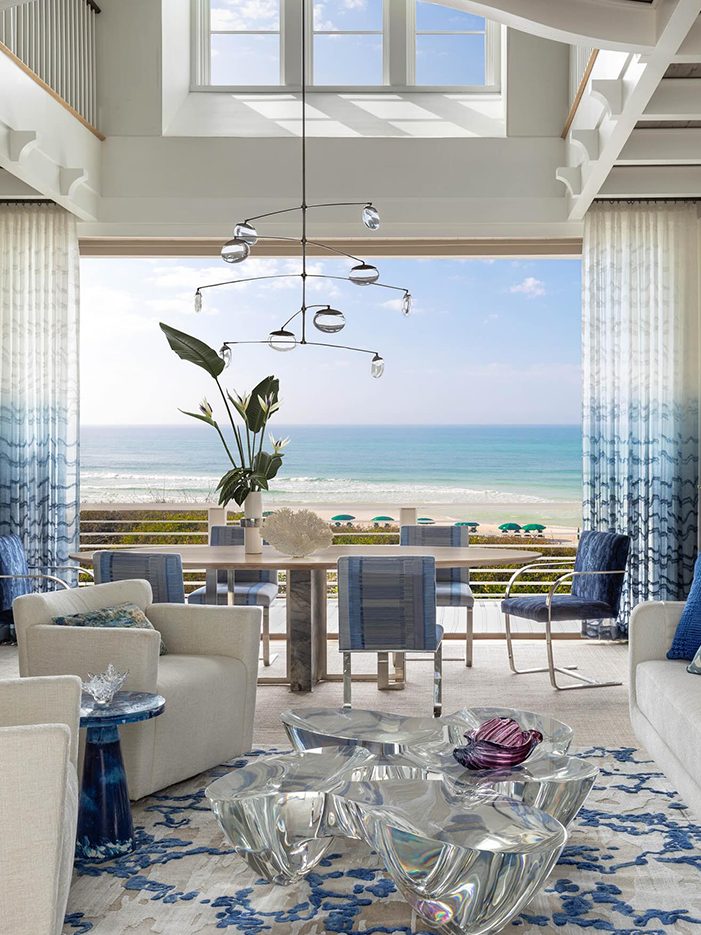
As seen in Incollect Magazine’s Issue 11 of Spring 2025, a Rosemary Beach house in Florida designed by Marshall Watson & Reid Deane Gaines Interiors features a bold custom rug design by Rug & Kilim.
America as Arbiter
The United States has long been the world’s most influential consumer of high-end design. From New York to Los Angeles, from Palm Beach to Aspen, American demand has shaped global production determining what is made, how it is made, and where it travels.
Tariffs, in this context, function less as economic tools and more as instruments of design influence.
When the cost of importing a rug from India, Turkey, or Morocco shifts, the effect is not isolated. It reverberates through ateliers, workshops, and weaving communities across continents. Patterns change. Materials shift. Production timelines adjust.
In subtle ways, American policy begins to redraw the global design map.
The New Geography of Making
One of the most immediate consequences of tariffs has been the quiet redirection of sourcing.
Manufacturing migratesl not abruptly, but incrementally. Regions once dominant reconsider their position. Others rise in relevance. Supply chains become less about tradition and more about viability. And yet, within the rug industry, this shift is uniquely complex.
Unlike furniture or industrial design, rug-making is not easily relocated. It is rooted in:
~ generational knowledge, regional materials, cultural specificity
To move production is not simply to change location. It is to risk altering the very identity of the object.
This tension between economic necessity and cultural continuity now defines much of the industry.
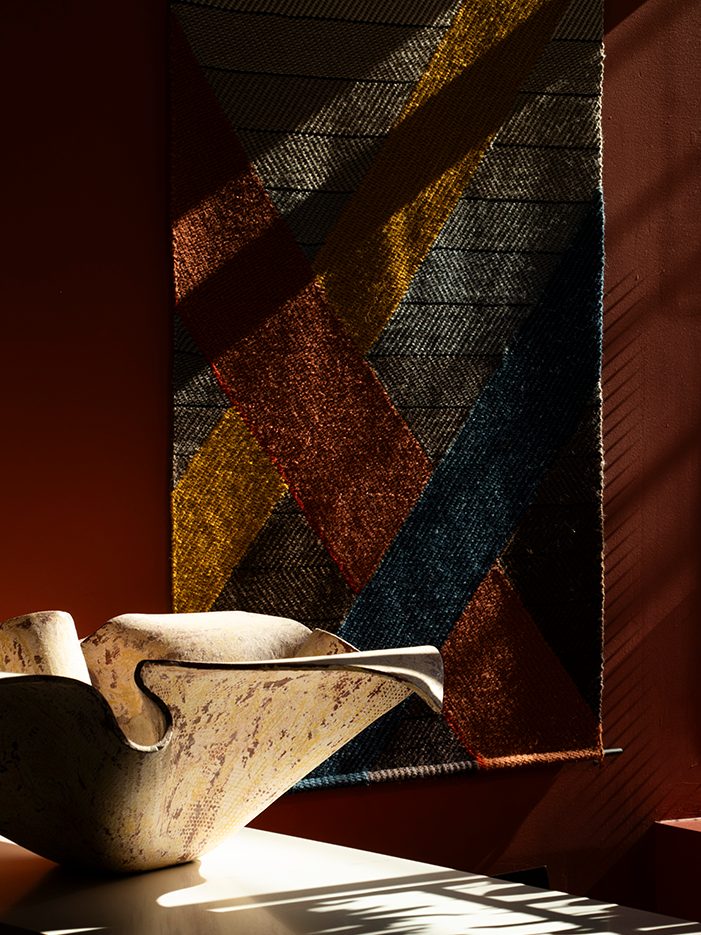
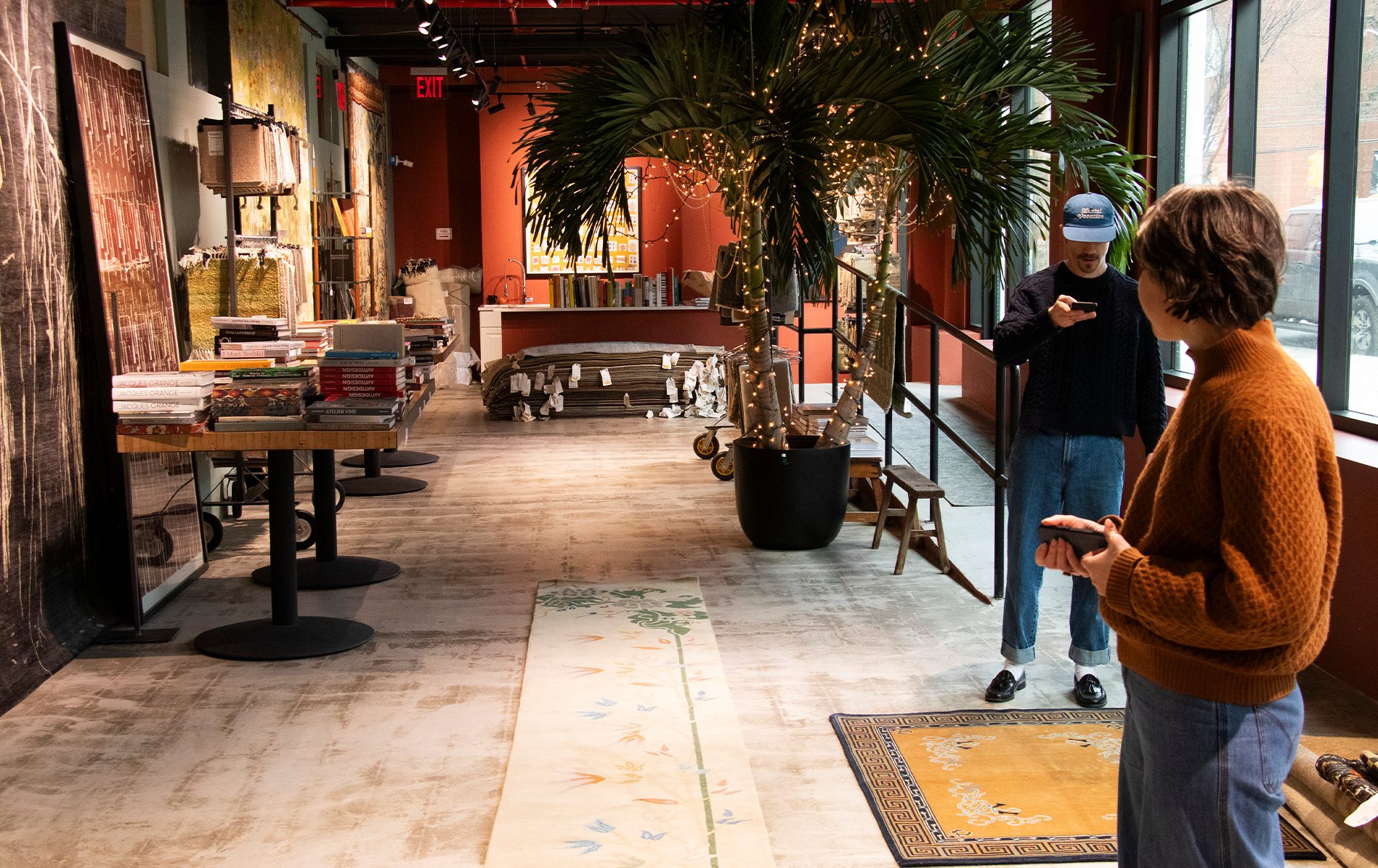
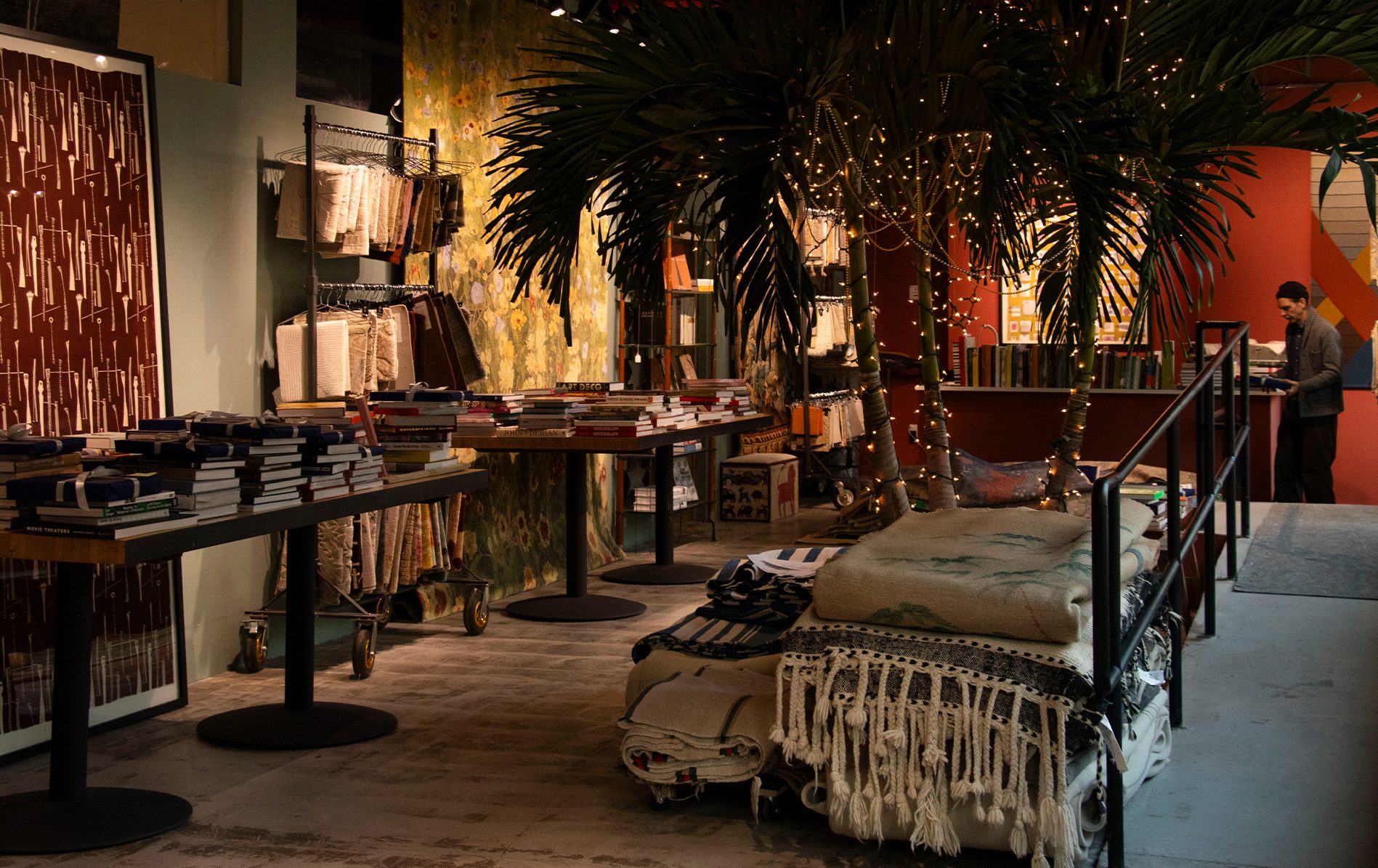
Rug & Kilim Showroom
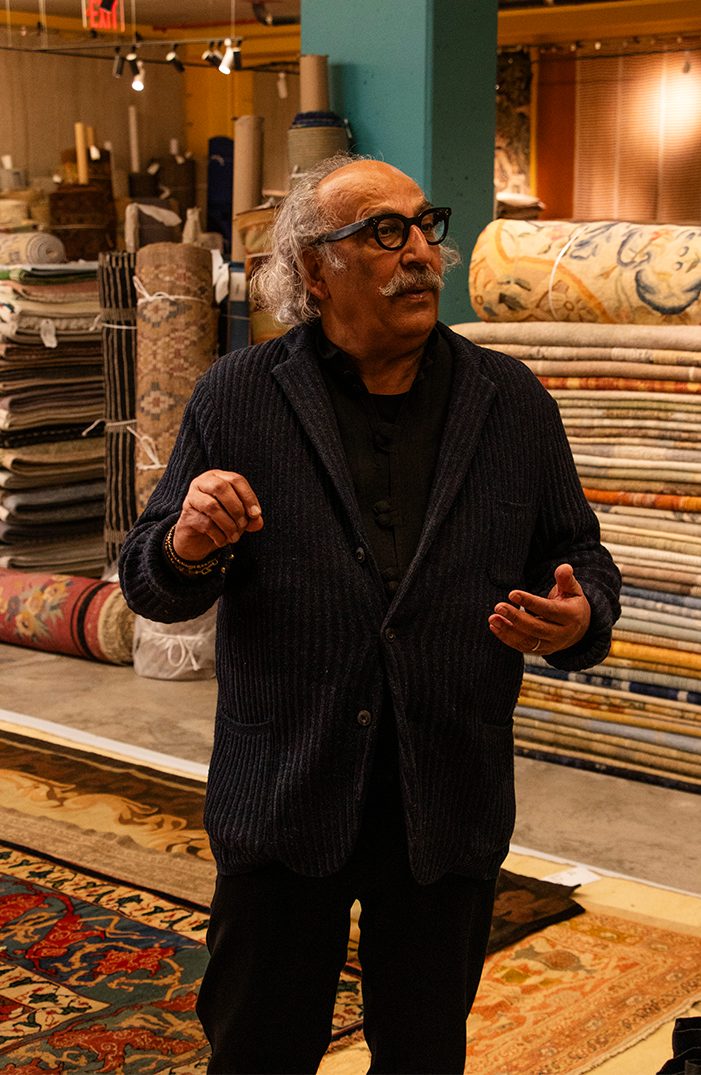
Rug & Kilim Principal, Jahanshah Nazmiyal, shares his insights.
The Cost of Time
Much has been said about the financial implications of tariffs. Less discussed, though equally significant, is the cost of time.
Designers, importers, and studios now operate within an expanded field of attention:
monitoring policy changes
recalculating sourcing strategies
navigating documentation and logistics
Time once spent on composition, material exploration, and creative development is increasingly shared with administration. The industry has not slowed but it has become more burdened.
And yet, there is a quiet irony: constraint, historically, has often sharpened design.
The effects of tariffs are not evenly distributed. Large firms absorb, adjust, and negotiate. Scale offers insulation. Smaller studios, often the most experimental, the most artisanalm operate with far less margin. And yet, these same studios often represent the future of design.
They are the ones:
preserving hand techniques
advancing material innovation
resisting homogenization
Their survival is not merely economic. It is cultural.
The Designer’s Response
Faced with rising costs and shifting availability, designers have not retreated. They have refined.
Projects are edited more rigorously. Fewer pieces are selected, but with greater precision. Vintage and existing works are reconsidered. Local production gains relevance, not as ideology, but as practicality. The result is subtle but important: interiors become more intentional.
One might observe, with some restraint, that tariffs have unintentionally reinforced a principle long understood by the best designers: that less, when chosen correctly, is more than enough.
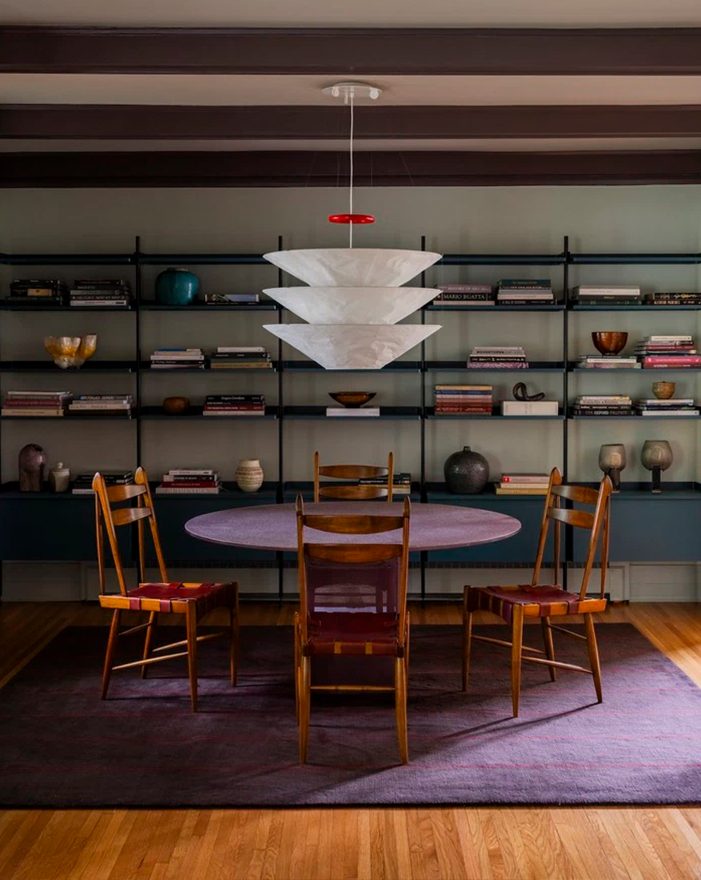
As seen in Galerie Magazine, a restored turn-of-the-century house on Minnesota’s historic Summit Avenue—designed by Prospect Refuge Studio—features a custom hand-knotted Nepalese rug from the Modern Collection by Rug & Kilim. Read More >>
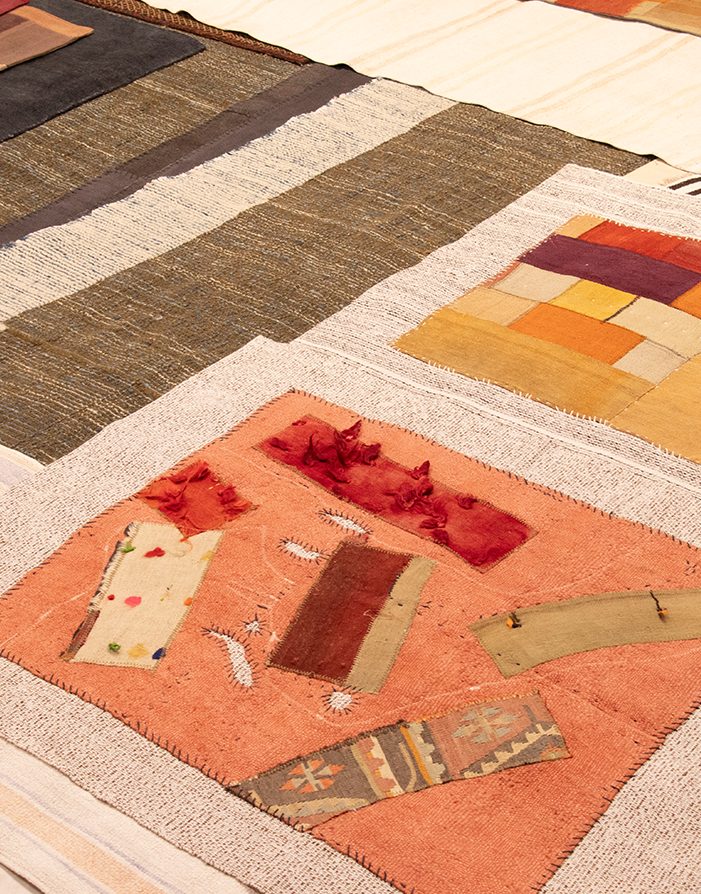
Rug & Kilim Showroom
Craft, Value, and the Question of Authenticity
Tariffs have also forced a reconsideration of value. When costs rise, the distinction between mass production and true craftsmanship becomes more visible. A handwoven rug, with its irregularities and depth, begins to justify itself not only aesthetically, but economically.
The question shifts from:
“Is this expensive?”
to
“Is this worth preserving?”
For Rug & Kilim, this question has always been central.
The commitment to material knowledge, to weaving traditions, to the integrity of the object itself, these are not easily replaced by efficiency. And perhaps, in this moment, they are more relevant than ever.
Design, Fashion, and the Parallel Economy of Luxury
The design industry is not alone in this recalibration.
Fashion, too, has long navigated the intersection of global production and national policy. Houses such as Loro Piana or Brunello Cucinelli have built their identities around controlled production, material traceability, and geographic specificity.
Their lesson is instructive: luxury is not defined by scale, but by discipline. In this sense, the rug industry finds itself aligned with a broader movement—one that values origin, process, and authorship over convenience.
In architecture, there has been a parallel shift. Minimalist spaces—once aesthetic choices, are increasingly practical responses to complexity. Fewer materials mean fewer variables. Simplicity becomes not just visual, but logistical.
The interiors shaped by this thinking—whether in Manhattan, London, or Dubai—favor:
clarity of material
precision of placement
longevity over novelty
Rugs within these spaces must meet the same standard. They are no longer decorative afterthoughts. They are foundational decisions.
It would be easy to imagine tariffs as entirely disruptive. And yet, the design industry has responded with a certain quiet resilience. Showrooms remain composed. Installations proceed. Clients continue to commission spaces that feel, reassuringly, untouched by external forces.
One might say without exaggeration that design has developed a particular skill: the ability to absorb turbulence without appearing disturbed.
It is too early to fully understand the long-term consequences of this moment. Supply chains will continue to evolve. Policies will shift. Markets will recalibrate.
But some changes are already evident:
greater awareness of origin
increased respect for craftsmanship
more deliberate design decisions
In this sense, tariffs may be remembered not only as disruption, but as clarification.
On What Remains
At the level of the finished interior, little appears to have changed. A rug is placed. A room is composed. Light moves across surfaces as it always has. But beneath that surface lies a more complex reality, one in which design is no longer separate from the systems that sustain it.
And perhaps this is the most important shift of all: that the objects we live with, rugs among them are not isolated expressions of beauty, but participants in a broader world of exchange, policy, and power.
They remain, as ever, quiet.
But they are no longer neutral.