
Swedish Rya Rugs in Art, Architecture, and Culture: The High Art of Scandinavian Textiles
July 7, 2025
Postwar Swedish Flat Weaves: The Mastery of Märta Måås-Fjetterström, Barbro Nilsson, and the MMF Collection
July 11, 2025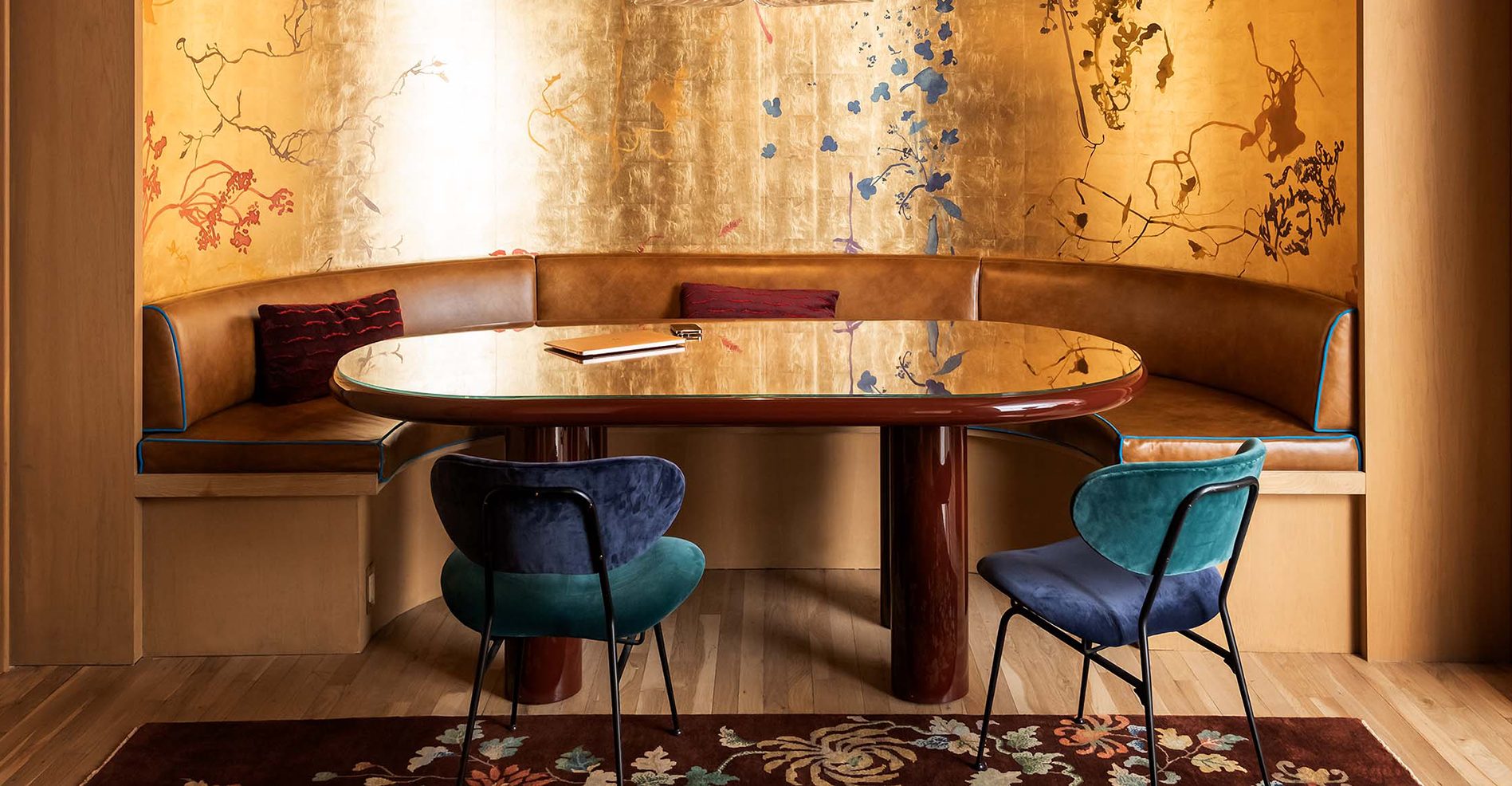
Studio DB x Rug & Kilim, featuring a Chinese Deco rug >>
At the turn of the 20th century, textiles—particularly rugs and kilims—transcended their utilitarian roots to occupy a critical role at the nexus of fine art, design, and ideology. This editorial, rooted in the archival mastery of Rug & Kilim’s most prestigious Art Deco collection, offers a fact-based, institutional lens into the aesthetic metamorphosis of textile arts. We chart the path from Art Nouveau’s lyrical organicism to the rigorous geometry of Art Deco—a transition that was not rupture, but dialogue. In tracing this transformation, we underscore the theoretical, cultural, and technical forces that shaped one of the most pivotal evolutions in textile history.
Formal Evolution: From Foliage to Facets
The visual language of late 19th-century textiles was dominated by the whiplash curves and vegetal motifs championed by William Morris, Alphonse Mucha, and Gaudí. These artists saw ornament as a moral imperative, a revolt against industrial uniformity. The Art Nouveau aesthetic found expression in tapestry and rug design through asymmetry, undulating florals, and sensual naturalism.
By contrast, the Art Deco period (roughly 1910s–1940s) responded with rationalism. Artists like Paul Follot and Ivan da Silva-Bruhns introduced symmetry, cubist abstraction, and stepped geometry into rug design, embracing both classical order and futurist dynamism. Decorative rhythm shifted from flowing tendrils to interlocking facets—where line and structure dictated movement.
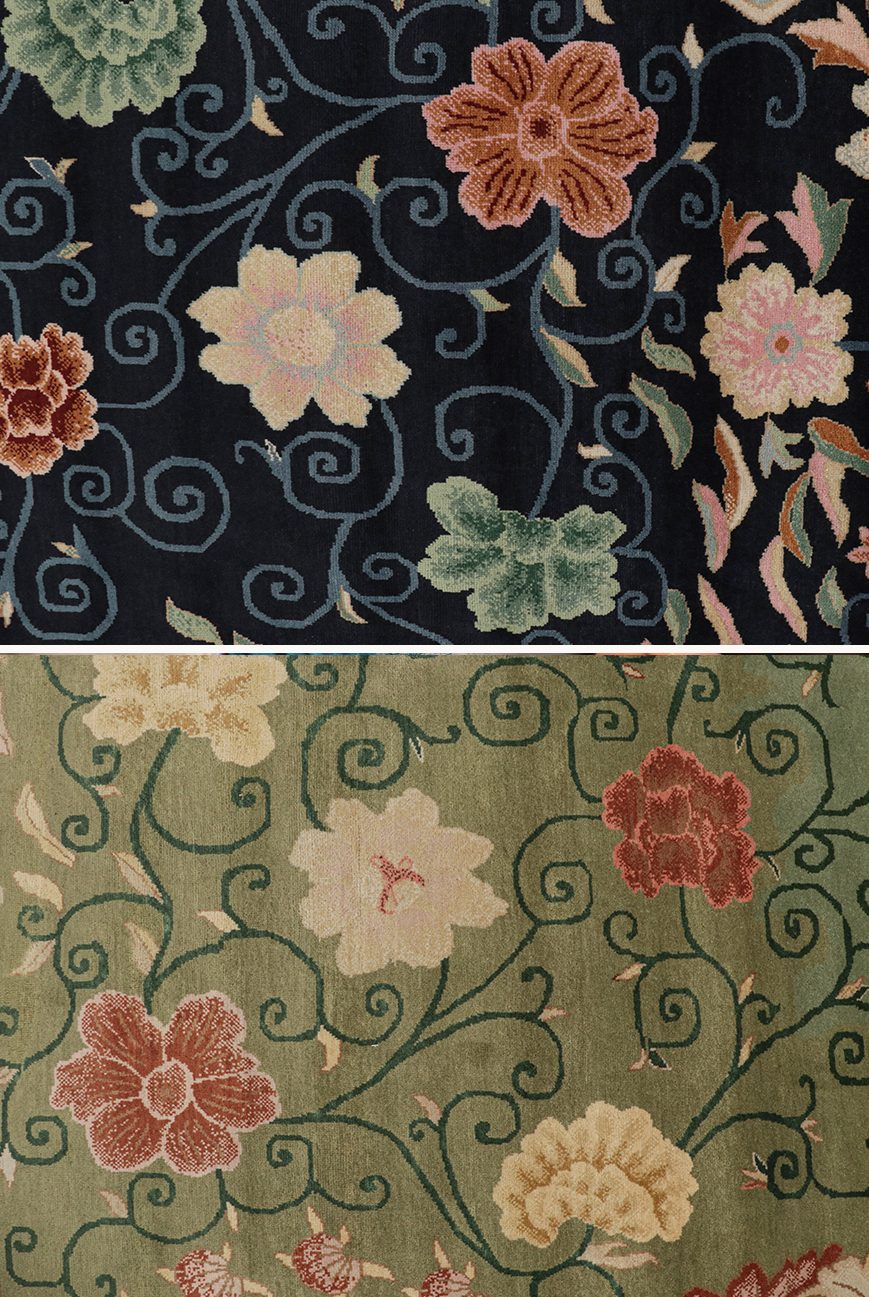
This wasn’t a rejection of Art Nouveau but a reconfiguration. The floral remained, but it was now prismatic. The vine became vector. Rug composition began to mirror architectural grids and mechanical systems, aligning ornament with order.
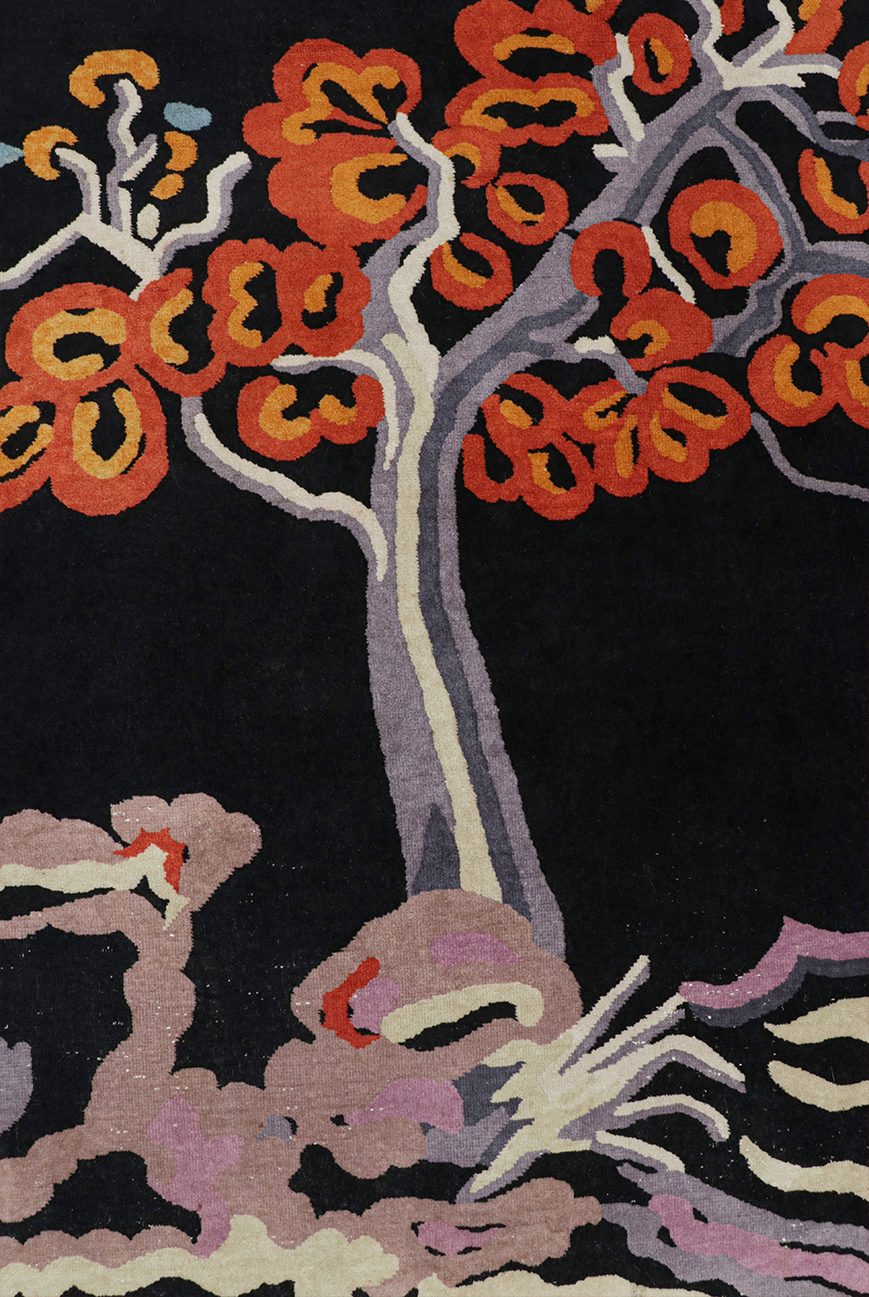
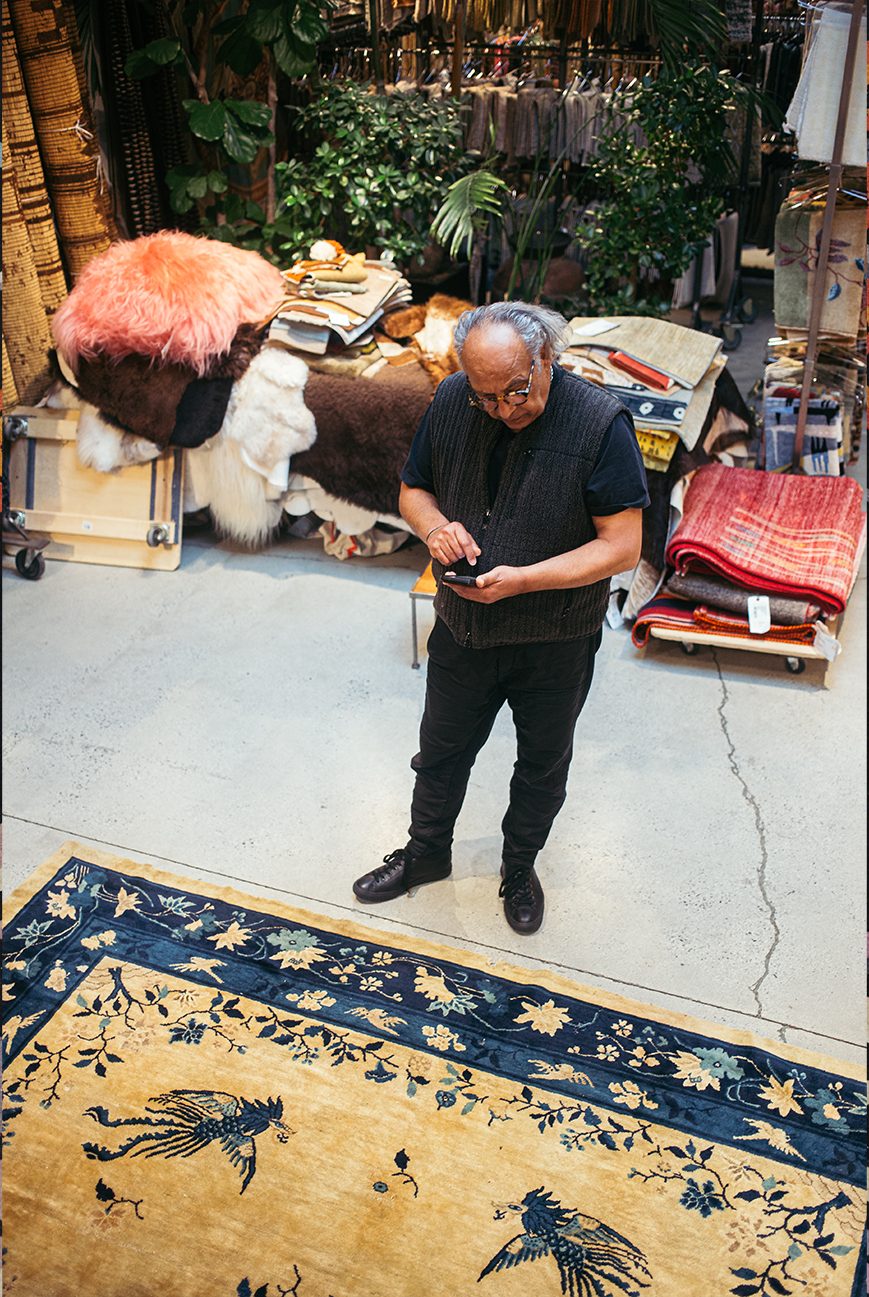
Our principal, Jahanshah Nazmiyal, with our one of a kind Antique Chinese Deco rug.
Color Language: Earth to Alloy
The chromatic evolution of rug design paralleled its formal shifts. Art Nouveau’s palette favored earthy ochres, moss greens, and botanical pastels, reflecting a reverence for nature. In contrast, Art Deco’s urban temperament embraced saturated jewel tones—sapphire, onyx, amethyst—alongside metallics like bronze and chrome. This reflected a broader embrace of luxury, progress, and cosmopolitanism.
Importantly, Art Deco color theory was not only about visual pleasure but also about psychological engagement. Colors were chosen for their symbolic clarity, industrial sheen, and ability to activate space. In kilims and hand-knotted rugs, color modulation became an architectural device—a chromatic geometry where hue articulated form.
Looms and Workshops: The Architecture of Art Deco Weaving
Crucial to this story are the institutions that shaped the textile avant-garde. Workshops such as Aubusson and Beauvais in France, the Wiener Werkstätte in Vienna, and later the Bauhaus in Germany, became crucibles for modern textile philosophy.
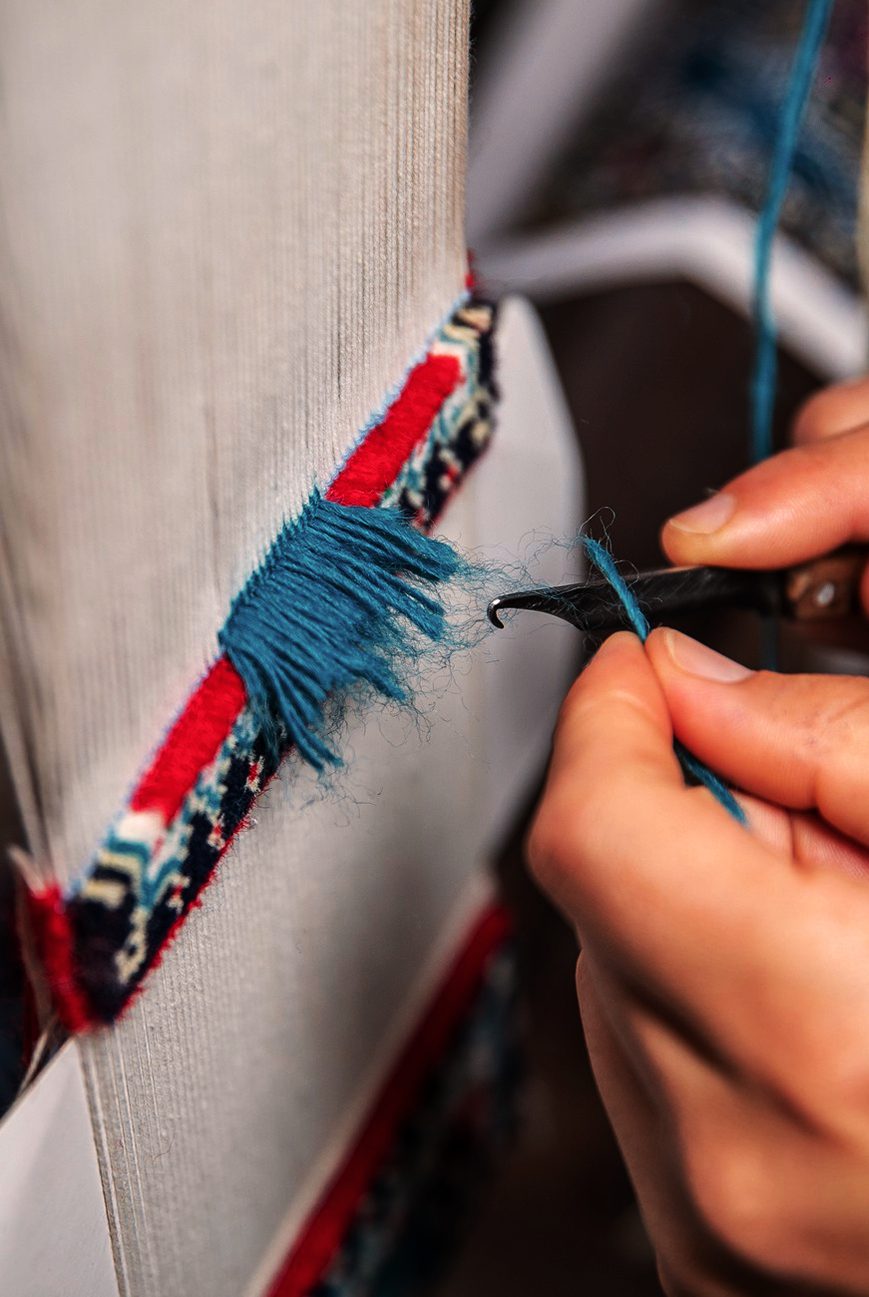
At Aubusson, the shift from figurative to abstracted tapestry was led by artists like Jean Lurçat, whose cubist-inflected designs redefined monumental wall textiles. In Vienna, Josef Hoffmann and Koloman Moser advanced the idea of “Gesamtkunstwerk”—a total artwork—where rugs were integral to interiors, not mere adornments. The Bauhaus, under Gunta Stölzl, fused geometric rationality with expressive craft, rethinking the loom as a space for experimentation.
These ateliers merged fine art with utility. Their rugs were not passive surfaces; they were active spaces of modern ideology, coded in warp and weft.
Romantic Resistance to Machine Aesthetics
The ideological divide between Art Nouveau and Art Deco can be distilled through two paradigms: Morris’ anti-industrial romanticism vs. the Deco embrace of machine aesthetics.
Morris, deeply influenced by medieval craftsmanship, sought to restore spiritual and moral value to labor through the handmade. His approach was inherently political—a critique of capitalist mechanization. His rugs, saturated in symbolism, reflected a yearning for pre-industrial harmony.
By the 1920s, however, modernism demanded new answers. The post-war era heralded progress, precision, and mass-production. Deco design, while still handcrafted in elite circles, no longer rejected the machine—it stylized it. The stepped zigzags and radial bursts seen in Deco kilims were inspired by skyscrapers, locomotives, and ocean liners. Ornament became streamlined, coded in speed and symmetry.
Gender and Labor: Women at the Warp
Textile arts provided one of the rare arenas where women exercised both authorship and authority. The Bauhaus weaving workshop, led by Gunta Stölzl, redefined gendered roles in design by positioning women at the forefront of abstraction and innovation. Stölzl’s designs—modular, dynamic, and chromatically bold—bridged utility with the avant-garde. Similarly, Annie Albers blurred the boundaries between weaving and graphic design, asserting the loom as a tool for modern visual language.
In kilim traditions, particularly in Anatolia and the Caucasus, women wove ancestral knowledge into textile design. Their motifs—diamonds, rams’ horns, stars—underwent radical reinterpretation in the Deco period, merging tribal symmetry with modern minimalism.
Rug & Kilim’s Chinese Deco
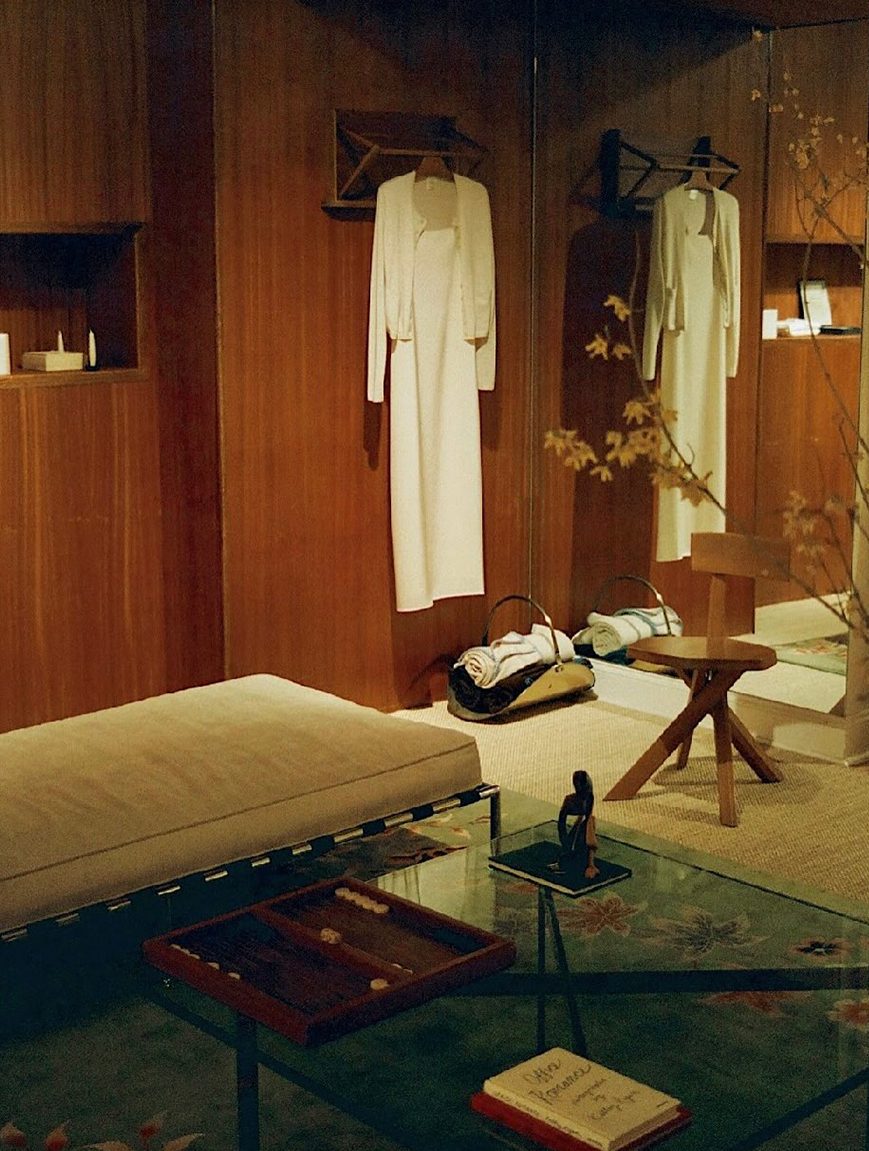
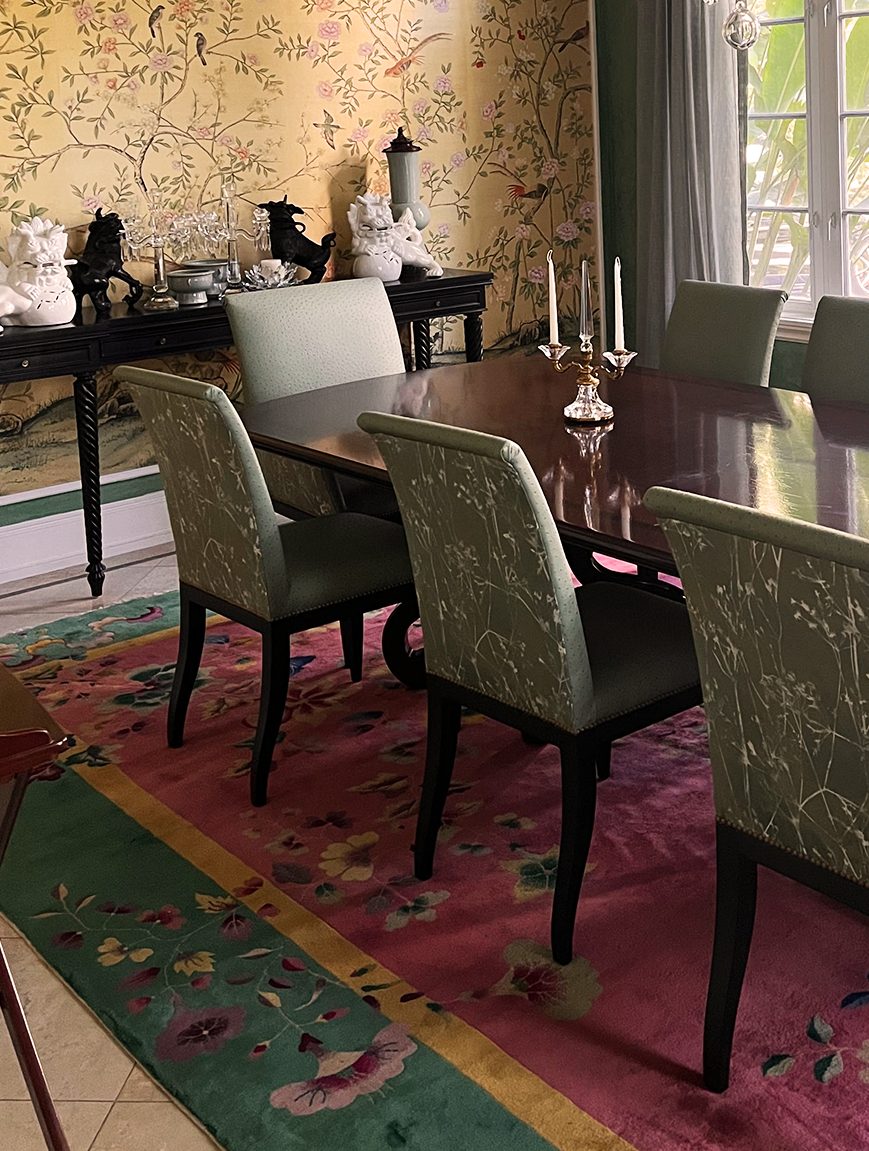
Phoebe Little x Rug & Kilim, featuring our Antique Chinese Art Deco
Art Deco Rugs as Societal Barometers
The transformation in textile design cannot be separated from larger cultural shifts. The early 20th century saw rapid urbanization, the rise of global trade, and a redefinition of taste. Rugs began to reflect the aesthetics of cinema, aviation, jazz, and industrial design.
Rug collecting also changed. No longer the preserve of Orientalist nostalgia, the modern rug emerged as a status symbol for the elite cosmopolitan. Deco rugs adorned salons in Paris, penthouses in New York, and Bauhaus homes in Dessau—signaling participation in global modernity.
This cosmopolitanism also introduced hybridity. European artisans borrowed motifs from Anatolia and North Africa, reinterpreting them through the lens of cubism and constructivism. Textile design thus became an arena for both cultural appropriation and cross-pollination.
Crosscurrents in Fine Art: Pattern as Philosophy
Modern painters such as Paul Klee, Sonia Delaunay, and Gustav Klimt profoundly influenced textile design. Their use of repetition, rhythm, and chromatic layering informed rug patterns that were less pictorial and more structural—visual music, if you will. Delaunay’s simultaneism directly informed tapestries woven at Aubusson, where chromatic contrasts generated optical movement. Klee’s symbolic geometries found parallel in the iconography of kilims. In Klimt, the decorative met the mythic—an ethos echoed in figural Art Deco tapestries.
Rugs ceased to be supplementary. They became conceptual, experimental, and fundamentally modern.
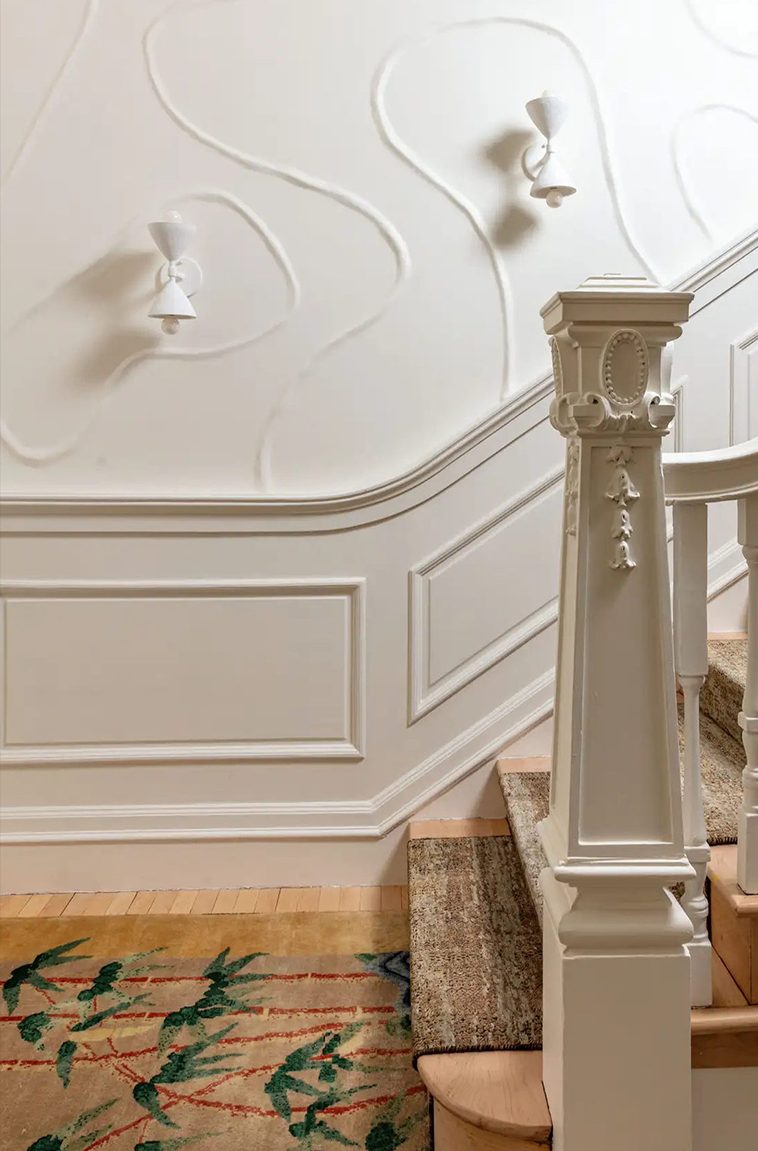
Kips Bay Show House (NY) x Rug & Kilim’s Chinese Deco
Provenance and Collections: The Legacy at Rug & Kilim
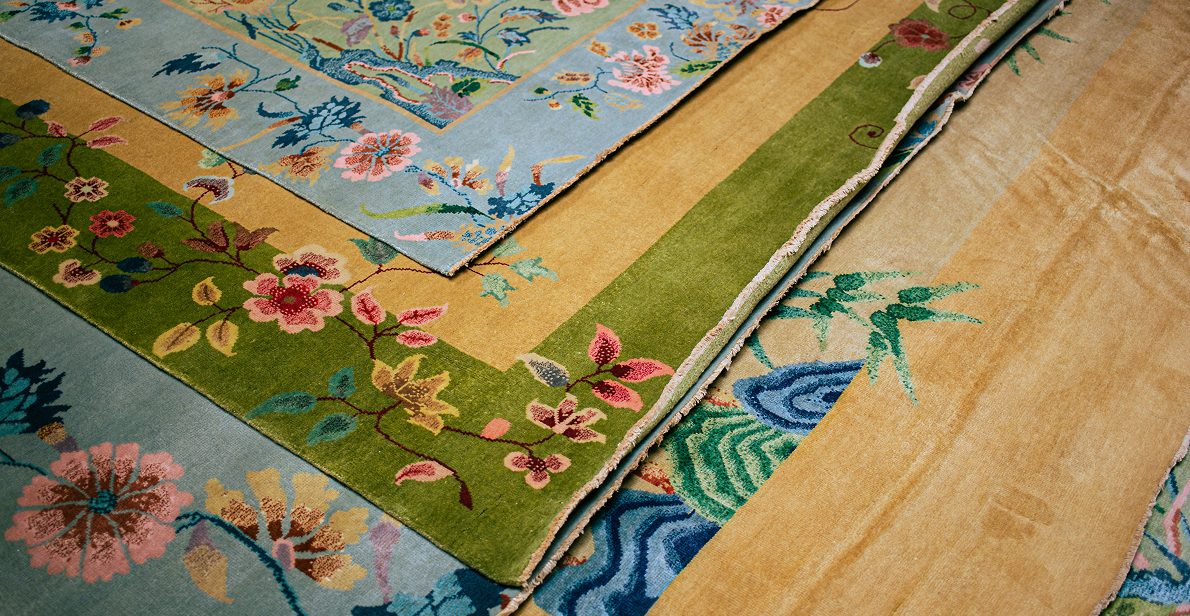
Over the past decade, Rug & Kilim has curated the world’s most rigorous archive of Art Deco rugs. It hosts both a wide range of one-of-a-kind antique and vintage rugs as well as a new custom line nearly indistinguishable in its quality from the original 1920s inspirations — Chinese Deco, French Deco, Austrian Deco, Swedish Deco, American Deco, Dutch Deco and many more.
Each piece is meticulously documented—its origin, materiality, artistic lineage—preserving not just an object, but a chapter in modern design history.
Textiles as Modern Narratives
Rugs and kilims are not ornamental footnotes—they are narrative surfaces that index the very movement of modernity. They record the ideological pivot from organic reverie to mechanical elegance; from myth to machine.
The Art Deco rug is where abstraction found form, and where ornament found intellect.
From tendrils to triangles, from loom to living room, this is is the geometry of modern thought, made soft underfoot.
Explore the Art Deco collection at Rug & Kilim and witness the woven modernity yourself.