

The Extraordinary Design Legacy of Eyre de Lanux: Art Deco to Modernist Furniture
March 10, 2025
The Art of Living with Scandinavian Tapestries
March 13, 2025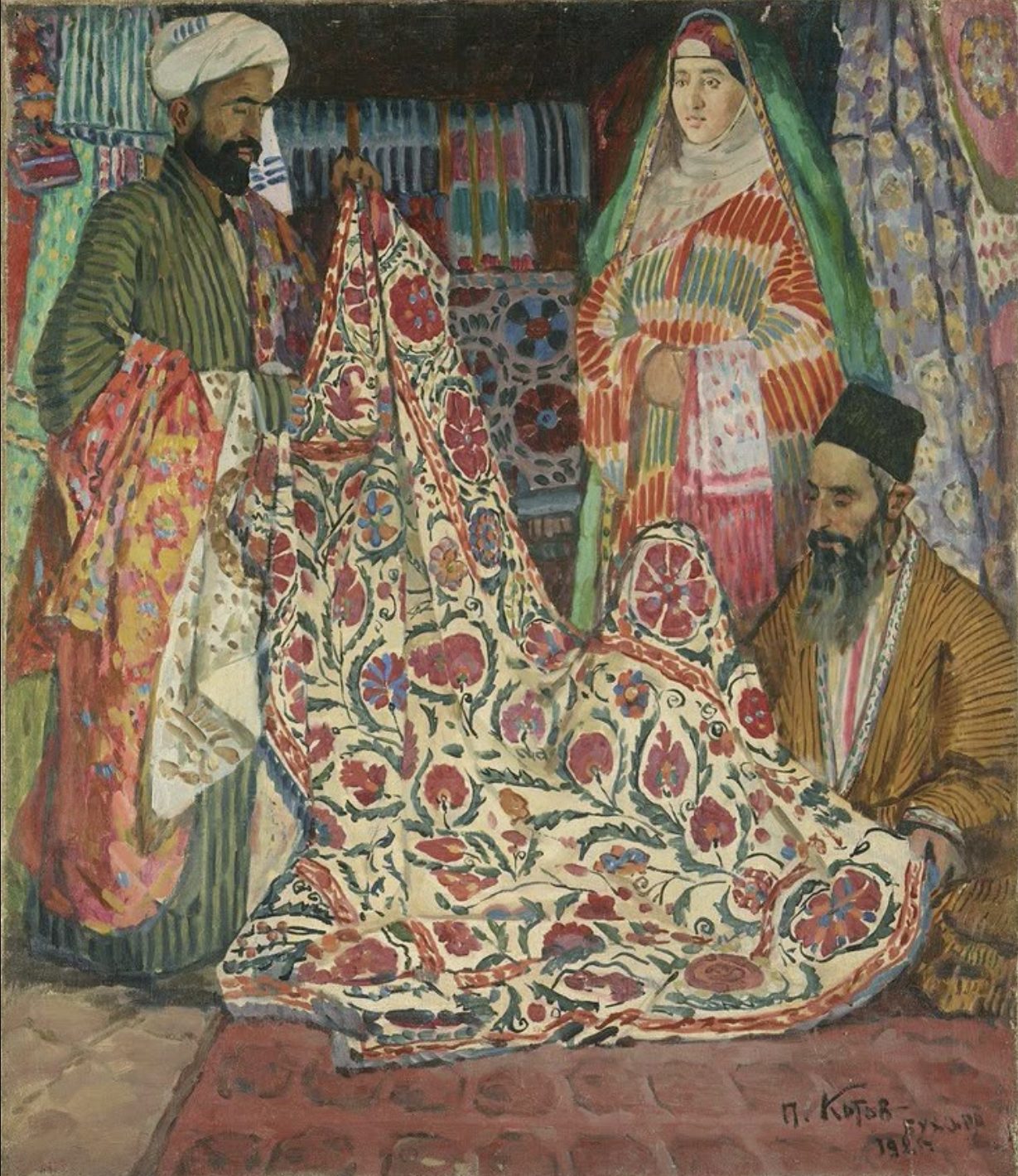
Suzani textiles in Uzbek art
In Suzani rugs and kilims, we witness the intersection of utility and poetry.
Indeed, these Suzani rugs as remarkable Central Asian embroideries have captivated collectors and connoisseurs for centuries, not merely as decorative objects, but as chronicles of cultural heritage.
Historiography of Suzani Rugs and Kilims
The term “Suzani” derives from the Persian word “suzan,” meaning needle. These embroidered panels emerged from the regions of present-day Uzbekistan, Tajikistan, and neighboring areas along the ancient Silk Road.
Dating primarily from the 18th to early 20th centuries, their intricate patterns speak to us across time and geography.
To understand Suzani is to understand the female artisans of Central Asia. Their hands transformed simple cotton and silk into visual symphonies.
This female-dominated art form historically served as dowry pieces, with mothers and daughters collaboratively creating textiles that would eventually adorn the marital home.
What distinguishes the finest Suzani rugs in our collection is their masterful command of motifs. The most captivating examples utilize a visual language reminiscent of the eternal conflict between the arabesque and the sphere.
Large solar disks (often called “moon disks”) radiate alongside sinuous floral forms, creating a tension between cosmic order and organic growth.
There exists in these works no fixed point of view…the way things actually exist.
Design and Significance
They contain entire cosmologies within their borders. Suzanis encode cultural knowledge, spiritual beliefs, and aesthetic sensibilities into geometric and floral abstractions.
They represent the visible trace of an invisible idea.
The palette of Suzanis offers another layer of fascination. Traditional pieces employ natural dyes—madder root producing vibrant reds, indigo yielding blues, pomegranate skins creating yellows.
These organic compounds interact with light differently than their synthetic counterparts, possessing a living quality that shifts under different illumination.
The prominent floral forms—particularly the iconic carnation, tulip, and pomegranate motifs—serve as charged images, carrying layers of cultural meaning. The pomegranate, with its abundance of seeds, symbolizes fertility; the tulip represents divine perfection; the almond shape (badam) wards off the evil eye.
These are not simply patterns but a sophisticated visual language expressing hopes, beliefs, and cultural values.
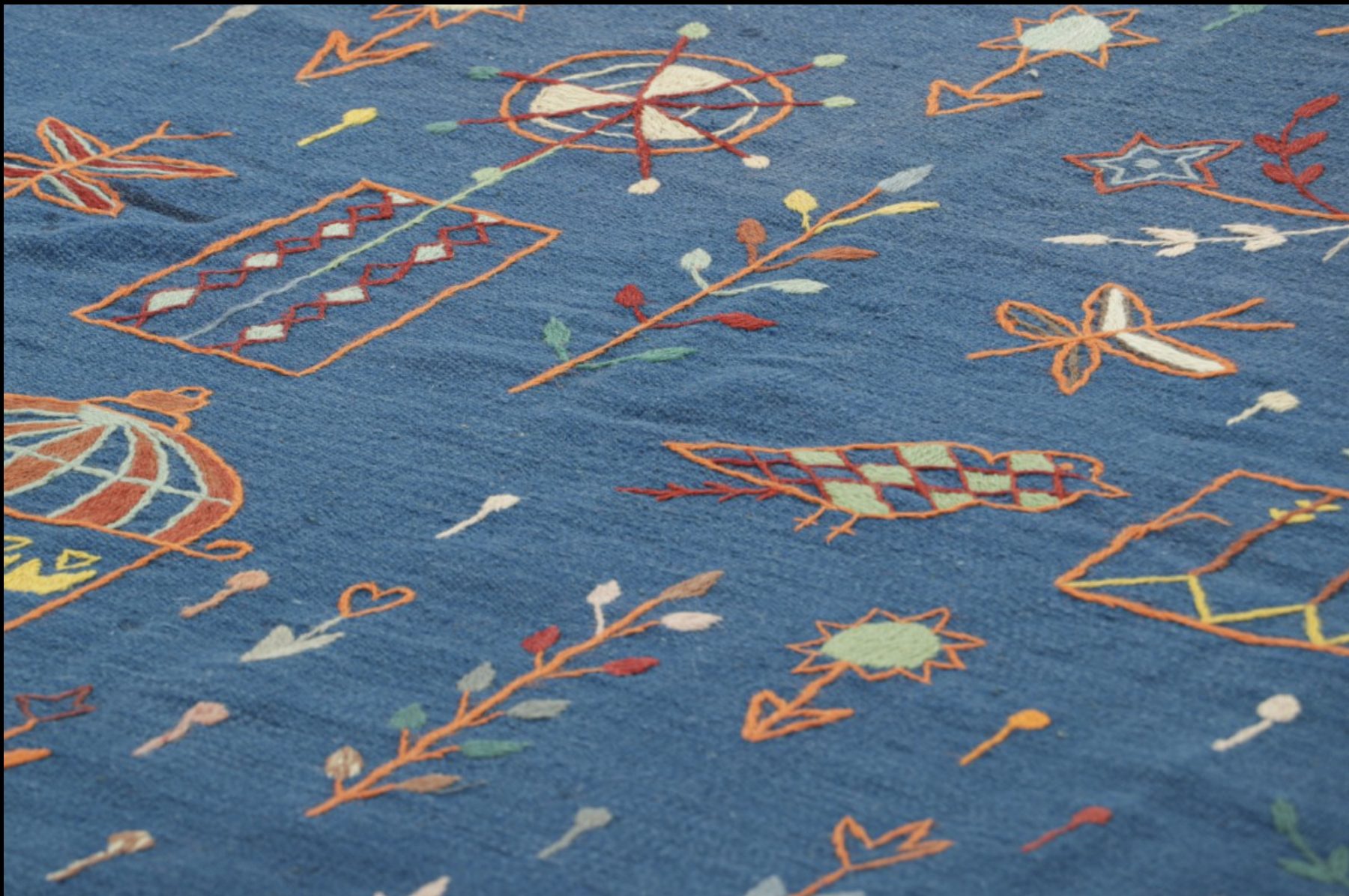
The Suzani brings an immediate sense of history and warmth to modernist spaces.
This juxtaposition—ancient handicraft against minimalist architecture—creates a dialogue between past and present that resonates with collectors.
Bukhara Suzanis tend toward bold, graphic compositions with pronounced medallions. Nurata pieces feature more delicate, densely arranged floral motifs. Tashkent examples often incorporate architectural elements alongside botanical imagery.
The finest pieces possess the shock of the old—a quality that transcends technique to achieve genuine artistic expression.
Connection of Suzani Rugs and Kilims to Art History and Movements
Studying these textiles have revealed their connection to broader art historical currents.
The abstracted floral patterns in Suzanis predate similar explorations by Western modernists by centuries. One can see echoes of their compositional strategies in everyone from Gustav Klimt to Howard Hodgkin—artists who understood the power of pattern and decorative elements as carriers of meaning.
The continuing appeal of these textiles lies in their ability to connect us to distant traditions while speaking to contemporary sensibilities.
Compositionally, Suzanis often employ what modern art criticism would identify as all-over patterning—a technique that distributes visual elements across the entire surface without privileging any single area.
This approach predates similar explorations by Western abstract expressionists by centuries.
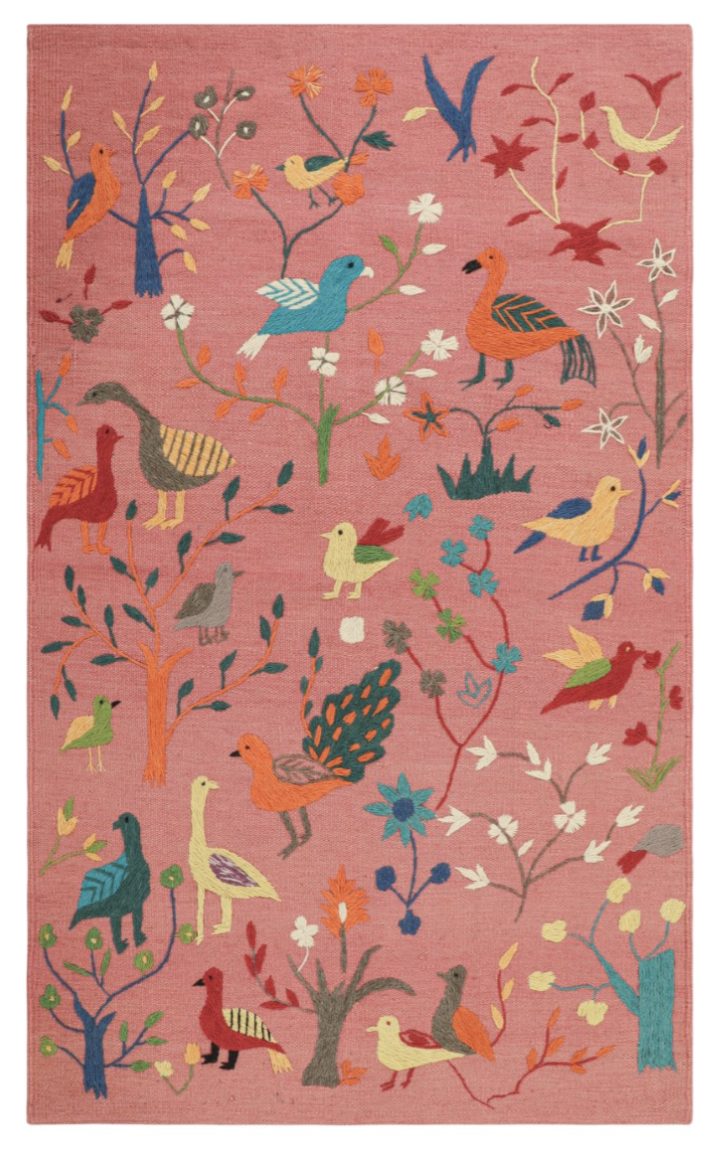
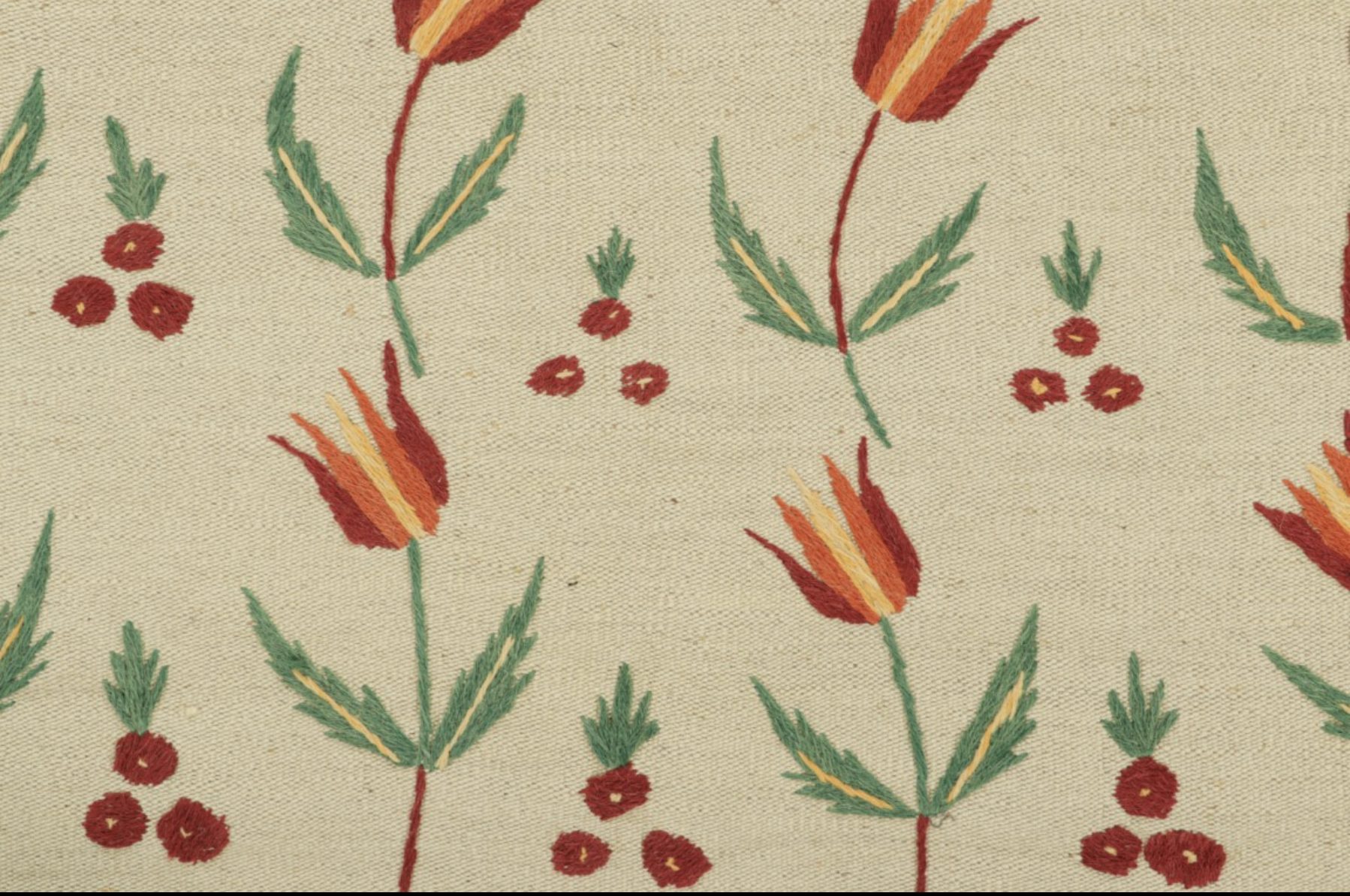
When Jackson Pollock created his drip paintings in the mid-20th century, he was (perhaps unknowingly) engaging with compositional strategies that Central Asian embroiderers had mastered generations earlier.
The dense horror vacui (fear of empty space) approach in many Suzanis shares sensibilities with Pattern and Decoration artists of the 1970s like Miriam Schapiro and Joyce Kozloff, who deliberately embraced “feminine” decorative traditions as valid artistic expression.
These artists recognized in non-Western textile traditions what Western art history had long ignored—the intellectual sophistication of pattern-based expression.
The arabesque lines and rhythmic repetitions in Suzani designs also prefigure Art Nouveau’s organic flowing forms. When examining works by Alphonse Mucha or textiles by William Morris, one detects similar strategies for organizing space through sinuous linear elements.
The significance of Suzanis extends beyond their aesthetic achievements.
They represent thick objects—cultural artifacts dense with contextual meaning.
Created primarily by women in patriarchal societies, they offered one of the few sanctioned outlets for female artistic expression.
In each stitch we find assertions of identity and agency within constrained circumstances.
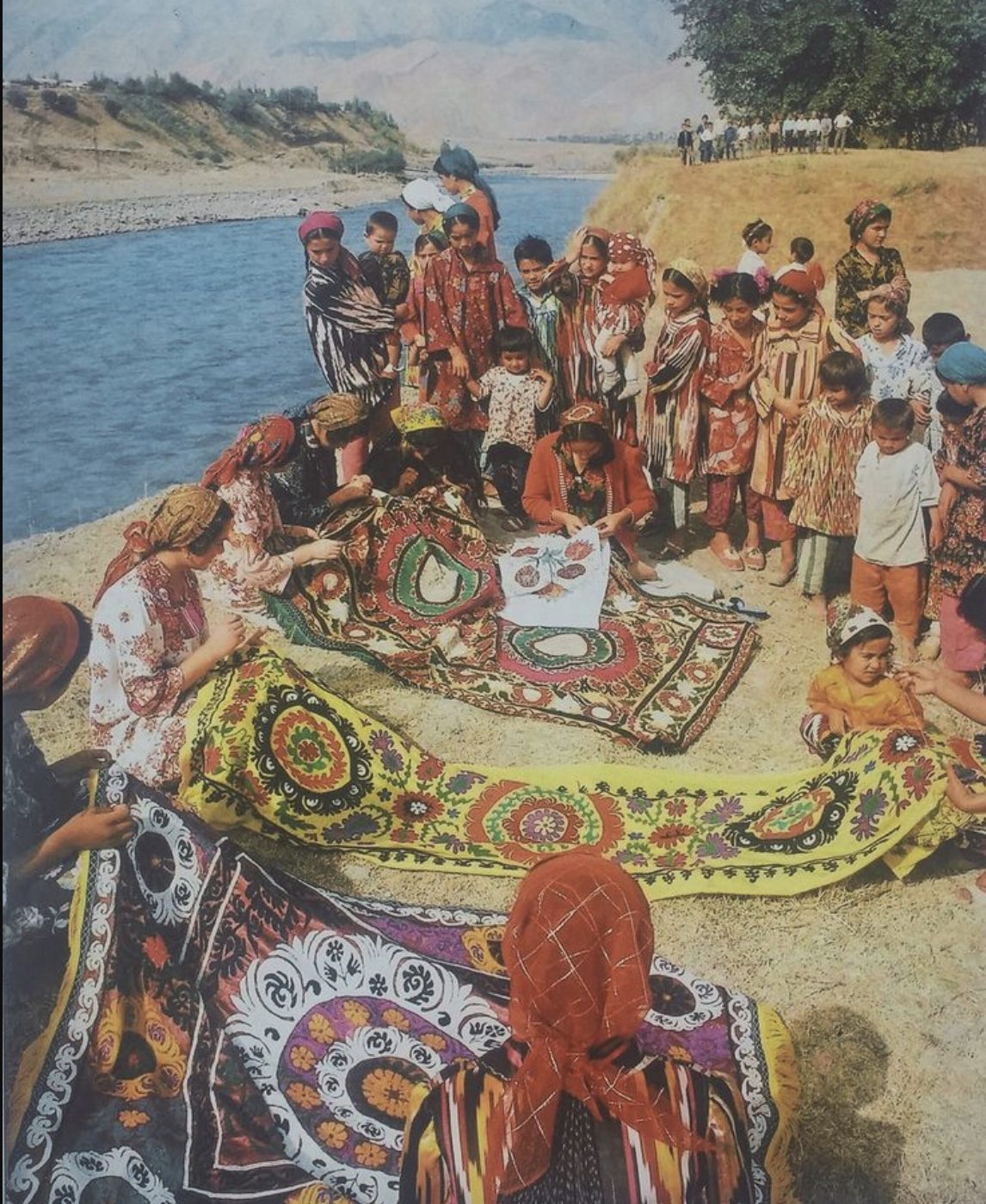
Suzani textiles in Uzbek art